Faculty - Teaching as a Profession 👨🏫 | Passionate Teacher | VIT University | Chennai | PhD in Computer Science | Proud father of Two Daughters 👨👨👦👦
A proud milestone. A new beginning. A future waiting to unfold.
VIT Chennai proudly celebrates the achievements of its graduating students at the 14th Annual Convocation on 16 August 2026.
Celebrating achievements. Inspiring futures.
#VITChennai#14thAnnualConvocation
Job seekers in the U.S. and many other nations face a tough environment. At the same time, fears of AI-caused job loss have — so far — been overblown. However, the demand for AI skills is starting to cause shifts in the job market. I’d like to share what I’m seeing on the ground.
First, many tech companies have laid off workers over the past year. While some CEOs cited AI as the reason — that AI is doing the work, so people are no longer needed — the reality is AI just doesn’t work that well yet. Many of the layoffs have been corrections for overhiring during the pandemic or general cost-cutting and reorganization that occasionally happened even before modern AI. Outside of a handful of roles, few layoffs have resulted from jobs being automated by AI.
Granted, this may grow in the future. People who are currently in some professions that are highly exposed to AI automation, such as call-center operators, translators, and voice actors, are likely to struggle to find jobs and/or see declining salaries. But widespread job losses have been overhyped.
Instead, a common refrain applies: AI won’t replace workers, but workers who use AI will replace workers who don’t. For instance, because AI coding tools make developers much more efficient, developers who know how to use them are increasingly in-demand. (If you want to be one of these people, please take our short courses on Claude Code, Gemini CLI, and Agentic Skills!)
So AI is leading to job losses, but in a subtle way. Some businesses are letting go of employees who are not adapting to AI and replacing them with people who are. This trend is already obvious in software development. Further, in many startups’ hiring patterns, I am seeing early signs of this type of personnel replacement in roles that traditionally are considered non-technical. Marketers, recruiters, and analysts who know how to code with AI are more productive than those who don’t, so some businesses are slowly parting ways with employees that aren’t able to adapt. I expect this will accelerate.
At the same time, when companies build new teams that are AI native, sometimes the new teams are smaller than the ones they replace. AI makes individuals more effective, and this makes it possible to shrink team sizes. For example, as AI has made building software easier, the bottleneck is shifting to deciding what to build — this is the Product Management (PM) bottleneck. A project that used to be assigned to 8 engineers and 1 PM might now be assigned to 2 engineers and 1 PM, or perhaps even to a single person with a mix of engineering and product skills.
The good news for employees is that most businesses have a lot of work to do and not enough people to do it. People with the right AI skills are often given opportunities to step up and do more, and maybe tackle the long backlog of ideas that couldn’t be executed before AI made the work go more quickly. I’m seeing many employees in many businesses step up to build new things that help their business. Opportunities abound!
I know these changes are stressful. My heart goes out to every family that has been affected by a layoff, to every job seeker struggling to find the role they want, and to the far larger number of people who are worried about their future job prospects. Fortunately, there’s still time to learn and position yourself well for where the job market is going. When it comes to AI, the vast majority of people, technical or nontechnical, are at the starting line, or they were recently. So this remains a great time to keep learning and keep building, and the opportunities for those who do are numerous!
[Original text; https://t.co/zbIhZHfCC0 ]
Hi @IRCTCofficial , Trying to connect to the IRCTC app(not in tatkal hrs). It is showing Validating Pin for 1 or 2 mins, then goes back to the home screen. Updated the app also. Kindly suggest to me how to login into that app.@RailMinIndia@GMSRailway@RailwaySeva @TN_RailNews
Words of Wisdom from our Visionary Leader!
On the momentous occasion of the 13th Convocation of VIT Chennai (6th September 2025), our beloved Chancellor, Dr. G. Viswanathan Sir, delivered an inspiring address that reflected his vision for education.
#VITChennai#13thConvocation
Our Honourable Chancellor, Dr. G. Viswanathan speaks to the South Asian Herald about his @FeTNA connection, India's education shifts, VIT's student first approach, and time with iconic TN leaders.
Read the full article: https://t.co/zEPKwMIl4L
Dear @AshwiniVaishnaw . IRCTC linking with Aadhaar. If name in aadhaar is Ashwani V and IRCTC has V Ashwani, you cannot correct it in IRCTC profile. Change of name is not permitted. To create afresh, we need a fresh phone number also. Can you enable name change in the IRCT APP?
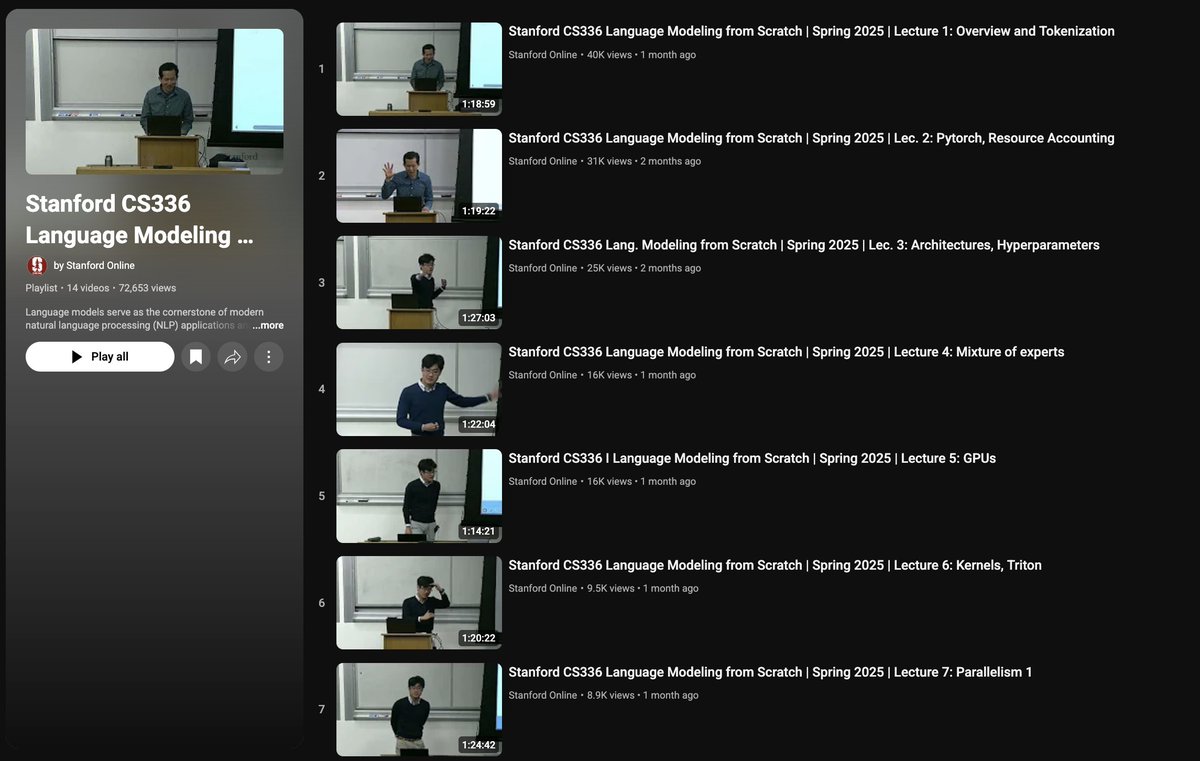
Stanford CS336 - Language Modeling from Scratch
Excellent new lectures on "language modelling from scratch" class from Stanford just dropped.
Covers a whole LLM stack from data collection, cleaning, transformer modelling and training, evals and deployment.
There’s a new breed of GenAI Application Engineers who can build more-powerful applications faster than was possible before, thanks to generative AI. Individuals who can play this role are highly sought-after by businesses, but the job description is still coming into focus. Let me describe their key skills, as well as the sorts of interview questions I use to identify them.
Skilled GenAI Application Engineers meet two primary criteria: (i) They are able to use the new AI building blocks to quickly build powerful applications. (ii) They are able to use AI assistance to carry out rapid engineering, building software systems in dramatically less time than was possible before. In addition, good product/design instincts are a significant bonus.
AI building blocks. If you own a lot of copies of only a single type of Lego brick, you might be able to build some basic structures. But if you own many types of bricks, you can combine them rapidly to form complex, functional structures. Software frameworks, SDKs, and other such tools are like that. If all you know is how to call a large language model (LLM) API, that's a great start. But if you have a broad range of building block types — such as prompting techniques, agentic frameworks, evals, guardrails, RAG, voice stack, async programming, data extraction, embeddings/vectorDBs, model fine tuning, graphDB usage with LLMs, agentic browser/computer use, MCP, reasoning models, and so on — then you can create much richer combinations of building blocks.
The number of powerful AI building blocks continues to grow rapidly. But as open-source contributors and businesses make more building blocks available, staying on top of what is available helps you keep on expanding what you can build. Even though new building blocks are created, many building blocks from 1 to 2 years ago (such as eval techniques or frameworks for using vectorDBs) are still very relevant today.
AI-assisted coding. AI-assisted coding tools enable developers to be far more productive, and such tools are advancing rapidly. Github Copilot, first announced in 2021 (and made widely available in 2022), pioneered modern code autocompletion. But shortly after, a new breed of AI-enabled IDEs such as Cursor and Windsurf offered much better code-QA and code generation. As LLMs improved, these AI-assisted coding tools that were built on them improved as well.
Now we have highly agentic coding assistants such as OpenAI’s Codex and Anthropic’s Claude Code (which I really enjoy using and find impressive in its ability to write code, test, and debug autonomously for many iterations). In the hands of skilled engineers — who don’t just “vibe code” but deeply understand AI and software architecture fundamentals and can steer a system toward a thoughtfully selected product goal — these tools make it possible to build software with unmatched speed and efficiency.
I find that AI-assisted coding techniques become obsolete much faster than AI building blocks, and techniques from 1 or 2 years ago are far from today's best practices. Part of the reason for this might be that, while AI builders might use dozens (hundreds?) of different building blocks, they aren’t likely to use dozens of different coding assistance tools at once, and so the forces of Darwinian competition are stronger among tools. Given the massive investments in this space by Anthropic, Google, OpenAI, and other players, I expect the frenetic pace of development to continue, but keeping up with the latest developments in AI-assisted coding tools will pay off, since each generation is much better than the last.
Bonus: Product skills. In some companies, engineers are expected to take pixel-perfect drawings of a product, specified in great detail, and write code to implement it. But if a product manager has to specify even the smallest detail, this slows down the team. The shortage of AI product managers exacerbates this problem. I see teams move much faster if GenAI Engineers also have some user empathy as well at basic skill at designing products, so that, given only high-level guidance on what to build (“a user interface that lets users see their profiles and change their passwords”), they can make a lot of decisions themselves and build at least a prototype to iterate from.
When interviewing GenAI Application Engineers, I will usually ask about their mastery of AI building blocks and ability to use AI-assisted coding, and sometimes also their product/design instincts. One additional question I've found highly predictive of their skill is, “How do you keep up with the latest developments in AI?” Because AI is evolving so rapidly, someone with good strategies for keeping up — such as reading The Batch and taking short courses 😃, regular hands-on practice building projects, and having a community to talk to — really does stay ahead of the game.
[Original post: https://t.co/I3alxNs0vn ]
#VITChennai Placements 2025🎓💼
Excellence continues as our students secure top roles across leading global companies.
A reflection of strong academics, industry-aligned training, and future-ready talent.
Proud of our graduates. Grateful to our recruiters.
#FutureReady
We are pleased to share that our Chancellor, Dr. G. Viswanathan, will be conferred an Honorary Doctorate in Pedagogy by RIT, USA.
Date: May 9, 2025 | Time: 7:00 PM IST
Watch live: https://t.co/iDKc6Lyumr
#VITChennai#RIT2025#VIT#AcademicExcellence