Dutch are masters of proliferation. Like they did in case of AQ Khan, the Dutch will deny this and truth will spill out 20 years later when it is too late to stop China.
How Expensive Homes Are Shrinking India's Economic Future
My column @91basispoints (Not behind a paywall. One time registration required.)
Do read and share.
The link is in the first comment.
India's housing boom is doing much more than making homes expensive.
Bigger home loans mean bigger EMIs, leaving families with less money to spend and save.
Affordable homes are disappearing from our cities, pushing people farther away from where the jobs are and forcing longer commutes.
Many people now buy homes as investments instead of places to live, pushing prices even higher.
And there may be another unexpected effect: high housing costs could be one reason why urban families are choosing to have fewer children.
Housing is not just about real estate. It shapes how much we spend, how much we save, where we live, how long we travel to work and even the size of our families.
The biggest effects of high home prices are the ones we don't notice immediately.
https://t.co/VcTUTmHee8
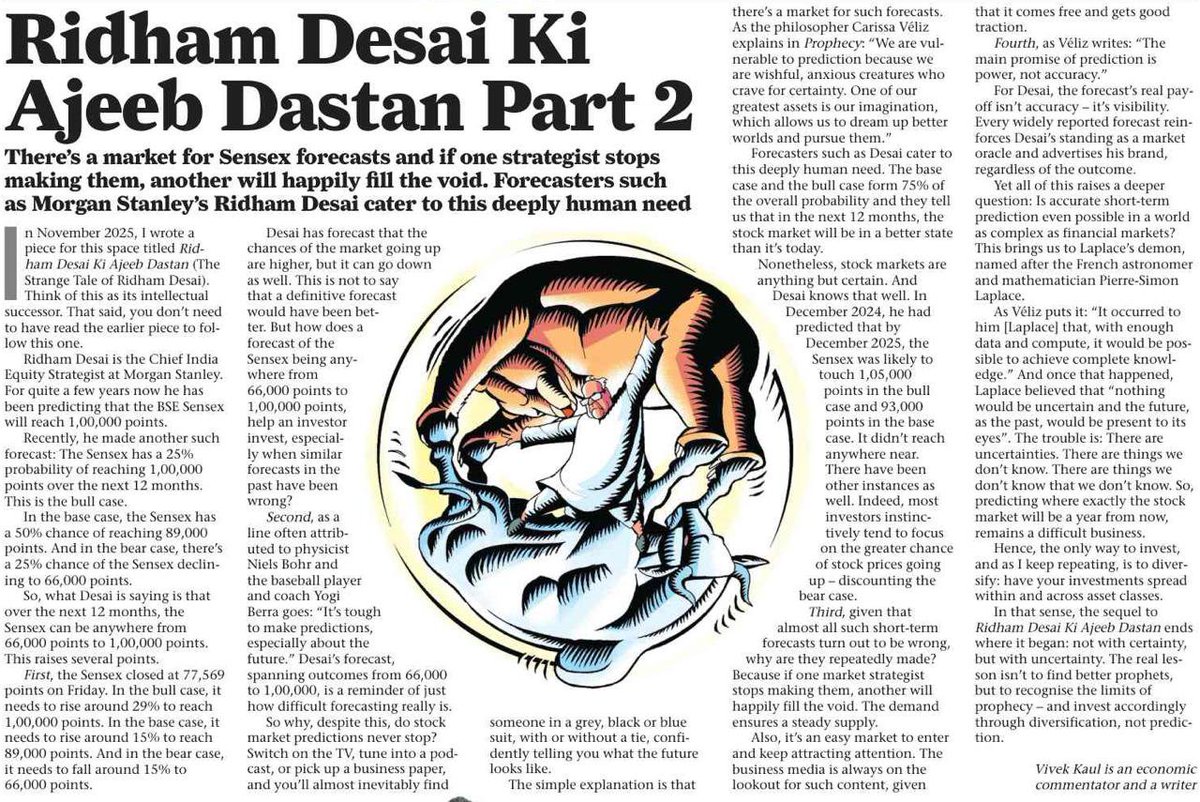
It is difficult to forecast earnings of one company, more so for one industry. To do it for the entire stock market, that seems to be feeding on insecurity rather than fulfilling a tangible purpose. But the analysis behind it can be interesting sometimes. (Sorry, Ridham Desai!)
China's property crisis offers important lessons for Indian homebuyers and the real estate sector. @ANAROCK weighs in on why India's housing market fundamentals remain different. https://t.co/q1W0lKkMI6 #IndianRealEstate#HousingMarket
'Jevons Paradox: More Evidence of a Positive Employment Effect of AI Adoption'
'A new study from Ramp, linking observed AI spending to workforce records across 21,559 US firms, finds that companies adopting AI grow their headcount 10% over the two years following adoption.
These gains are entirely driven by high-intensity adopters with entry-level jobs rising by about 12%, suggesting that heavy AI investment is complementing workforce growth rather than replacing workers'
- Apollo Chief Economist Torsten Slok
https://t.co/LdYlQ0QW8Z
In India, “billions of dollars are being
funnelled into physical infrastructure, basic foundational learning, public health languish”
Human capital is the differentiator - not geography, culture, natural resources - is why some countries become rich, others don’t @Moneylifers
"Conspiracy theory" time 👇
Phase 1: Russia
Phase 2: Middle East
Phase 3: China
Phase 1: Tie up Russia in the north so they're unable to support their allies in the Middle East
Phase 2: Pivot away from Russia leaving Europe to hold the bag.
Provide strategic air support for Israel's invasion. Claim you can't commit ground troops because you've drained your Strategic Petroleum Reserve (SPR) & all ammo supplies for Ukraine.
Iran retaliates against the U.S. by "cyber attacking" critical infrastructure, galvanizing the public in retaliation against Iran. Blame them for causing the stock market crash & banking system collapse.
Phase 3: Pivot to China providing naval support for all allies in the region, boxing them in after having destroyed their Belt and Road Initiative through the middle east.
The entire world is at war & you've rebuilt your manufacturing base by selling all the weapons. This is exactly what the U.S. did from 1939-1944.
This also saves the U.S. from the worst effects of the depression unleashed on the rest of the world, ensuring they recover first.
Satya Nadella’s “Reverse Information Paradox” is one of the clearest frameworks yet for understanding the next competitive battleground in AI.
The first phase of AI was about who built the best models. The next phase may be about who owns the learning generated from using those models.
Every prompt, correction, workflow, evaluation, and decision gradually encodes an organization’s institutional knowledge. Over time, this “AI exhaust” becomes a proprietary asset that is arguably more valuable than the underlying foundation model itself. If that learning primarily compounds for the model provider rather than the enterprise generating it, economic value will inevitably concentrate around a handful of AI infrastructure owners.
This shifts the discussion from model performance to ownership rights. The winning enterprise AI architecture will likely be one where companies fully own their memory, evaluations, fine-tuning data, reasoning traces, and orchestration layer while remaining free to swap between frontier models. Foundation models should increasingly resemble interchangeable infrastructure, while the real moat becomes the proprietary learning loop built on top.
That also explains why every major AI company is racing beyond chatbots. Microsoft, OpenAI, Anthropic, Google, Meta, Palantir, Amazon, and Nvidia all understand that whoever controls the enterprise learning loop ultimately controls the highest-value layer of the AI stack.
The implications extend well beyond software. This is becoming a battle over digital sovereignty. In the cloud era, companies accumulated data. In the AI era, they accumulate intelligence itself.
The firms that successfully protect, compound, and own that intelligence may build the most durable competitive advantages of the next decade.
Bandar Abbas, Qeshm, Sirik and Jask form a strategic chain around the Strait of Hormuz and the Gulf of Oman. Together these locations support the system Iran uses to monitor shipping, move naval forces and threaten access to the Gulf.
Reports of explosions do not confirm which facilities were hit, but the geography is consistent with an effort to weaken Iran’s ability to target commercial and military vessels.
Bandar Abbas and Qeshm
Bandar Abbas is Iran’s main southern commercial and naval hub. The wider area contains major port infrastructure, military facilities and logistics networks supporting both Iran’s regular navy and the Revolutionary Guard.
Qeshm sits directly inside the Strait of Hormuz. Its value comes from its position overlooking one of the most important shipping corridors in the world. The island can support surveillance, communications, coastal defense and mobile missile operations.
Pressure on Bandar Abbas and Qeshm would target the western side of Iran’s maritime network near the narrowest section of the strait.
Sirik and Jask
Sirik and Jask lie farther east along the Gulf of Oman. They extend Iran’s reach beyond Hormuz toward the shipping lanes vessels use before entering or after leaving the Persian Gulf.
Jask is known as a naval and energy logistics location. It gives Iran strategic depth if facilities near Bandar Abbas are damaged. Sirik occupies the same coastal corridor and could support radar, air defense, communications and mobile missile or drone units.
Strikes across this entire coastline would make sense if the objective were to break the chain connecting sensors, commanders, launchers and naval forces.
Ahvaz
Ahvaz is different because it sits inland in Khuzestan, the center of Iran’s oil producing economy. It is also an important industrial, transportation and logistical hub.
A confirmed strike there could indicate an attempt to disrupt the infrastructure Iran uses to support military operations or protect its energy sector. That would suggest the campaign is moving beyond immediate coastal defense suppression and toward Iran’s broader ability to sustain a prolonged conflict.
Khondab
Khondab is associated with the Arak heavy water and reactor complex. A confirmed strike there would carry a different strategic message from attacks along the coast.
The coastal locations relate primarily to Hormuz and maritime operations. Khondab relates to Iran’s nuclear infrastructure and bargaining power. If it was deliberately targeted during the same operation, the campaign may be combining maritime suppression with renewed nuclear coercion.
My Hypothesis
The coastal pattern reflects an effort to break Iran’s maritime kill chain.
That means degrading its ability to
• Detect and track vessels
• Pass targeting information
• Coordinate naval units
• Launch missiles and drones
• Protect those systems with air defenses
The goal is probably not to destroy every Iranian weapon or occupy territory. It is to make Iran less capable of closing Hormuz, imposing unofficial control over passage or threatening ships whenever it wants leverage.
Ahvaz and Khondab are the warning signs. If both are confirmed the operation may be expanding beyond restoring freedom of navigation and into pressure on Iran’s economic and strategic infrastructure.
That could improve Washington’s bargaining position, but it also increases the chance Iran retaliates against Gulf bases, shipping, energy infrastructure or regional allies.
The military logic is straightforward. Dismantle the network that makes Hormuz dangerous. The political risk is that every expansion of the target set gives Iran another reason to widen the war.
Dow Jones📉
Keeping it simple.
The index is forming a classic rising wedge pattern.
At the same time, the RSI is making lower highs while price continues to ascend a clear bearish divergence.
These are classic hallmarks of an impending major sell-off.
For one's private perusal.
Enjoy.
She's beautiful.✨
Cyclical Stocks Boom in India: How to Play
Michael Burry ("The Big Short”) gave a lesson on X this weekend: "Now, Class, repeat after me. I will never buy cyclicals at low PEs and record earnings.” It’s the classic mistake retail investors make.
Burry’s Lesson
a. Retail investors in the US are going all-in on certain AI stocks that are delivering record earnings, and yet they are available at very low P/E.
An investor called out on X:
Micron Tech @ 6.49 Fwd PE
Nvidia @ 16.05 Fwd PE
These stocks have become the poster boys for US retail investors because the earnings guidance is enormous and forward P/E is mouth-watering cheap.
b. Michael Burry responded to that tweet on X: “Now, Class, repeat after me. I will never buy cyclicals at low PEs and record earnings. Say it again. I will never buy cyclicals at low PEs and record earnings.”
c. Cyclicals are companies whose revenues are heavily tied to economic cycles, resulting in massive boom-and-bust periods. Examples include steel, power, capital goods, automakers, and semiconductors (chips).
Boom Phase: Demand is super-high, supply is super-tight, prices skyrocket, and the company makes historic profits.
Bust Phase: By the time supply catches up, demand cools. Prices nosedive, and earnings evaporate.
Low PE Trap in Cyclicals
a. P/E = Price ÷ EPS. In value investing, low PE ratio means the stock is cheap. But in cyclical investing, the reverse logic applies. Low PE becomes a trap for retail investors. Here’s why:
At the peak of the boom, the cyclical stock’s earnings are huge. But stock market is forward-looking. When institutional investors (smart money) believe a downturn is coming, they stop bidding up the stock price any further.
So, the Numerator (Price) is restrained, while the Denominator (Earnings or EPS) is still massive (peak before the downturn). It means Forward PE becomes very cheap. That’s where retail investors get tempted to buy and get into a trap.
b. Burry’s Lesson: SELL cyclicals when they look cheap (low PE, record earnings – the cycle top). BUY cyclicals when they look expensive (high or negative PE, poor earnings or even losses – the bottom of the cycle).
Apply this Lesson to India
Bottom of the Cycle: EXAMPLE: Specialty chemicals and fluorochemicals sector in India went through a multi-year downcycle during 2024, 2026 and early 2026 due to global oversupply.
By mid-2026, this sector is nearing the bottom of this capital cycle. Old inventories (over-stocking) are exhausted globally; fresh demand is emerging.
For example: SRF is trading at a high PE of 45x, while earnings are heavily suppressed. According to Burry’s lesson, this is the buying point.
PE is high because earnings (denominator) are low. But smart investors are maintaining a high price (numerator) because they believe the cycle is turning.
Similarly, you can identify “cycle top” examples in the steel sector or auto sector (example: M&M), where PE looks comfortable due to high earnings
High PE & Record Earnings
a. India has a classic problem of extreme overvaluation in certain cyclical stocks, which become the “growth stories” of India’s future. That creates a dangerous setup for retail.
b. When a cyclical stock trades at near triple-digit PEs and record earnings, it means the market has completely rejected the idea that this business is cyclical. The market is pricing it as a business with permanent demand (like Coca-Cola).
c. Examples: Hitachi Energy 140x PE; CG Power 120x PE; ABB 95x PE; GE Vernova 94x PE; Siemens Energy 93x PE; and BHEL 86x PE are in dangerous territory.
Their business is booming (Hitachi’s revenue jumped 47% last quarter). But at 140x valuation, there is zero margin of safety. Even a minor change in future earnings guidance will create a major price drop.
d. Retail investors get trapped in the hype. But in the history of stock markets, no asset-heavy business has ever stayed in a continuous boom for too long.
As S. Naren (ICICI Pru Fund) recently said: “The moment AI & data center race cools down in the US, India’s energy sector boom will deflate.”
So, it is important to rationalize valuations for future risks and downcycles.
The Bottom Line
If you are an investor in the current cyclicals boom in India, keep a sharp eye on the second derivative of growth: whether the speed (intensity) of new order inflows is beginning to decelerate.
The moment revenue growth moves from geometric to linear, PE decompression will be swift. So, never forget your “Margin of Safety.” Buffett called them the three most important words in investing.
@arabicatrader
Two stories from India’s bond market landed in the same week.
One took years of committees, index reviews and tax debates to make happen.
The other needed no invitation at all.
Read them together and they tell you something nobody is saying out loud.
The U.S. and Iran are locked in a "neither war nor peace" stalemate. The U.S. enjoys overwhelming military superiority, but Iran holds the power to shake the global economy. Trump's renewed air campaign reflects not only an effort to recover from a war that has become a political liability, but also mounting pressure from rising U.S. gasoline prices ahead of the congressional midterm elections.
Pavan K. Varma argues that many foreign critics, including Wendy Doniger, misunderstand Hinduism because they judge it through an Abrahamic template that expects one God, one scripture, one church, one prescribed doctrine, and one authorized ritual order.