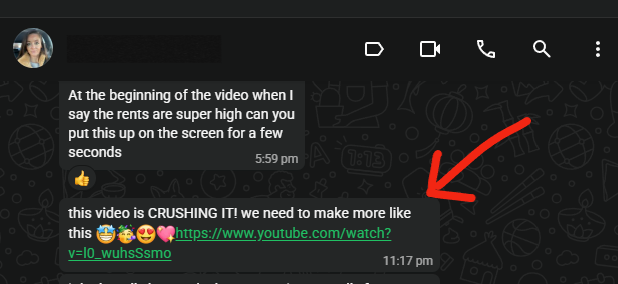
Got this from Ben, a client I've been editing for a while now.
"A+ team member" is the part that stuck with me.
That's what I want to be for every client. Not just an editor who sends files and disappears, but someone who understands and actually cares about your brand.
#VideoEditing #YouTubeEditor #ContentCreation
If you're a real estate agent posting videos that nobody watches, this is for you.
One of my clients does NYC property content. Her latest video started performing so well she messaged me saying we need to make more like it.
The difference wasn't fancy effects or more SFX. It was pacing, holding the right moments on screen, and hooking people before they scrolled past.
And most importantly, keeping people engaged long enough to build trust. Because that's what actually brings business to my client.
#RealEstateMarketing #RealEstateContent #NYCRealEstate
People around me see that I work from home and assume it's easy money.
They tell me, "I also want to start editing and earn money like you."
But before you do, here's why you shouldn't.
1. You're only here for the money.
Money should matter, but it can't be your first goal. If you're just chasing a paycheck, you'll take any client at any price and burn out in six months.
The real goal is making something that actually works. A video that gets views. Content that performs. Clients who care about results will pay for that. Clients who just want cheap edits will drain you.
2. You can't focus for long hours.
Editing means sitting for hours with full focus. Sometimes rewatching the same 5 seconds twenty times. Making tiny corrections again and again because something feels off.
If you get bored easily or can't lock in on details, you'll hate this. Most of the work is repetitive, tedious, and invisible to anyone watching the final product.
3. You think it's just about learning the software.
If you think editing is about knowing Premiere or any editing tool, you're already behind. Basic tool skills? AI is coming for that. It's already here.
What AI can't replace is taste. Judgment. Knowing when to cut and when to let a moment breathe. Understanding the psychology of why people keep watching. Controlling emotion through pacing and sound. Understanding storytelling and everything that comes with it.
If you're not willing to evolve regularly and keep improving your skills, don't enter this field.
4. You think you'll get clients easily and have regular work.
Sorry, but if you're just starting, you can go months without work. Clients will ditch you. You'll get stuck with bad clients who don't let you improve your skills. You'll question if this was even worth it.
The freelancer struggle is real. Inconsistent income. Constant hustling. Dealing with people who don't value your work. If you're not ready for that, this isn't the path.
The ones who succeed aren't the ones with the best tools. They're the ones who care about why things work. If that's you, go for it. If not, don't waste your time.
#VideoEditing #EditingCareer #FreelanceStruggle
In my starting days of editing, I said yes to every project.
Someone offered $20 for a 1-minute edit? Sure.
$100 for a full podcast episode? Done. If they were willing to pay anything, I'd take it.
Back then I thought that's what hustle looked like. Stay busy, take every project, build something.
But here's what really happened.
The $20 clients didn't know what they wanted. They'd ask for four rounds of changes because they were figuring it out as we went. The $100 ones would ghost me for weeks, then suddenly need it done overnight. I was working nonstop but barely making money.
The shift came when I started noticing which projects didn't feel terrible.
Some clients gave me clear instructions. Their feedback made sense. They paid on time. The work actually felt good. And those clients had one thing in common, they weren't the cheapest ones, and they actually got why editing matters.
So I stopped taking every project.
Not because I could afford to say no. I stopped because the bad clients kept me too busy to find good ones.
Look, if you're just starting out and need every project you can get, I get it. Take the work. Learn what you're good at. Figure out your process.
But start paying attention to which clients you'd actually want to work with again.
The ones you wouldn't? They're showing you exactly who to avoid next time.
#VideoEditing #Freelancing #ClientWork #EditingBusiness #FreelanceLife
7 editing habits that separate amateurs from pros
1. Organize before you even touch the timeline.
Set up folders, label your files, clean project structure.
If your project is messy from the start, you’re already slowing yourself down.
2. Cut for the story, not for effects.
Focus on clarity and flow first.
Transitions and effects come later. Always.
3. Cut ruthlessly.
If a clip doesn’t add value, remove it.
Tighter videos = better retention. Simple as that.
4. Master pacing.
Cut to the beat, change the speed, keep things moving.
The best pacing is invisible. You feel it, but you don’t notice it.
5. Audio comes first.
Feel sound, balance levels, subtle effects make your video feel more professional instantly.
6. Build systems.
Shortcuts, plugins, workflow.
Fast editors aren’t just talented, they’re organized.
7. Review like a viewer.
Watch the full video, even on your phone.
Notice where your attention drops… and fix it.
Most editors already know this.
Very few actually follow it every single time.
That’s the real difference.
I've edited enough videos to tell you something most creators won't admit. The content isn't the problem.
I get footage from creators who know their stuff. Sharp people. Real insights. But the video dies in the first 8 seconds because nothing pulled you in.
Here's what's actually working in 2026 from what I see editing for my clients:
Documentary style is taking over. Not because it looks cool. Because people are exhausted by scripted. The raw behind the scenes stuff I edit holds attention longer than anything polished. Audiences feel the difference.
Personal brands are winning every time. The founders showing their face, sharing their opinion, being an actual human, they're the ones growing.
A logo never built trust. A person does.
Short and educational is the sweet spot nobody is fully using. I edit explainers that take off because they respect the viewer's time. Quick tips, tricks, hacks. Teach something useful fast.
But what actually separates videos that grow from videos that flatline is intentional storytelling, pacing, motion design and visual rhythm. That's where retention and growth come from.
Most founders have something worth saying.
Very few have videos worth watching.
That's the gap I close.
hashtag#YouTubeGrowth hashtag#ContentCreators hashtag#PersonalBranding hashtag#ContentStrategy
30 frames ready to animate.
This is where 80% of the work happens. Animation is the easy part.
Knowing what to show and when. That's the real skill.
This one's gonna be fun.
We don't just edit videos.
We edit for your industry, your audience, your goal.
Here's what a client in the pay-per-lead space said after seeing his intro.
hashtag#YouTubeGrowth hashtag#ContentCreators hashtag#PersonalBranding hashtag#BussinessOwner
"He pays attention to my humor, my brand."
Most editors deliver what you asked for.
I pay attention to how you actually communicate.
That's the difference.
"He really cares about his work."
That's what matters most to me.
I'm not trying to be the fastest editor or take on the most clients.
I'm trying to show up for the clients I work with and make sure they don't have to stress about revisions or quality.
When a client says "you can just trust him," that's everything.
"Just post more videos."
I hate this advice.
It's like telling someone who's eating the wrong food to just eat more of it.
The problem isn't volume. It's strategy.
Because here's what nobody tells you:
Your audience isn't one person scrolling through their feed.
It's three completely different people. With three completely different brains.
Processing your content in three completely different ways.
#1 Strangers:
They don't know you exist. They don't care about your business. They're scrolling fast.
What they need: A video that stops the scroll. Pattern interrupt. Visual hook in the first frame.
Not your brand story. Not your credentials. Just something that makes them pause.
#2 Followers:
They've seen your content before. They like what you post. But they haven't reached out yet.
What they need: Proof that you understand their problem. A video that makes them think "this person gets it."
Show the transformation. The before/after. The result they want.
#3 Prospects:
They've DM'd you. They're on your email list. They're comparing you to others. Deciding if you're worth it.
What they need: Case studies. Clear outcomes. Trust signals that remove doubt.
Show the process. The client testimonial. The reason to believe you.
Here's the problem:
Most businesses post the same type of video for all three groups.
They wonder why their content gets views but doesn't convert.
It's because a stranger doesn't care about your client testimonial.
And a prospect doesn't need another scroll-stopping hook. They need proof.
One video can't serve all three.
Do this right now:
Look at your last 10 videos.
How many were for strangers vs. followers vs. prospects?
If it's all #1, you just found your problem.
A stronger intro. Cleaner frames. Nothing extra.
That's what I focus on when I edit.
I'm not here to add effects because they look cool.
I'm here to make your message land.
Every frame serves the point you're trying to make.
Just clean work that communicates your message clearly.
That's my thing.
#videoediting #contentcreation #realestateagent