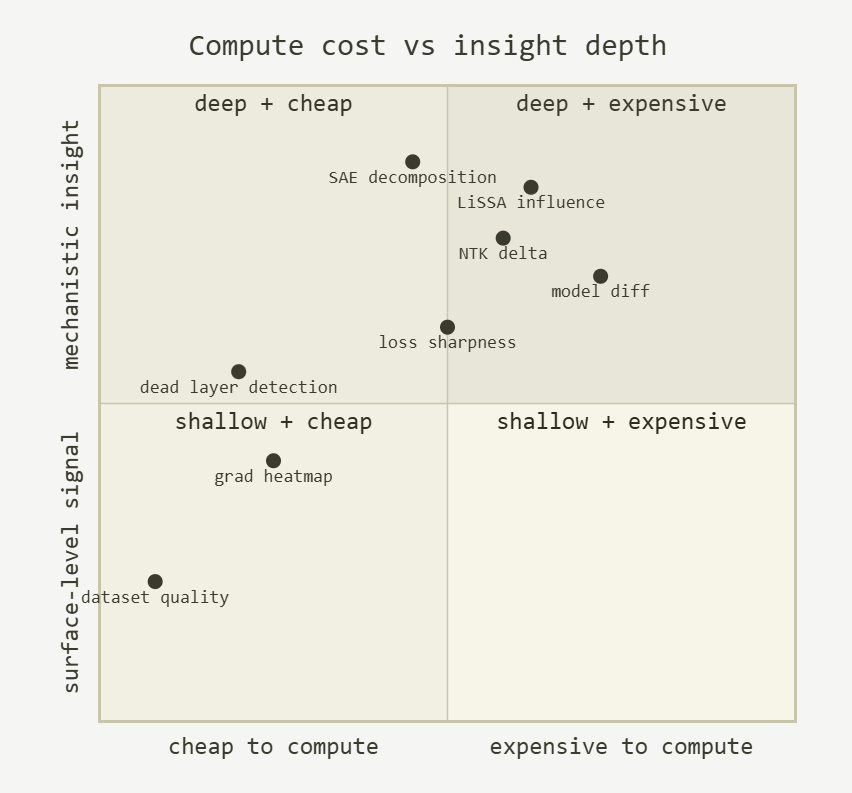
This chart is actually so satisfying to look at!
deep + cheap quadrant is everything we're going for at @Aquinf03, like why would you spend serious compute on surface level signals.
Aquin isnt bottom right and it shows deep insights with cheap ways to get there!
for the first time you can simulate fine-tuning before committing any compute
with @AquinF03, see exactly which features strengthen or suppress, which samples hurt generalization, which layers go dead!
If you do mech interp research, @sammmbhav and @MaxMill06 made badges for your repos!
from SAEs, causal tracing, evals to benchmarks and more!
https://t.co/ZMXuZ6XLo4
We used Aquin to debug and improve a QLoRA fine-tuning pipeline for LLaMA 3.2 1B on a healthcare dataset.
With a sdk to transform any local into communicable server for the application!
every time an LLM hallucinates in production, someone says 'we should fine-tune it.'
that's not engineering, it's literally superstition with a GPU bill.
you're hiding bugs you tested for, not fixing them.
@AquinF03 is building the alternative.
nobody wants to say it so i will:
we're deploying AI into hospitals, banks and cars
and we genuinely don't fully know what these models learned
interpretability is the field trying to fix that
@AquinF03 is building for it
Fine-tuning can become a unsecured attack surface!
Anyone who can touch training data can attack your model and nobody's talking about this.
Ergo, At @AquinF03, we built the strongest security check systems!
Here's how it works:
compiler changed software, with it you could trace bugs to source.
AI has no equivalent. when models hallucinate, there's no way to debug. just retrain & hope.
@AquinF03 built the debugger for models, tracing exactly what broke. if you're developing AI/ML, this is for you!