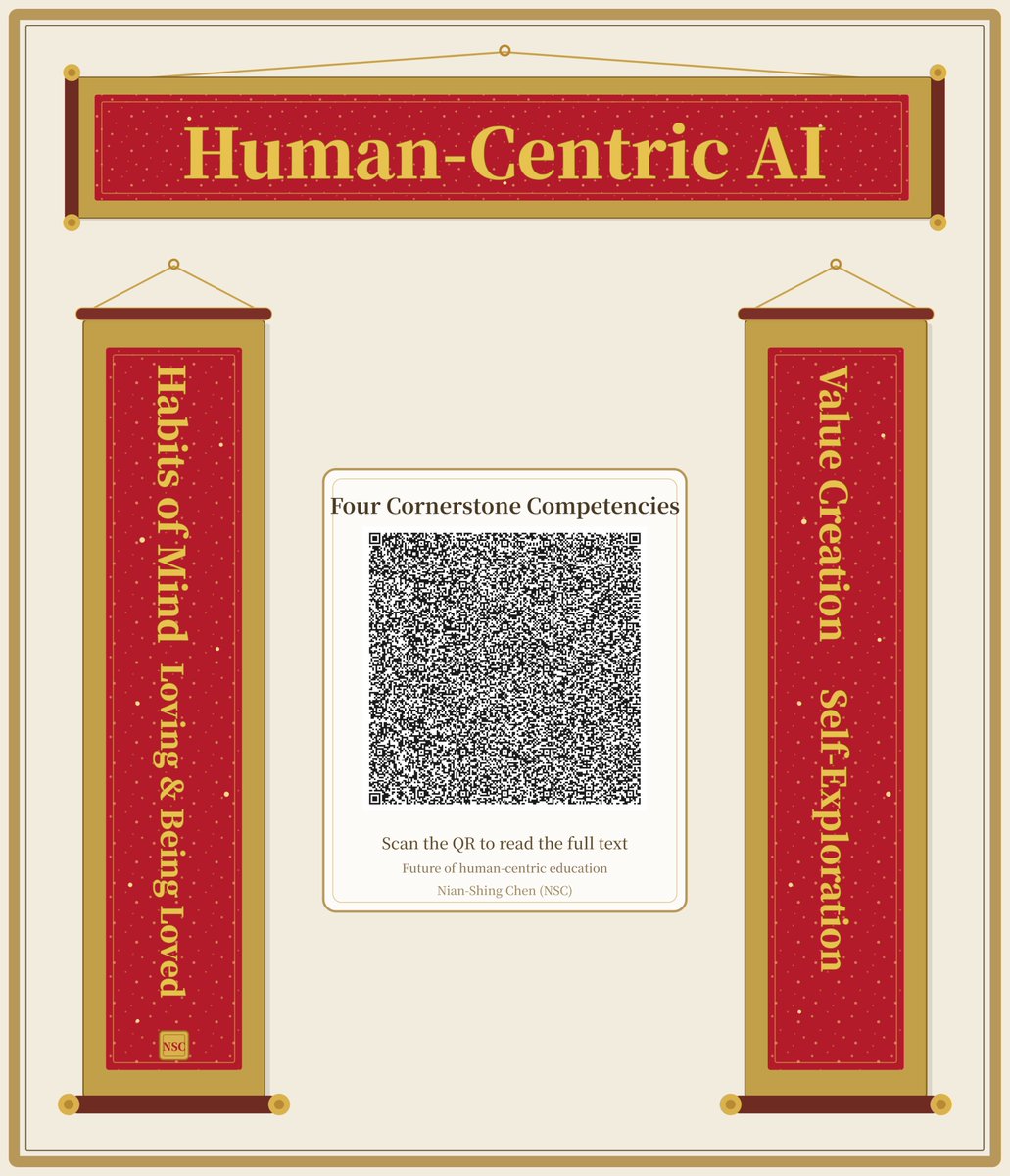
The mission and goals of future formal education need to be transformed toward the cultivation of four core foundational capacities.
Educational ideals that were previously unattainable, or extremely difficult to realize within the formal education system, may become possible in the post-AI era, opening a new door for educational transformation.
Value Creation:
As the creation of material value is increasingly taken over by AI and robots, the creation of spiritual and humanistic value will become humanity’s future mission.
Self-Exploration:
One’s worldview shapes how one understands the environment; one’s outlook on life shapes how one organizes one’s life; and one’s values shape how one makes choices. Cultivating a worldview, an outlook on life, and a system of values is to guide a person from “passive living” toward “conscious living.”
Habits of Mind:
Habits of mind are not merely the accumulation of knowledge. They are the patterns of thinking and tendencies toward action that a person repeatedly demonstrates when facing problems, difficulties, uncertainty, and interpersonal interactions. Cultivating habits of perseverance, reflection, openness, precision, listening, inquiry, and self-regulation is to guide a person from “passive reaction” toward “active thinking.”
Loving and Being Loved:
Loving and being loved are not one-way emotional needs, but the capacity to learn understanding, acceptance, giving, trust, and responsibility within relationships. Knowing how to love enables a person to move beyond self-centeredness; being able to receive love enables a person to accept goodwill and develop a sense of security. Cultivating the capacity to love and be loved is to guide a person from an “isolated self” toward a “complete life within relationships.”
Former Google CEO Eric Schmidt once said:
Generational differences in using AI:
Under 20 years old: They use AI as a completely new operating system that can build anything they want.
Ages 20–30: They use AI as an assistant that helps increase productivity for specific tasks.
Over 30 years old: They use AI much like a traditional Google search.
My own statements:
If you don’t know how to use AI, you will struggle to stay employable.
If you cannot use AI effectively, it means you do not yet have the capability to write clear instructions for intelligent agents to accomplish your tasks.
Therefore, you should treat AI as a working partner and strengthen your communication, writing, and delegation skills to improve you&AI's collaboration productivity.
LLM + Robot + IoT ==> Universal AI Agent Execution Platform
After ten years of effort, my team has finally completed the development of a universal AI Agent execution platform that seamlessly integrates three core technologies: Artificial Intelligence, Robotics, and Internet of Things (AI + Robot + IoT).
This AI Agent Universal Execution Platform provides four different user interfaces:
1. Physical Robot Version
2. Digital Robot Version (Dual Tablet)
3. Digital Robot Version (Browser)
4. Multimodal Version (Browser)
Developers (Domain expert like teachers) only need to clearly describe the workflow of any Agent in natural language, and they can then choose any of the four user interfaces above to deploy it to the front-end for users to interact with. (Zero coding)
You may watch some videos on LAB’s YouTube channel to get an idea if you’re interested:
https://t.co/Vyz7cWwqCV
After I posted my viewpoint on May 11th that a human-to-human-like interactive interface is what you need, just ten days later, Google showcased actual application scenarios to the world at this week's Google I/O conference. Gemini has become a super AI operating system (AIOS), evolving from a most complete foundation model into a super real-world model. Android XR GLASSES will bring everyone a brand new human-computer interaction experience. https://t.co/9FVQR4kbjS
Rethinking the future of UI:
The user interface (UI) is no longer the core.
Traditional human-computer interfaces are dead.
A human-to-human-like interactive interface is what you need.
Rethinking the Future of UI:
The User Interface (UI) is no longer central.
The Computer-Human Interface is dead.
A Human-to-Human-like Interface is all you need.
Reasoning behind the above concepts:
Seamless interaction: Traditional on-screen elements (buttons, menus, windows) are giving way to voice, gesture, and context-aware inputs that require no conscious UI navigation.
Invisible compute layer: The mechanics of hardware and operating systems recede behind AI and cloud services—users never “see” the computer.
Conversational paradigm: Interfaces should emulate human dialogue—with natural language, empathy, and social cues—so users interact as they would with another person.
Three Main Components of an AI Agent:
Instruction + Model + Tool
Agent Tool Protocol (MCP: Model Context Protocol): Enables an agent to use a wide range of tools.
Multiple Agent Protocol (A2A: Agent-to-Agent Protocol): Allows an agent to be powered by multiple models.
Now, with MCP and A2A in place, the only missing piece is YOU — the brain, the know-how behind writing effective instructions.
Education does not need generative AI to cultivate copy-and-paste students.
What education truly needs is to cultivate generative students — students who generate critical thinking, generate problem-solving abilities, and generate creativity.
As more and more students turn to generative AI teachers for learning, the role (and value) of human teachers will gradually be replaced.
What we need is for students to learn from the digital twins (AI Teaching Agents) of human teachers, thereby creating and preserving the value of human teachers in the AI era.
Thus, the goal, content, and skills of our Pedagogical AI Agent training program are to provide teachers with a systematic framework and methodology for designing AI teaching agents.
This enables teachers to replicate their expertise, teaching materials, and pedagogical methods into their own digital twins through the power of AI, allowing them to assist their students in effective learning 24/7 in the metaverse.
Core Concept: A Pedagogical AI Agent is the digital twin of a human teacher.
Paradigm Shift:
AI models are evolving from passive systems into intelligent, autonomous operational systems.
Tool usage is shifting from humans using tools (e.g., apps) to AI agents utilizing tools (e.g., MCP services).
--------------------------------------------------------------
The critical question for everyone is whether humanity is advancing toward sustainable abundance or facing the end of its era.
*** Call for papers - ICITL 2025 ***
International Conference of Innovative Technologies and Learning (ICITL 2025)
Oslo Metropolitan University, Oslo, Norway, Aug. 5 – Aug. 7, 2025
Statement:
From "Machine Learning" to "Human Value" — from "Attention Is All You Need" to "Needs Analysis and Specification Is All You Need."
Rationale:
Forget about prompt engineering skills. After AGI, what truly matters is needs analysis and specification. Understanding yourself is the key to knowing what you genuinely need. First, consider "why" you want something; then, define precisely "what" it is you want; and finally, determine "how" to make it a reality. While AI can execute your instructions—making the "how" less critical—it still struggles to grasp what you want and why you desire it.
I’d like to share a recent success from my lab: we have successfully integrated AI Agents with SQL databases, and this capability is now seamlessly incorporated into the R&T Learning platform! With this advancement, teachers can easily design AI-driven learning activities for any teaching agent using natural language through the Pedagogical AI Agents framework. All learning resources are centrally stored in the database and can be instantly retrieved according to each specific learning task. Moreover, the entire interaction process between learners and the AI instructor is fully recorded in the database, enabling the use of Learning Analytics to optimize teaching strategies. This makes the agents increasingly intelligent and better equipped to provide personalized, one-on-one guidance tailored to each learner.
We believe that nurturing talent capable of integrating AI, Robotics, IoT, and Databases is crucial to meeting the future workforce needs in education technology! #AI #EdTech #Database
Addressing the challenge of insufficient teaching resources to support personalized learning by designing AI teaching agents to create AI teachers. AI teachers act as the digital counterparts of human teachers, providing one-on-one learning.
https://t.co/fobSSOdowY