Nstproxy is now Nstdata.
This is more than a new name. It reflects how our technology — and our vision — have evolved.
We started with reliable proxy infrastructure, helping developers and businesses connect to the web at scale.
Today, we’re going further: turning the web into clean, structured, AI-ready data that agents, RAG pipelines, and business systems can use directly.
• Proxy provides reliable IP egress
• Crawl transforms websites into LLM-ready data
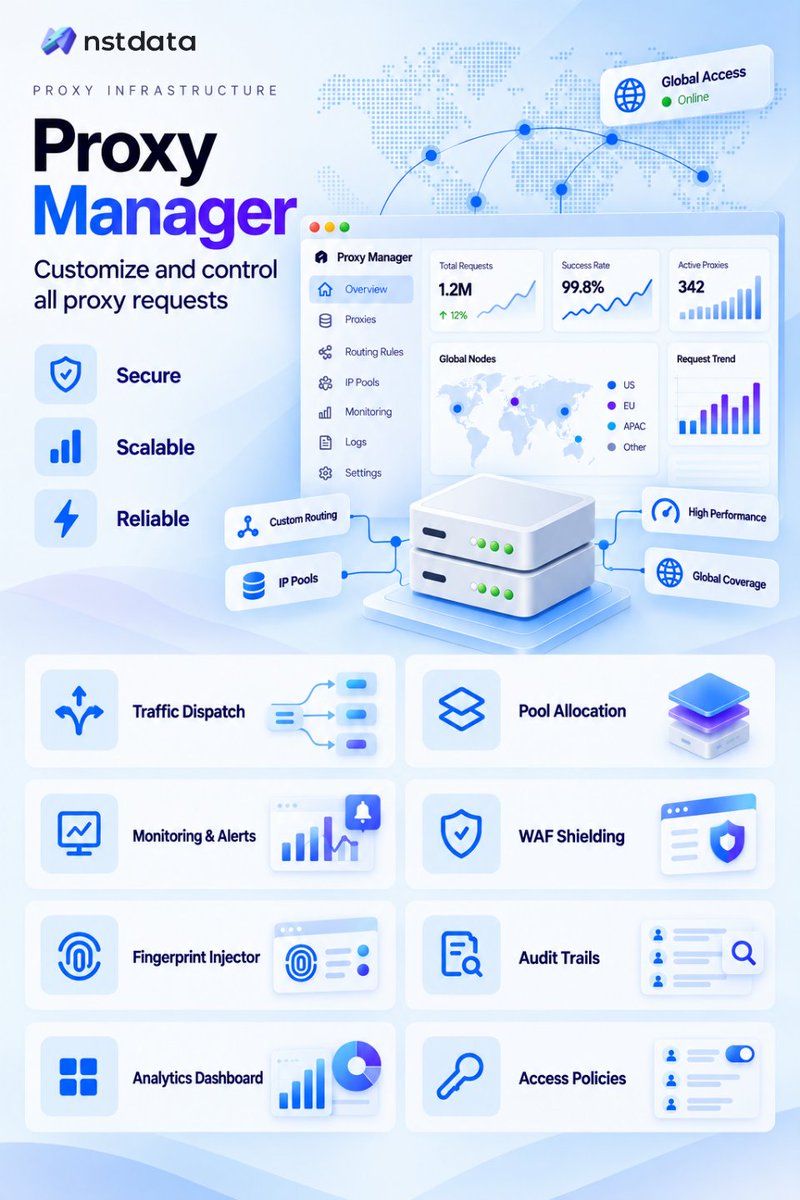
• Proxy Manager brings routing, control, and infrastructure management into one place.
Proxy remains our foundation.
Nstdata represents the next layer: moving beyond successful connections to delivering data that is ready to use.
From access to data. From proxy infrastructure to web data infrastructure.
#nstdata #webcrawl #onlinedata #LLM
Nstdata is now live on Product Hunt 🚀
We’re building a web data infrastructure stack for teams that need reliable access, scalable collection, and centralized management across regions.
If you like what we’re building, we’d really appreciate your support.
Give us an upvote and share your feedback on Product Hunt:
https://t.co/CIrDOONuun
#ProductHunt #WebData #DataInfrastructure #DevTools #Nstdata
Growth is built for teams that want Crawl and Proxy Manager working together in one subscription.
It brings the collection layer and the infrastructure layer into the same workflow:
- Included credits can be used across eligible Crawl, Proxy Manager, and proxy usage
- Crawl handles large-scale URL collection and turns web pages into structured data
- Proxy Manager centralizes routing, proxy pools, monitoring, fingerprints, and traffic management
- Multi-region access helps teams collect localized data across different markets
-Batch operations make it easier to manage recurring jobs, large URL sets, and multiple workloads from one place
The result is a more complete data acquisition stack for B2B teams:
Access → Manage → Crawl → Deliver
Growth is designed for teams that need more than isolated scraping jobs. It combines web access, proxy management, and data collection in one infrastructure layer built for ongoing, large-scale data workflows.
Nstdata Crawl turns web pages into structured, ready-to-use data without requiring teams to build and maintain the entire crawling workflow themselves.
Start directly with Pay Per Use at $1.20 / 1k URLs, with no subscription required. As your workload grows, subscriptions reduce the unit cost to as low as $0.60 / 1k URLs, while adding more concurrency and resources for continuous crawling.
Pricing scales across four levels:
- Pay Per Use: $1.20 / 1k URLs
- Starter: $79/month · $1.00 / 1k URLs
- Growth: $249/month · $0.80 / 1k URLs
- Scale: $699/month · $0.60 / 1k URLs
Paid plans include credits matching the subscription amount, along with Proxy traffic for Crawl workloads, so teams can manage both web extraction and network access within the same workflow.
From Growth onward, Proxy Manager is also included, providing a more convenient way to organize, manage, and control different proxy resources as crawling workloads become more complex.
Crawl is designed for more than simply downloading web pages. It can transform web content into structured formats such as JSON, Markdown, HTML, Links, and PDF, making the output easier to connect directly to downstream systems.
That makes it suitable for workflows including:
· AI & RAG data pipelines
· competitor tracking
· e-commerce monitoring
· SEO data collection
· documentation crawling
· large-scale URL processing
· automation workflows
Teams can begin with a small number of URLs, then scale toward higher concurrency and larger batch workloads without changing the overall data collection workflow.
For companies running larger or more specialized workloads, custom ToB packages are also available. Contact the sales team for dedicated capacity, tailored configurations, and individual pricing.
#WebScraping #Crawler #DeveloperTools #DataInfrastructure #Automation #AIInfrastructure
LLMs are changing what happens after web data is collected.
Instead of writing a new parser every time the page structure changes, teams can first use Crawl to turn websites into clean, structured content, then let an LLM extract the fields they actually need.
For larger data workflows, the pipeline looks more like:
Multi-region Proxy Access
→ Crawl & Rendering
→ Clean Markdown
→ LLM Extraction
→ Structured Data
Nstdata handles the web acquisition layer with proxy-powered access, JavaScript rendering, full-site crawling, and structured outputs. The LLM can then focus on understanding the content and turning unstructured pages into usable records.
For enterprise teams, this also means the collection layer can be managed separately from the extraction logic, making it easier to scale across more URLs, regions, and recurring data jobs.
Access the web.
Collect the content.
Let the LLM structure what matters.
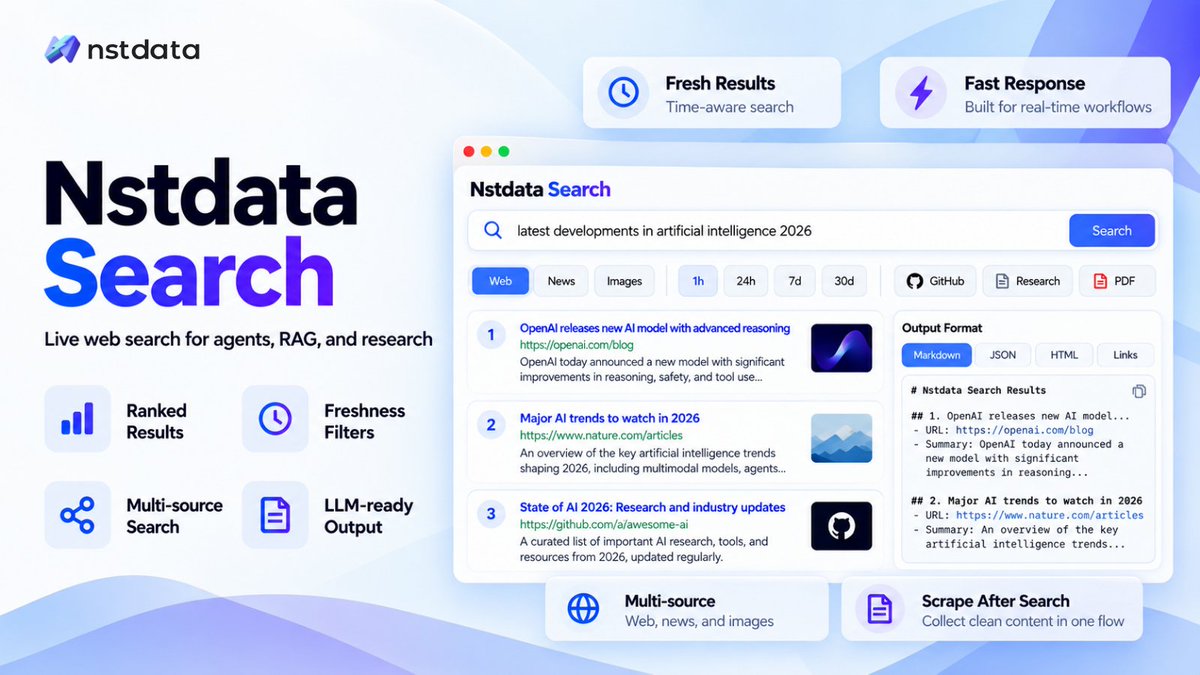
Search the web. Get the data behind the results.
This is designed to give AI agents and applications a simpler way to work with live web data.
Start with a query, discover relevant pages, then use Nstdata’s web data infrastructure to turn those pages into content your system can actually use.
With Crawl behind the search layer, results can be rendered, cleaned, and converted into structured Markdown, including content from JavaScript-heavy pages.
Query → Search → Render → Crawl → AI-ready Data
Instead of wiring search, proxies, browsers, and extraction together yourself, Nstdata brings the web access and data collection layers into one workflow.
#WebSearch #AIAgents #RAG #WebData #WebScraping #Nstdata
Why Markdown for RAG?
Raw HTML contains much more than the content your RAG pipeline actually needs: navigation, scripts, ads, layout markup, and other page elements can all add noise.
Markdown keeps the useful structure, such as headings, paragraphs, lists, and links, while making the content much easier to split into meaningful chunks for embedding and retrieval. Structure-aware chunking can also preserve section boundaries instead of cutting content arbitrarily.
With Nstdata Crawl, a webpage can be rendered, cleaned, and returned directly as structured Markdown. Nstdata recommends Markdown for AI workflows specifically because it reduces interference from navigation, scripts, ads, and other irrelevant content.
URL → Crawl → Clean Markdown → Chunk → Embed → Retrieve
Cleaner input makes the rest of the RAG pipeline easier to work with.
#RAG #Markdown #WebData #LLM #WebScraping #Nstdata #AI #crawl
Nstdata brings Proxy, Crawl, and Proxy Manager together into one unified web data infrastructure.
One infrastructure stack for turning reliable web access into usable web data. https://t.co/OBhtQZNBfn
Introduce Proxy Manager as part of the foundation of our data infrastructure.
It sits at the service layer, handling proxy access, routing, health, and traffic control so the data layer above it can focus on collection, processing, and delivery.
For developer and enterprise teams, that means one place to manage the proxy resources behind crawlers, scripts, browsers, and automation workflows.
- Proxy Pools: organize proxies by region, source, quality, project, or workload.
- Routing Rules: route traffic to different pools based on request logic.
- TLS Fingerprints: apply fingerprint configurations to outbound traffic when needed.
- Monitoring & Alerts: track success rates, latency, failures, and traffic in real time.
- Automatic Recovery: remove unhealthy proxies and return them after recovery.
- Logs & Analytics: inspect request status, response codes, latency, failures, and usage.
- WAF & Access Policies: centralize traffic controls and team access.
- Proxy Saver: reuse sessions and cached resources to reduce unnecessary proxy traffic.
You can manage Nstdata proxies and third-party proxy resources through the same layer.
What you see in a browser isn’t always what comes back in the initial HTML.
On many JavaScript-heavy pages, content is added after load as scripts run and update the DOM. That means a crawler working only from the first HTML response can miss parts of the page. Google documents the same pattern for JavaScript apps where the initial HTML may not contain the actual page content until JavaScript is executed.
Nstdata renders the page before Crawl starts extracting, so dynamically loaded content such as prices, inventory, and reviews can be captured from the rendered page and turned into Markdown or structured data.
#webscraping #js #jsrendor #crawl #datacrawl #webdata #nstdata #website
Nstdata Crawl turns web pages into structured, ready-to-use data without requiring teams to build and maintain the entire crawling workflow themselves.
Start directly with Pay Per Use at $1.20 / 1k URLs, with no subscription required. As your workload grows, subscriptions reduce the unit cost to as low as $0.60 / 1k URLs, while adding more concurrency and resources for continuous crawling.
Pricing scales across four levels:
- Pay Per Use: $1.20 / 1k URLs
- Starter: $79/month · $1.00 / 1k URLs
- Growth: $249/month · $0.80 / 1k URLs
- Scale: $699/month · $0.60 / 1k URLs
Paid plans include credits matching the subscription amount, along with Proxy traffic for Crawl workloads, so teams can manage both web extraction and network access within the same workflow.
From Growth onward, Proxy Manager is also included, providing a more convenient way to organize, manage, and control different proxy resources as crawling workloads become more complex.
Crawl is designed for more than simply downloading web pages. It can transform web content into structured formats such as JSON, Markdown, HTML, Links, and PDF, making the output easier to connect directly to downstream systems.
That makes it suitable for workflows including:
· AI & RAG data pipelines
· competitor tracking
· e-commerce monitoring
· SEO data collection
· documentation crawling
· large-scale URL processing
· automation workflows
Teams can begin with a small number of URLs, then scale toward higher concurrency and larger batch workloads without changing the overall data collection workflow.
For companies running larger or more specialized workloads, custom ToB packages are also available. Contact the sales team for dedicated capacity, tailored configurations, and individual pricing.
#WebScraping #Crawler #DeveloperTools #DataInfrastructure #Automation #AIInfrastructure
Join our Discord community to stay closer to the product and the team.
Inside the community, you can:
- get help with technical and dev questions
- receive occasional free credits
- share product feedback and report issues
- follow updates from our official developer blog
If you’re building with Nstdata or exploring what it can do, our Discord is the best place to start.
Join us here: https://t.co/cgwrQTOjGk
JavaScript rendering at scale requires careful control over when rendering is triggered, when page data is actually ready, and whether the output is valid for downstream use. https://t.co/nJ3SN035xX
Product prices can vary by region, platform, and market.
With Nstdata infrastructure, you can collect pricing data from different locations and track how those prices change over time.
You can also see where your own product ranks against competitors on price. When that ranking moves, your team can react faster and make pricing adjustments with more context.
Useful for:
- Regional price tracking
- Competitor price comparison
- Price ranking alerts
- Faster pricing adjustments
A practical way to keep regional pricing and competitor movements in view without relying on manual checks.
#PriceMonitoring #EcommerceData #CompetitiveIntelligence #WebData #ProxyInfrastructure #shopify #eBay #ecommerce
Give Crawl any webpage URL and get the full page content back in Markdown.
It collects the content from the page, cleans it up, and returns a structured result that is easier to work with downstream.
For RAG pipelines, agents, and other AI applications, this gives you web content in a format that is ready to process without having to start from raw page data.
Paste in a URL, run Crawl, and get the complete Markdown result.