How do we know if we’re meaningfully supporting engagement in our #implementation work? In this article, the authors outline key research needs and opportunities at the intersection of #implementation science and #engagement science.
📖 Read more: https://t.co/lDObOEMw5U
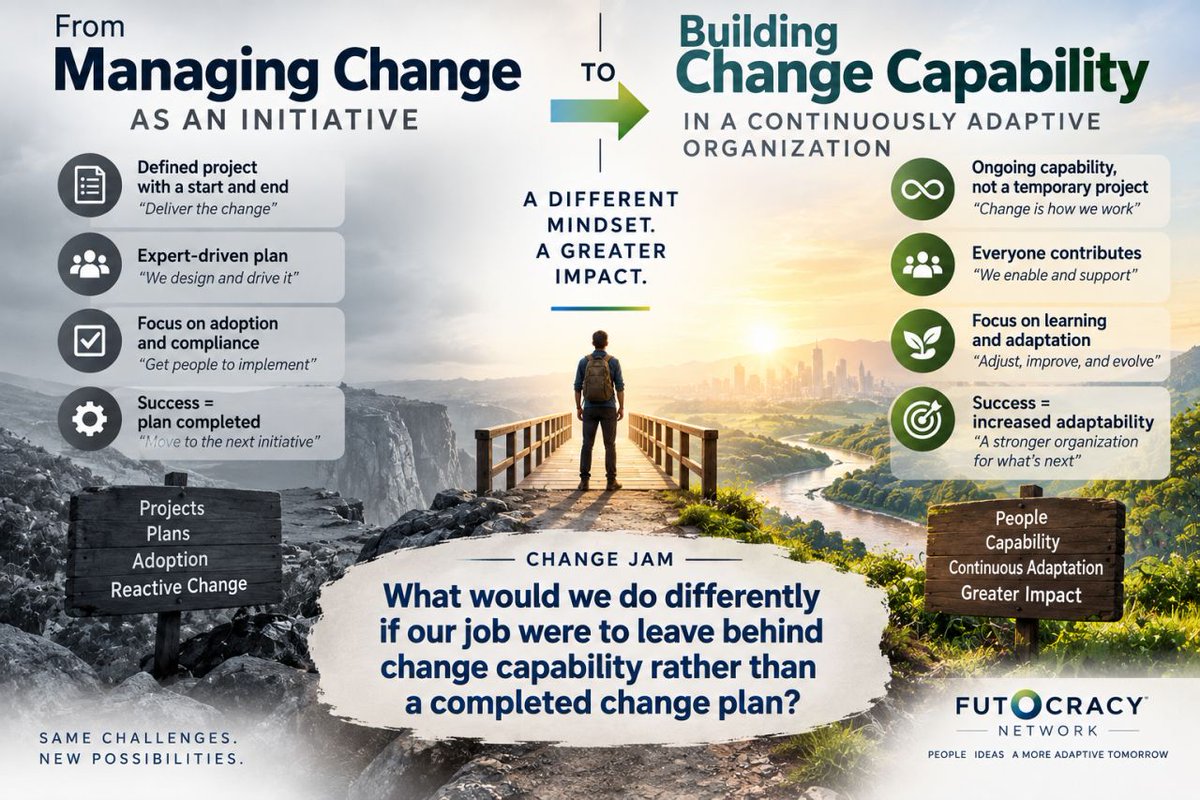
How can we navigate more adaptive, continuous approaches to change when our organisations still see change as a series of initiatives?
What got me thinking is this graphic that the Change Management Network posted on LinkedIn. It describes a journey "from managing change as an initiative to building change capability in a continuously adaptive organisation". What I write below is not a criticism of the network. I agree that we need more adaptive capability for change and I appreciate that the Change Management Network is enabling this conversation.
My question is: should we frame this as binary "from/to"? Change leaders adopting the adaptive approach promoted by the graphic will still have to continue to work with (and struggle with) most features of the "change as an initiative" approach that the graphic sets it against. In the complex systems most of us work in, this isn't a tension we can resolve. We have to hold and navigate both continuously and that won't change anytime soon.
The direction of travel is towards organisations with the capability to adapt continuously. Yet the systems we work in today still fund, govern and judge change as a series of initiatives. As leaders of change, we are accountable for delivering the project in front of us. We are also the best placed people to build the adaptive change capacity our organisations will need for the evolving future.
I would frame our strategic task as follows. Rather than moving away from “change initiatives” towards a different future, use them to build that future from inside the present. Five ways we can do this:
1) Hold two horizons at once. Seek to deliver what the initiative promises. At every stage, ask what the organisation will be able to do after the project closes that it could not do before.
2) Make capability part of the accountability. Work with programme sponsors to write capability outcomes into business cases, benefits plans and final reports.
3) Design for handover from day one. Share decision making with the people who will carry the change forward. Help build their skills in improvement and data and their sense of agency while the project team is still there to support them.
4) Turn governance moments into learning moments. Milestone reviews and Board papers can ask what we are learning and how we are adapting, as well as whether we are on track.
5) Connect the initiatives. Many organisations (especially in health and care) run dozens of change programmes in parallel. If we link them, share learning across them and grow a common change community, we can build adaptive capacity across the whole system.
The future of change leadership is being shaped now, inside the initiatives we lead today. We want each project to leave people more able to spot problems, test ideas, take action and adapt. This isn’t “from/to”. It’s “both/and”: the initiative can become the vehicle and the adaptive capability can become the legacy.
Graphic comes from a post by the Change Management Network on LinkedIn: https://t.co/ZAJKT8ei9I
This article argues that tackling global challenges (like pandemics, climate change, and social crises) require a collective, capacity-building approach.
Read the full article:
https://t.co/LE5B6KxQsp
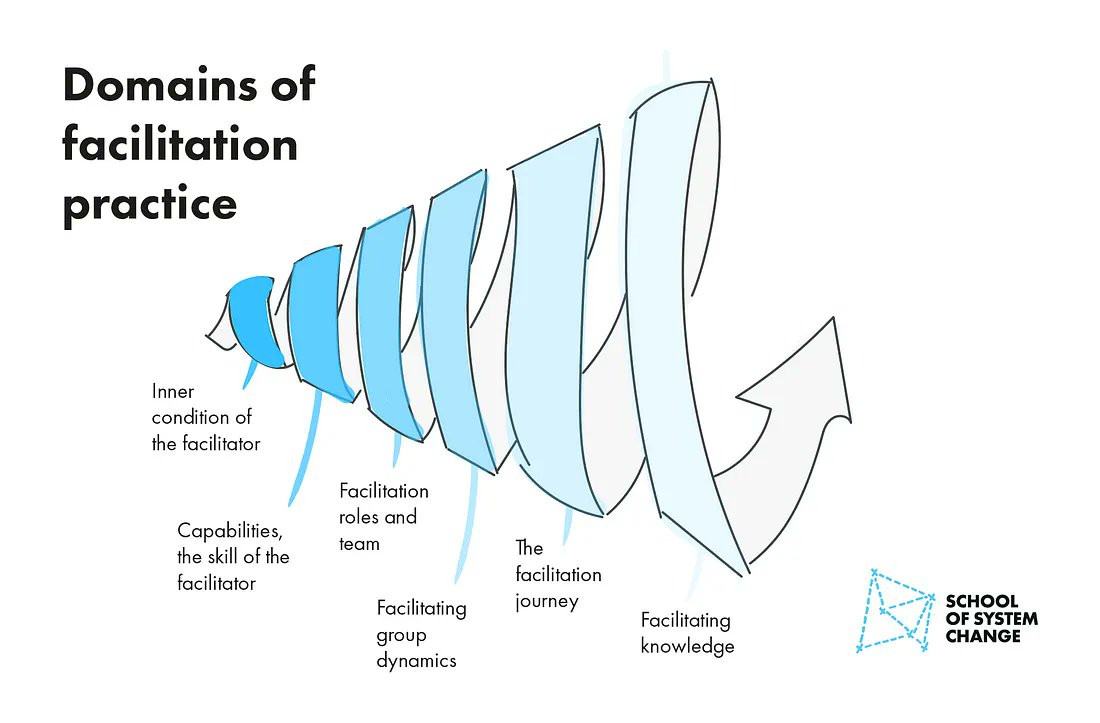
Facilitation plays a critical role in leading sustainable change. This article explores the key domains of facilitation practice and why it matters for systems change.
Read the full article:
https://t.co/zhQ4frpFg9
AI in healthcare continues to gain momentum. In this article, the authors present a tailored framework for successfully implementing and sustaining #AI in #healthcare—drawing on case studies, expert interviews, and existing models.
Read the full article:
https://t.co/EPo7Msdh0y
⚕️#Healthcare quality is essential to safer, more effective care.
Build practical skills in patient safety, infection prevention, safe surgery, medication safety and more with @IFC_org's free self-paced courses in English, French and Arabic.
https://t.co/8z9KCFVYFO
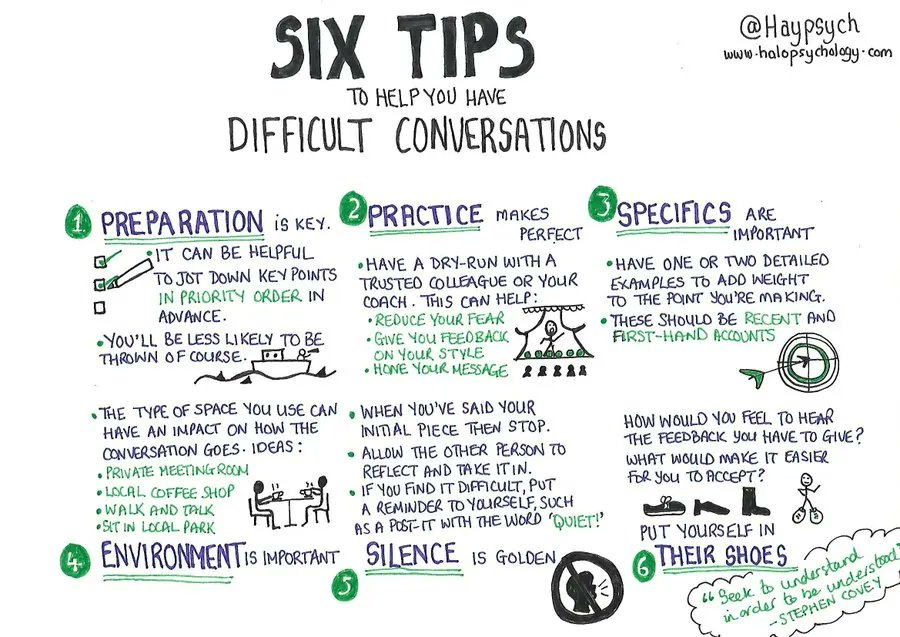
Building trust and navigating power dynamics effectively in #implementation work starts with good communication. This infographic offers helpful tips for approaching difficult conversations and creating spaces for meaningful dialogue.
What would you add to this list?
@Haypsych
A change initiative may also involve de-implementation, a critical process when a program or practice is outdated, ineffective, or no longer appropriate. Read the full scoping review introducing de-implementation models and frameworks: https://t.co/IcEc5XbPAZ
FRAME-IS is a flexible, practical tool for documenting modifications to #implementation strategies in #healthcare. In this article, the authors describe its development and examples of how it can be put into practice.
Read more:
https://t.co/mjywuSXggs
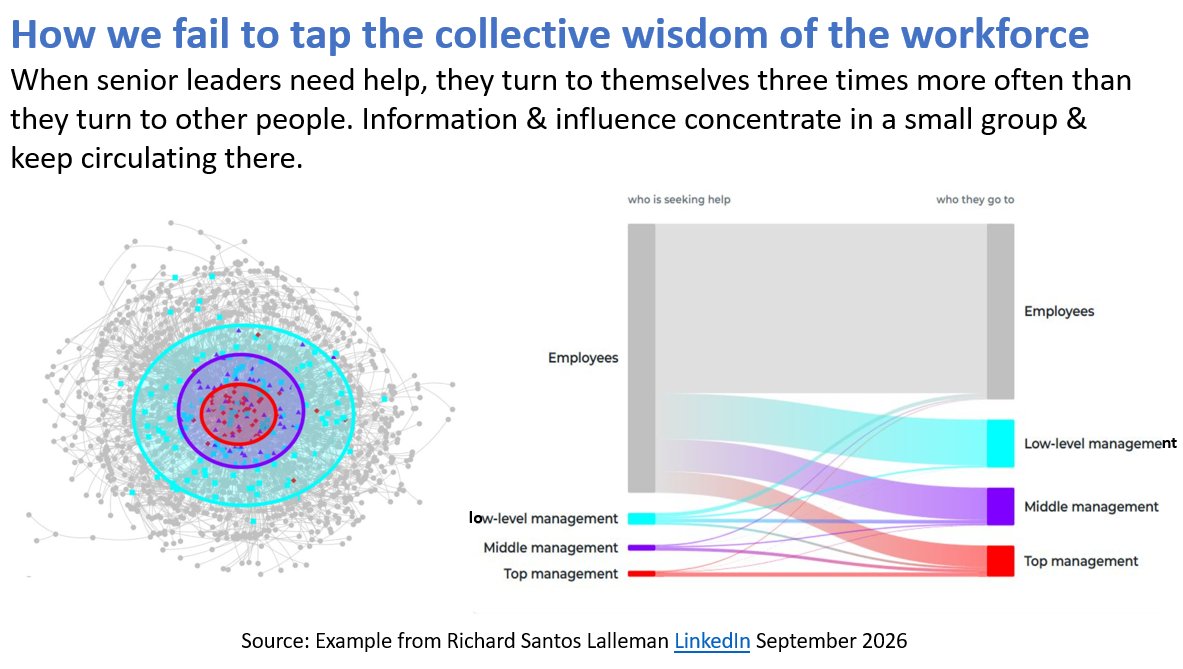
To what extent do we use the wisdom of the whole workforce when it comes to resolving difficult issues?
I'm a big fan of organisational network analysis (ONA). It maps and measures how communication, collaboration and influence really flow between people. It reveals the "hidden organisation": the informal networks that org charts never show.
In leadership circles, we talk a lot about "collective” or "distributed” or “empowering” leadership. ONA often shows a different picture. @RLalleman77215 from @InnovisorInc recently shared data from an example organisation. The top two layers of leadership make up 4% of the workforce. They absorb roughly a quarter of all the requests for help. When those leaders need help themselves, they turn to each other three times more often than they turn to other colleagues. Because the senior group is so much smaller, person for person a senior colleague is around 70 times more likely to be asked than anyone else. Without ever deciding to, the most experienced people in the organisation have arranged things so almost every problem they struggle with is thought about by the same small group. A closed loop at the top: leadership talking to itself.
This pattern is not unusual. Rob Cross's research across more than 300 organisations found that 20% to 35% of value-adding collaborations involve only 3% to 5% of people. 766,000 people responded to the most recent NHS Staff Survey. More than half did not agree they are involved in deciding on changes that affect their work area, and the proportion who do agree has fallen for the second year running. We measure it from the other end in the NHS, and the answer is the same. Different measure. Same conclusion.
This means that:
- A small group with similar jobs and experience makes the decisions, so they all miss the same things.
- The people closest to the work hold knowledge that is never asked for, so better options go unseen.
- Work queues behind a small number of overloaded leaders, so good decisions arrive slowly or too late.
- People stop offering ideas once nothing comes of them and research shows that organisations with lower engagement tend to get worse outcomes.
Some actions we can take as leaders:
- Audit our own help networks. List the last ten people we went to with a hard problem. Count how many of them do the core work of the organisation.
- Map the “hidden organisation”. ONA shows who people go to in practice and where to focus action. It seldom matches the org chart.
- Change who is in the room. Make it a rule that decisions about a piece of work include someone who does that work.
- Ask the questions only people at the front line or point of care can answer. Go and ask them directly, with nobody summarising in between.
- Show what changed. Visible follow-through keeps people engaged.
There is a massive, untapped well of wisdom within people inside our organisations. It stays largely untapped for as long as we keep turning to each other when we get stuck.
Richard Santos Lalleman's original post (Innovisor organisational network analysis): https://t.co/S4oaSYHBA0
Cross R, Rebele R & Grant A. Collaborative Overload. Harvard Business Review, January-February 2016. https://t.co/AetHUaPtWq
In situations of change, what holds people together when the ground keeps moving? A sense of belonging.
I define “belonging” (in a change context) as confidence that we are part of the group the change is happening with, that our effort to adapt is visible to the people around us and that what we contribute still counts as the organisation reshapes itself. Belonging is one of the most underrated conditions for change leadership. We plan structures, timelines and communications. We plan far less for whether people feel connected, seen and significant while the change happens around them.
Three reasons belonging matters to the change itself:
1) Change travels through relationships. New practice spreads when people we trust adopt it first.
2) Uncertainty is more bearable in company. When people are unsure of their standing, their attention moves to self-protection. That attention is then unavailable for the work of adapting.
3) Belonging is a condition for speaking up. What goes unsaid in the early weeks of a change initiative (when people don’t feel secure enough to name problems) often reappears later as failed implementation.
Research by Gartner, across multiple industries and sectors (including health and care) shows a widening “transformation deficit gap”: the chasm between the pace at which leaders introduce change into their organisations and the depleted capacity of people at work to absorb, believe in, and deliver it. Glassdoor named "fatigue" the defining word of the year.
A recent @hacking_hr analysis describes how the scars of disruption are relational. Change fatigue often shows up as withdrawal. People stop asking questions, stop offering ideas, stop working across boundaries.
BetterUp's research links a high sense of belonging to a 56% rise in job performance and a 50% drop in turnover risk.
The graphic sets out three dimensions of belonging that become critically load bearing during change. Each one points to actions that leaders of change can take:
CONNECTION, or "I am not alone": do I have people here I can trust? Protect time for peer conversation and mentoring when delivery pressure rises. Create spaces where people can ask questions, so uncertainty is not faced alone.
FEELING SEEN, or "I am not invisible": does anyone see me and my contribution? Notice effort, including the work behind the scenes: learning an unfamiliar system, holding a team together, absorbing extra load while roles settle. Value adaptation and learning.
MATTERING, or "I make a difference": does what I do make a difference here? Reinforce to people how their contribution is meaningful for the organisation. Clarify roles when priorities change, so people can see where they still fit. This is the dimension that change disturbs most, because purpose gets lost in the noise of implementation.
We cannot treat belonging during change as a “cultural nicety”. The evidence points to it being one of the fundamental conditions that decides whether a change takes hold.
https://t.co/5bBEUlSEIv.
The @MRC_Uganda invites applications for 2 fully funded PhD positions under a study exploring community-led delivery of long-acting injectable lenacapavir for HIV prevention among men who are mobile for work in Uganda.
Apply here: https://t.co/tY4z3r0HeK
What happens when the performance targets we chase take the place of the purpose we set out to serve?
Goodhart's Law: "When a measure becomes a target, it ceases to be a good measure."
A famous historical example is the "cobra effect". During the British Raj, the government, concerned about the number of venomous cobras, offered a bounty for every dead cobra. Initially, this worked well. Then people started breeding cobras for the bounty income. The reward programme was scrapped so the breeders set their snakes free & increased the cobra numbers.
The pattern repeats across centuries & contexts. A modern example involved carbon credits. The United Nations set up a programme to pay companies for destroying HFC-23 (a potent greenhouse gas), a byproduct of refrigerant chemical manufacture. The payments were so lucrative that companies in some countries increased production of the refrigerant specifically to generate more of the HFC-23 they’d be paid to get rid of.
Health & care has many “cobra effect” examples. The US Hospital Readmissions Reduction Program penalised hospitals for 30-day readmissions. Readmission rates fell. Retrospective analysis of eight million hospitalisations found that 30-day mortality rose for patients admitted with heart failure & pneumonia. The measure improved. Many patients deteriorated at home.
This isn’t an argument against measurement. Every improvement initiative I’ve worked on depends on data. Goals give direction. Metrics help us learn, surface inequity & hold us to account for outcomes we say matter. The risk sits in the moment the proxy measurement quietly becomes the purpose.
@Digitaltonto argues that leaders should manage for mission, not only for metrics. He points to many activists touting a “rule” from Erica Chenoweth's research that once a protest movement mobilizes 3.5% of the population, it achieves its goals within a year. Some uprisings mobilised more than 6% of a population & still failed. Others succeeded well below 3.5%. The number described what happened in movements that won. It did not manufacture the winning.
Five ways to cobra-proof our metrics:
1) Map the whole system. The cobras were bred because the incentive was designed in isolation from the system it was meant to change.
2) Ask the gaming question before launch. Could a team deliver this number in full without delivering the outcome we care about? If the answer is yes, the metric is already fragile.
3) Pair every metric with a counter-metric. Readmissions with mortality; waiting times with clinical outcomes; activity with the experience of patients & colleagues.
4) Have conversations with teams that constantly bring us back to the bigger context. Stay focused on purpose so that the target doesn't become the proxy purpose.
5) Build fast feedback loops. Ask frontline teams & patients what the data is not showing. Distortion shows up in stories long before it shows up in a dashboard.
The work of a change leader is to keep the purpose more vivid than the number. When everyone can see clearly what we are here to do, the measure is more likely to stay in service of it.
Links: https://t.co/vIqG5uMSV1 by @Digitaltonto and https://t.co/RudKLxIqQO by Science Insights.
Second graphic by @sketchplanator
This article describes using cognitive interviewing to improve measurement in #ImplementationScience.
Read the full article for an overview of this qualitative method, which uses partner feedback to refine and strengthen measurement tools.
Read more: https://t.co/ah0RR0DHzk
The Simulation Lab at The Impact Center at FPG, UNC-CH is an interactive learning tool packed with #ImpSci resources, from education modules to implementation measures.
Explore the resource and experience the simulation:
https://t.co/gpajJAForZ
Did you know that the articles featured as our monthly picks in the Implementation in Action Bulletin can be found all in one place?
Check it out:
https://t.co/aDpXBaNiME
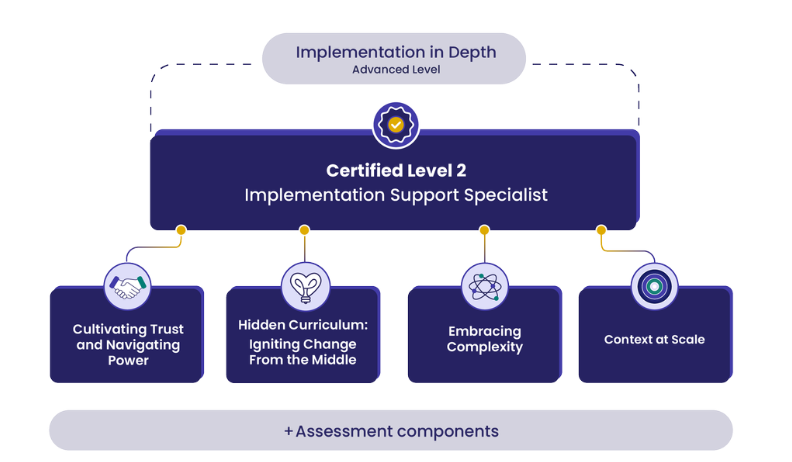
Applications for the Level 2 Implementation Support Specialist Certificate are now open! 🎉🎉🎉
Level 2 is designed for changemakers who are ready to take their #ImplementationSupport skills and career to the next level.
Learn more and apply!
https://t.co/ohKaneZ1Cg
This scoping review reveals that while power dynamics critically shape the implementation of evidence-based interventions, #ImpSci has yet to systematically define, measure, & intervene on power.
Read the full article:
https://t.co/5wZ9upPHe5
Equity is top of mind in the fields of #ImpSci.
People have been asking us how we suggest they go beyond performative acts that address equity, and what are concrete ways to weave equity into the fabric of what they do.
Read our thoughts on this:
https://t.co/0e0CeolJ9l
How could we massively boost productivity in health and care?
I recently co-authored "Productivity starts with people" in BMJ Leader which sets out some answers. I wrote it with @LauraJYearsley, Richard Wylde, Barbara Cramond, Jennifer Carroll and Karen Hampson, drawing on the Modern Productive Series.
We make a distinction that often gets blurred:
- Efficiency is how well resources are used to achieve a given result.
- Productivity is using available resources carefully to achieve the best outcomes for the people we serve.
High efficiency does not equal high productivity. We can design a highly efficient process, but if people are not engaged in the work, the results unlikely to follow.
Three quarters of a million NHS colleagues filled in the last NHS Staff Survey. What they said shows where the opportunity sits. 72% said they have frequent opportunities to show initiative. 70% felt able to make suggestions to improve their work. Only 54% said they were able to make improvement happen in their area. We call that 46% difference a systemic loss of productivity. It appears nowhere in national productivity data.
Appraisals tell a similar story. 86% of respondents had one in the past twelve months. 26% felt it helped them do their job better. Delivered at scale, generating a fraction of the value it could.
Potential actions for those of us who lead change:
1) Treat the improvement gap as a measure in its own right. In any team, the distance between "I have ideas" and "I can make change happen" shows how much capability is locked up. Closing that distance is productivity work.
2) Watch what we do under pressure. When performance is scrutinised, the instinct is to tighten control. Control erodes engagement, narrows the cognitive capacity people bring to problems and depletes the voluntary commitment that productivity gains depend on.
3) Treat engagement as an operational variable. The evidence associates rising people engagement with falling mortality, fewer errors, lower sickness absence and lower turnover. It belongs in the productivity conversation alongside beds, lists and rotas.
4) Make improvement a core part of everyone’s job. While improvement remains largely the property of specialists and programmes, the 46% stay where they are.
5) Make room for doing things differently. Much productivity effort in our sector goes into doing the same things faster. Innovation is where the larger gains sit. It comes from teams with the trust, time and permission.
6) Build routines for doing things differently. Start with the conversations teams already have, e.g.., asking each week: “what really matters this week?”, and “what can we stop, pause or simplify?”.
None of this is “soft”. Trust, psychological safety and connection between leaders and our teams are the conditions everything else rests on, built through daily leadership behaviour.
Productivity in health and care is a human possibility to be unlocked. Fully supported, connected people are literally unstoppable.
Graphic by @andreadgibbons (thank you).
Links to the article: https://t.co/mt3ewGu9bX or https://t.co/347qnlEc2g @HorizonsNHS