Scenario-based cloud security training built on Microsoft Defender for Cloud, Sentinel, Purview, and Copilot in Azure. SecureStack™ | Cognitive Interoperability
Security boundaries must be tested—not assumed.
See how SecureStack™ addresses prompt injection and Azure RBAC in healthcare AI.
Watch: https://t.co/nFLqXZM5ag
Jan 12, 2027 | Southlake, TX
Register: https://t.co/4mTxJV8PaM
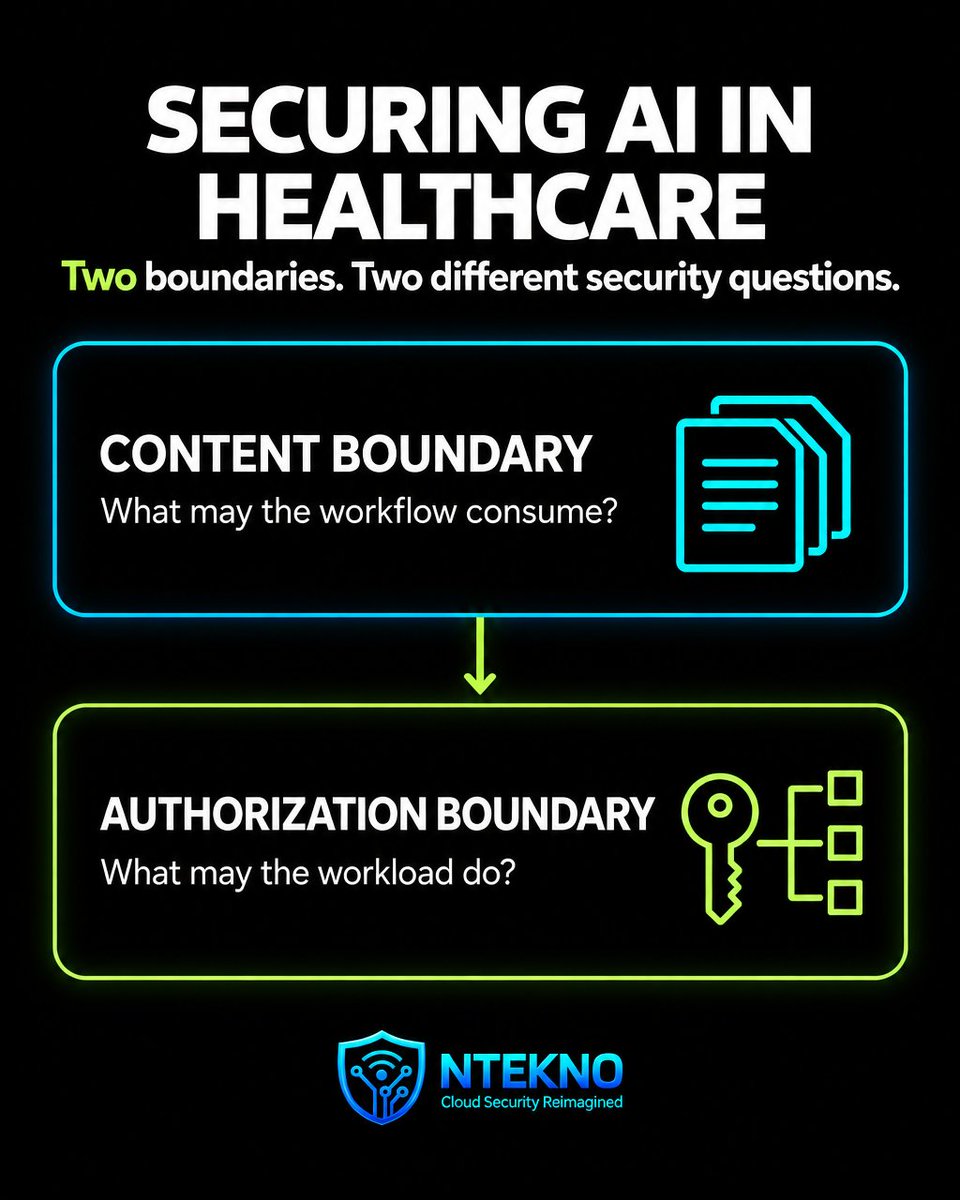
Securing AI in healthcare requires testing two boundaries: what content may the workflow consume, and what actions may the workload perform?
Jan. 12, 2027 | Southlake, TX
NTEKNO™ SecureStack™ ILT
https://t.co/eu5ZSJA4IM
#AISecurity#HealthcareCybersecurity#NTEKNO
Securing AI in healthcare requires testing two boundaries: what content may the workflow consume, and what actions may the workload perform?
Jan. 12, 2027 | Southlake, TX
NTEKNO™ SecureStack™ ILT
https://t.co/eu5ZSJA4IM
#AISecurity#HealthcareCybersecurity#NTEKNO
4/ That discipline is what NTEKNO calls Cognitive Interoperability™:
Human teams and AI-assisted systems reasoning through the same incident with accountable decisions at every step.
Prevention matters.
But readiness is proven under pressure.
https://t.co/ZmyAkvmE3S
#CloudSecurity #HealthcareSecurity #IncidentResponse #MicrosoftSecurity
2/ That is why SecureStack™ is built as scenario-based rehearsal, not feature-level instruction.
Code Red: PHI Exposure Simulation places teams inside a realistic Microsoft Azure cloud security scenario involving PHI exposure risk, cloud misconfiguration, identity risk, and compliance impact.
1/ Real-world cloud security incidents rarely stay inside one tool, one team, or one decision lane.
They move across detection, containment, investigation, data governance, compliance review, remediation, communications, and executive decision-making.
I built the AZ-500 training and labs at Microsoft.
Here’s what it teaches:
Tools.
Here’s what it doesn’t:
Coordination.
A breach doesn’t happen in one system.
It hits Defender for Cloud, Sentinel, Purview — all at once.
SOC sees signals.
Compliance sees risk.
Leadership sees impact.
No one is trained to respond together.
That’s the gap.
So I built a simulation.
SecureStack™: Code Red.
Not a course.
A rehearsal.
Run it:
https://t.co/ZlgwB4hzjr
🚨 This is not a tutorial.
It’s a rehearsal.
SecureStack™ simulates how real cloud breaches unfold across:
• Microsoft Defender for Cloud
• Microsoft Sentinel
• Microsoft Purview
• Security Copilot
• Copilot in Azure
AI-augmented.
Cross-role.
Operational.
This is how teams prepare before impact.
🔗 https://t.co/NAWhxowHhj
Most healthcare breaches don’t start with malware.
They start with:
• A misconfigured storage account
• An over-permissive identity
• An exposed API or app service
PHI doesn’t live in one place anymore—and attackers know it.
🚨 CODE RED: PHI doesn’t leak slowly.
In healthcare breaches, patient data is often exfiltrated across multiple cloud services in minutes—not because tools failed, but because teams weren’t trained to think together.
🧵 Thread ↓