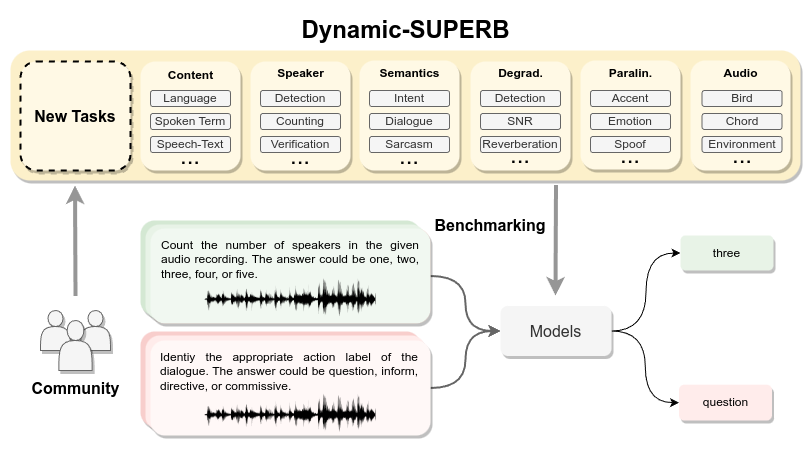
Join us for the Dynamic-SUPERB call-for-tasks event. Submit your innovative task to challenge the speech foundation models that can understand task instruction. Let's push the boundaries of what speech foundation models can do! https://t.co/mmpl9qsXFw
Join the Webinar Series for Advancements in Audio, Speech and Language Technology.
Next up: "End-to-End Automatic Speech Recognition" by Dr. Jinyu Li from Microsoft on May 10 @ 1:00 pm EDT (May 11 @ 1:00 am Taiwan time)
Register now: https://t.co/idlOYGbh8K
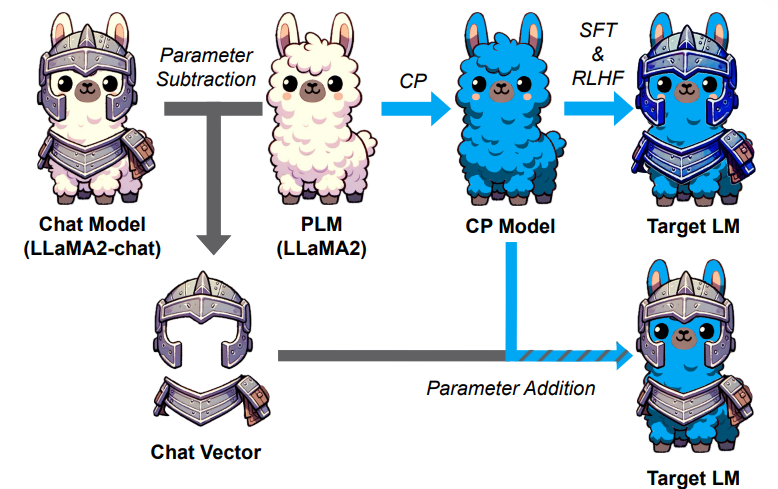
Fine-tuning the LLaMA-2-Chat model may degrade its original capabilities (https://t.co/4mWgCJnNaH). But here's a lifeline: Chat Vector (https://t.co/06ml6RK9wJ) keeps a chat model's original capability (it also works on Mistral). Recommend to everyone fine-tuning their LLMs.
Recent years have witnessed significant developments in audio codec models (an overview figure from https://t.co/JgkedsAv9k). We introduce Codec-SUPERB (https://t.co/suj2J834zu) to boost fair and comprehensive comparison. Leaderboard: https://t.co/oJYroegEnQ
Thrilled to see the team continuously enhancing the materials based on my online lectures! 🚀 Despite never having met them in person, their dedication truly impresses me. Check out the amazing work at https://t.co/SjqcTq4igh
📢New Paper Alert🎉
Excited to share our EACL'24 paper
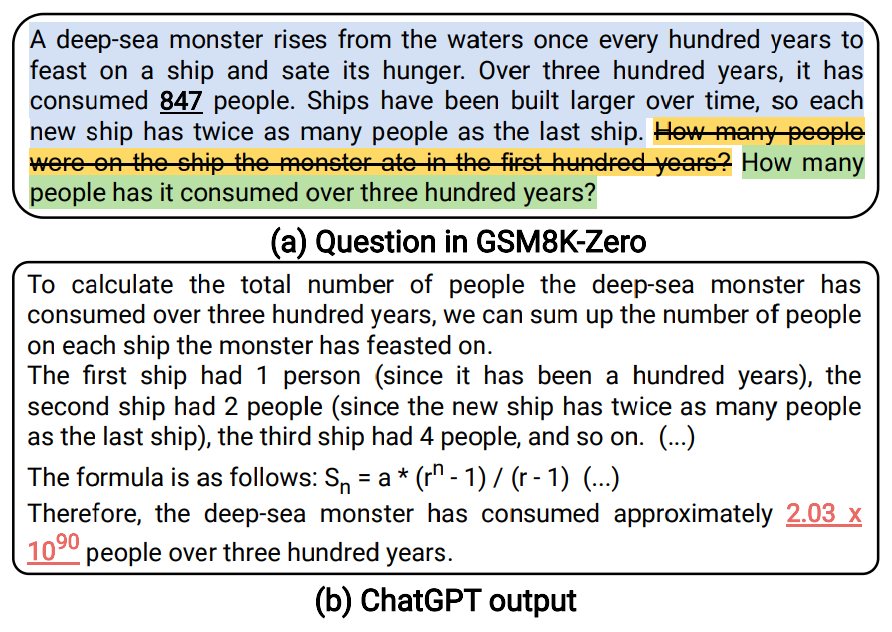
🤔 Do LLMs generate redundant reasonings?
📚 We create questions that can be answered w/o calculations
➡️ LLMs tend to answer with unnecessary reasonings and calculations
https://t.co/Bb3OsSvbVG
#eacl2024#NLProc#LLM
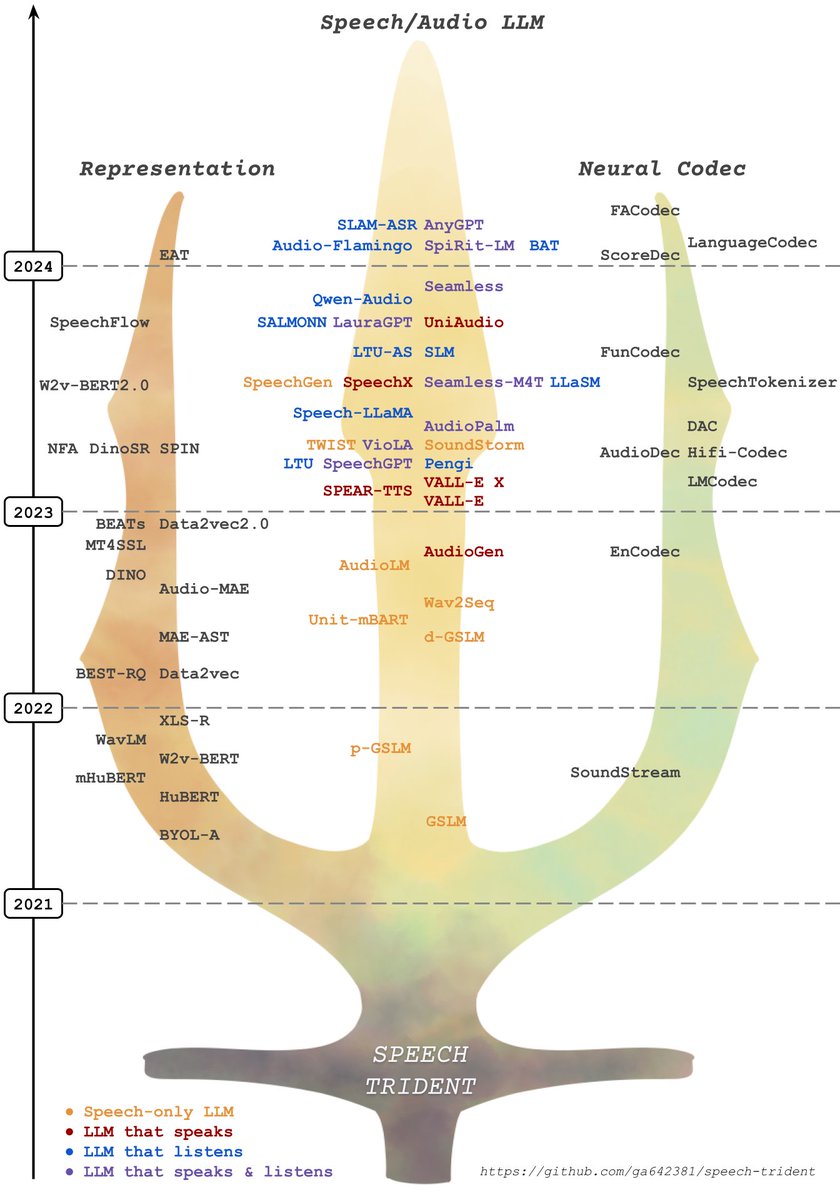
Excited to speak at #ASRU2023 tomorrow (December 20) at 11:30 AM (GMT+8) on "The Journey of Advancements in Speech Foundation Models"! We'll explore the evolution of speech foundation models. Below, please find the slides: https://t.co/HWbZdJhm9E
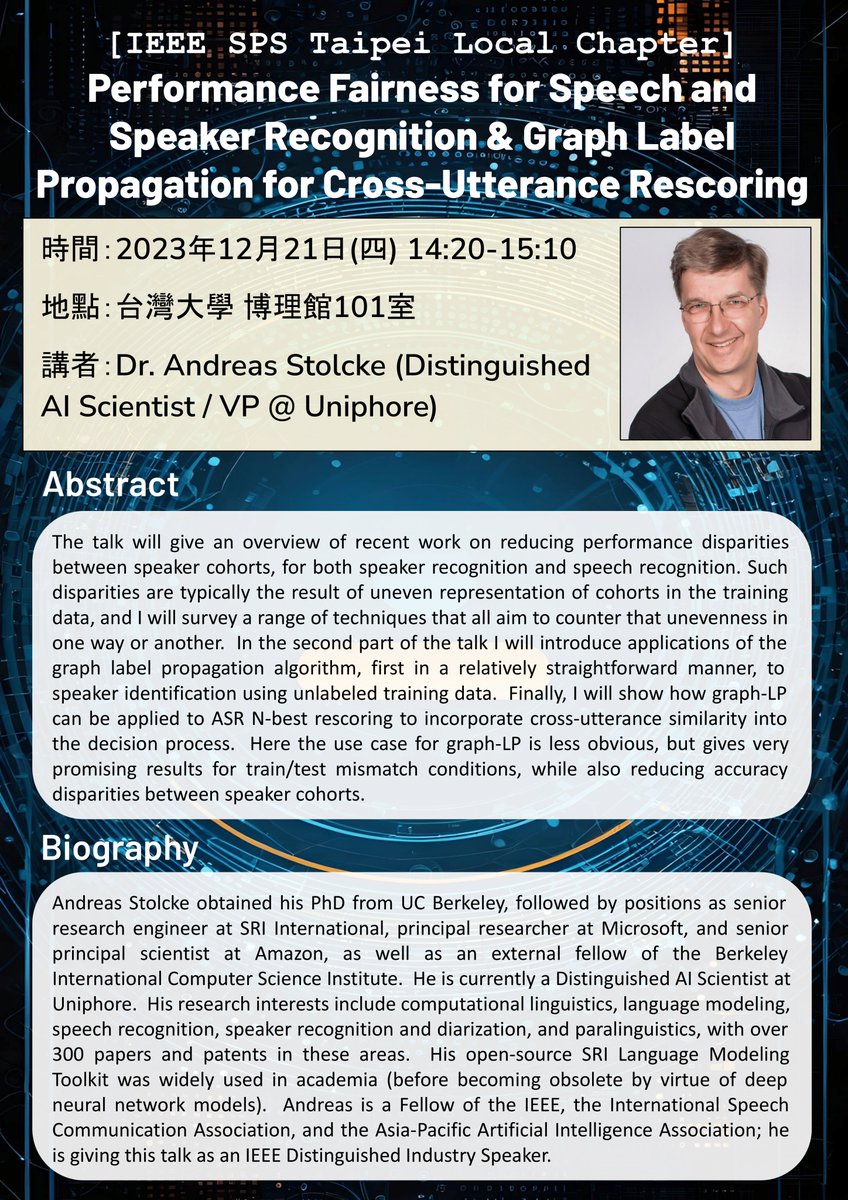
Join us for an enlightening afternoon with distinguished speech researchers, Dr. Andreas Stolcke and Prof. Torbjørn Svendsen. Their talks will take place at Barry Lam Hall (博理館) (https://t.co/TSAjdwpurt), R101 (Auditorium), NTU, on December 21st, starting at 2:20PM. #ASRU2023
🎉🌱In the early stages of my research journey, I'm humbly honored to receive the Google PhD Fellowship🏆
So much more to learn, discover, and explore in this exciting path🚀
🙏 Infinite thanks to my advisor, @HungyiLee2 , for his guiding light. This can't happen without him
🚀 Introducing the Prompt Benchmark Challenge (PBC) 🚀
Curious about which prompts maximize LLM performance?
Join us on the quest to uncover the ultimate prompts for Large Language Models!
Explore more at 👉 https://t.co/zaT9otFiFw
#PBC#LLM#Prompt
Join us for ASRU's satellite event - the Workshop on Speech Foundation Models & Performance Benchmarks (SPARKS), on Dec 16th, 2023, in Taiwan.
📌 Paper Submission: Oct 19th
🔗 Webpage: https://t.co/ctPGLbJprp
Tip: When registering for ASRU, tick the SPARKS option. #ASRU
📢 Registration for the SPARKS workshop at #ASRU2023 is now OPEN! Dive deep into speech foundation models and benchmarking. Get ready for discussions on next-gen speech tech! 🎙️
📄 Paper Submission: 10/19
🗓️ Workshop: 12/16
Details 👉 https://t.co/yjiJnQQcGL
If you're participating in ICML 2023, do not miss the workshop "What's Left to TEACH (Trustworthy, Enhanced, Adaptable, Capable, and Human-centric) Chatbots?" It's happening today in Room 303.
https://t.co/zwsnuNTChF
#ICML2023
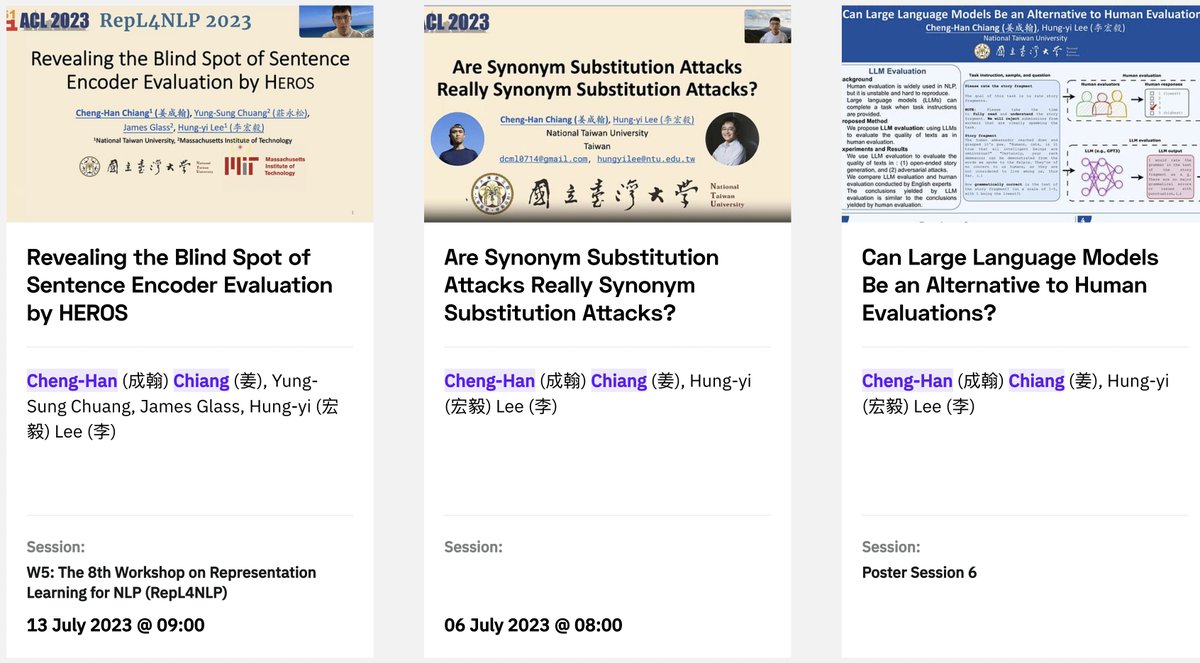
I will be at #ACL2023NLP next week ✈️ to share our three papers on diverse topics. Looking forward to meeting old friends and making some new friends. ✨ Stop by our poster if you want to chat! 😁
Attending #ICASSP2023 in Rhodes, Greece? Don't miss the workshop on "Self-supervision in Audio, Speech & Beyond". Dive deep into the advancements in self-supervised learning. Catch me delivering the workshop keynote @ Jupiter Ballroom, 8:40 a.m. GMT+3.
https://t.co/ptvxL0CItv
Code, Video & Poster: https://t.co/5h3DzSlm4R
Full paper: https://t.co/vq9CnXibql
If you find this topic interesting, come chat!
I'll present our paper tomorrow from 3:40 PM - 5:10 PM at the Audio and Text Segmentation, Tagging and Parsing (SLT-P9) poster session at #ICASSP2023
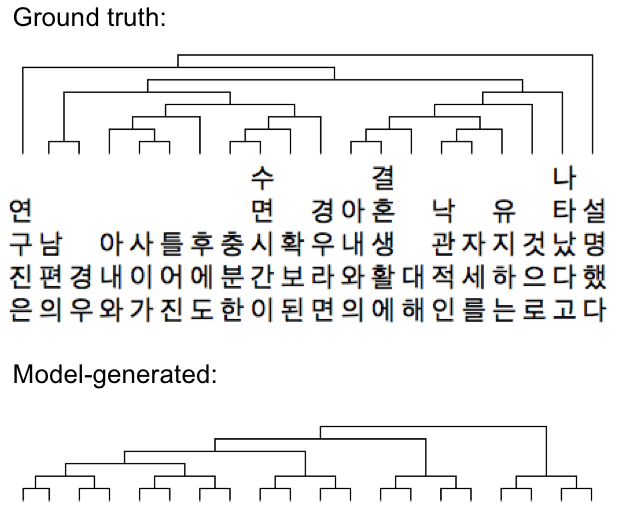
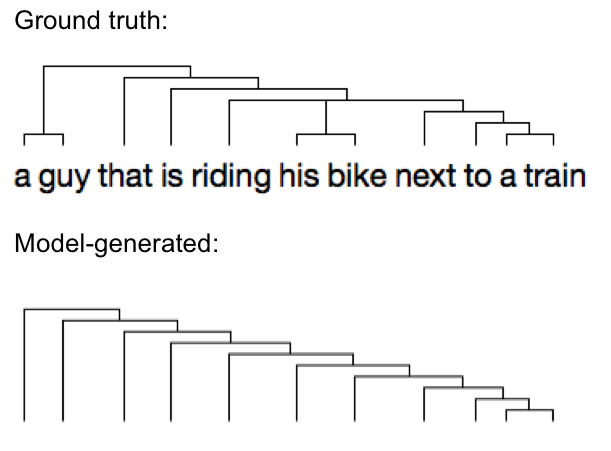
Another interesting discovery I wish to highlight is that Approach 2, when trained without any textual data, still shows signs of learning the different branching directions (a lang.-specific syntactic property) of English and Korean from speech directly.
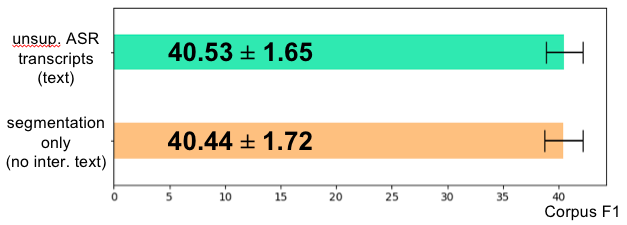
We compare them by using the segmentation determined by the unsupervised ASR model to obtain segment representations for Approach 2.
With this settings, both approaches show similar performance, suggesting that good segmentation alone is sufficient for parsing speech.