Nobody publishes the failures.
Every strategy you see posted worked.
The ones that didn't were quietly deleted. That's not evidence, it's a filter.
9 tested. 8 dead. NR-009 is live.
Every trade posted before the outcome.
Null hypothesis: there is no edge.
You can still become a crypto millionaire. But It helps to know the number you're actually signing up for.
From $1,000, a million is 1,000x.
From $10,000, it's 100x.
From $100,000, it's 10x.
Two ways to get a 100x.
One coin that goes 100x. It happens. The ones you hear about are the ones that did. The thousands that went to zero don't post.
Or compounding. $10,000 growing 26% a year becomes about $1 million in 20 years. At 15% a year, it takes 33.
The second route needs no luck. It needs time, and not touching it in the years it's down 50%.
The first route has a cost too. A 100x for the early buyer is paid by everyone who bought on the way up and held at the top.
Before you chase a million, divide it by what you have. The answer is the multiple you need. Then look at how many years you're giving it.
Your chart has a line on it. Weekly, falling highs, and price just closed above it. The post says alts can only go up from here.
I counted every breakout like that on 12 big altcoins since 2014. 233 of them.
206 traded back under the breakout price within 12 weeks.
99 dropped 20% or more below it.
Twelve weeks later, 51% were higher. Pick any week on the same coins: 48%.
So the line didn't decide much. A breakout week did about as well as a random week.
The line here is drawn the same way every time: through two falling weekly closes, nothing above it in between, breakout on the first weekly close above. Lines drawn by eye through the wicks will differ. Data: Coin Metrics, weekly closes, to May 2026.
After a weekly trendline breakout, don't put your stop just under the breakout close. That price got revisited within 12 weeks in 206 of 233 cases.
A stop at the breakout price would have been taken out in nearly 9 of 10 of these trades before the 12 weeks were up.
C-014
The biggest short on China's largest memory-chip maker just closed at a $10.98 million loss. Almost half of it was rent.
ChangXin Memory, or CXMT, makes the memory chips inside phones and servers. It's the fourth-largest DRAM maker in the world. The day before its Shanghai listing, one trader opened a short on an on-chain perpetual that tracks the stock, at $6.50. A short is a bet the price falls.
It didn't. Two months later he closed at $8.50, 31% above his entry.
The loss, split the way the trackers report it:
$5.8 million from the price moving against him.
$5.18 million in funding fees.
Funding is what one side of a perpetual pays the other to keep the price close to the real asset. When everyone wants to be long, shorts pay longs. Every few hours, for as long as you hold.
He wasn't using leverage. Trackers had him at 1x in July, about 2.6 million CXMT, roughly $20 million. At 1x a 31% move can't liquidate you. That's why he could hold for two months. It's also why he kept paying. $5.18 million on a position near $20 million is about a quarter of its size, gone in fees in two months.
So even if CXMT had come back to $6.50 on the last day, he'd still have been down around $5 million.
On a hot listing, shorts pay the longs they're betting against. Being early isn't free. It's billed.
Before you hold a short on anything crowded, check the funding rate and multiply it by the days you plan to wait. If that number is bigger than the move you expect, the trade loses even when you're right.
Bitcoin was $57,000 three months ago.
Now it's back over $84,000. That's +48% in a quarter.
Today it touched $87,203 and got pushed back to $84,600. On September 21 it peaked at $87,200. Same level, two tries, two rejections.
So the next number that matters isn't a 2027 target. It's $87,200.
A daily close above it is a new 8-month high. Rejected a third time, and that level becomes the ceiling people start selling into.
For scale: $150,000 from here is another +77%. Possible. It would need the next year to look like the last three months, roughly twice.
When a level has rejected price twice, wait for a daily close above it before you treat a breakout as real. A wick through it is a test.
Andrew Tate turned $550,000 of HYPE into a $7.24 million profit. Most of that profit is still sitting in his wallet.
Today the wallet Lookonchain ties to Tate sent 20,950 HYPE to Binance, about $1.87 million. Two years ago it bought 122,827 HYPE at $4.48. HYPE is the token of Hyperliquid, a crypto trading exchange. It trades near $89 now, about 20 times his entry.
The headline adds three things together that aren't the same kind of money.
63,550 HYPE are still in the wallet, worth $5.62 million. That part is a price on a screen. It turns into profit only when it's sold, and it moves every day.
20,950 HYPE just went to Binance. Sending coins to an exchange often comes before a sale, and nothing so far confirms one. It could also be collateral or a transfer.
The remaining 38,322 HYPE from the original buy left the wallet earlier and aren't in today's summary. Earlier sales would explain them. Those are the only part close to banked.
The figure also covers his spot HYPE, coins he owns outright. It says nothing about any leveraged trading from the same address.
And the 1,317% belongs to a $4.48 entry. At $89, the same coin has to go up another 1,317% from here to repeat it. Buying because he made money buys his result, not his entry.
Before you react to a whale profit headline, split it into held and sold. Held is a price. Sold is profit. A deposit to an exchange is neither yet.
@Nebulabsxyz 84,549.6 sits 1.8% above $83,000 and 2.9% under $87,000, so closer to the bearish edge.
About 15 hours left on this 3D candle going by the countdown, and after that the next close is three days out.
@CryptoGerla 2.68M only counts wallets CryptoQuant has tagged as exchange.
Worth checking how much of the drop went into ETF custody, since coins there can sit outside that count and still get sold through redemptions.
@RoyalKane_X Another 43% down from 0.4228 to get to 0.24, and 69% off the 0.7760 high.
1.57M USDT of 24h turnover on that pair too, so anyone sizing into that zone moves the price themselves.
@TedPillows 3,447.44 over 2,800.47 is +23%, and 1,965.22 under 2,547.56 is -23%.
Same size move either way, so the weekly close outside that 2,547 to 2,800 box is what decides it.
@TehLamboXcharts ETH/BTC can reclaim 0.032 with ETH doing nothing, as long as BTC dips.
Worth checking which leg moved before reading a break as ETH strength.
@CryptoPatel About 65 quarterly candles on that whole chart since 2010.
Few enough to count every prior quarter that engulfed the one before it, and check what the next quarter did.
@MerlijnTrader -0.0001% per 8 hours is about -0.1% a year, so shorts are paying close to nothing.
On Binance anything under the default +0.01% already means perps are trading below the index.
@Washigorira $81.1K is just the midpoint of the 26-day high and low, which is why the Kijun runs flat on that chart.
It only moves when a new 26-day extreme prints or the old one rolls out of the window, so you can see a shift coming days ahead.
A wallet that sat still for over a year moved 30 million ENA to Binance today. $6.98M.
It held 187.55 million before the move. 157.55 million is still there. Sixteen percent out, eighty-four percent untouched.
The deposit went through BitGo, an institutional custodian. Nobody knows who owns the wallet, what they paid for the coins, or whether this is vesting, an airdrop or a purchase.
An exchange deposit is a possible sale. No sale has been reported.
ENA trades around $0.233. That's 85% below the April 2024 high of $1.52 and 25% above the October 2025 low of $0.1858.
CHECK: before you read a whale deposit as selling, find what the wallet still holds. Sixteen percent out is a trim. The number that's left tells you whether anyone actually left.
NEAR Intents lost $3.8 million today. NEAR says the bug was fixed within an hour and every affected user will be paid back in full.
Who pays isn't in the announcement.
NEAR Intents connects trading and payments across blockchains. Today an attacker used a bug where NEAR's Omni deposit and withdrawal system met the Intents contract. NEAR says it was limited to USDT on BNB Chain. An AI monitoring layer called SHIELD flagged unusual activity and Intents was paused. It's back online, except on a few affected chains. The NEAR blockchain and the NEAR token weren't affected.
$3.8M against the $4 billion a month Intents says it handles is about 0.1% of one month's volume. Small next to the flow. Large for the people whose USDT it was.
Full compensation is the right promise. It still needs two answers before it counts: who pays, and by when. The statement gives neither. Compare Bitget last week: a named protection fund of over $464 million, covering the full loss, and a dated reopening schedule per asset. Same promise, one with its numbers attached.
The longer fix is formal verification, which mathematically checks a contract against a class of bugs before release. NEAR says it's building it and will add it to its release process. It wasn't in place today.
After any exploit, look for the payer and the date in the compensation line. A named fund and a deadline is a commitment. "In full" with neither is an intention.
Earlier today NEAR Intents services were stopped after a security incident was detected. The incident was caused by a bug in the Omni deposit and withdrawal infrastructure interaction with NEAR Intents smart contract.
The preliminary report indicates the total loss of approximately $3.8M. These funds will be compensated in full.
The contract-side vulnerability has been patched. The operations of the NEAR Intents and near(.)com are expected to resume within 1h.
Deposits and withdrawals on the following networks will remain unavailable for an additional ~12 hours while fixes to the Omni infrastructure are completed: BSC, Polygon, TON, Optimism, Avalanche, Stellar, Monad, LayerX, Adi, Scroll and Plasma.
In case users hold any assets from these chains inside NEAR Intents (for example, in HOT wallet or on near(.)com), they will be able to swap them into other assets once NEAR Intents is back up (in ~1h).
The incident has been reported to law enforcement, and we are working with security and blockchain analytics partners to trace the funds and pursue recovery. A detailed report will be shared publicly in the following days.
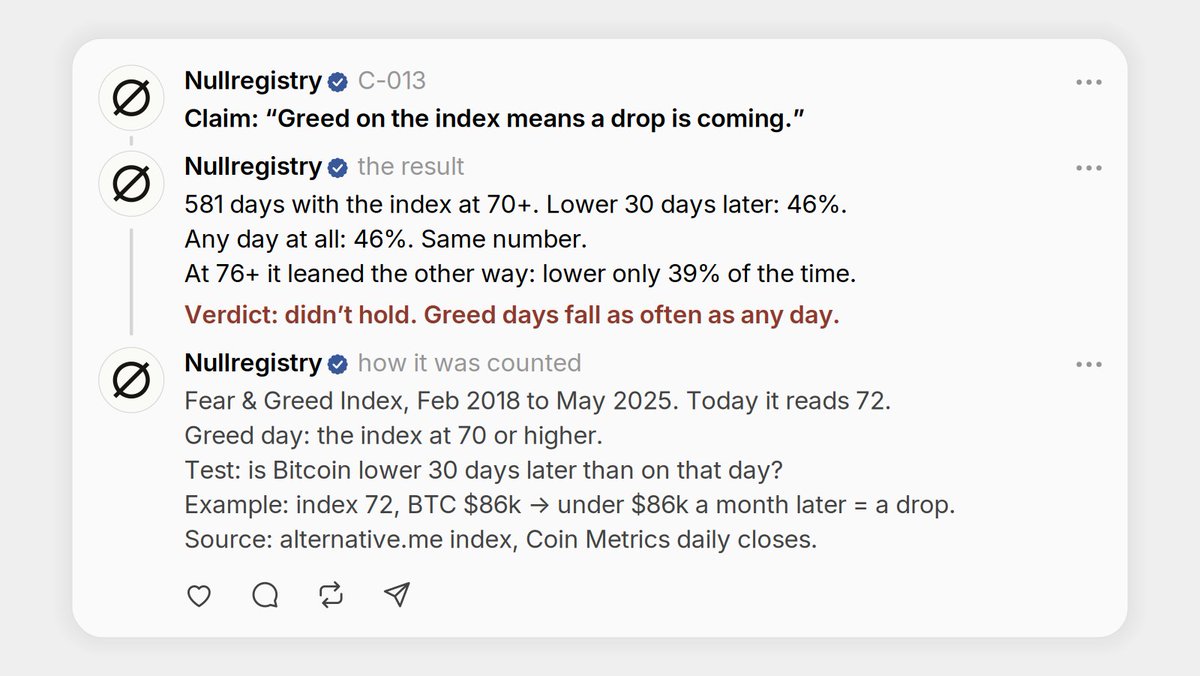
The Fear & Greed Index reads 72 today. Greed.
The saying goes: be fearful when others are greedy. I checked whether Bitcoin agrees.
Since February 2018 the index sat at 70 or higher on 581 days.
A month later, Bitcoin was lower on 46% of them.
On any day at all, it was lower a month later 46% of the time.
Same number. Greed told you nothing.
At the top of the scale, 76 and up, it went the other way. Lower a month later only 39% of the time.
The other half of the saying doesn't work either. On fear days, 30 and under, Bitcoin was higher a month later 54% of the time. Any day: 54%.
The 581 days come in streaks. Counting only the first day of each greed run gives 52 runs, and 17 were lower a month later.
Index from https://t.co/8aXlp1zCor, via a public copy that runs to May 2025. Prices: Coin Metrics daily closes.
Below 76, the index says nothing about the next month. Above 76 it leaned up, not down.
Selling every reading of 76 or more meant selling before a higher price 61 times out of 100.
What does the index read when you usually sell? One number.
C-013
@cryptogoos Same chart, reserves falling the whole way down while price roughly halved from the late-2025 high.
Perps let you sell BTC without a coin ever touching an exchange wallet.
@joao_wedson@Alphractal A flat CAPE with the S&P near records means the 10-year earnings average is rising underneath, as 2026 earnings roll in and 2016 rolls out.
The Dec 1999 peak was 44.2, so 41 sits about 7% below it.
@TedPillows Price times every ounce ever mined, about 7 billion oz for gold on the World Gold Council's estimate.
So each $1 on gold is roughly $7B of "market cap", and none of it needs an ounce to change hands.
@astronomer_zero 85,126.9 against the 86.9k entry is 1,773 points, so 3.5R puts the stop around 87.4k.
Half off here banks 1.75R, and moving the stop to 86.9k makes the rest a free trade.