An editor searches a received image in Verify Engine and gets a plausible result.
Before the interface says anything like “verified,” it should explain what kind of result was actually returned.
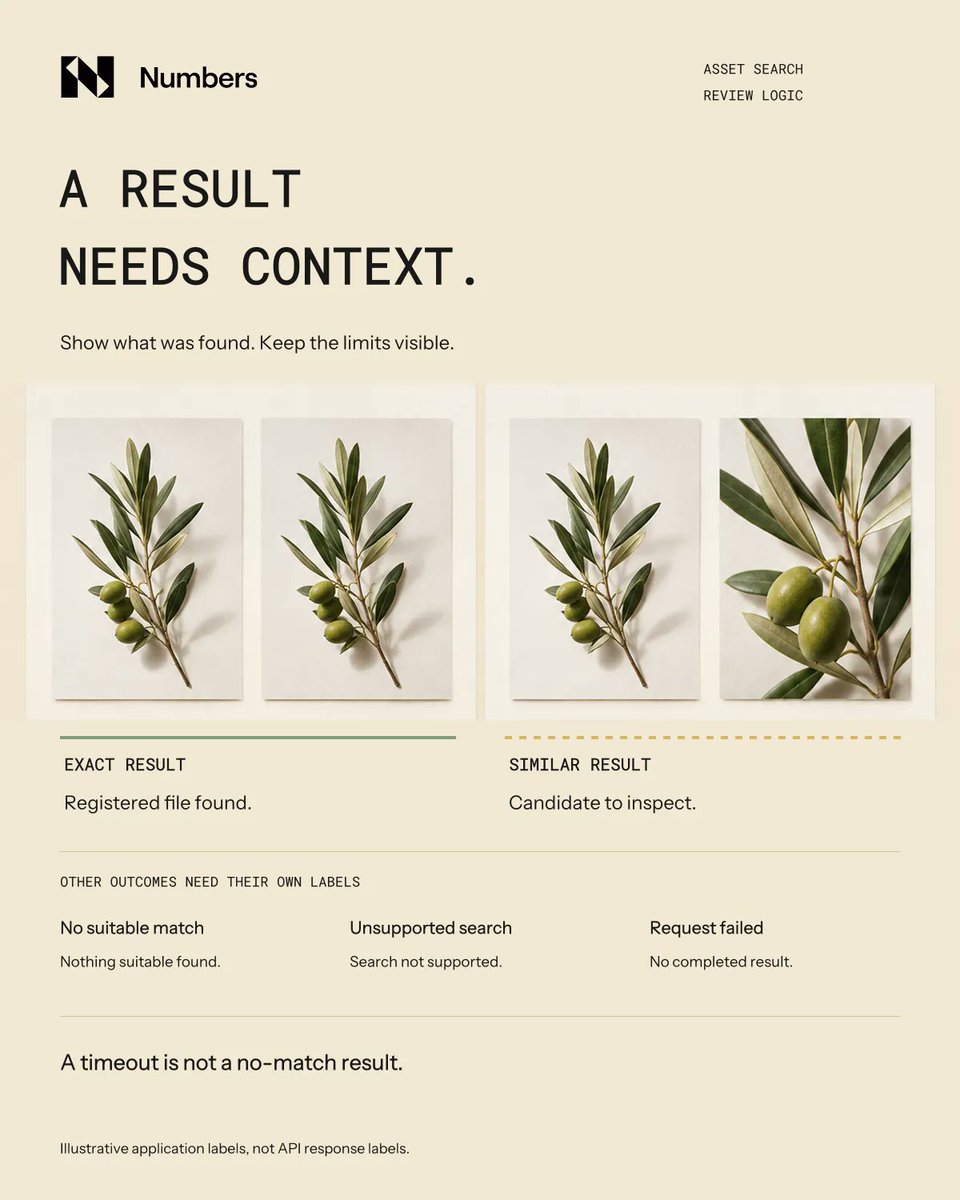
Asset Search separates exact results from visually similar candidates. Those should stay distinct in the product experience.
An exact result identifies the registered asset. A similar result can help investigate a modified copy, but it does not mean the two files are identical.
The same clarity matters when nothing useful comes back. “No suitable match,” “unsupported search,” and “request failed” are different outcomes. A timeout should never quietly become “no match.”
This is application logic around the API response, not a claim that Verify Engine already returns those user-facing labels.
Good verification UX does not just show a result.
It tells the reviewer what kind of result it is, how strong it is, and what cannot be concluded from it.
Docs: https://t.co/W3I5sxaTAm
A bigger NUM burn is coming in Q4.
We're combining the Q3 and Q4 burns, with plans to burn at least 12,000,000 NUM in total.
Our quarterly minimum is 6,000,000 NUM. By bringing both quarters together, the combined burn will be twice that minimum, covering the full amount for Q3 and Q4.
12 million NUM is the minimum.
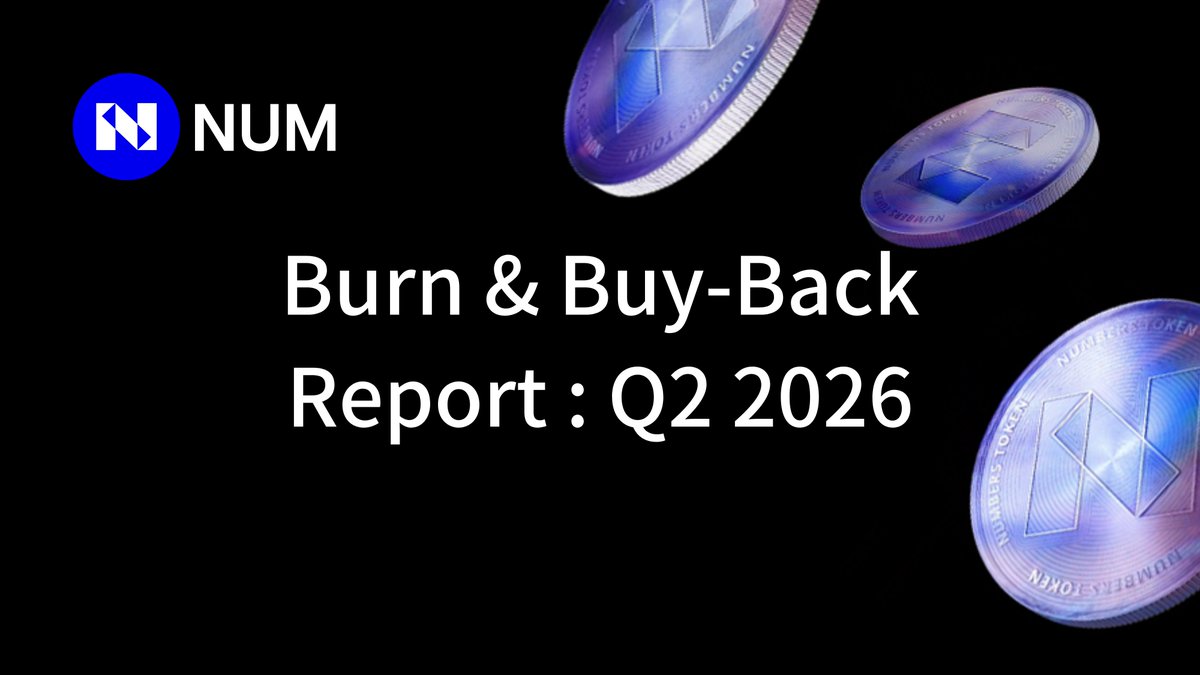
The Q2 NUM burn is done.
6,000,000 NUM were burned in quarter 2. That’s around $15,000 in notional value removed from supply.
But aside from that, one thing you need to note of:
In Q1, there were 247,000+ transaction
In Q2, we reached 523,431+ transaction
The network doubled in size. More receipts are being printed, shared, and utilized.
https://t.co/BrJqbG5pje
The search request succeeds. The editor sees a green check and assumes the image has been verified.
But those are two different things.
A successful request only means Verify Engine returned a response. The response still needs to be interpreted: exact registered asset, visually similar candidates, no suitable result, unsupported case, or request failure.
The interface should show the evidence result, not just the network status.
Otherwise, every completed lookup risks looking like a positive verification.
"Request completed" and "asset verified" should never share the same label.
The agentic web needs more than machine-readable payments.
Agents need to access content, pay for it, and then know where that content came from and whether it changed along the way.
x402-style payments can help with access.
Provenance makes what comes through that access inspectable.
To publish something on a paywalled site is to make it invisible. If AIs can't find it, then for all practical purposes it doesn't exist.
These two sentences aren't 100% true yet, but they will only get truer.
The producer knows which original went into the design. The publisher knows which copy reached the page.
Neither side holds the whole handoff on its own.
The source reference connects the producer's registered asset with the recipient's investigation. File access lets the recipient compare the candidate. Delivery context explains which changes were intentional.
If a similar search returns no suitable candidate, the source reference still gives the two teams a concrete place to continue. If the original is inaccessible, the identifier alone does not finish the job.
Bring the source reference into the delivery conversation before the folder is archived.
Provenance works better when finding the source is part of the workflow, rather than someone's memory.
A source NID can still exist six months later while the original file is no longer available to download.
Registration gives the asset a persistent reference and history. It does not, by itself, promise that the underlying file will remain hosted forever. Numbers' registration docs note that the default IPFS pin is available for one month; longer availability requires an ongoing Capture plan or pay-as-you-go storage.
So a good handoff needs both: the source NID and a maintained path to the original file.
The NID tells you exactly which source you are talking about. Storage makes sure there is still something to inspect when that source needs to be compared later.
"Registered" and "available forever" are different promises.
An editor downloads a JPEG from a publication page. The embedded provenance is gone.
That does not always mean the trail is gone too.
Verify Engine can search the image itself against registered assets. For supported PNG and JPEG files, Asset Search separates exact matches from visually similar candidates, so the reviewer can tell whether the received copy is the registered asset or whether it may be connected to one that has changed along the way.
That distinction matters.
An exact result points to the registered file. A visual match gives you a source candidate to inspect, not proof that the two files are identical.
And no exact match does not automatically mean the source was never registered. The copy may have been cropped, recompressed, or otherwise changed before it reached you.
Recovery also depends on coverage. If the intended source was never registered, there may be nothing for Verify Engine to find.
The useful principle is simple: let the result say exactly what was found.
Search can help reconnect a changed copy to a known source. It should not turn a plausible relationship into certainty.
Try Asset Search:
https://t.co/W3I5sxaTAm
A publisher uploads an agency image and the embedded metadata disappears along the way. Later, an editor has only the published copy and wants to know where it came from.
Verify Engine can search that file for registered source candidates. But search has one basic dependency: the source has to have been registered in the first place.
If the original was never registered, the editor cannot recreate that missing history by searching harder.
Asking the agency for the original and registering it afterwards is still useful, but it is a new source record. It is not proof that the published copy was already connected to that record.
This is why receiving-side verification actually starts upstream.
The sender creates the reference point. The receiver can only recover what was made available to recover.
Receiver-side recovery starts with a decision made by the sender.
An editor downloads a JPEG from a publication page. The embedded provenance is gone.
That does not always mean the trail is gone too.
Verify Engine can search the image itself against registered assets. For supported PNG and JPEG files, Asset Search separates exact matches from visually similar candidates, so the reviewer can tell whether the received copy is the registered asset or whether it may be connected to one that has changed along the way.
That distinction matters.
An exact result points to the registered file. A visual match gives you a source candidate to inspect, not proof that the two files are identical.
And no exact match does not automatically mean the source was never registered. The copy may have been cropped, recompressed, or otherwise changed before it reached you.
Recovery also depends on coverage. If the intended source was never registered, there may be nothing for Verify Engine to find.
The useful principle is simple: let the result say exactly what was found.
Search can help reconnect a changed copy to a known source. It should not turn a plausible relationship into certainty.
Try Asset Search:
https://t.co/W3I5sxaTAm
Visual similarity is a lead, not proof. Verify Engine distinguishes exact matches from similar candidates. Numbers and LETSBURN explore provenance for activity rewards.
Read: https://t.co/rTg86WSOK7
What must a handoff carry?
An editor downloads a JPEG from a publication page. The embedded provenance is gone.
That does not always mean the trail is gone too.
Verify Engine can search the image itself against registered assets. For supported PNG and JPEG files, Asset Search separates exact matches from visually similar candidates, so the reviewer can tell whether the received copy is the registered asset or whether it may be connected to one that has changed along the way.
That distinction matters.
An exact result points to the registered file. A visual match gives you a source candidate to inspect, not proof that the two files are identical.
And no exact match does not automatically mean the source was never registered. The copy may have been cropped, recompressed, or otherwise changed before it reached you.
Recovery also depends on coverage. If the intended source was never registered, there may be nothing for Verify Engine to find.
The useful principle is simple: let the result say exactly what was found.
Search can help reconnect a changed copy to a known source. It should not turn a plausible relationship into certainty.
Try Asset Search:
https://t.co/W3I5sxaTAm
Numbers Protocol is partnering with @letsburnlab to explore how provenance can bring greater transparency to activity-driven digital economies.
LETSBURN turns movement tracked through connected fitness apps into verified activity, competition, XP, and on-chain rewards. Numbers Protocol builds infrastructure to record and verify the origin and history of digital assets.
Together, we'll explore how verifiable records can help people trace how real-world activity becomes a digital contribution.
Move, compete, and build with confidence. More details to follow.
Two copies can look identical and still tell different provenance stories.
One may be the registered source. Another may have been cropped, re-exported, or recompressed somewhere along the way.
That is why the source NID matters. It gives you a fixed point to compare against instead of relying on appearance alone.
Start with the NID, then check the file that actually arrived. An exact match confirms the registered asset. Visual search can help reconnect a changed copy to a likely source.
The image may look the same.
The provenance question is whether it still points back to the same source.
Filenames could change. But the source NID should not.
A designer renames the original. An editor exports a crop. The client downloads it as final-final.jpg.
Numbers ID (NID) gives the registered source a persistent reference. Keep that NID with the delivery, and the receiver has a clear path back to the source record and its history in Asset Profile.
That does not mean every later crop, resize, or export inherits the source NID. A modified file may be a different asset with a different identity, even when it looks almost identical.
The important part is keeping the distinction clear: this is the copy we delivered, and this is the NID of the source it came from.
If visual search later becomes inconclusive, that source reference still gives the reviewer something known to inspect.
NID is the anchor. The handoff explains how the delivered copy relates to it.
Inspect an Asset Profile:
https://t.co/xiVd3wyO1C
A file should not need a meeting to explain itself.
When creative work is handed off, the next person should be able to tell where it came from, which version they received, what could be verified, and what they can do with it next.
Registration gives the source a persistent reference. Verify Engine helps inspect the copy that actually arrived.
A good handoff transfers more than the asset.
It transfers enough context for the next person to keep going.
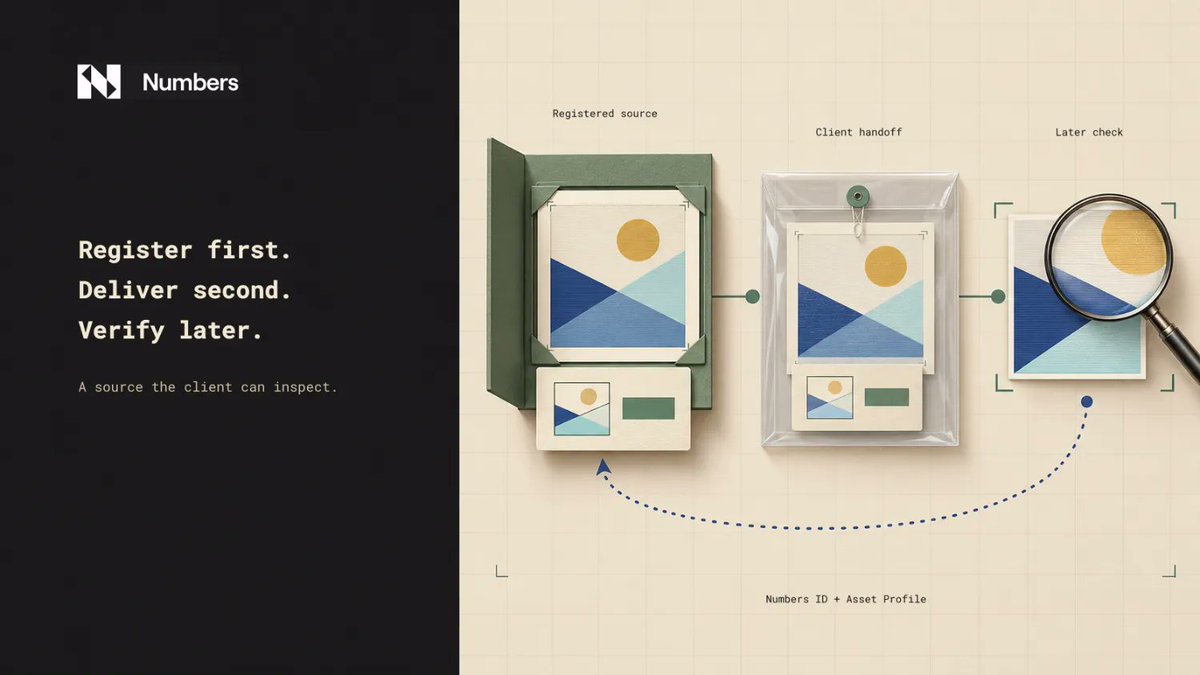
An agency delivers an image to a client. The best time to register its provenance is before that handoff happens.
Otherwise, the client's first verification attempt starts with a file and a promise.
Registering the source first gives the asset a Numbers ID and an inspectable Asset Profile. That reference can travel with the delivery, so the client has somewhere to check the source instead of reconstructing its history from old messages and attachments.
This becomes even more useful once the file starts changing.
A cropped, resized, or recompressed copy may no longer produce an exact match. But if the original source was registered, visual search can still help identify a related asset and give the reviewer something known to compare against.
Registration does not automatically record every later edit, and it does not grant permission to reuse the asset.
What it does is establish a source that can still be inspected after the handoff.
Register first. Deliver second. Verify later.
Build the handoff around a registered source:
https://t.co/vChWs96omC
This is also where verification needs to know when to stop.
A publisher may find a visually similar registered source, but if the supplier cannot confirm that it is the original used for the campaign, the relationship is still unresolved.
The right answer is not to upgrade “similar” into “verified” because the deadline is close.
Keep the received copy, the candidate source, and the uncertainty together. Then ask for the registered original or a replacement with a clear source reference.
A deadline can shorten the review.
It should not change what the evidence actually says.
The file a publisher receives is the file that should be verified.
Say an agency sends over a compressed campaign image. The source link may tell you what they intended to deliver, but it does not tell you whether the file in front of you is still that exact asset.
This is where Verify Engine becomes useful.
Asset Search can take the delivered file or file URL and search Numbers-registered assets for both exact and visually similar results. An exact match points to the registered asset itself. A similar result gives you a candidate source to investigate, along with a similarity distance.
Those results should not be treated the same.
Exact means the registered file was found. Similar means there may be a relationship worth inspecting. It does not mean the files are identical.
From there, the reviewer can open the candidate's Asset Profile to inspect its Numbers ID, creator and registration details, and any recorded history or license information.
And if no useful source appears, that is useful information too. Ask for the registered original instead of turning a weak signal into certainty.
Verify Engine gives the receiving side a way to check the copy that actually arrived, not just trust the story that travelled with it.
Explore Asset Search:
https://t.co/W3I5sxaTAm
Registering the source before delivery solves one side of the problem.
The other side is checking what actually arrived.
A supplier can send the correct source reference while the delivered banner is a different crop, with a credit removed, a caption changed, or part of the image left out.
Visual similarity can help connect that copy back to the source. It cannot tell you whether those editorial changes were appropriate.
So check both: where the asset came from, and what the delivered version became.
A correct source does not automatically make every later copy correct.
An agency delivers an image to a client. The best time to register its provenance is before that handoff happens.
Otherwise, the client's first verification attempt starts with a file and a promise.
Registering the source first gives the asset a Numbers ID and an inspectable Asset Profile. That reference can travel with the delivery, so the client has somewhere to check the source instead of reconstructing its history from old messages and attachments.
This becomes even more useful once the file starts changing.
A cropped, resized, or recompressed copy may no longer produce an exact match. But if the original source was registered, visual search can still help identify a related asset and give the reviewer something known to compare against.
Registration does not automatically record every later edit, and it does not grant permission to reuse the asset.
What it does is establish a source that can still be inspected after the handoff.
Register first. Deliver second. Verify later.
Build the handoff around a registered source:
https://t.co/vChWs96omC
Source references should travel with the file. Numbers Protocol explored handoffs through Verify Engine and ValueQube's digital financial exposure records. What should the next team check?
Letter:
https://t.co/mi39S7uiIF
The file a publisher receives is the file that should be verified.
Say an agency sends over a compressed campaign image. The source link may tell you what they intended to deliver, but it does not tell you whether the file in front of you is still that exact asset.
This is where Verify Engine becomes useful.
Asset Search can take the delivered file or file URL and search Numbers-registered assets for both exact and visually similar results. An exact match points to the registered asset itself. A similar result gives you a candidate source to investigate, along with a similarity distance.
Those results should not be treated the same.
Exact means the registered file was found. Similar means there may be a relationship worth inspecting. It does not mean the files are identical.
From there, the reviewer can open the candidate's Asset Profile to inspect its Numbers ID, creator and registration details, and any recorded history or license information.
And if no useful source appears, that is useful information too. Ask for the registered original instead of turning a weak signal into certainty.
Verify Engine gives the receiving side a way to check the copy that actually arrived, not just trust the story that travelled with it.
Explore Asset Search:
https://t.co/W3I5sxaTAm
Numbers Protocol is partnering with @ValueQube_io to explore how provenance can support clearer, more traceable records for digital financial exposures.
ValueQube's qAsset Certificates are designed to record key details about an exposure, including when a position was confirmed, how its reference value is formed, which risk labels apply, and what rules govern fees, distributions, and exit.
Together, we'll explore how verifiable records can help people and systems follow the history behind these financial records.
A delivery link tells you where the file is. It does not tell you what the file came from.
That is why registration matters before handoff.
Put the Numbers ID beside the delivered file. The filename helps the client identify the copy they received. The Numbers ID gives them a way to inspect the registered source behind it.
The two should travel together.
And one important distinction: a Numbers ID does not mean the original file will stay hosted forever. It gives the source a persistent reference, not permanent file storage.
Give the recipient both: the file they received, and the source it connects back to.
An agency delivers an image to a client. The best time to register its provenance is before that handoff happens.
Otherwise, the client's first verification attempt starts with a file and a promise.
Registering the source first gives the asset a Numbers ID and an inspectable Asset Profile. That reference can travel with the delivery, so the client has somewhere to check the source instead of reconstructing its history from old messages and attachments.
This becomes even more useful once the file starts changing.
A cropped, resized, or recompressed copy may no longer produce an exact match. But if the original source was registered, visual search can still help identify a related asset and give the reviewer something known to compare against.
Registration does not automatically record every later edit, and it does not grant permission to reuse the asset.
What it does is establish a source that can still be inspected after the handoff.
Register first. Deliver second. Verify later.
Build the handoff around a registered source:
https://t.co/vChWs96omC