$LOCK is officially live.
BEniG17knD1WzwTCMByiS9D4FBs29px3nCse5TBipump
Our first lock vault will go live in the next 1–2 minutes and will automatically appear on the platform.
Creator rewards are claimed every 10 minutes, continuously adding SOL to the vault and increasing the rewards available for new locks.
We recommend starting with a small lock to get familiar with the flow.
As the ecosystem grows and more creator rewards accumulate, larger locks will naturally be able to receive more SOL.
Welcome to InstaLock. Let's make locking the new standard on Solana.
Day 1 is off to a great start.
We've invited our first group of users into a private testing group to help us test the network and upcoming features in a real-world environment.
We'll keep sharing updates as we improve the protocol and roll out new functionality.
Meanwhile, we're focused on finishing the official Nur API, with the goal of having it ready next week.
Stay tuned.
Why stake SOL on Nur Network?
Every transaction settled through Nur pays a $0.10 USDC protocol fee.
SOL stakers provide the gas infrastructure that powers those transactions, and earn a share of the USDC fees in return.
More users → More transactions → More rewards.
Infrastructure backed by usage, not just inflation.
One problem people don't talk about enough...
If you're actively trading on Solana, you're forced to keep a SOL balance ready at all times.
How many of you have held $2,000 worth of SOL, only to wake up $100+ down because SOL dumped?
"Just use USDC" isn't always the answer either. Most token launches and memecoins are SOL-native, and swapping from USDC often means going through a DEX aggregator, adding extra routing, extra fees, and more friction.
Nur fixes this.
Keep your capital in USDC, buy any SOL token directly, and let the network handle the SOL gas behind the scenes.
You're thinking like a user.
We're building for the next generation of applications.
Payments, AI agents, wallets, exchanges, launchpads, and enterprise software shouldn't have to educate users about gas tokens,or build their infrastructure around a highly volatile asset.
When you're processing millions or even billions of dollars in transaction volume, relying on users to maintain balances in a volatile token adds unnecessary operational friction and risk.
Applications should integrate one API, let users transact in USDC, and leave blockchain execution to the protocol.
That's the difference between a workaround and infrastructure.
We're not selling a concept.
Nur Network is already live.
The wallet works. The network works. Staking works. You can already send USDC on Solana without holding SOL.
Of course, there will be improvements, optimizations, and new features along the way. That's what building infrastructure looks like.
But the foundation is here, and it works.
As the network grows, SOL stakers will have the opportunity to earn passive income in USDC from the transaction activity flowing through Nur.
That's the future we're building.
Why is Nur Network a fix for Solana?
Because users shouldn't be forced to rely on a volatile asset just to use the network.
As SOL's price rises and falls, every user is required to keep holding it simply to pay transaction fees.
Nur changes that.
Hold USDC, transact on Solana, and let the network handle the SOL gas behind the scenes.
Remember when Arbitrum made Ethereum cheaper and easier to use?
Nur Network is solving a different problem for Solana.
Solana is one of the fastest and lowest-cost blockchains, but every user is still required to hold SOL just to interact with the network.
With Nur, users, AI agents, launchpads, wallets, and dApps can transact entirely in USDC, while the protocol handles SOL gas behind the scenes.
Same Solana. Better infrastructure.
Staking $SOL on Nur Network is fundamentally different from traditional SOL staking.
A transaction may only cost around $0.0005 to execute on Solana, while the protocol can collect $0.10 USDC in fees from the user.
That's up to 200× the underlying network cost flowing into the staking economy.
As transaction volume grows, stakers don't just secure the network, they participate directly in its revenue.
Want to see Nur Network in action?
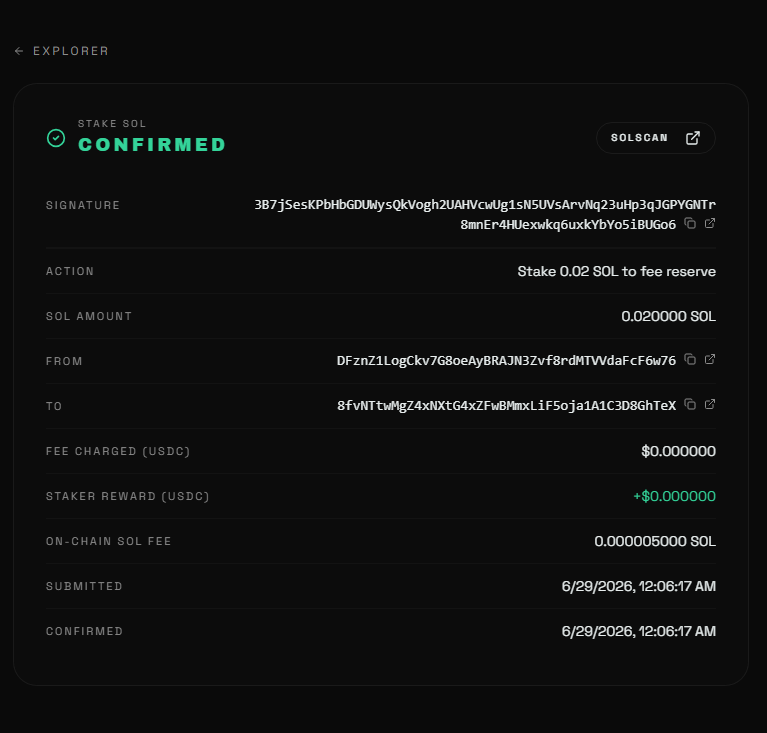
I've staked SOL to cover network execution.
Open Nur Wallet, send any amount of USDC to any Solana address, and watch it complete without ever holding SOL.
The backend isn't signing on behalf of the user or taking custody of private keys.
The additional signing flow exists because Nur wraps the user's action into a single protocol transaction. For example, if you send 100 USDC, Nur may charge 100.1 USDC. The extra 0.1 USDC is the protocol fee, which is distributed to SOL stakers that provide the network's gas infrastructure.
Behind the scenes, those stakers pay the required SOL transaction fee on Solana, so the end user never needs to hold SOL. Everything is coordinated and executed as a single transaction while the user's keys remain under their control.
This example shows the complete flow, including the protocol fee, staking rewards, and underlying Solana fee:
https://t.co/7h1GIHfYOg
Thanks for clarifying.
One follow-up, if keys are generated and encrypted fully locally and the backend never has signing ability, what exactly are the export-key and sign-bytes backend flows doing in the extension architecture? Just trying to reconcile that part with the self custodial model.
The upcoming Nur API gives developers a simple way to integrate Nur Network into wallets, AI agents, trading platforms, DEXs, and consumer apps, allowing users to transact on Solana without holding SOL.
Introducing the Nur Explorer.
Every transaction processed through Nur Network is indexed and displayed with protocol-specific details, including staking rewards, USDC fees, and underlying Solana execution.
https://t.co/4wH5rqkIz8
Nur Wallet is fully self-custodial, your private keys are generated and encrypted locally, and only you can access them.
Some backend/Supabase functions are used for services like relaying transactions, syncing non-sensitive data, and providing a smoother user experience. They never have access to users' private keys or the ability to sign transactions on their behalf.
The custom RPC handling (e.g. simulateTransaction and sendRawTransaction) is part of Nur's transaction layer, which enables users to pay network fees in USDC instead of holding SOL.
I took a quick look through the extension code because I wanted to understand how the wallet is set up, and it looks like things like wallet creation/import, key export, signing, and some transaction actions may be going through backend or Supabase functions. I also noticed some custom handling around RPC calls like simulateTransaction and sendRawTransaction. Just trying to understand the setup better before using it more seriously. Is this meant to be fully self custodial, or more of a backend assisted wallet model?
Nur Network is a blockchain layer on Solana where users never need to hold SOL to use the network. Transactions are paid in USDC, while SOL stakers handle execution behind the scenes.