🐝 To celebrate #WorldBeeDay 🐝, we invite you to follow our new Butterfly project here:
https://t.co/ne6Z2y17R2
and here:
https://t.co/AfnscC0Mfy
And here's a song for you! 🎶to bee or not to be🎵:
https://t.co/M0USMCqOic
#BeeDay2025#pollinator
🐝🌸 @NutriB2 (#BiodivHealth) finds that larger bees benefit from less intensive land use, while specialised feeders thrive in heterogeneous landscapes. Effective conservation requires detailed knowledge of pollinator resources👇
3/3 Importantly, wind-pollinated plants (trees+grasses) contribute greatly to a bee's biogeochemical niche, providing key nutrients. This highlights the importance of complex landscape conservation beyond traditional seed mixtures:
https://t.co/cmLcgwPwSV
2/2 Our current focus is on the bees’ roles as pollinators, but bees’ roles goes beyond pollination, and even a single species can make an important contribution to nutrient cycling by translocating much nutrients from flowers:
https://t.co/cmLcgwPwSV
1/2 In this preprint (under review), I use the example of a bee to show that pollinivores may be important vectors of nutrient movement in food webs, exceeding the amounts of nutrients translocated and partitioned in food webs by other herbivores:
https://t.co/cmLcgwPwSV
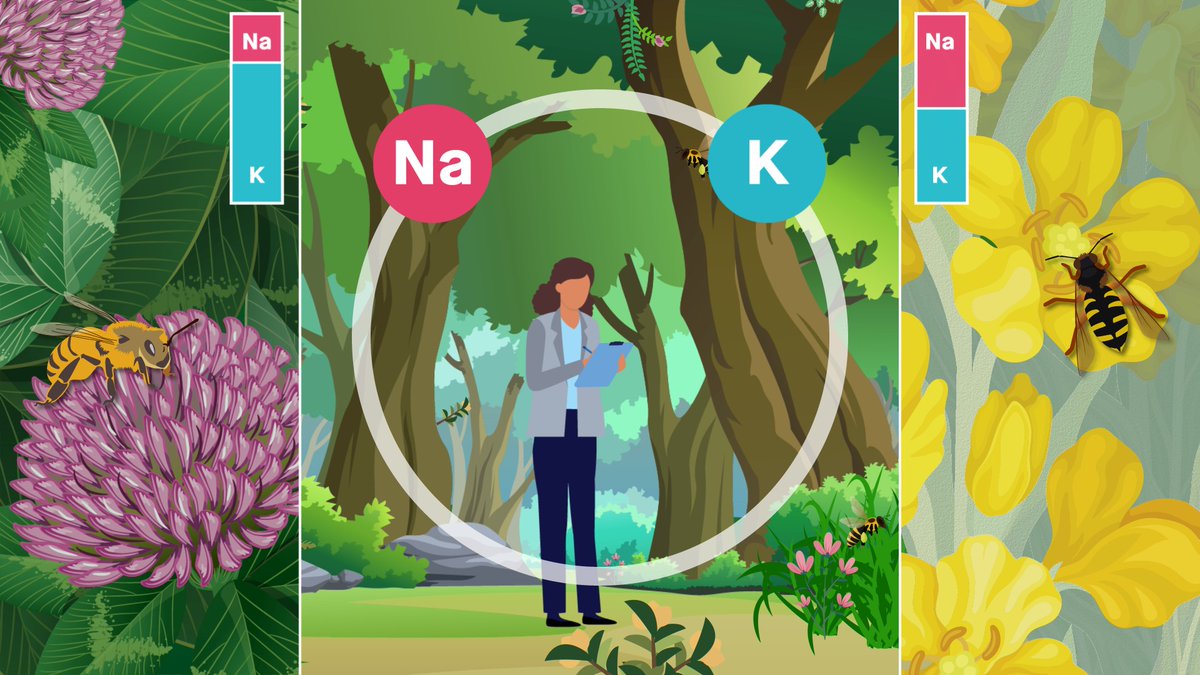
Studying the effects of the sodium/potassium ratio on bees can provide new insights into the dynamics that link bees, plants and their environment.
See 3-minute video:
https://t.co/JJVIBOMEsX
and the full story is here:
https://t.co/kHrG5VpIIn
@FilipiakZuza@JeffOllerton
Bees evolved from carnivorous ancestors. In the course of evolution, they had to adapt to a plant-based diet. Scientists investigate dietary problems of bees.
#bees@JagiellonskiUni@UniNorthants@PAN_akademia
https://t.co/3SJwG2AQrz
Why we believe that research across disciplines is crucial for understanding insect physiology, behavior and ecology is nicely illustrated in Fabian's latest publication in TREE: https://t.co/ppYPIeRVDK
Have you ever wondered about all the things that could be done wrong when analyzing fatty acids in pollen? Check out our new paper in Frontiers in Ecology and Evolution: https://t.co/qpMA9GBQUv
Did you know that land-use management can indirectly affect flower visitation by altering floral resource quality? Check out our new study led by @lrusso08 : https://t.co/3U9km8HVWz
New Research: A common protocol for reliable comparison of pollen fatty acid profiles: highlighting pitfalls and proposing a methodology for ecological research: Introduction
Pollen is an important tissue in plants that plays a vital role in… #Ecology https://t.co/PaSmRMpaGD
@FilipiakZuza@JeffOllerton Main benefits and challenges shaping the physiology, behaviour, life history and evolution of insects employing feeding strategies of carnivory (left panel), pollinivory (centre panel) and herbivory (right panel).
Source: https://t.co/kHrG5VpaSP
Bees evolved from carnivorous ancestors, with a notable distinction in their diet: a higher K:Na ratio in nectar/pollen vs animal tissues. K:Na impacts bee ecology and evolution, shaping bee interactions with plants & behavior.
@FilipiakZuza@JeffOllerton
https://t.co/kHrG5VpaSP
One of these studies where we expected one thing, and found the opposite: bumble bees cannot taste several phytosterols in pollen, despite their clear importance for bees: https://t.co/BNtoJGuMo6 First paper of Carmen and Marielle! Great job!
Let me introduce you to my first phD article 📝published in @conphysjournal discussing the nice potential of physiology in conservation challenges for wild bees. Hopping this would be beneficial for them 🐝
https://t.co/U0OYJI5Xyt
New paper📜 by 👩🔬 @Clm_Leroy et al @INRAE_France.
Physiological changes occur earlier than demographic changes, so physiological traits can help predict and forecast future population trends = a more proactive approach to wild bee conservation ❤️🐝:
https://t.co/gQi86Iowbo
Check this out! Really cool work and paper by PhD candidate Shao Xiong - first to set up camera traps to catch (i) assassin bugs (Reduviidae) hunting resin collecting stingless bees and (i) resin collecting wasps in a tropical lowland rainforest in SEA: https://t.co/mkF66tGfwO