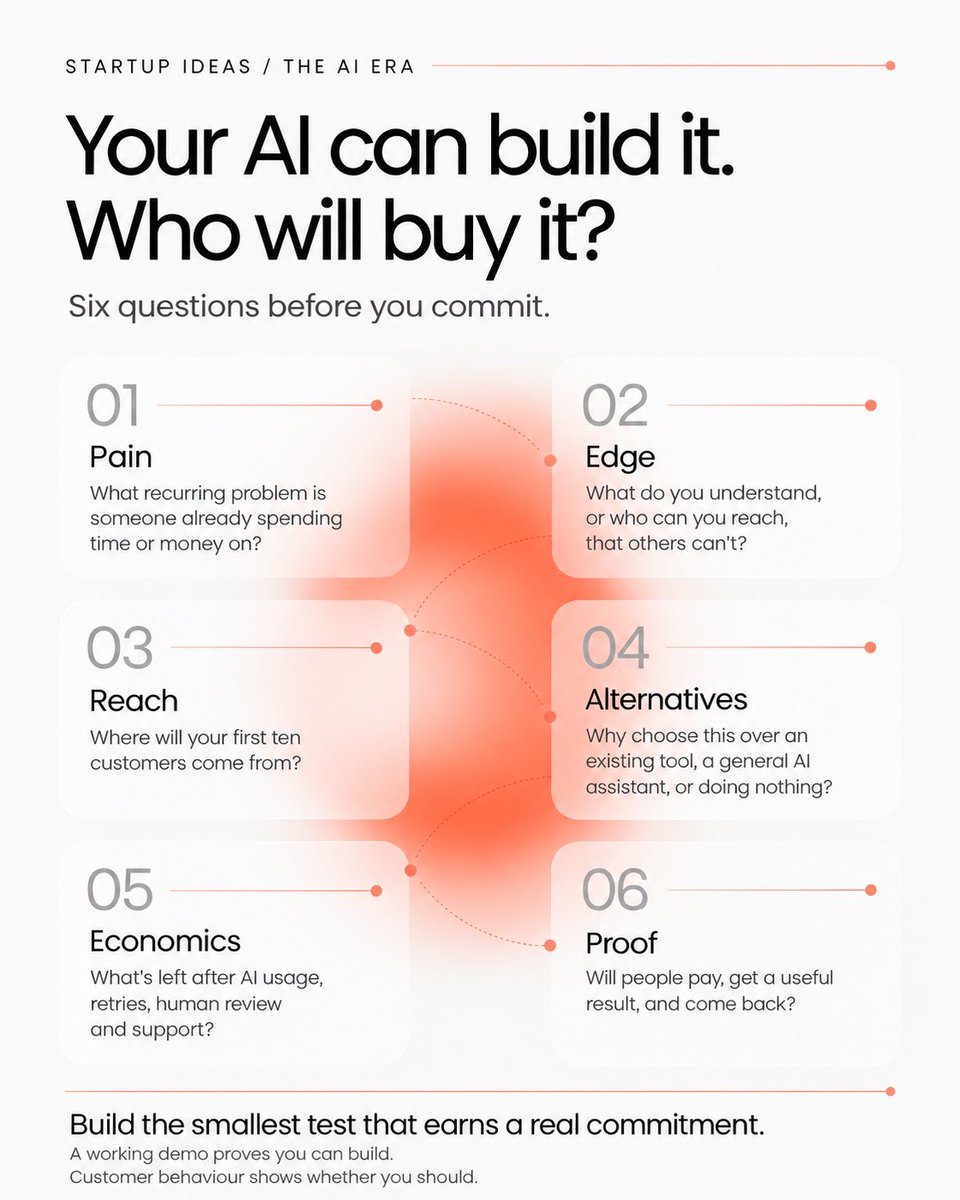
1/ AI can help you ship an app before you’ve figured out who needs it.
That makes choosing the wrong idea a very efficient activity.
Before opening the coding agent, here’s how I’d decide whether an idea deserves a weekend or the next year.
PSA to all of the Ascend and Elysium community.
I keep seeing a lot of posts about the friction Ascend created when we launched so I wanna speak on that myself. If I’d spent weeks getting a community off the ground and woke up to a copy of our coin trading on Ascend, I’d be pretty annoyed too. So I do see where a lot of your guys frustration comes in. Stay with me here.
Ascend is a fully permissionless launchpad. Anyone can go on the site and launch whatever they want without talking to me or anyone on the team. We never set out to vamp another project or pull people away from a community they’d already built.
One of the coolest parts of this past week has been seeing people rally around Blob, e/acc, chameleon. Some not launched on Ascend, and I’m still hyped to see it. Elysium hasn’t even officially launched yet and people already have a community here they care enough about to defend. These are the vibes we need to bring back to crypto.
A lot of you guys know me from when I was apart of Azuki community. Half the time you knew who was tweeting just from their PFP. I miss that. In crypto now it feels like people are already asking “what’s next?” before they’ve even gotten to know the people in the coin they just bought. A big reason we built Ascend was to keep supporting projects after launch and give those communities time to grow.
I also want to clarify about why we were quiet when trading started. We were asked to hold off on saying Ascend was live during private testing. The plan was always to deploy on Elysium early so we could test the protocol and integrate partners ahead of November 9. People figured out how to bridge in and started trading. We can't control who bridges in, but I also get how it looked from your side. You could see trades going through and you hadn’t heard a word from us.
The Ascend model is fully built on giving value back to you guys. We believe that to many top protocols in the space rip so much value from the ecosystem and give very minimal value back. Ascend wants to make the change that we all wanna see happen so bad in our industry.
The team and I have put a lot of late nights into Ascend. I’m proud of what we’ve built and I can’t wait for you guys to get your hands on the full product when Elysium officially launches on November 9.
The Ascend Token Catalyst Pipeline. ↗️
At Ascend we have built an entire pipeline of catalysts designed to help projects grow and reach their full potential by leveraging Hyperliquid’s infrastructure.
Launch → Ascended Status → HyperCore Spot → HIP-3 Perps → Ascend Strategic Partner
And because we have no separate Ascend token, our priority remains the projects launching with us. We want these tokens to grow freely without unnecessary ceilings holding them back.
Ascend is becoming the growth engine of the entire Elysium ecosystem, and we’re actively looking for promising teams to support.
To celebrate our upcoming launch, we’re giving away 5 whitelist spots to our community.
To enter:
* Follow @AscendLaunch
* Like and repost this tweet
* Quote tweet describing your favorite feature of Ascend.
We’ll be selecting whitelist winners in 24 hours.
Ascend to Elysium
Introducing agent-desktop
agent-browser, for your whole computer
→ Computer Use for any coding agent
→ macOS, Windows and Linux
→ Runs in bg while you keep working
→ Agents use your computer in parallel, each with its own cursor
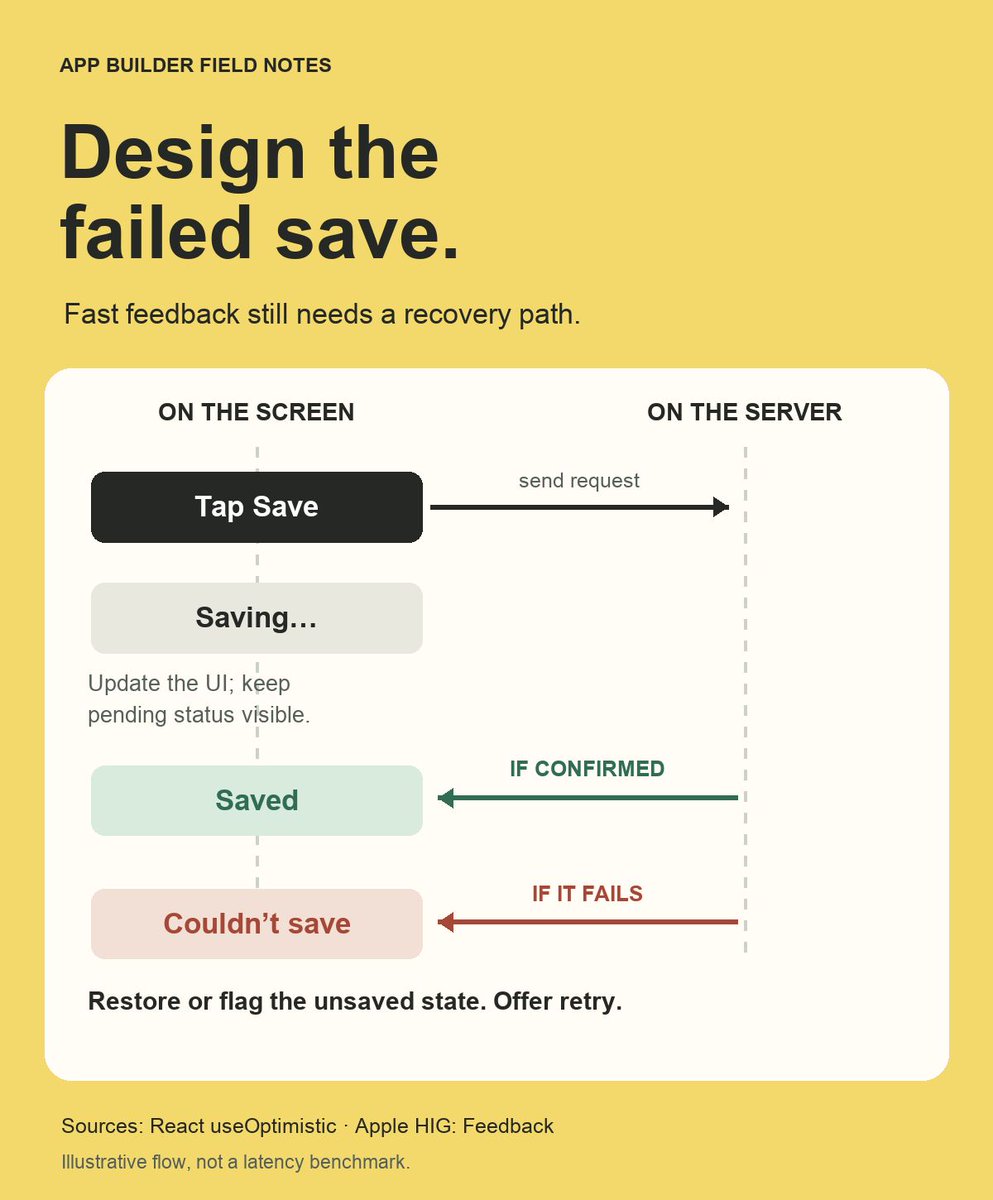
An instant response is only half the save flow. Show what is still pending, then design what happens if the write fails. A small state diagram for that handoff.
Before you rebuild after an App Review message, check what Apple actually needs. More information, working demo access and a build defect call for different next steps.
@aaronrubin computer use can click “submit.” an API can tell you whether it succeeded before you retry and charge someone twice. access gets cheaper. reliable execution is still worth paying for.
i’d start where people disappear. no visits? test distribution. visits but no installs? fix the listing. installs but no return? investigate the experience. more traffic gets expensive when you haven’t figured out why people leave.
Instead of adding more features to your app, do this:
- Start running Apple Search Ads. You don’t need a huge budget. Even $100 can help you understand which keywords actually convert.
- Fix your App Store screenshots. Sometimes better screenshots can bring more users than spending weeks building a new feature.
- Start posting on TikTok and Instagram Reels. You don’t need fancy production. Simple videos showing what your app does can work surprisingly well.
- Start testing Meta Ads. Before spending money, check Adapty’s free Meta Ads Benchmark Report to see what other apps are paying for installs and subscribers across different countries. It might save you a lot of money.
- Reach out to micro-influencers in your niche. A creator with 5K engaged followers can sometimes outperform one with 500K.
- Find communities where your target users hang out. Reddit, Discord, Facebook groups. Be helpful first, promote your app second.
- Experiment with your pricing and paywalls. Sometimes changing how you sell your existing features makes more money than building new ones.
Your app probably doesn’t need another feature right now.
It needs more people discovering it, trying it, and paying for it.
Distribution beats another feature nobody knows about.
@buildwithhassan a shared pool would turn every background task into a spending decision. do i want a daily briefing if it means less coding later? the useful upgrade would be letting users reserve quota by task, not just making the bucket bigger.
i’d use expiring credits to test a workflow i might keep paying for.
500 max-quality images tell me little. testing which visuals get people to try my app tells me what the credits are worth.
the useful metric is cost per usable asset, including rejected generations.
ChatGPT Pro now gives you $100 to $500 in API credits every month. They expire and don't roll over. And you can't spend them on Codex itself, not even by signing in to Codex with an API key.
So 𝘀𝗽𝗲𝗻𝗱 𝘁𝗵𝗲𝗺 𝗼𝗻 𝗶𝗺𝗮𝗴𝗲𝘀, ����𝗮𝘅𝗲𝗱 𝗼𝘂𝘁. In ChatGPT you can't pick the model or the quality setting. According to one user's tests on the OpenAI forum, ChatGPT images are fixed at about 1.5 million pixels. A 16:9 image comes out at 1672×941.
In the API, maxing out takes three parameters: model gpt-image-2.5-sunburst, quality max, size 3840×2160.
And "high" 𝗶𝘀𝗻'𝘁 𝘁𝗵𝗲 𝗵𝗶𝗴𝗵𝗲𝘀𝘁 quality.
gpt-image-2.5 has five quality settings, and high is only the third. At the same size, high gets a quarter of the tokens max gets. Leave quality out and it defaults to auto, where the model picks the setting.
By OpenAI's own calculator, one 3840×2160 image at max costs about $0.40, so $200 of credits gets you 𝗮𝗿𝗼𝘂𝗻𝗱 𝟱𝟬𝟬. If you're not in a hurry, use the Batch API: half price, around 1,000 images for the same money. No Pro? Your own API key works too. You just pay for it yourself.
Paste this into Claude Code or Codex. The script generates the images through the API, so they come out of those credits:
Write a script that reads prompts.txt (one prompt per line) and generates one image per line with the OpenAI Images API. Use model gpt-image-2.5-sunburst, quality "max", size 3840x2160. Read the key from OPENAI_API_KEY and save each image as a numbered PNG in ./out. After each image, print the output tokens from the response's usage field and a running total at $30 per million output tokens ($15 with --batch). Retry rate-limit errors with backoff, but stop if the error code is credit_balance_exhausted. Add a --batch flag that sends the same requests through the Batch API instead.
Two catches:
Use an API key from the organization that got the credits. Keys from other orgs don't draw on them.
The first time you call an image model, you may need to verify your organization in the developer console first.
Day 25/
We are doubling all usage limits for all Pro 100/200/500 tiers and Business Premium, effective today.
We heard your kind feedback and won’t be reducing usage limits for Pro 200, so your Work and Codex usage will stay the same. We’re also going to continue offering extended limits for dots for now, and usage of your dot will still continue to be separate from your default usage.
And we'll of course also keep shipping better models and other efficiency improvements that increase your effective usage over time.
@dadumeta a few deposits are a good signal, not a verdict. i’d ask what they expect to get and when—then see if you can deliver that before building the rest.
@SwiftDev_UI the scary part for builders: you weren’t lost over price. you were a paying customer asking for the same thing for two years. AI just made leaving easier.
@MystiqueMide i’d test a series by whether anyone comes back for episode two. a beautiful AI clip can win a view; a character people care about gives you something to build on.
@downeastdev curious what the MCP lets someone do with the product. getting around the queue is nice; fitting into a workflow people already use could be even better.
@pradyum1916 i’d separate two risks: the policy might make promises the product doesn’t keep, and it might disclose details you didn’t intend to publish. both need review. neither requires assuming the model is secretly acting for the other side.