Experimental multipartite #quantumcommunication—with a composable security proof.
We demonstrate four-party quantum secret sharing over a 20 km fibre network, secure against general attacks, including attacks by untrusted participants. A concrete step from multipartite entanglement toward secure quantum networks.
https://t.co/j01t3uel5l
Usually, I avoid having several submissions on the same day. As a coincidence, today is the first time of my with three arXiv submissions on the same day.
Warm thanks to the @HeriotWattUni around Russell Brooks and Alessandro Fedrizzi the @TUBerlin team around Janka Memmen and Anna Pappa and of course @nwalkthisway at @FU_Berlin.
Optimal stellar rank approximation of squeezed cat states with photon catalysis
We present and carefully analyze a scheme for preparing photonic cat states, motivated by efforts of preparing states for photonic quantum error correction.
https://t.co/UAGAPuVVLo
Non-#Gaussian quantum states and operations constitute essential resources for achieving quantum computational advantage and enabling #quantumerrorcorrection in #bosonic platforms. However, their generation in optical settings remains a challenging experimental task, often relying on probabilistic heralded protocols.
Here, we present an in-depth analysis of the suitability of photon catalysis between low number Fock states and squeezed states for the generation of squeezed coherent state superpositions. We employ the #stellarrank formalism to characterize the non-Gaussian complexity of input resources (including both states and measurements) and the generated states. This enables a systematic comparison of the fidelity between the catalyzed output and the target states to the maximum fidelity achievable by any protocol with the same non-Gaussian input resources. In this sense, we identify instances where the#catalysis protocols considered here are provably optimal. We identify parameter regimes in which high-fidelity approximations of the target states can be achieved with minimal resources.
Furthermore, we benchmark the performance of photon catalysis against Gaussian boson sampling-inspired protocols in terms of success probability and state quality, highlighting the advantages of deterministic Fock state sources. We also investigate the generation of related non-Gaussian resources including squeezed Fock states relevant for quantum error correction. To account for experimental imperfections, we model losses across all optical modes using a Hilbert space truncation approach in the Fock basis and analyze the robustness of the generated states under realistic conditions. Our results quantify the trade-offs between non-Gaussian resource complexity, achievable fidelity, and losses in photon catalysis protocols, providing practical guidelines for near-term photonic implementations.
Warm thanks to Julian K. Nauth, @nwalkthisway, Ananga M. Datta, Kurt Busch, Oliver Benson, and Roger A. Kögler for the collaboration. For @qt__berlin, this is the result of a collaboration involving an experimental and theoretical team, done within the @BerlinUAlliance research landscape, involving @FU_Berlin and @HumboldtUni.
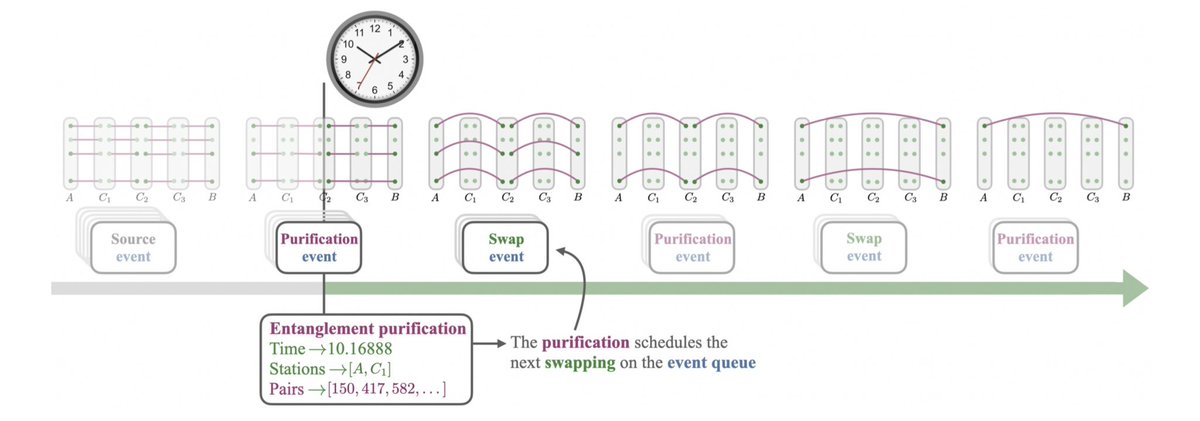
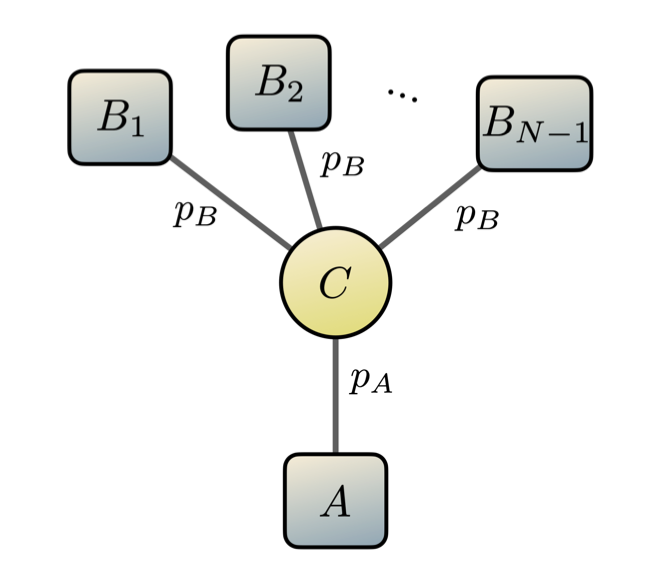
Multipartite quantum communication is subtle, and the design principles become complicated when aiming for experimentally feasible schemes. This is why event-ready Monte Carlo simulations of protocols are so important. Here, we illustrate this through strategy optimization for quantum conference key agreement in asymmetric star networks.
https://t.co/Tp6q5cpHLe
Warm thanks to Janka Memmen, Julia Alina Kunzelmann, @nwalkthisway and Julius Wallnöfer for the collaboration. And thanks to our funders. For the @bmftr_bund #QRN, for @ML4Q_cluster, and for @qt__berlin, this is the result of a joint-node collaboration, involving the @FU_Berlin, @TUBerlin, and @HHU_de.
@WKCosmo@ericcavalcanti Absolutely! Before when I wrote that roughly “physics = X, metaphysics = Y”, that was kind of wrong in the sense most foundations/philosophy types agree that all physics rests on *some* metaphysical basis. The idea is to make those assumptions more explicit.
@WKCosmo@ericcavalcanti I’m not aware of what symmetry a la Noether’s theorem really “means” (not in the same way as locality anyway). So I’d be hesitant to call it a metaphysical property.
@WKCosmo@ericcavalcanti Calculating what the Schrödinger eqn says happens (ie assuming QM is true and seeing what it predict) = physics. Asking what are the properties on any physics theory that satisfies the principle of locality (ie reasoning about theories rather than a specific one) = metaphysics
@WKCosmo@ericcavalcanti I guess I’d have to know what your definitions of physics and metaphysics are to make a good fist of answering that. Maybe the following is useful:
@WKCosmo@ericcavalcanti Quantum mechanics only enters the story when we ask: does quantum mechanics obey the Bell inequalities (derived independently of QM) or violate them? We find that it violates them, both in theory and experiment! People get Nobel prizes etc
@WKCosmo@ericcavalcanti Note that no specific physical theory (quantum mechanics or anything else) go into the derivation of a Bell inequality. Just metaphysical assumptions and the mathematics of probability. This is a framework where physical theories themselves can be classified - hence “meta”physics
@WKCosmo@ericcavalcanti Is there a significantly nicer way I could have said that? You got the basic definition of a Bell inequality wrong. I don’t know how to point that out much more gently than I did.
@WKCosmo@ericcavalcanti I don’t mean to be rude, but clearly you don’t. You just said Bell inequalities were a “prediction of quantum mechanics” even though the derivation of Bell inequalities makes no use whatsoever of quantum mechanics.
@WKCosmo@ericcavalcanti I mean…Eric’s explanation seems pretty clear. You can also find a longer version on the Bell’s theorem wiki page that has more details. Which part do you find confusing?
Advantage of multi-partite entanglement for quantum cryptography over long and short ranged networks
https://t.co/7s3xynPiVy
This work shows an advantage over multi-partite #quantumcommunication networks over bi-partite schemes.