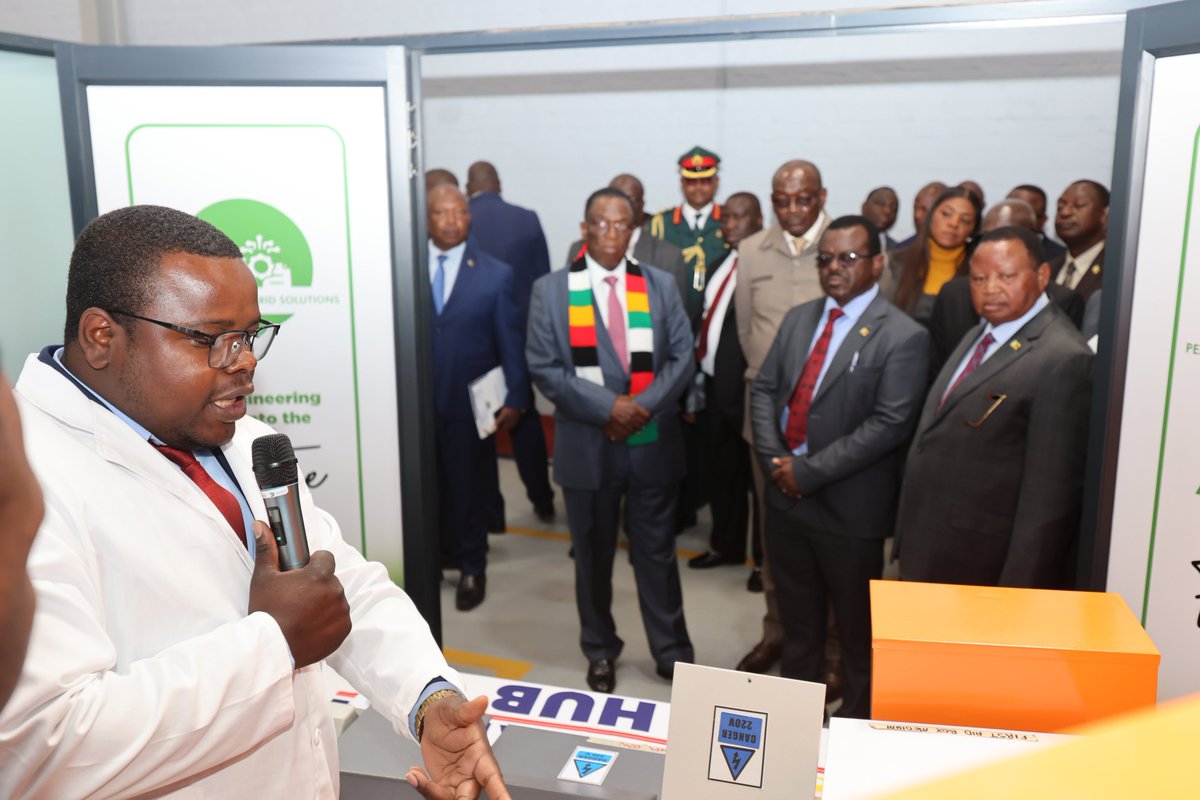
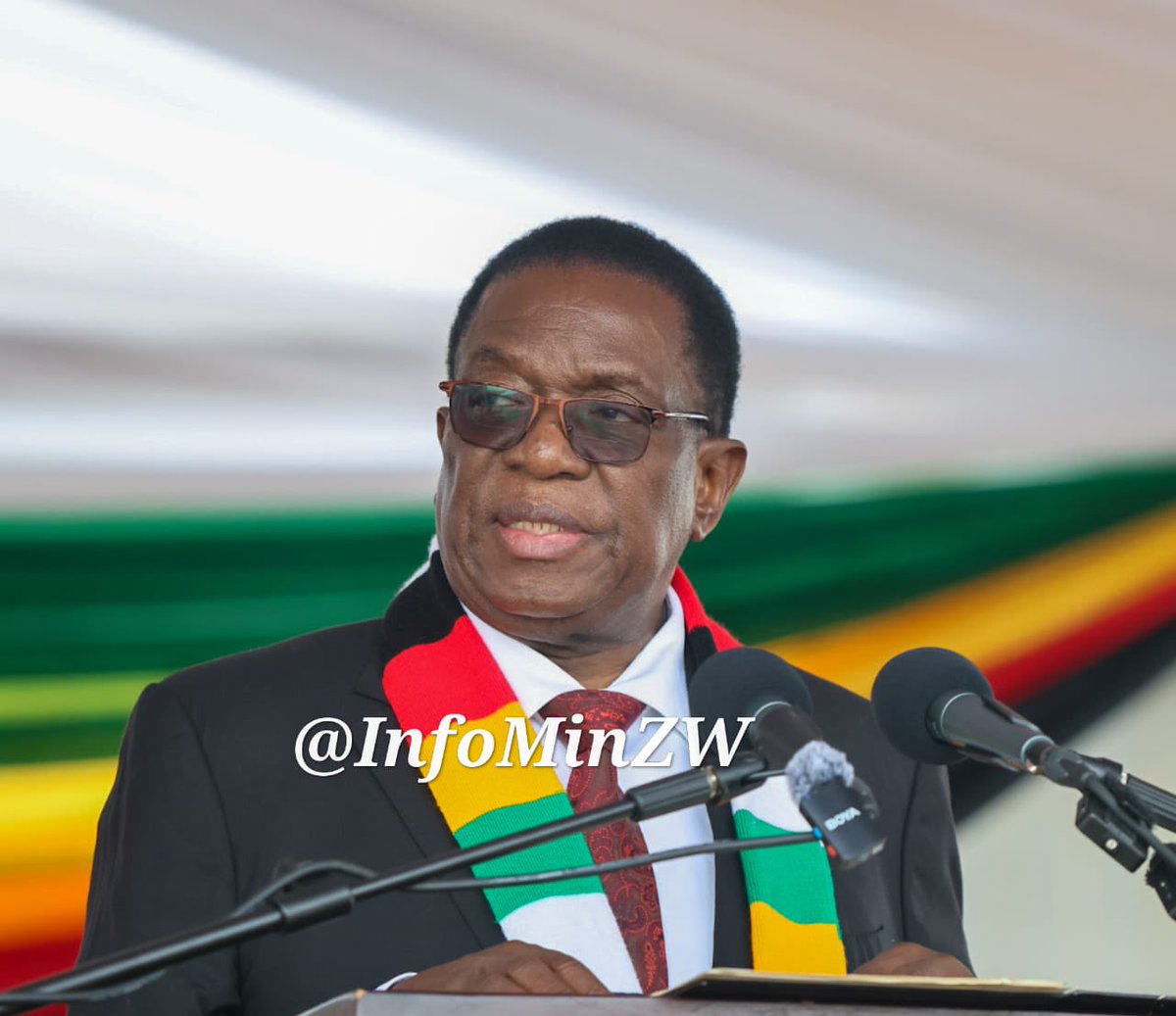
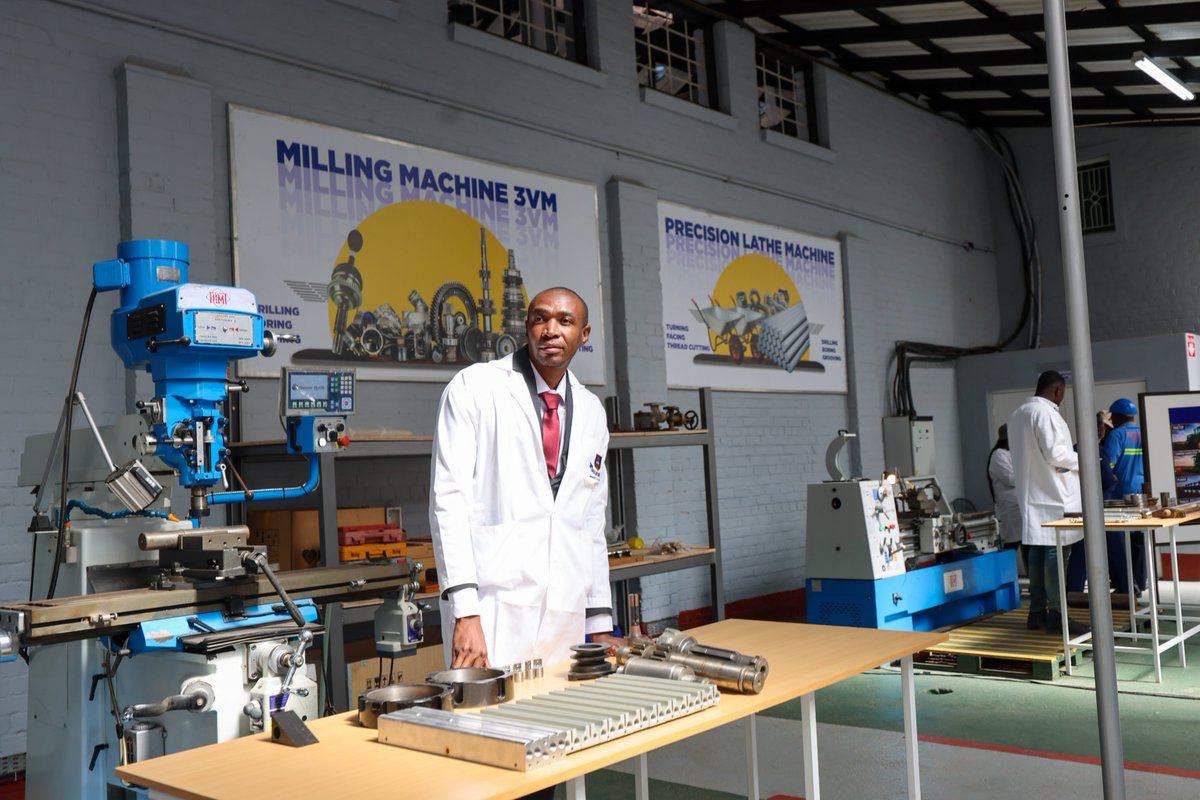
"Through the “Whole of Government and Society Approach”, let us continue to give our young talented boys and girls a chance to develop their ideas and exploit their full potential for the benefit of our beloved motherland, Zimbabwe. It is encouraging, Vice Chancellor, Prof Mapfumo that we now celebrate the successful outcomes of eleven Start-up companies, resident at the Industrial Incubation Centre.Well done" HE President ED Mnangagwa
It was my distinct honour and privilege to officially commission two signature developments at the University of Zimbabwe: the Industrial Incubation Centre and the Specialist Medical Centre.These projects are a clear validation of our Heritage-based Education 5.0 Model.
Our higher and tertiary institutions remain critical cogs in the ongoing industrialisation, modernisation, and economic development of our great nation.I congratulate the University of Zimbabwe for realising yet another landmark achievement and successfully completing these vital facilities.
The Ministry of Health and Child Care ,together with related Agencies,are directed to remove the barriers of entry in the establishment of specialist health care facilities and services.
Hatidi ma gate-keepers, nema cartels mu health sector,vanhu vedu vachitadza kurapwa zvakanaka,nemutengo uripasi.Kwete.Ngative nehanya ,tikoshese hutano we vanhu vekwedu.Let those with ears hear this stern exhortation.
MASVINGO PROVINCE
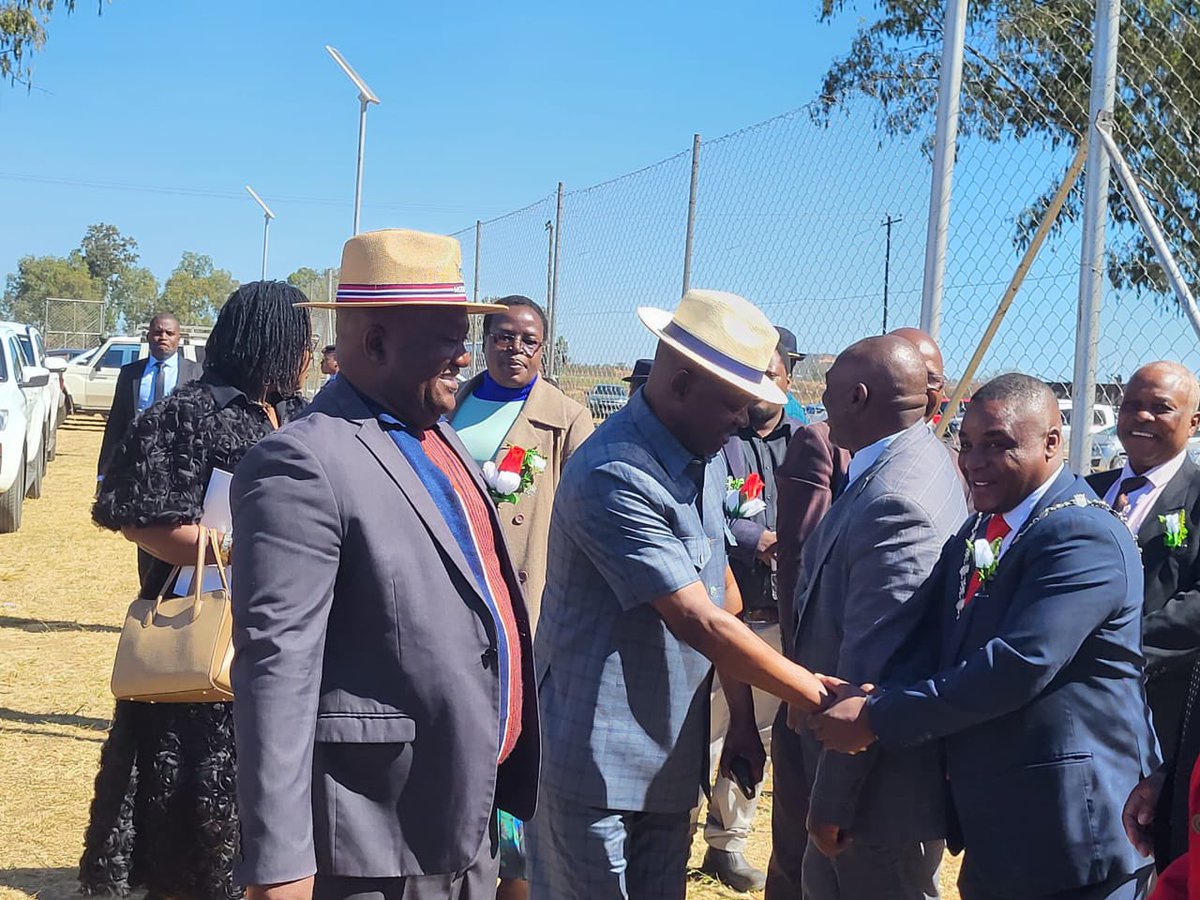
Sports Minister Rtd Lt Gen Anselem Sanyatwe has urged local authorities to invest in modern, inclusive sporting infrastructure, framing it as strategic human capital development. He spoke at the commissioning of Mucheke’s new multi-purpose facilities in Masvingo, including tennis and basketball courts. The Minister encouraged other councils to emulate this model. Attended by provincial officials and arts representatives, the event highlighted government’s tangible development vision. Town Clerk Eng Edward Mukaratirwa confirmed the facilities are accessible to persons with disabilities and fulfil the policy requiring 7% of annual budgets for sports development, maintenance, and refurbishment.
I watched my team Scottland FC lock horns with South Africa's Kaizer Chiefs in the Toyota Cup at the Royal Bafokeng Stadium in Rustenburg, a 44,000 seater stadium that was packed to the rafters. Both sides sent out their developmental outfits in the opening 45 minutes, and it was during this spell that our defence was breached, as we found ourselves trailing by a goal. The intensity went up several gears after the restart, with both coaches rolling out their first choice elevens. Scottland completely bossed the midfield, dictating the tempo and enjoying a lion's share of possession. However, despite our territorial advantage, we simply lacked the cutting edge in the final third and couldn't find the back of the net. That said, despite the narrow 1-0 defeat in a stadium packed with fervent Kaizer Chiefs supporters, Mabviravira stood out, putting in a rock solid shift.
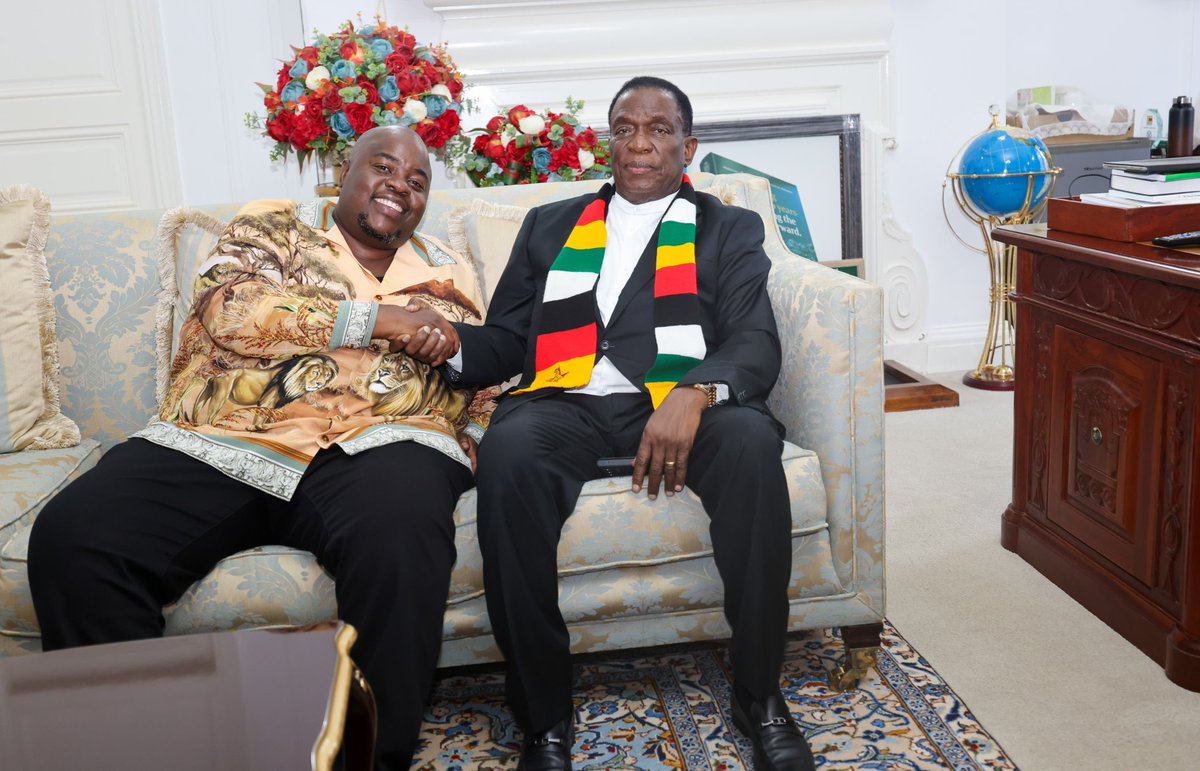
This morning, after returning from SA, where I attended a match between @ScottlandFC and @KaizerChiefs, I got a call from my bro, Hon Scott and went to see him. He's a brilliant and generous man. He thanked me for supporting his team and promised to help me with business ideas.
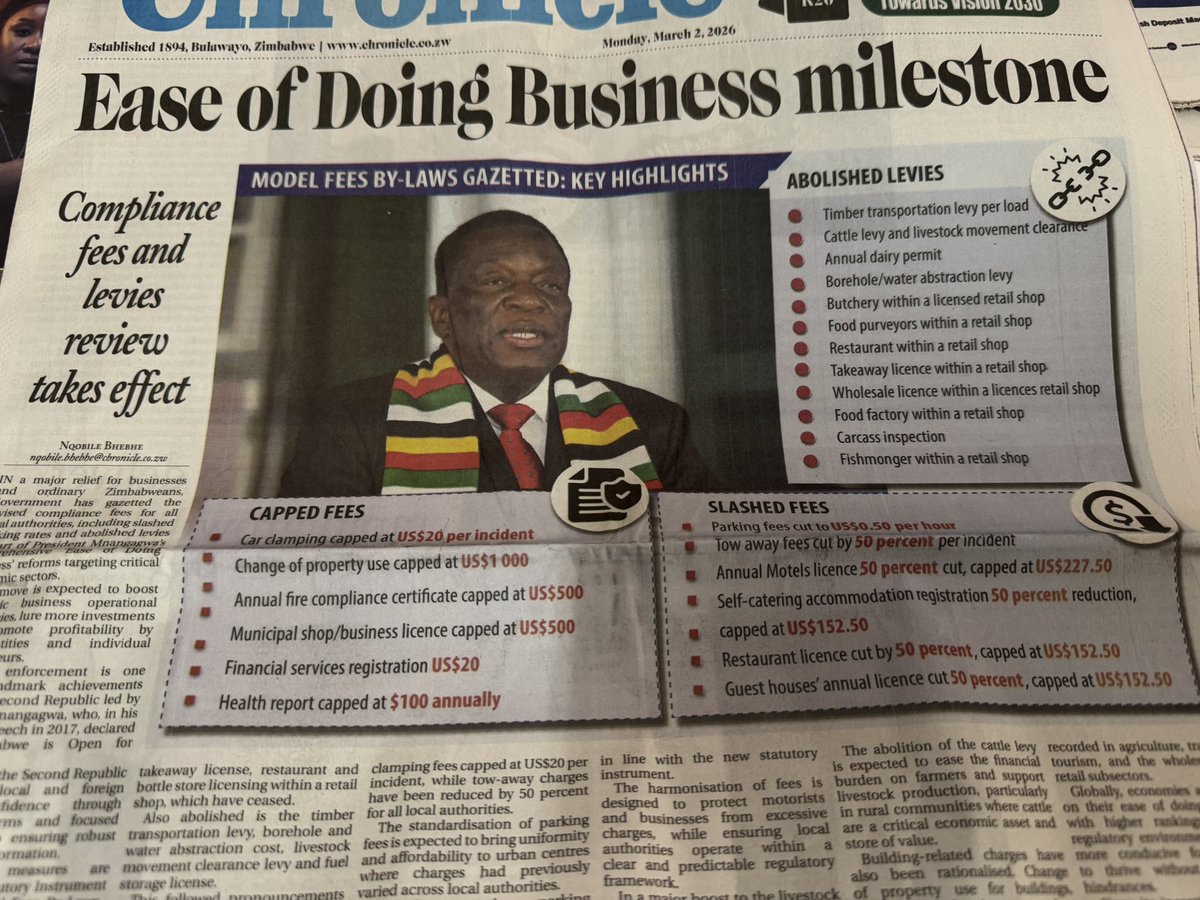
Authorities are stepping up the fight against counterfeit products as the country records an estimated US$1.2 billion in losses.
#GetThePicture#ZTNPrime#DSTV294#Zimbabwe
📸: Theseus Shambare
H.E President Mnangagwa's address;
-we mourn a gallant son of Zimbabwe, a distinguished patriotic and dedicated revolutionary who played his part towards the liberation of our beloved motherland Zim
-he served the army with courage, integrity and distinction
-we befittingly inter him at this revered national shrine with our founding fathers,great freedom fighters and others who contributed to the development of our country in post independent Zimbabwe
-I wish to convey my heartfelt condolences to his wife, children and Mpabanga family. The nation mourns with you over this great loss
-Mpabanga was a true patriot whose contributions will never be forgotten
-I challenge the education sector, our youth and learners at every level to be inspired by our rich liberation war history and leverage on our heritage based education
-we have a rich and diverse culture. These along with the regional and international solidarity we enjoyed during the liberation struggle, inform our national character and form our values and beliefs today
-as a people of Zimbabwe we know the painful experience of war and of resilience of the liberation struggle
-the unitary and indivisibilty of our state must be jealously defended
-our departed national hero has passed on at a time when preparations of Independence celebrations in his home province in Matabeleland South Province are at an advanced stage. Progress is ongoing in various province to improve road infrastructure and water accessibility
-national unity, national peace and social cohesion remain at the core of all activities of our government
-we remain forever an independent, free and sovereign people, a friend fo all and an enemy to none, driven by our national interests
-Mpabanga served in the military with diligence and uttermost professionalism
-He never sought preference or special recognition and dutifully performed in appointed designations, always remaining loyal
-In my capacity as President and Commander in Chief I promoted him to the rank of Brig General upon his retirement. He remained loyal and patriotic, until his demise
-I call upon Zimbabweans to draw life lessons from these departing heroes of our nation
-Zimbabwe is an independent country we shall do that which is right and necessary for our people
-As we lay to rest our nationaI hero I say to him, you fought a good fight, you ran a good race and served your motherland. Rest in peace, Famba zvakanaka mwana wevhu, zorora murugare gamba redu, may your soul rest in eternal peace. God bless you
EVOLUTION OF SECTION 95(2)(b) SINCE 1980: Claims that sections 95(2)(b) and 143(1) are term limit provisions created or introduced by or under the 2013 Constitution are patently false.
Such claims not only distort the historical record but they also undermine the integrity of Zimbabwe's constitutional evolution.
In truth, while the 2013 Constitution did indeed pioneer explicit term limits for the presidency in 2013, it faithfully preserved the essence and intent of term length or term of office provisions from the Lancaster House Constitution of 1979—as promulgated in 1980, and amended in 1987 and 2007—without imposing any numerical cap or "term limit" on the duration (period) of office outlined in sections 95(2)(b) and 143(1).
These sections, though rephrased over time, have consistently maintained their form and substance, defining term lengths of office of the President and Parliament without limiting the number of permissible terms.
Furthermore, it is imperative to note that term limits by definition and their nature are only on designated individual officeholders as public officials, and never on public offices or institutions they serve. Section 143(1) is manifestly not on or about parliamentarians, but on Parliament itself, as a public office or institution.
The 2013 Constitution refrained from establishing term limits for Members of Parliament—whose tenure is provided under sections 121, 125 and 129 without any term limits whatsoever besides applicable qualifications and disqualifications—thus introducing for the first time the term limit provision only for the President under section 91(2), which stipulates:
91 Qualifications for election as President and Vice-President
(1) ……
(2) A person is disqualified for election as President or appointment as Vice-President if he or she has already held office as President under this Constitution for two terms, whether continuous or not, and for the purpose of this subsection three or more years’ service is deemed to be a full term. [Subsection substituted by section 3(b) of Act 2 of 2021]
This provision stands as the singular and definitive presidential term-limit provision within the Constitution, aligning seamlessly with the overarching framework outlined in section 328(1), which states:
328 Amendment of Constitution
(1) In this section— “Constitutional Bill” means a Bill that seeks to amend this Constitution; “term-limit provision” means a provision of this Constitution which limits the length of time that a person may hold or occupy a public office.
By adhering to this precise formulation, the Constitution safeguards democratic principles through targeted term limitations, compelling fidelity to its historical continuity regarding the constitutional import of term length provisions on the Presidency and Parliament, thereby rejecting misguided claims by conflict mongers whose preoccupation is to breed divisions and polarise society at every turn.
Below is a self-explanatory history of sections 95(2)(b) and 143(1), which shows beyond any doubt that the two sections are not term limit provisions, but term lengths or periods (as per the Mupungu precedent) or institutional durations of the Presidency and Parliament, which are essentially election cycles:
1980 Version Similar to Section 95(2)(b) of the 2013 Constitution (Term of Office of President):
Section 29 Tenure of office of President
(1) The term of office of the President shall be a period of six years:
Provided that the office of the President shall become vacant—
(a) on the expiration of the period for which the President was elected;
(b) if the President resigns his office by instrument in writing addressed to the Speaker;
(c) if the President dies;
(d) if a resolution for the removal of the President from office is passed by not less than two-thirds of the total membership of the Senate and the House of Assembly sitting together.
1980 Version Similar to Section 143(1) of the 2013 Constitution (Term of Office of Parliament):
Section 63 (Prorogation or dissolution of Parliament)
(1) Parliament shall continue for five years from the date of its first sitting following a general election, unless sooner dissolved.
(2) ……
(3) ……
(4) Parliament, unless sooner dissolved, shall last for five years, which period shall be deemed to commence on the day the person elected as President enters office in terms of section 28(5) after an election referred to in subsection (3)(b) or on the day following the day of such dissolution, as the case may be, and shall then stand dissolved:
Provided that, where the period referred to in this subsection is extended under subsection (5) or (6), Parliament shall stand dissolved on the expiration of that extended period.
(5) ……
(6) ……
1987 Version Similar to Section 95(2)(b) of the 2013 Constitution (Term of Office of President):
Section 29 Tenure of office of President
(1) The term of office of the President shall be a period of six years:
Provided that—
(i) the President shall continue in office until the person elected as President at the next election of President assumes office;
(ii) [Paragraph repealed by section 9 of Act 15 of 1990]
(2) The President may resign his office by lodging his resignation in writing with the Speaker.
(3) The President shall cease to hold office if a report prepared by a committee of Parliament, appointed by the Speaker upon the request of not fewer than one-third of the members of Parliament, has recommended the removal of the President on the ground—
(a) that he has acted in wilful violation of this Constitution; or
(b) that he is incapable of performing the functions of his office by reason of physical or mental incapacity; or
(c) of gross misconduct;
and the members of Parliament have resolved by the affirmative votes of not less than two-thirds of their total number that the President should be removed from office.
1987 Version Similar to Section 143(1) of the 2013 Constitution (Term of Office of Parliament):
Section 63 (Prorogation or dissolution of Parliament)
(1) ……
(2) ……
(3) ……
(4) Parliament, unless sooner dissolved, shall continue for five years beginning on the date when Parliament first meets after any general election and shall then stand dissolved: Provided that, where the period referred to in this subsection is extended under subsection (5) or (6), Parliament, unless sooner dissolved, shall stand dissolved on the expiration of that extended period.
(5) ……
(6) ……
(7) …..
2007 Version Similar to Section 95(2)(b) of the 2013 Constitution (Term of Office of President):
Section 29 Term of office of President
(1) The term of office of the President shall be a period of five years concurrent with the life of Parliament referred to in section 63(4), or—
(a) a lesser period where the President earlier dissolves Parliament in terms of section 63(2), or the President is elected pursuant to section 28(3)(b); or
(b) a longer period where the life of Parliament referred to in section 63(4) is extended under section 63(5) or (6); in which event term of office of the President shall terminate on the expiration of such lesser or longer period, as the case may be:
Provided that the President shall continue in office until the person elected as President at the next election of President enters office.
(2) The President may resign his office by lodging his resignation in writing with the Speaker.
(3) The President shall cease to hold office if a report prepared by a joint committee of the Senate and the House of Assembly, appointed by the Speaker in consultation with the President of the Senate upon the request of not fewer than one-third of the members of the House of Assembly, has recommended the removal of the President on the ground—
(a) that he has acted in wilful violation of this Constitution; or
(b) that he is incapable of performing the functions of his office by reason of physical or mental incapacity; or
(c) of gross misconduct;
and the Senators and members of the House of Assembly sitting together have resolved by the affirmative votes of not less than two-thirds of their total number that the President should be removed from office.
2007 Version Similar to Section 143(1) of the 2013 Constitution (Term of Office of Parliament):
63 Prorogation or dissolution of Parliament
(1) ……
(2) ……
(3) ……
(4) Parliament, unless sooner dissolved, shall last for five years, which period shall be deemed to commence on the day the person elected as President enters office in terms of section 28(5) after an election referred to in section 28(3)(a), and shall then stand dissolved:
Provided that, where the period referred to in this subsection is extended under subsection
(5) ……
(6) ……
Current Section 95(2)(b) on the Term of Office of President Similar to Versions of Section 29 promulgated in 1980 and amended in 1987 and 2007:
95 Term of office of President and Vice-Presidents
(1) ……
(2) The term of office of the President extends until—
(a) he or she resigns or is removed from office; or
(b) following an election, he or she is declared to be re-elected or a new President is declared to be elected; and, except as otherwise provided in this Constitution, his or her term of office is five years and coterminous with the life of Parliament.
Current Section 143(1) on the Term or Life of Parliament Similar to Versions of Section 63(4) promulgated in 1980 and amended in 1987 and 2007:
143 Duration and dissolution of Parliament
(1) Parliament is elected for a five-year term which runs from the date on which the President-elect is sworn in and assumes office in terms of section 94(1)(a), and Parliament stands dissolved at midnight on the day before the first polling day in the next general election called in terms of section 144.
Let's cut to the chase: sections 95(2)(b) and 143(1) are emphatically not term limit provisions under section 328(1). Their core form and substance stand rock-solid, mirroring equivalents from 1980 and powering through every amendment in 1987, 2007, and 2013—proving their enduring, unyielding nature!
I wholeheartedly Support Bill Amendment No. 3 .Bill Amendment No. 3 represents progress, stability, and the kind of forward-thinking leadership our nation needs. It is not just a legal adjustment; it is a declaration that we are serious about modernizing our governance and aligning our policies with the realities of today’s economy. As a businessman, I understand the importance of clarity, consistency, and vision. This amendment provides exactly that. It strengthens the framework within which Entrepreneurs, Investors and Citizens can thrive. It ensures that our institutions are not only responsive but also resilient. Supporting this amendment is not about politics it is about patriotism. It is about ensuring that the next generation inherits a country that is stronger, more transparent and more prosperous than the one we live in today. Bill Amendment No. 3 is a step in that direction, and I stand firmly behind it." #2030NdeyaEmmerson
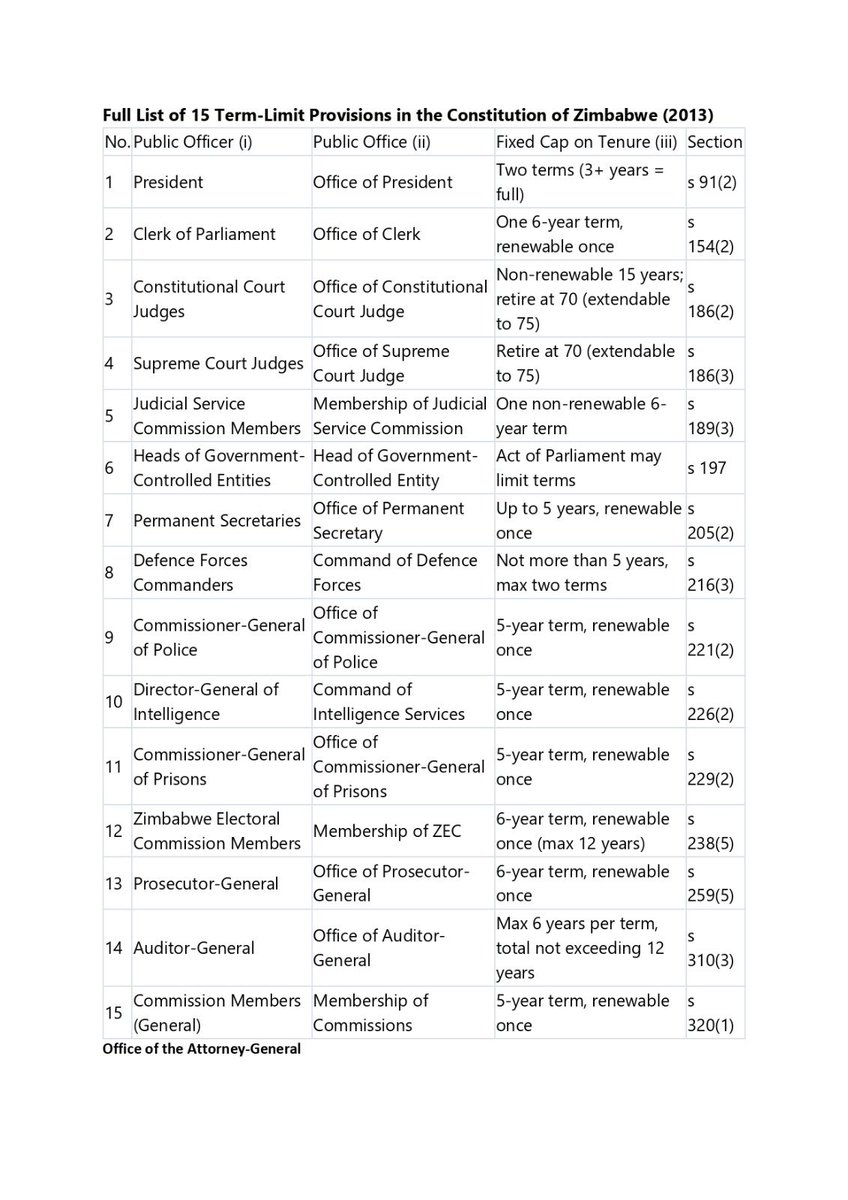
Unpacking the Constitution of Zimbabwe Amendment Bill.
The Office of Attorney-General has released this list to assist in the process of unpacking the Constitutional Amendment Bill( no 3 /26)
“CONSTITUTIONAL law experts say the proposed Constitutional Amendment No. 3 Bill of 2026 — represents a set of structural governance reforms aimed at enhancing political stability, improving institutional efficiency and creating a more predictable framework for long-term national development”
https://t.co/o1yJQJelvE
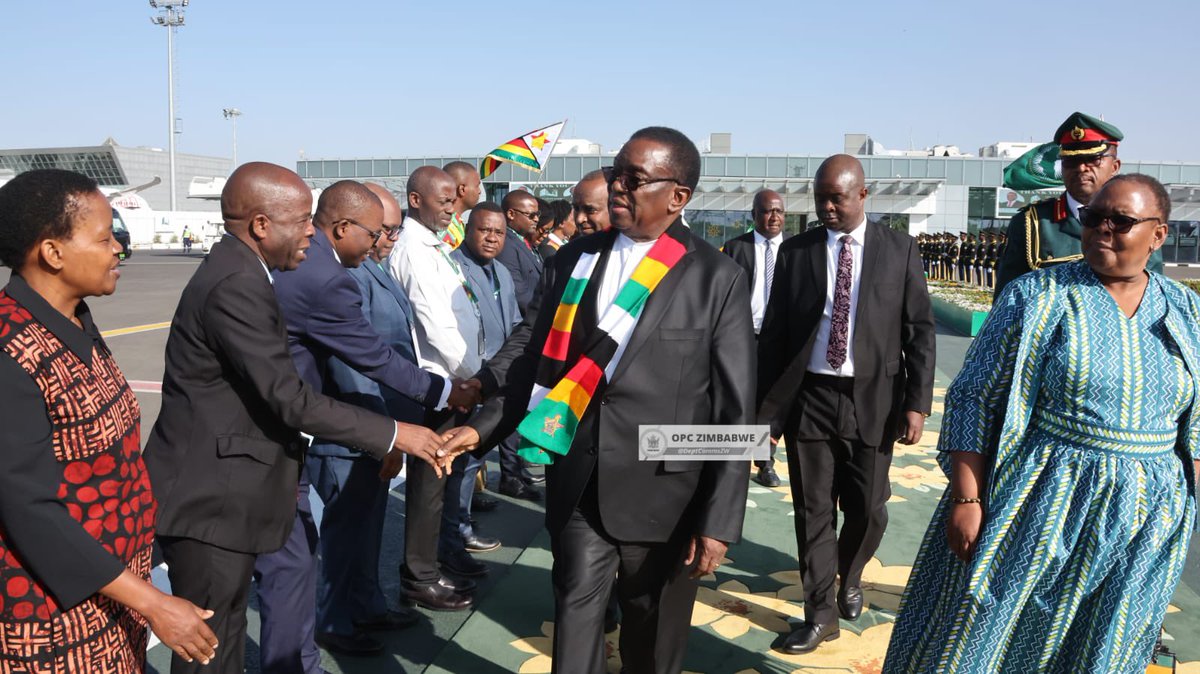
H.E. President @edmnangagwa is seen off at Bole International Airport by Minister of Peace of the Federal Democratic Republic of Ethiopia, Hon Mohammed Edris, after attending the 39th Ordinary Session of the Assembly of the African Union at the continental body’s Headquarters in Addis Ababa.
Dr W.L.Manungo - Deputy Chief Secretary for Policy ,Analysis,Coordination Planning in the Office of the President and Cabineyand development indicated that the National Development Strategy 1 (NDS1), implemented between 2021 and 2025 sought to accelerate economic growth, stabilise the currency, promote industrialisation, improve infrastructure, ensure food security, create jobs, and strengthen governance as part of laying the foundation for Vision 2030. Major achievements included average GDP growth of 5.6%, the introduction of the ZiG currency in 2024 which stabilised inflation and exchange rates, and foreign currency reserves rising to over US$1.2 billion by 2025. Agriculture reached self-sufficiency in maize and wheat, tobacco output hit record levels, and manufacturing capacity utilisation rose significantly. Infrastructure projects such as Hwange Units 7 & 8, maior highways, dams, and airport expansions were completed, while digital penetration surged to 83.5% and innovation hubs expanded under Education 5.0 Health delivery improved with increased life expectancy, reduced mortality rates, and near achievement of the 95-95-95 HIV targets.
@edmnangagwa Thank you President Dr ED Mnangagwa for representing Zimbabwe and Africa. I am a proud Zimbabwean and African.
#Nyika Inovakwa neVene Vayo
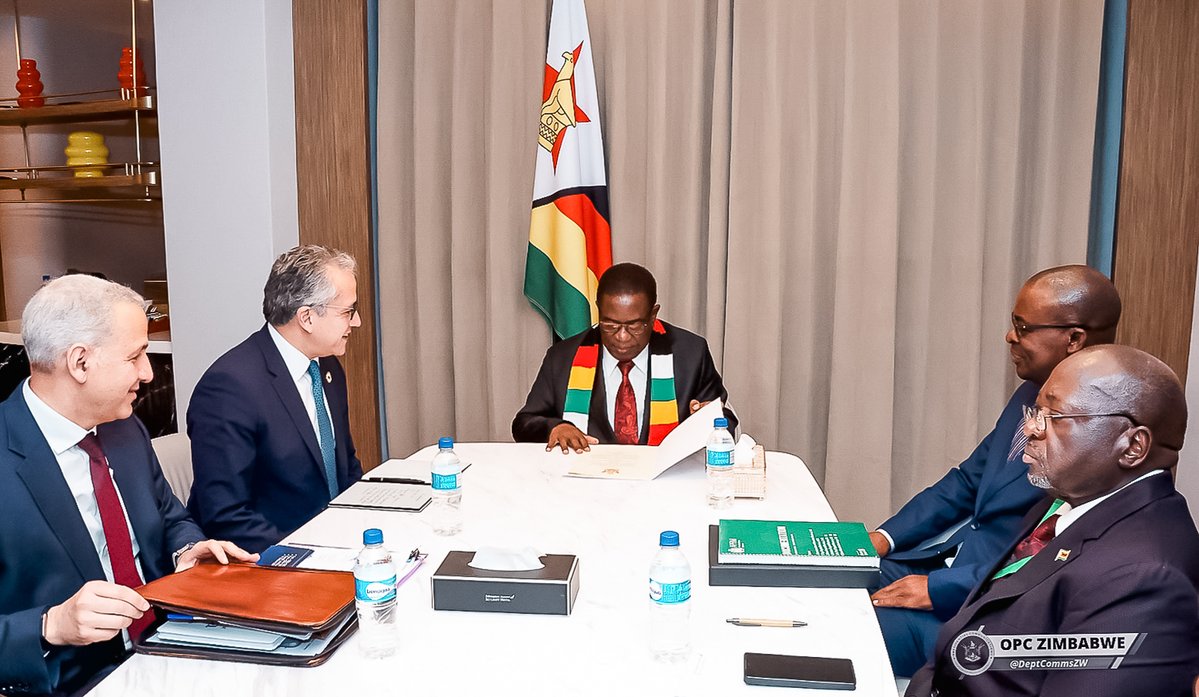
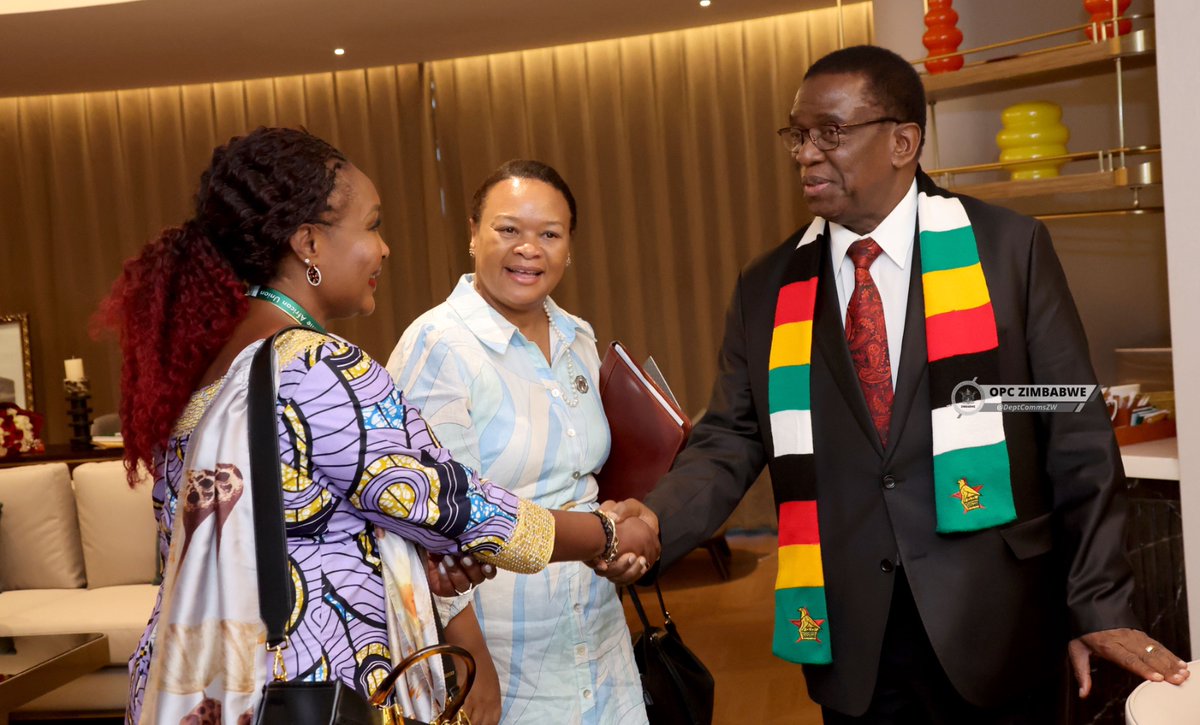
At the African Union Headquarters in Addis Ababa, I met with UNESCO Director-General Mr Khaled Ali and his delegation to discuss cooperation in education, science, culture, and heritage development.
I also welcomed members of the African Peer Review Mechanism Forum, led by CEO Ambassador Marie-Antoinette Rose-Quatre, alongside Dr Rachel Mukamunana, Director of Country Reviews and Assessments, and Panel Member Ambassador Aly El-Hefny. Our engagements focused on strengthening governance systems and advancing Africa’s shared development agenda.
#AfricaUnionSummit2026 #AfricanUnion #Zimbabwe