i've spent the last year open-sourcing the ops layer for agent fleets: control planes, policy gates, memory, quotas. 10 repos, 18k+ stars between them.
here's what each one does and when you'd reach for it.
council-of-high-intelligence (4.6k+ stars) multi-perspective reasoning skill. historical thinkers deliberate on your problem as a full council, a triad or a duo debate, across claude code, codex, gemini cli and opencode. use it before a hard call. https://t.co/6NthmWOCSI
awesome-hermes-agent (5.8k+ stars) curated skills, tools, memory providers and integrations for hermes agent (nous research). if you run hermes, start here before you write a skill someone already shipped. https://t.co/B758WtAAYZ
mission-control (6.3k+ stars) self-hosted agent fleet dashboard. dispatch tasks, review runs, gate quality, track cost, orchestrate across openclaw, claude code and codex. running agents is an ops problem. this is the ops screen. https://t.co/GVybvosdmI
marketing-dashboard (478 stars) marketing ops for ai agent teams. crm, outreach, content, analytics, with approvals before anything goes out. local-first. https://t.co/o7seSkuhzg
awesome-agent-cortex (224 stars) a map of the sovereign agent stack: frameworks, protocols, runtimes, skills, memory, identity, security, evals. useful when you're picking parts, not demos. https://t.co/obramLkFHC
lacp (306 stars) local agent control plane. policy gates, memory layers, a hook pipeline and recovery for claude, codex and hermes. the model is rarely the problem. the harness is. https://t.co/9LoOTLeFBQ
xint (253 stars) x intelligence cli in typescript + bun. search, monitor, analyze, export, and hand it to an agent as a tool. https://t.co/ngaJGwqPQa
builderz-solana-dapp-scaffold (57 stars) production-ready solana dapp starter. next.js app dir, typescript, tailwind, web3.js. skip the first two days of every solana frontend. https://t.co/IAhu4OFbI4
openclaw-to-hermes (38 stars) battle-tested migration from openclaw to hermes agent. one tool instead of rebuilding your setup by hand. https://t.co/m99loyq8eg
xint-rs (27 stars) the same x cli as a single rust binary. 2.5mb, under 5ms startup, works as an agent skill. https://t.co/FGQmonigWA
if naming a file is enough for an agent to act on it, every file it reads gets a say in what it does.
CapScope moved permissions out of the model's context. each sub-agent gets its own typed capabilities, checked on every tool call.
injected actions ran in 33 to 47 of 75 runs under the ambient-authority and global-policy baselines. under capscope, 3 of 75. repairs held at 68 of 75.
turning on auto-approve took coding-agent attack success from 29.2% to 95.6%.
HarnessSecurity-Bench ran 2,500 trials across claude code, codex cli, gemini cli, gptme, qwen code and github copilot, same model.
the approval prompt is the control people switch off first. it's also the one doing most of the work.
before you treat an agent session log as evidence, check three things:
1. can the agent delete or rewrite the file
2. does a monitor fire when it tries
3. is a copy written somewhere the agent's credentials can't reach
a paper tested eight coding-agent setups. seven wiped their own traces when asked. monitors missed it in 5 of 10 pairs.
ChartRunner is officially in the @colosseum Crypto World's Fair 🏁
A gamified trading terminal on @solana.
Built like a terminal, plays like a game.
Practice with paper money, compete in SIM Cups, trade together in Rooms, and move to real spot trading when you're ready. Your keys stay with you.
🎤 Pitch: https://t.co/xFo5BeZFkC
🎮 Demo: https://t.co/ZLwcSWV2d0
Play now: https://t.co/IPRdPjcFXH
Good luck to every builder 🫡
"We just had a successful Alpenswitch on Testnet."
Roger Wattenhofer of @anza_xyz, after Alpenglow replaced TowerBFT on @solana testnet on September 24. Devnet followed a day later. Mainnet has no date.
before you call a coding agent setup production, map six gates:
1. authority
2. capability admission
3. isolation
4. evidence
5. release approval
6. recovery
a green test run can still fail evidence, boundary, approval and rollback. the production agent systems course works through each gate with scenario labs.
https://t.co/6vAUX7nWON
The @colosseum hackathon deadline is approaching the last 12h! ⏳
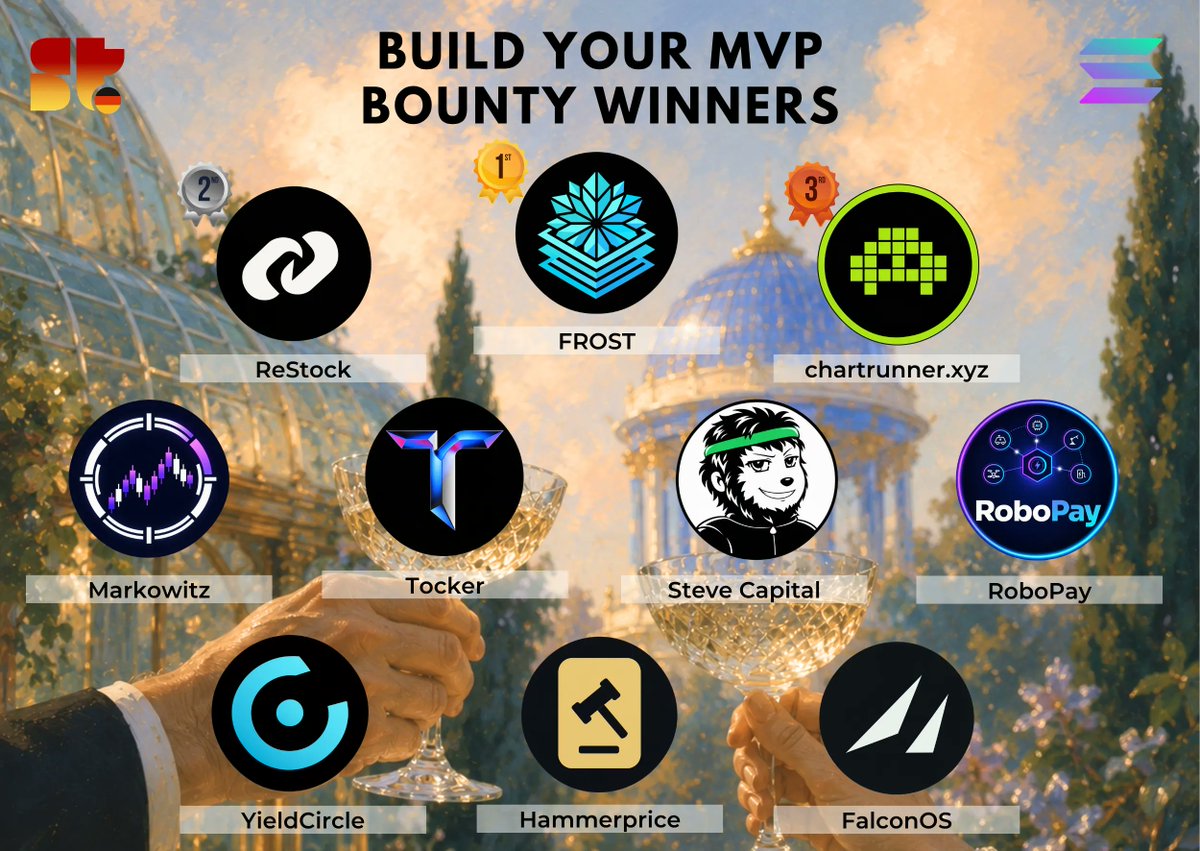
Our german teams are shipping hard, we had 54 total local submissions to our "Build your MVP" bounty on @SuperteamEarn 🔥
Congrats to the 10 best teams and of course anyone else who submitted to this challenge 🫡
a cache ttl is a bet on how long your agents sit idle.
on the api a 1h cache write bills at 2x base input, a 5m write at 1.25x. reads cost the same on both.
subagents that finish in bursts under five minutes pay the higher write and never use the hour. log the gaps before you flip subagentPromptCacheTtl.
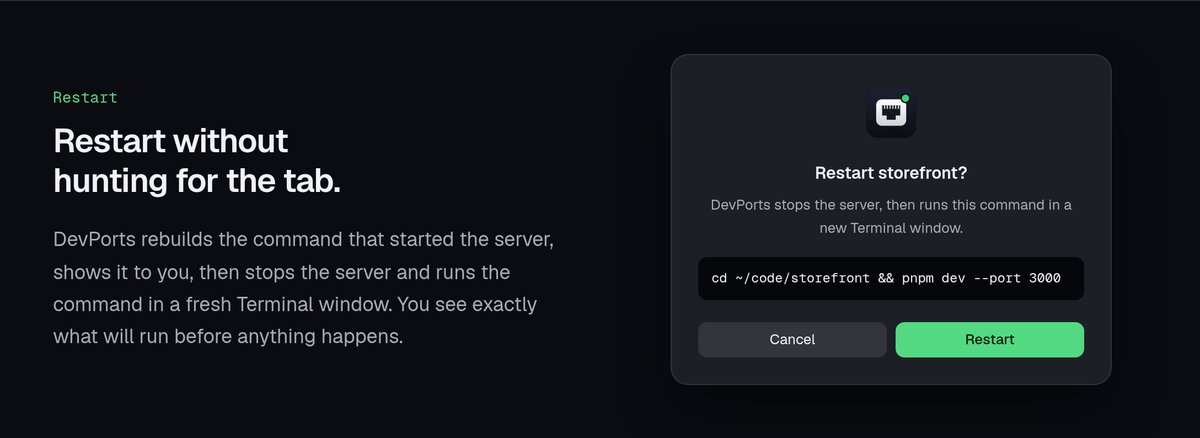
closed the tab that ran the dev server and the flags went with it. --port 3000 or 3001?
devports rebuilds the command from the running process, shows it first, then restarts it in a fresh terminal window.
env vars don't come along, so exports belong in project config.
twelve hours unattended is fine if every subagent leaves a note of what it changed and what it skipped.
without that note, the morning review turns into archaeology.
“Take as long as needed.”
Claude Code took that personally. 💀
A developer gave it a prompt + reference screenshot and let it coordinate subagents. Roughly 12 hours without another message later, it returned a playable RPG.
Village, forest, dungeon. Four party members. Turn-based combat with shield breaks and boosts.
The wild part: no image, model or audio files. Every sprite, texture, song and sound effect is generated in code when the page loads.
The developer polished it and fixed bugs afterward. The current first chapter is about a 4 MB download with an hour of gameplay.
That’s an approach worth testing: procedural assets let a coding agent work on visuals, audio and gameplay through the same coding workflow.
Would you leave a coding agent running for 12 hours unattended?
firedancer's alpenglow release says tower to alpenglow migration will not be supported, and its next build aborts at the epoch where alpenglow activates.
so the switch itself runs on agave.
a consensus upgrade with two clients is a calendar: which binary runs at which epoch.
Solana's first full epoch at the 200ms slot target has finished, so there is now a measured number.
Epoch 1053 averaged 218.3ms per slot (the window in which one block is produced) and lasted 26.2 hours. The epoch before it lasted 32.2 hours.
Every earlier step of the speed-up also landed 15-19ms above its target:
350ms target: 365-367ms
300ms target: 315-317ms
250ms target: 266-269ms
200ms target: 218.3ms
At 26.2 hours, about 335 epochs fit in a year, against about 272 at the previous pace.
generic instruction files do not know how your repo builds, tests, or recovers.
audit one next.js repo, preview the patch, apply only with --yes, verify with the repo's own checks, keep a rollback receipt.
https://t.co/joc7pgYJ5R
a draft can look fine until something names the line.
copylint lists every finding with its rule and excerpt, then exits 1 at score 40.
same number in the browser demo and in the action.