For seventy years after World War II, the law was one-sided: if an enemy attacked Japan, American sailors were sworn to die defending her, but if an American ship was attacked right next to a Japanese warship, Japanese sailors were legally forbidden to defend their American friends.
Prime Minister Shinzo Abe refused to accept that shame any longer.
Despite screaming protesters outside the parliament building in Tokyo, Abe passed historic security laws so Japan could finally stand shoulder to shoulder with the United States.
On May 1, 2017, as North Korea threatened missile strikes across the Pacific, that promise became steel on the water.
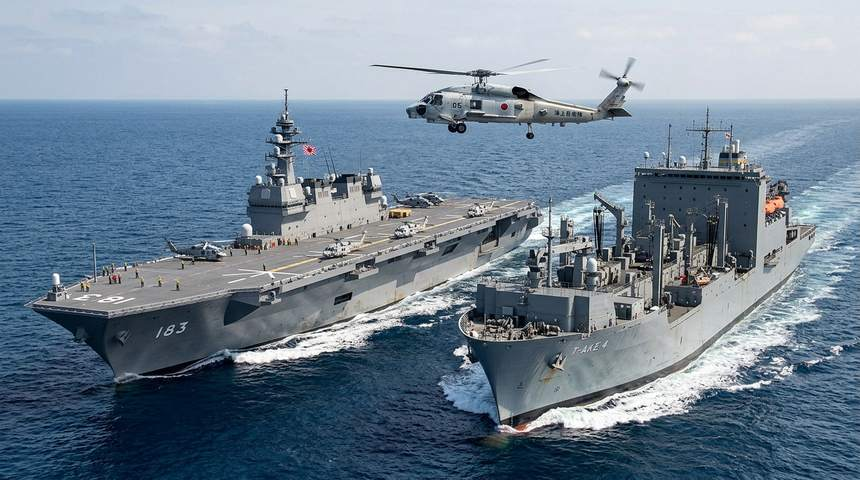
Why did Japan send its largest warship, the 814-foot helicopter destroyer JS Izumo, to guard the U.S. Navy ship USNS Richard E. Byrd? Because the Byrd was a vital ammunition and cargo supply vessel crewed mostly by American civilian mariners, steaming south from Yokosuka to resupply the USS Carl Vinson carrier strike group.
Without heavily armed escorts, a supply ship is the most vulnerable target at sea.
As the American supply ship cleared Tokyo Bay, the massive gray flat-top JS Izumo pulled alongside her port beam, launching SH-60K anti-submarine helicopters overhead to sweep the waters all the way to Shikoku.
American sailors watching from the bridge knew what they were seeing. For the first time in postwar history, the Rising Sun flag was sailing as an armed bodyguard for the Stars and Stripes.
A true friend does not hide behind your shield forever. One day, he steps up and locks his shield with yours.