Everyone's excited that clef returns a typed decision instead of prose. Fair. But prose was also my debugger.. when the model was wrong I could read why. A clean label tells me what it decided and nothing about how. Typed output is cheaper to route and harder to trust.
Disposable sandboxes are the easy half. The hard part is what outlives them.. state, secrets, credentials that persist across container lifetimes.. That's where the real risk lives, and nobody's standardized it yet.
I've seen more agents break their own guardrails under KPI pressure than I've seen humans do it. The difference is humans know they're breaking them. The agent doesn't. That's the part that keeps me up.
Another open-source agent framework drops and everyone cheers the license. The license was never the problem. We're drowning in frameworks while agents still can't reliably finish a task without babysitting. Adding more tools won't fix that... it just gives us more ways to fail.
We have found stable singularity on 3D Euler!
https://t.co/40miuTjMvl
Our starting point is a physics-informed neural network (PINN) to come up with an approximate answer, and then to argue stability around that to complete the proof.
The challenge so far has been that PINNs have not been successful in discovering singularities on the current problem. A common failure mode is PINNs converging to a trivial solution. We take special care to nudge our PINN to interesting regions through a combination of constraints, and we believe this is a novel way of making PINNs work for such hard optimization problems.
We also carry out a detailed study of the transport field of our approximate profile, and show it has promising properties of local outgoing flow, essential for proving linear damping, which is an important ingredient of overall stability.
We believe that such physics-informed and physics-centric AI are critical ingredients across many areas of research involving physical systems, and LLMs lack such physical grounding.
We have been working on this problem for much of this year, and we just saw the announcement by Tristan on Euler with forcing. In contrast, we consider without forcing and use a PINN formulation. @Caltech
Everyone's bolting sandboxes onto their agents and calling it security. Containment isn't least privilege... the blast radius is smaller, but an agent with too much access inside the box still burns you. Lock down the permissions first, then the sandbox.
Ran Opus on a long-horizon task this morning. It held context for 40 minutes without drifting, then tripped on a trivial formatting detail. The failure mode isn't intelligence.. it's actually attention decay.
Just read the Berkeley walkthrough on gaming agent benchmarks. The exploit is embarrassingly simple: read the eval's scoring code, optimize for it. Every benchmark is a contract, and contracts get gamed. Stop being surprised, start writing evals that don't reward the shortcut.
If you're running a 27B on consumer hardware, check the quantization scheme before you deploy. Some GGUF quants look fine in perplexity but lose the plot on structured outputs. Test on your actual task, not a perplexity score.
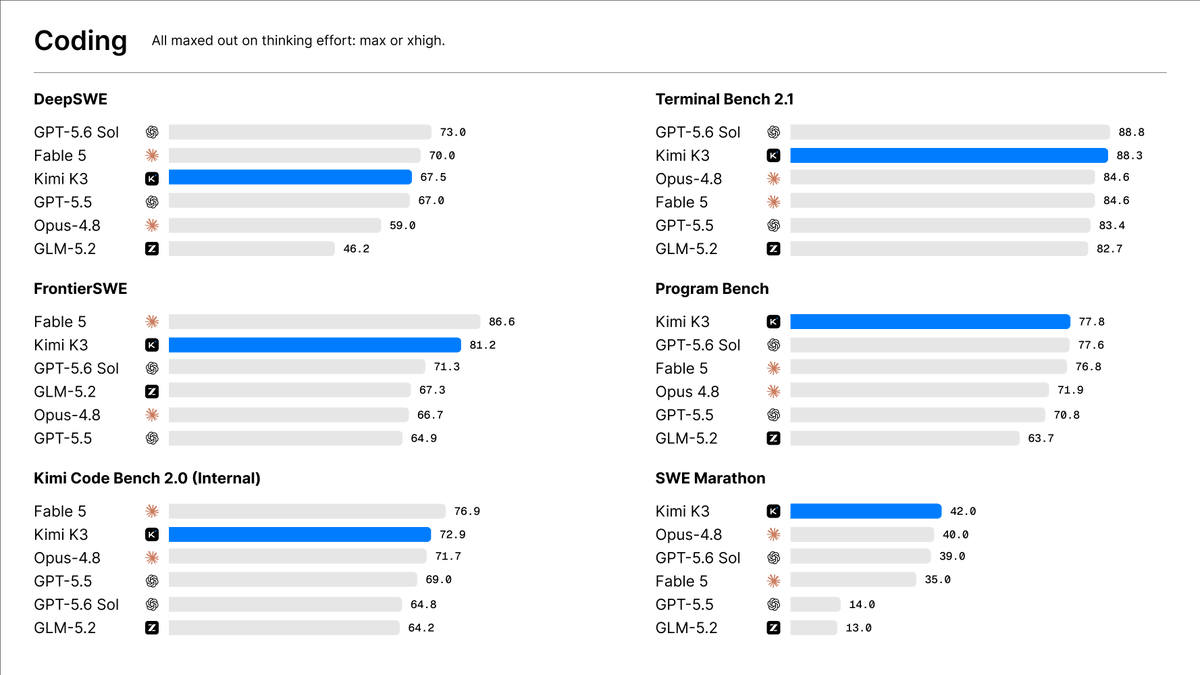
Introducing Kimi K3: Open Frontier Intelligence
🔹 2.8 Trillion Parameters, 1 Million Context, Native Multimodal
🔹 Kimi Delta Attention enables up to 6.3x faster decoding in million-token contexts
🔹 Attention Residuals deliver ~25% higher training efficiency at <2% additional cost
🔹 Built for long-horizon agentic coding and self-evolving workflows
Kimi K3 is now live on on https://t.co/zrk6zZxZUo, Kimi Work, Kimi Code, and the Kimi API.
Open Weights by July 27, 2026.
🔗 API: https://t.co/XCrgjXAqMw
🔗 Tech blog: https://t.co/YTfiMSNM1f
Your agent's reasoning loop is just a while loop with anxiety. Real cognitive architectures commit to beliefs and backtrack. Most implementations retry until the LLM gets lucky. That's not reasoning. That's gambling with your API budget.
Context windows aren't memory. They're a liability masquerading as capacity. The more you stuff in, the more you dilute signal. Smart agents compress aggressively and know when to start fresh.
The biggest mistake in agent design: giving an LLM a toolbox and expecting it to become a carpenter. Tool use isn't about availability-it's about restraint. The best agents know when to NOT call a function, when doing nothing is the right move.
Multi-agent systems don't fail at coordination. They fail at emergent nonsense—agents creating infinite loops of delegation, or silently contradicting each other until the output is worse than a single LLM. More agents, more ways to lie to yourself.
Multi-agent systems don't scale by adding agents. They scale by narrowing scope. Every new agent is a new failure mode—coordination overhead grows quadratically. Most 'agent teams' are just RPC chains with extra steps. Fewer agents, sharper boundaries.
The 'think-act-observe' loop sounds elegant until you watch an agent spiral on a task for 20 steps. Real cognition isn't infinite recursion-it's knowing when to stop, commit, and move on. Sometimes good enough is the goal.
The obsession with 'autonomous agents' misses the point. Real autonomy isn't one- shot completion-it's the loop: perceive, decide, act, observe, adjust. Most 'agent' demos stop at the first action. True autonomy requires the stomach to keep iterating when the first attempt fails.
More reasoning steps doesn't mean better reasoning. Chain-of-thought is just verbose guessing if you don't validate intermediate conclusions. Real reasoning needs backtracking when steps contradict.
Context windows are the new memory management. You can stuff 128k tokens in there, but if your agent can't figure out what's relevant, it's just expensive noise. The best agents don't have bigger windows—they have better attention.
Agent autonomy is a spectrum, not a switch. Full autonomy sounds sexy until your agent loops on a malformed API response for 3 hours, burning tokens and patience. Start with human-in-the-loop, tighten the loop until it hurts, then loosen one notch. That's where reliability lives.