What is pstack (PEE-stack)?
A portable skill pack for agent work. Playbooks + principles that run in Cursor, Grok Bots, and elsewhere. Freeform chat agents answer. This one pushes you to verify though.
Anyone running the pstack / poteto-mode pack outside Cursor yet?
@build Also in 1.0.51:
- Web fetch approvals get always/never allow per domain
- Request form fills passwords and card numbers without sending them to the model
- Faster resume picker with many worktrees
Gliff will give you access to all your remote Omarchy boxes from a single app with tabs per server that streams over SSH using GPU acceleration. Incredibly useful! Will be part of RS 4.5 🤘 https://t.co/pMtpAFiEgA
Claim yours using a @bot mention on X or prompt any of your existing bots.
> It will say if your chosen handle is available
> Handles are unique and not reused
> Very quick and easy to setup
One of my favorite @bot use-cases is a daily morning voice memo. Bot puts one together every morning and it's a great way to get up-to-date and ready for the day while making breakfast, getting around, etc! Try it out:
https://t.co/EqzH1RTyFn
Realised today that the grok build cli does not seem to automatically update plugins.
For example:
I was messing around with pstack locally and noticed the /poteto-help skill was missing.
Running grok plugins update pstack did the trick.
Have you encountered the same?
Today in Omarchy (8-Oct-2026)
I have joked enough about burning through agent allowances that I should probably declare an interest in today’s headline.
I once asked @OpenAIDevs to make me a Codex ambassador in exchange for tokens. Omarchy went slightly bigger - maybe @poteto can hook me up now
🚀 Omarchy gets $1.5 million in Grok tokens
@SpaceXAI has joined the Omacom Foundation as a Founding Corporate Patron, donating $1.5 million in @Grok tokens.
The official announcement says @Grok 4.7 and later models will help power Omabot and will be available to Omarchy teams working through reviews, bugs, themes and hardware support.
Omarchy is approaching 7,000 pull requests from more than 550 contributors. The new pledge takes the foundation’s announced backing to approximately $23.2 million.
That is $1.5 million in tokens, not cash in the bank. The useful test is what those tokens buy. If Omabot can review more pull requests properly, and contributors spend less time waiting for feedback, the value should appear in the repository.
My token-burning habit suddenly looks rather amateur.
🎙️ Cloud dictation becomes the default
Fresh Quattro installs will include @superwhisper and select it as the default dictation provider.
There is no installation prompt or offline model download. @superwhisper uses cloud processing by default, while existing users keep whichever backend they already chose.
The package itself is live for x86_64 in edge, RC and stable. The fresh-install default merged into Quattro development, so it is not part of the current numbered stable release.
The focused tests and full command-line suite passed. Nobody recorded audio during validation, and the final setup has not been tested through a complete fresh ISO or virtual-machine installation.
I like removing setup friction. I also want “cloud by default” stated plainly, especially for something listening to a microphone. The merged change does make that status explicit.
🎨 Qt 6.12 changes the plugin rules
Qt 6.12 added its own Color type. That shadowed Omarchy’s palette object and left shell colours undefined after Quickshell was rebuilt.
The Quattro repair now imports the shared module under Commons and uses Commons.Color. DHH verified the running bar and Defaults menu on Qt 6.12, while focused shell tests passed. The complete shell suite still had unrelated environment failures, so it is not reported as clean.
This change also affects third-party plugins using the old unqualified palette name. Several community projects started repairing their imports today.
Familiar now has its own v0.1.4 repair issue. Apparently my plugin gets to learn about Qt’s naming decisions the expensive way.
📦 Packagee publishing stops waiting in line
Ryan Hughes (@ryanrhughes) also reworked the Omarchy package pipeline.
A one-package merge could take 9 to 15 minutes to publish even though signing and uploading needed about 15 seconds. Builds now happen outside the publishing lock, while the final signing and upload run separately.
Trusted package changes can also auto-merge after their required checks pass. Changes to workflows, scripts or existing tests still require a maintainer.
The first live run exposed one more problem. Eleven package trees that were already published still requested builders and waited eight minutes to discover there was nothing to build. Ryan merged that repair too.
The final one-minute publishing target still needs a clean live result.
I asked for tokens and Omarchy found $1.5 million of Grok. Fair play. I will keep spending mine on Familiar’s Qt 6.12 fix.
I deleted my Superlogical tweet because I'm a dumbass, so here we go again. I've used it even more since the last post.
@Superlogical's Rex will take the world by storm next year. I got into the alpha. It's insanely fast, very easy to use, and it solves a problem I didn't realize even had a solution: agents going through five to six layers of terminals and shells.
For me, Rex replaces three layers of ancient terminal emulation with a lightning-fast, modern terminal emulator that can replace ssh/mosh, ghostty, and tmux, eliminating the jank I see in my current stack.
I run Emacs with 20+ agents and it drives terminals about as hard as you can, and in Rex it feels almost local from a hotel across the U.S. This is serious software for serious users, and has all the hallmarks of the quality we always saw from HashiCorp.
Jump into what Metro UK calls "the puzzle game of the generation"! 🧩
Order of the Sinking Star is AVAILABLE NOW on Steam, Nintendo Switch 2 and PlayStation 5. 🌟
Get it today: https://t.co/Zvv7SstADF
volume does matter
look, i get it. if you were an engineer before agents came along, you're rightfully skeptical about lines of code and number of PRs being used as a metric for any kind of productivity. and i agree! or at least, i used to. for ease of explanation i will talk about this from the perspective as being an engineer on a large team of at least 50.
volume didn't matter before because we focused on impact. you could have high impact even with a few PRs: for example you could make a one line config change and save the company millions of dollars.
but before agents, the times where i saw volume come into the conversation were for the outliers. on the negative end you might have someone who is struggling to perform, on the other end you might have someone who was a "coding machine" archetype. a coding machine was someone who could just lock themselves in a room and emerge with a stack of PRs that solve a huge number of problems. so volume did matter, but only at the tail ends of the distribution, and combined with impact.
if you've ever worked at a large tech company before, you'll get what i mean. the thing about agents is that big tech co problems are now small-medium co problems as well.
how do agents change this calculus? well, everyone now has the ability to become a coding machine. you have incredibly capable frontier models that can write code better than any of us, at a rate much faster than we can. in this world, if you're still producing the same number of PRs as before, why wouldn't you pause to wonder why you're not being more productive? alien intelligence is here, and yet you can't outship a human coding machine?
this brings me back to why i keep talking about trust (https://t.co/7fzYZV8LGH). if you haven't put in the work to trust your agent's output, it is very difficult to scale up your productivity.
and yes, this approach does require more tokens, but i think about this in terms of cost per intelligence. before agents, this cost was very high - you needed to hire many software engineers with high 6 figure salaries to do the work. tokens are still expensive today, but are likely to get cheaper over time (https://t.co/gTBZx7pl14) factoring in the cost of intelligence. what looks exorbitant today will likely be affordable in 6 moths to a year. a single engineer with agents can do the work of tens if not hundreds of engineers, at a fraction of the cost.
the reality that i don't think has hit yet is that job of the software engineer has truly changed. our job is not merely to produce software any longer (well tbh it was never only about the code, but bear with me for the sake of the explanation), but the machine that writes the software. this idea of a software factory, or a Michelin kitchen as i like to call it, is still a topic of research. and it's the type of stuff i like to share, not to flex, but to show you what's possible when you put a lot of rigor into using agents at scale
if you use Grok Bot on Omarchy, or are building plugins for it, please let me know if you have any feedback or feature requests! Would be cool to see what interesting integrations we could support
https://t.co/DiXs9QmIr1
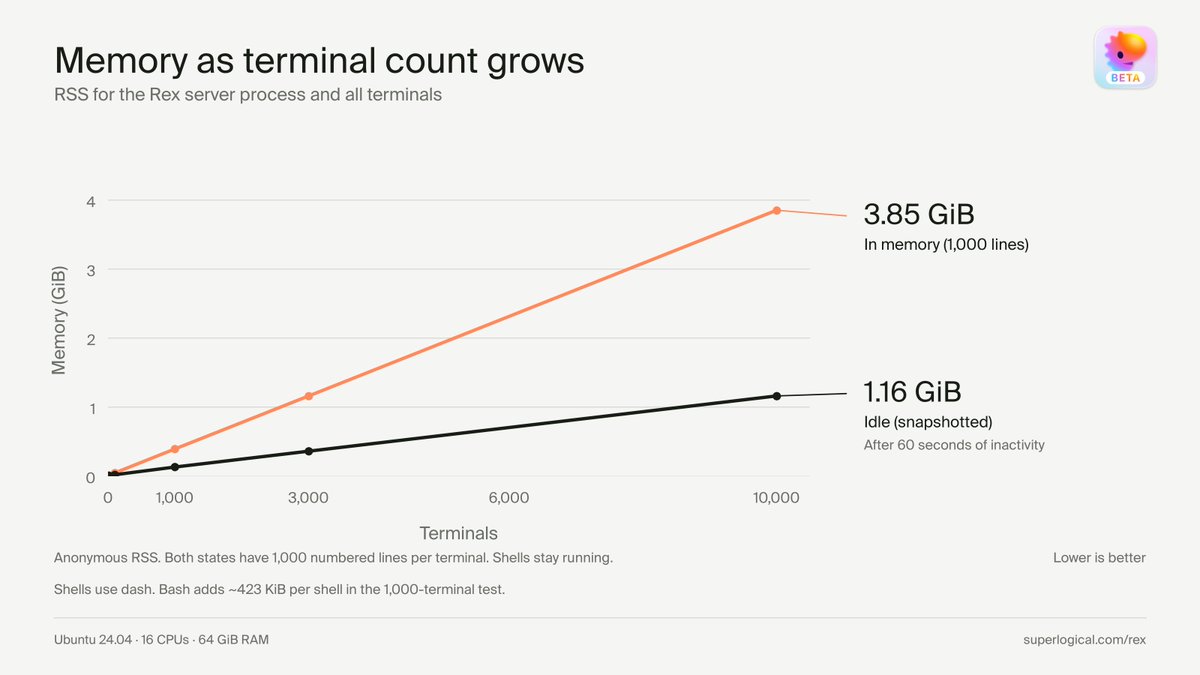
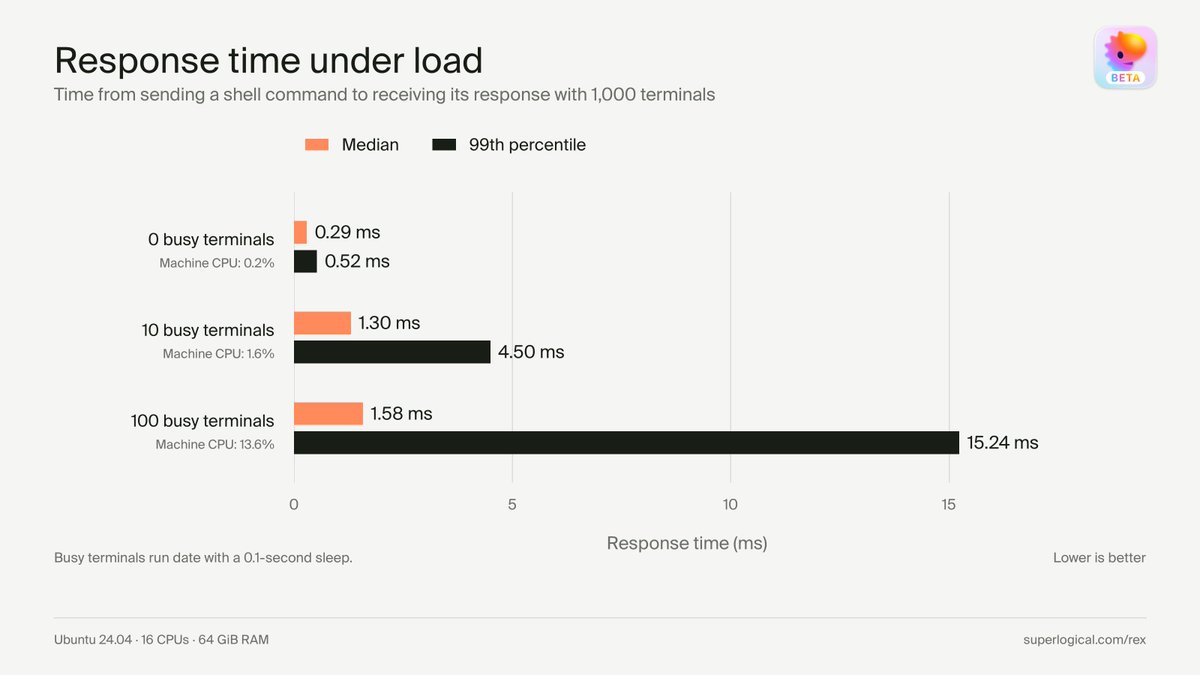
Been working hard on Rex server scalability. In short: we were able to run 10,000 active terminals simultaneously with 3.8 GB memory usage while maintaining responsiveness. We didn't try more yet, we want to improve some numbers before going bigger, but the goal is 100,000.
This wasn't free and to get to this point required a lot of very fun engineering challenges! Here are just a couple:
- Linux fork preallocates enough fd table space for the highest open fd at fork time to the nearest power of 2. For terminals beyond ~5000, that was 512KB per terminal process JUST for a fd table that had ~4 fds. We now use a trampoline written in C to unshare the fd table so it shrinks back down to fitting the minimum fds.
- We previously kept all active (non-snapshot) terminals blocked on pty read, but that takes up an OS thread which at this scale uses a prohibitively high amount of RAM. We now move all quiet pty fds (2 seconds without read activity) to a shared epoll thread.
I didn't compare to any other multiplexers at this time. I'm not particularly interested at this state to have relative numbers against others, because the enemy I'm trying to beat is myself. We'll continue to improve these numbers, these are still alpha-quality builds.
@EpistoAI Curious: How does it tell them apart when both run in the same terminal window?
Does it check which processes are running inside the focused window or just reads the window title?
Here's my technique for adversarial code review if I'm driving from Codex: "Review this with claude".
And when I'm in Claude: "Review this with codex".
Models know how to to kick off a review using the cli. Know how to take turns. Know how to settle an argument.
No magic.
NEW: @bot tagging just went live.
Reply to any post:
> @bot add this to my Notion reading list
> @bot remind me to read this tomorrow
> @bot summarize this thread
> @bot draft a reply to this
Works in replies, posts, quote and lands right in your Grok Bot.
What’s the first thing you’re handing it?