We built the Infrastructure Documentation Toolkit, a tool that brings together 28 infrastructure templates, 4 interactive checklists, 7 calculators, naming conventions, and quick reference tables:
https://t.co/i8udNaNDTV
Introducing wireless LAN support on Obelinf:
Every SSID you broadcast can now be documented as its own record, grouped by site or purpose instead of living only inside a controller.
You can give yourself a try for free at https://t.co/i495a5eQbb
Infoblox NetMRI reaches end of life on April 30, 2027, and its last order date has already passed.
We made a comparison of NetMRI alternatives for 2026: https://t.co/0aff51OUaQ
Claude just KILLED the old way of documenting servers on AWS
And I'm never going back.
Here’s exactly how I’m using Claude to document networks automatically 👇:
Most people still document infrastructure like this:
-> Create a spreadsheets with list of servers and IPs
-> Forget to update docs after every change
-> End up with documentation that’s outdated within weeks
And then when something breaks...
Nobody trusts the docs anyway.
THIS IS NOT how network documentation should work.
There’s a much easier way.
I built a system that lets Claude understand your infrastructure and keep your network documentation up to date automatically.
I’ve decided to share the whole setup:
→ How Claude connects to your infrastructure
→ How it discovers servers and network devices
→ How it understands relationships between them
→ How it generates structured documentation
→ How to keep everything updated automatically
I put the full playbook together so you can build the same setup 👇
https://t.co/T1ehvk8JzI
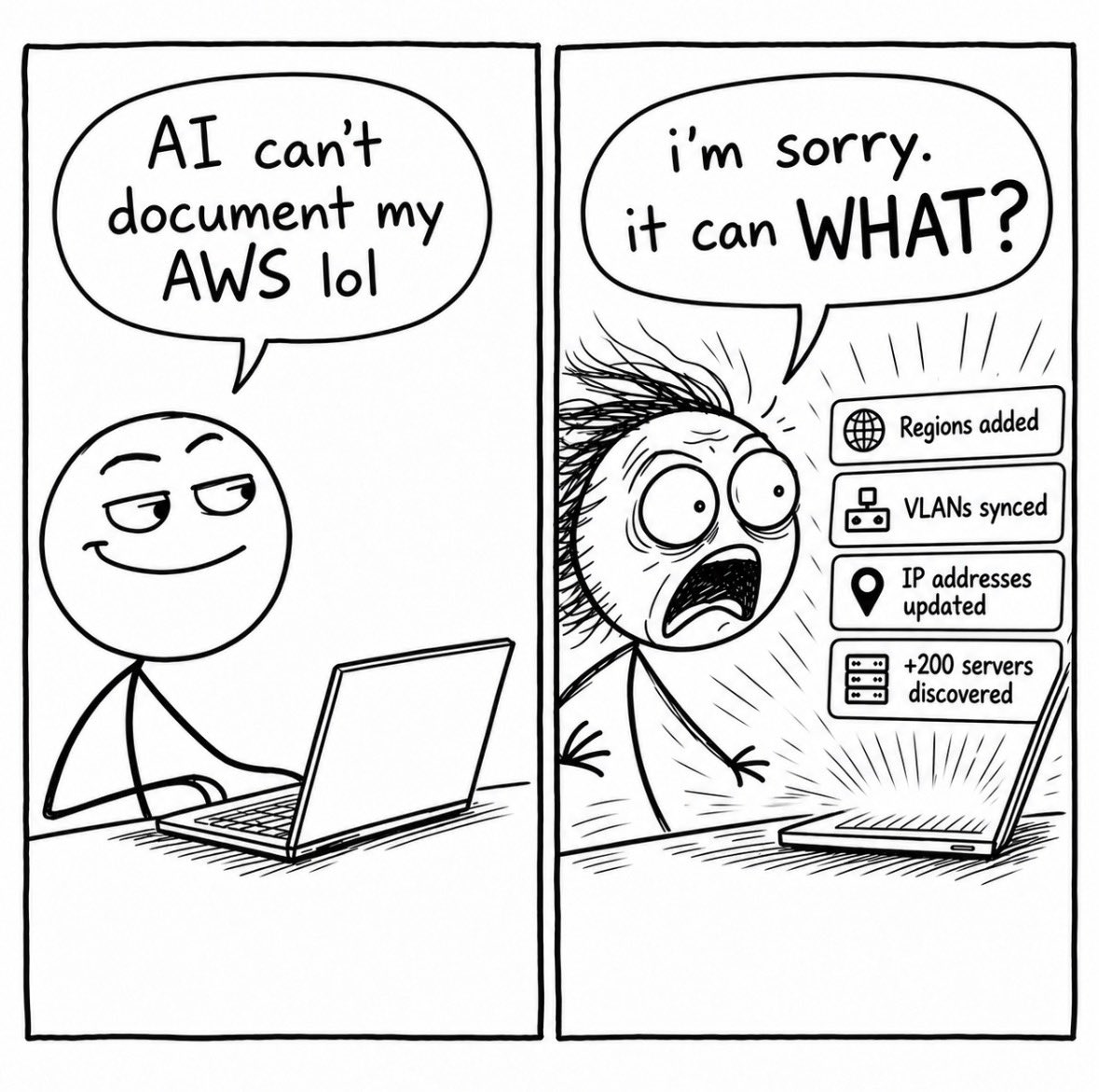
i'm sorry, Claude can WHAT?
it can connect to your AWS account, map your entire infrastructure and create a documentation of everything?
since when?? i've been doing this by hand for a YEAR.
ok. testing it: 👇
https://t.co/p9lY3U9sLo
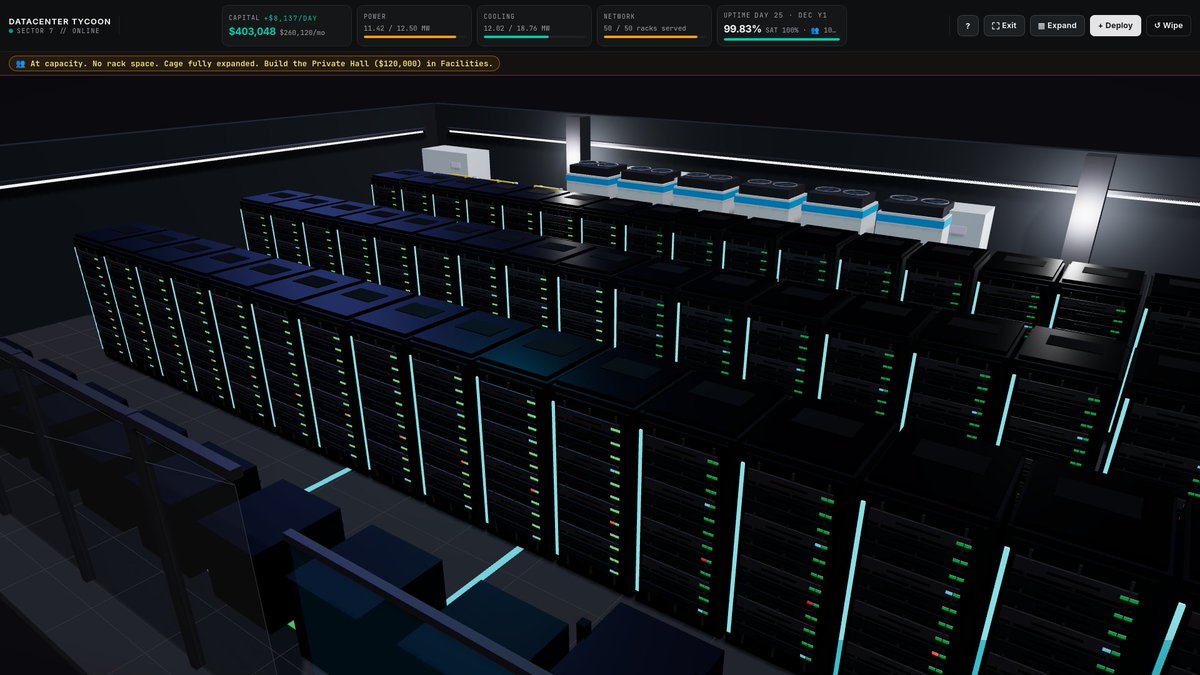
Today we are releasing Datacenter Tycoon:
Start in a garage with one server rack and grow a hosting business. Balance power, cooling, and network while surviving hardware failures, thermal runaways, and viral traffic spikes:
https://t.co/B54Abkzeva
Most infrastructure teams have used AI assistants for over a year now, yet their documentation still depends on someone pausing their real work to update a spreadsheet, because assistants had no standard path into the records that matter:
https://t.co/bav7TR2akW
AI assistants are only as useful as the systems they can reach, and for most network teams that reach stops at a chat window.
The MCP is changing that by giving assistants one standard way to discover and call the tools behind your infrastructure:
https://t.co/VjDbwGj16G
Retiring a server is rarely the single action it looks like from the outside.
Before the hardware leaves the rack, the machine still holds data, still appears in monitoring systems, and still occupies records that your team will rely on months later:
https://t.co/EmUaLD8erj
IP addresses get all the documentation attention, but the MAC address is the identity that actually follows a device everywhere it goes: https://t.co/kPUFfvcS3G
Few teams realize how much of their virtualization estate is undocumented until a compliance question, a capacity review, or a security incident forces the issue:
https://t.co/1GVj0gYE7K
Cloud providers now charge real money for every public IPv4 address, and more than half of the world's internet users are already reachable over IPv6, yet most enterprise networks are still planned as if the transition can wait another year:
https://t.co/1xGuNeRb7j
Rack capacity planning fails when it tracks only one dimension.
The five constraints of power, space, cooling, weight, and network ports are independent, and any single one of them can stop a deployment cold regardless of headroom in the other four:
https://t.co/KtfFE3kERA
Rack layout is one of those responsibilities that determines everything about your data center's operational efficiency, and it frequently gets less planning attention than it deserves:
https://t.co/EZMttK3mjc
Subnetting is a foundational skill that every engineer learns, but designing a subnet plan that actually scales across sites, environments, and teams over multiple years requires more than just knowing how CIDR notation works:
https://t.co/rqrG8cCvjy