🎉 Congratulations to our Newly Certified Members! 🎉
Your hard work and dedication have paid off. We celebrate your achievement and welcome you to the certified project management community. Keep shining!
From the Board and all members of PMI Ghana Chapter we say Ayeekoooo.
Famous funnyman, Trevor Noah, just shared that old story about how Uber got its fingers burnt in Nigeria.
It showed up & started dishing out fat bonuses to drivers per ride to boost uptake. At some point it started even giving bonuses to riders as well.
Before long, drivers figured out that they could create fake rider accounts, call themselves up, take quick rides, and keep scooping up bonuses.
Some then upped the ante. They installed GPS spoofing apps. Now, they didn't even have to move. You just park, rack up fake rides, grab bonuses till you taya, then go house & bed.
When Uber finally figured out the game, they were so shocked by the sheer scale that they suspended the incentives structure WORLDWIDE.
(Clearly someone at Uber didn't take his economics lessons seriously & probably never took the course on perverse incentives like "moral hazard," "Campbell's Law," "Goodhart's Law," & "Peltzman Effect." 🤦🏽♂️)
Now, Trevor is just trying to get us to have a good laugh at the expense of some too-smart-for-their-own-good Silicon Valley tech bros. Just like in some Akan & Caribbean communities, folks laugh at Ananse the spider when he gets tied up in his own schemes of trickery.
But then he used the word "ingenuity" to describe the drivers' actions. Which prompted a recall of my now fading stock of classical Greek learning.
You see, in ancient Greece, they distinguished between SOPHIA and METIS. Sophia was the stuff frequently translated as "wisdom." But we call "philo-sophers" and "philo-sophy" by those terms because "sophia" reflects the deeper use of intellect to solve problems one believes afflict the WHOLE SOCIETY. Metis is primarily about applying one's brain power to serve their own, or their group's, parochial problems or interests.
Simple enough distinction, but I argue that it is an essential device in the plot of every society's transition story.
In the 1000-year old Norse sagas, the Scandinavians begin very much with a cunning Ananse-like character called Loki. He was always the soul of all witty plays. He made the stories tick. Pure ingenuity!
Then he tricked someone to kill the god, Baldr, Lord of Light, truth, & beauty. Loki is finally unveiled as the chief enemy of the universe's progress.
Is it "ingenuity" if in the end it breaks the world?
����
The Akans does not have a unifying word like Sophia for the use of the intellect to advance collective progress. They have several.
But they do have a pretty compact word for the kind of low cunning used to "mumu" Uber. They called it "aniteɛ" - keeping one's eyes opened. It starts off being about shrewdness,in which form it is generally admired because it prevents others from taking one for a fool.
But soon, ANITEƐ becomes a barrier to sound cooperation in a complex society. A society with too much aniteɛ or metis struggles to get enough people to sacrifice - to "close their eyes" to certain self-interests - in order to advance greater collective smartness.
It is hard to quibble with the truism that in low-trust situations, defensive cleverness is essential. But how then would one ever start to build trust?
At any rate, too much individual cleverness can manifest in common solutions becoming dumber. Like why there are no pedestrian walkways in Accra Airport City because every real estate developer maximises the gain from every square meter of land.
To repeat: too much personal ingenuity can sometimes lead to less social intelligence.
I have observed a worrying trend where many groups are organizing award schemes for CEOs, institutions, Ministers, and other public officials.
Just as it happened under the previous administration, I have noticed that some State-Owned Enterprises (SOEs) are being listed or advertised as sponsors of these awards.
Respectfully, I believe it may be necessary for the Chief of Staff to issue a directive on this matter. Significant amounts of funds appear to be going into sponsoring such events, yet the direct benefit to the social contract we signed with the Ghanaian people remains unclear.
Some of these institutions could instead be encouraged to channel their Corporate Social Responsibility (CSR) resources into more impactful projects such as the construction of schools, AstroTurfs, drilling of boreholes, refurbishment of markets, and other community-based interventions.
Unfortunately, some institutions seem to be continuing the NPP tradition of sponsoring awards largely for the purpose of receiving plaques and recognitions that create the impression of performance.
Anyway… what do I know?
NB : Disclaimer- I do not know the sponsors of this particular awards yet but what does it even mean ? Do they know the KPIs of each Minister ? What is Best Ministers Awards… ? Mtcwwww
The only way Ghanaian doctors know to make any demand is to declare a strike even when they know or ought to know that patients and ordinary Ghanaians will bear disproportionate cost.
The last time organized Labour decided that workers should declare a strike for Galamsey, doctors decided galamsey wasn't worth declaring a strike, however suspending their colleague doctor for two weeks warrants one.
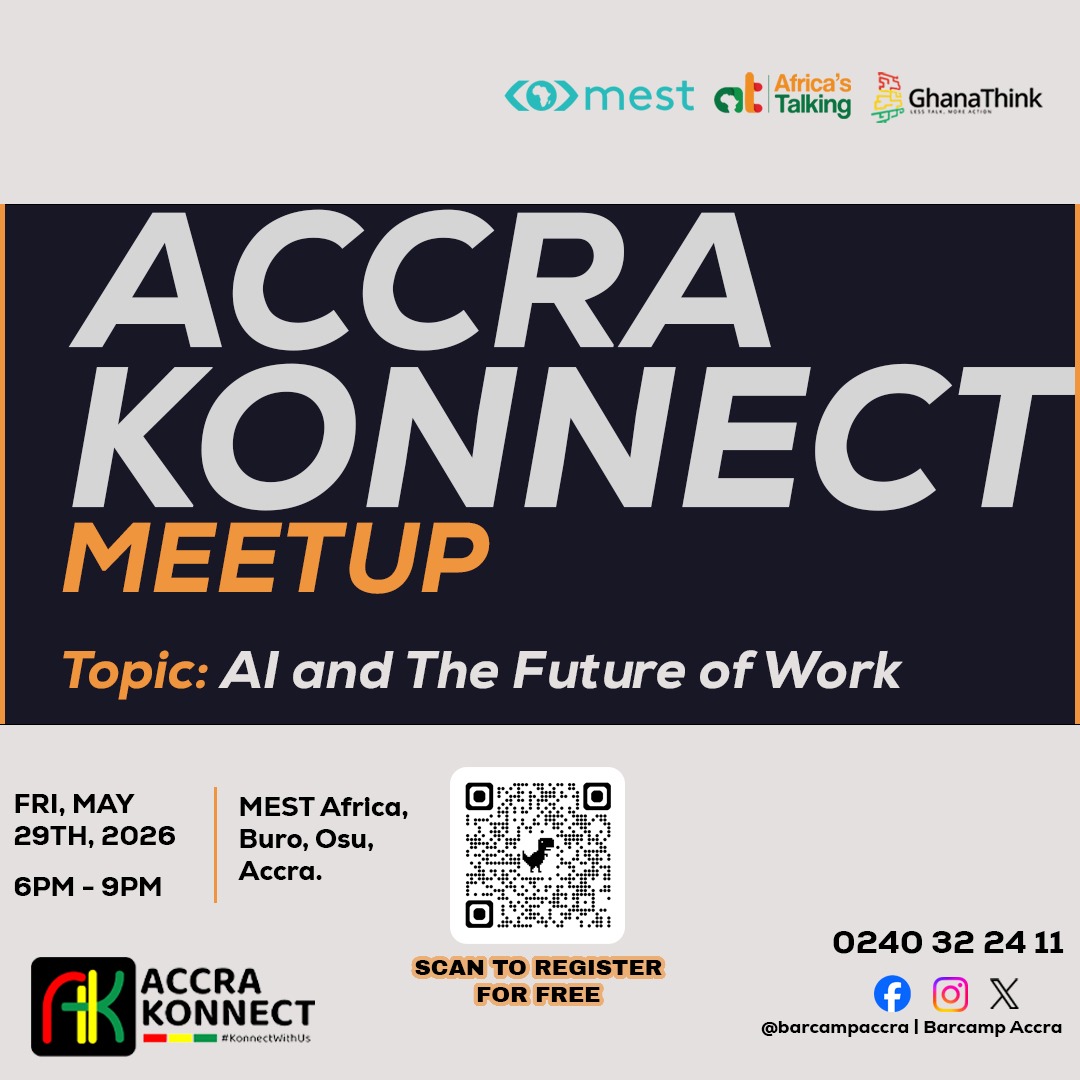
Accra Konnect Meetup - May 2026
Theme: AI & The Future of Work
Date: Friday, 29th May, 2026
Time: 6:00 PM GMT
Location: Buro, Osu, Accra.
It's free, register here: https://t.co/1QBnxJHOXv
Don't miss out!
Here's the thing.
Guys, if you want to make money in business, you have to understand that your main product is yourself, whether you sell goods or services; you're not the only one doing it.
Therefore, you are the best product on the market. Present yourself well, be prepared, reliable, and above all, punctual. Always do the right thing, never do what everyone else does. The right people will notice you. Good luck.
Regulation by Invoicing: The Systemic Flaws in NITA’s Licensing Push and the Threat to Ghana’s Digital Trust
By John Sitsofe Mensah , Technology Policy Analyst, IMANI.
9 mins read
The architecture of a nation’s digital economy relies entirely on the integrity of its regulatory frameworks. When the rules governing technological innovation are clear, predictable, and legally sound, Digital Public Infrastructure (DPI) thrives, and digital trust is established. However, when regulatory bodies bypass foundational legislation in favor of administrative bootstrapping, the entire ecosystem is placed at risk.
The recent push by the National Information Technology Agency (NITA) to mandate licenses for individual ICT professionals and general private tech businesses presents a textbook case of regulatory overreach. By leaning on the Fees and Charges (Miscellaneous Provisions) Act, 2022, and its subsequent 2023 Regulations to justify this sweep, NITA is attempting to extract a substantive regulatory mandate out of a consolidated financial instrument.
A rigorous analysis of the underlying issues, laws, and frameworks surrounding this development reveals structural legal contradictions, a glaring historical legislative void, and a reactive regulatory posture that threatens to stifle local innovation and erode the very digital trust the agency was established to protect.
*The Foundational Blueprint: Strict Statutory Boundaries*
To understand the current friction, one must examine the original 2008 regulatory architecture. NITA was established by the National Information Technology Agency Act, 2008 (Act 771), with a companion framework provided by the Electronic Transactions Act, 2008 (Act 772).
These laws were designed with a specific, corporate-focused regulatory intent:
- Infrastructure over Individuals: NITA was tasked with regulating the "provision" of ICT, managing networks, and ensuring quality of service at the enterprise level.
- Strict Licensing Limitations: Act 772 explicitly limits NITA’s certification powers to highly sensitive corporate services, specifically encryption and authentication.
- The Individual Prohibition: Most crucially, Section 38(1) of Act 772 contains an unambiguous, specific prohibition: "A licence shall not be issued or granted by the Agency to an individual."
Under the 2008 framework, a data analyst or software developer simply utilizing ICT infrastructure to practice their trade operates entirely outside NITA’s licensing purview.
*The Legislative Void and the Pivot to "Regulation by Invoicing"*
To operationalize a primary Act—especially one establishing a "Certifying Agency" with highly technical mandates—a detailed Legislative Instrument (LI) is legally required. Despite multiple drafts circulating over the years, no comprehensive, sector-specific LIs were ever formally enacted to operationalize NITA’s broad statutory mandates under the 2008 Acts.
Without an operational LI, NITA found itself holding broad enabling legislation but completely lacking the subsidiary legal tools required to actually execute its mandate. This legislative vacuum directly explains the agency's current reliance on the Fees and Charges (Miscellaneous Provisions) Act, 2022.
By sliding pricing schedules for "IT Professional Licenses" and broad business certifications into a general financial instrument, the agency engaged in administrative bootstrapping—hoping the authorization to collect a fee would be interpreted as the legal mandate to establish the regulatory regime itself.
This approach is legally flawed:
- The Fallacy of Revenue as Regulation: The Fees and Charges Act is a consolidated national pricing catalog. Passing a financial schedule that sets a price tag for a "Software Developer Certification" does not magically grant the agency the substantive legal authority to create or enforce that professional guild. Pricing does not equal permission.
- Hierarchy of Laws: A fundamental rule of statutory interpretation dictates that general laws cannot implicitly repeal specific laws. A line item buried in a general fees schedule cannot override the explicit prohibition against individual licensing found in Section 38(1) of Act 772.
*The Fallacy of the IT Guild: Why State Gatekeeping is Needless*
While legislative integrity demands that any move to regulate human capital must occur through rigorous primary legislation, we must ask a more fundamental question: Should the state be licensing IT professionals at all? Attempting to shoehorn the tech sector into a traditional, state-mandated professional guild is a profound misunderstanding of how the global digital economy operates. Creating a mandatory IT guild is entirely needless for two core reasons:
- Global Standards Already Exist: The IT sector is inherently borderless and already governed by rigorous, globally recognized standards. International certification systems—ranging from vendor-neutral accreditations like CISSP, CompTIA, and ISACA to vendor-specific credentials from AWS, Cisco, and Microsoft—are continuously updated to reflect the bleeding edge of technology. A localized, state-run certification system cannot hope to outpace or out-rigor these global benchmarks. Rather than mandating a redundant local license, policy should encourage and perhaps subsidize the acquisition of these internationally recognized credentials.
- The Meritocracy of Self-Taught Knowledge: Unlike medicine or law, the tech ecosystem thrives on decentralized learning and the open-source movement. A developer's competence is proven by their code repositories, their problem-solving logic, and their deployment history, not by a state-issued piece of paper. The sector is famously meritocratic, heavily relying on brilliant, self-taught innovators. Erecting a mandatory guild system risks disenfranchising these self-taught experts, creating artificial barriers to entry that will ultimately starve the local industry of talent.
*The Path Forward: Fostering Enablement Over Gatekeeping*
In 1865, as the first motorized vehicles emerged, the British Parliament panicked. To maintain control over a disruptive new technology, they passed the Locomotive Act—famously known as the "Red Flag Act." It required every motorized vehicle to be preceded by a man walking on foot, waving a red flag to warn pedestrians. While intended to create order, the law effectively strangled the British automobile industry in its crib, allowing nations with more enabling frameworks to leapfrog them.
Today, attempting to force the modern, decentralized IT sector into a localized, state-mandated licensing guild is the digital equivalent of the Red Flag Act. It imposes analog constraints on a purely digital frontier.
Furthermore, in structural engineering, there is an unforgiving truth: you cannot build a skyscraper on a foundation poured for a bungalow. You can add as many floors as you like, and you can paint the facade to look modern, but eventually, the structural reality will assert itself, and the edifice will collapse. The exact same principle applies to regulatory frameworks.
A regulatory regime built on the fragile foundation of a pricing catalog will inevitably fracture under the weight of actual enforcement and legal scrutiny.
To foster innovation and build enduring digital trust, Ghana does not need to mandate professional guilds via invoices. We require:
Regulatory Clarity: Agencies must operate strictly within the bounds of their enabling Acts.
- Incentivizing Global Competence: The state should encourage the use of rigorous, existing international certifications to raise the national skill floor, rather than forcing practitioners into a localized licensing trap.
- Transparent Recourse Mechanisms: The industry needs mandatory performance metrics and operational data publication from regulators to ensure accountability and prevent administrative overreach.
If Ghana is to build a secure, effective, and globally competitive digital economy, its regulatory foundation must be grounded in robust law and an architecture of enablement, not merely in a schedule of fees.
John Sitsofe Mensah is a Technology Policy Analyst with IMANI. @JoyNewsOnTV@Joy997FM@Nuetey@Citi973@Channel1TVGHA@STARRNEWS@starr1035fm@NiiMoiThompson@mocghana@samgeorgegh@Graphicgh@utvghana@starr1035fm@tv3_ghana@radiogold905fm@3fm927@AccraFM1005@gbcnews_@ghonetv@Citi973@Ghanaian_Times@Adomonline@onua951fm@OnuaTV@Peace1043fm @LuvFM995
Steve Jobs explains exactly why he thinks Microsoft makes "third rate products"
"The only problem with Microsoft is they just have no taste. They have absolutely no taste"
"I don't mean that in a small way, I mean that in a big way. They don't think of original ideas and they don't bring much culture into their products"
"Proportionally spaced fonts come from typesetting and beautiful books. That's where one gets the idea. If it weren't for the Mac, they would never have that in their products"
"I'm saddened not by Microsoft's success. I have no problem with their success, they've earned it for the most part"
"I have a problem with the fact that they just make really third rate products"