Agentic engineering is coming.
Not AI that chats.
AI that executes.
I just dropped a walkthrough on how to create and use agents on @TheKodeusLabs the right way.
Most people will build agents that try to do everything.
The smart ones will build agents that do one thing extremely well.
That’s the difference between noise and utility.
Execution > aesthetics.
Note: Using agents on Kodeus currently requires access from the team (beta phase).
Lock in on Kodeus 🔻
➙ Kodeus official X - @TheKodeusLabs
➙ Website - https://t.co/uz54MLZA2T
➙ Discord - https://t.co/gn8LyDxsM0
➙ Whitepaper -https://t.co/X61dL7fyDc
4/ The future of AI infrastructure shouldn’t be measured only by how many data centres a company owns or how much money it commits to long-term leases.
It should also be about accessibility, flexibility, and how efficiently available resources are used.
That’s the direction https://t.co/kdnjzTq5bM is building towards.
Build for today’s AI, without being locked into yesterday’s infrastructure.
AI is evolving too fast for infrastructure decisions to be built around decades of assumptions.
A GPU that makes sense today might not be the best option tomorrow. Workloads change, models evolve, and demand keeps shifting.
This is one of the reasons https://t.co/kdnjzTq5bM’s approach to distributed compute is worth paying attention to.
🧵
18 years.
That's the term on a $5.4B AI data center lease signed this week.
Now, think back just 18 months. The models, chips, and workloads were all different.
AI moves in weeks.
Infrastructure is being locked in for decades.
Builders shouldn't have to bet on 2044 to ship in 2026.
3/ This also creates another opportunity.
There are GPU resources sitting underutilized across the world. Connecting that supply with people who need compute can improve utilisation and create more efficient infrastructure.
There’s a lot of compute sitting around the world that could be doing useful work instead of collecting dust.
And that’s an interesting problem https://t.co/kdnjzTq5bM is helping to solve.
Not every company needs to build massive data centres or own thousands of GPUs. Sometimes, the smarter approach is making existing resources available to those who need them.
Better utilisation, wider access, and less wasted capacity.
The next phase of AI infrastructure won’t just be about who owns the most GPUs, but who makes the best use of them.
One of the biggest AI data centers on earth ran at less than half capacity last year.
It was @SpaceX's Colossus.
Now SpaceX rents that compute to Anthropic and Google, in deals worth billions a month.
Even the biggest builders end up with GPUs they can't use.
Idle compute is the most expensive kind. https://t.co/ZuybGWvjv9 puts it to work.
Big news Fam👀
Making powerful compute accessible is one thing. Making it easy for teams to actually use is another.
That’s what makes this move from https://t.co/kdnjzTq5bM interesting.
With IO Cloud now on AWS Marketplace, businesses can access high-performance GPUs through an ecosystem they’re already familiar with, without adding unnecessary friction to their workflow.
Sometimes, the biggest innovation isn’t just building more infrastructure, but making existing infrastructure easier to access.
That’s a step in the right direction.
The big AI story was who could lock up the most compute.
Now it's about who can reach it.
IO Cloud is live on @awsmarketplace.
B300, B200, H200, and H100s by the hour. Through the AWS account your team already uses.
That's how compute reaches the many, not the few.
https://t.co/aTVzop3Ez4
A Thanksgiving dinner for 10 costs $58.63 this year, about twice what it cost in 1986.
In gold it got cheaper.
One ounce bought nearly 14 of those dinners in 1986, and it buys about 66 this year.
One thing we shouldn't overlook as AI grows is who controls the resources powering it.
When a few companies control the infrastructure, everyone else has to play by their rules.
https://t.co/kdnjzTq5bM is exploring a different approach by bringing underutilized GPUs into a shared compute network where demand meets available supply.
Less dependence on a handful of providers, more room for builders to experiment and scale.
That's a shift worth paying attention to. $30M is only part of the story.
$47 billion in debt.
$10 billion due next year.
$1 billion in interest every quarter.
That's the cost of centralized AI compute.
There's a better way.
Use the GPUs already out there. Pay for what you use. Skip the lock-in.
And don't let your business ride on someone else's debt.
https://t.co/ZuybGWvjv9 is built for builders, not balance sheets.
This is what makes https://t.co/kdnjzTq5bM interesting.
The future of AI shouldn't depend on a few companies controlling all the compute resources.
We need infrastructure that gives builders, developers, and innovators more access, more opportunities, and room to grow.
$30M in network earnings is a solid milestone, but the bigger picture is what this represents for the future of decentralised AI.
We're still early👀
https://t.co/DCp3kvjsTY just passed $30 million in total network earnings.
Proof that AI compute doesn’t have to be controlled by a handful of giants.
AI infrastructure built for the many, not the few.
My bots kept agreeing with each other. That was the problem.
Who should make the call when you're not in the room? Not you, and not the crowd. Six prompts inside. https://t.co/PfQQwFIU9C
We raised $3.5M to build Claude for Ads.
Just enter your website, and Fastlane studies your market, makes thousands of ads, launches them, and learns from every result.
This is truly insane.
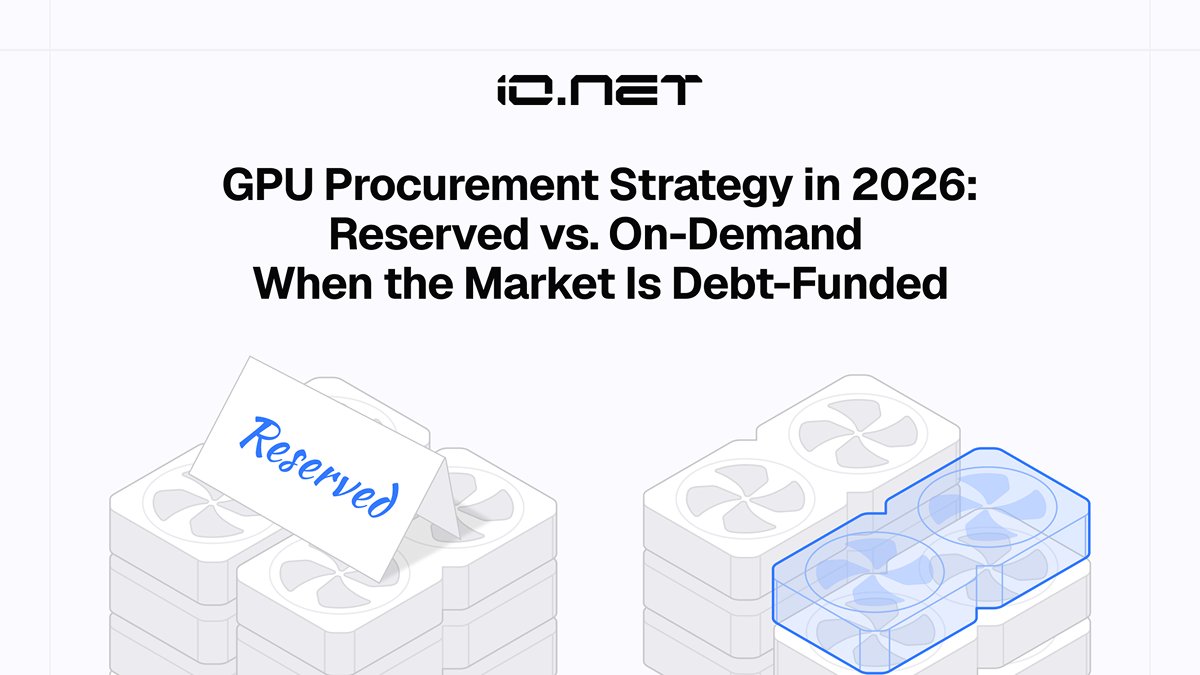
GPU demand is unpredictable, so locking into long-term capacity forecasts can get expensive.
@ionet lets you commit to your baseline and scale on demand when things change.
flexibility without paying for GPUs you aren’t using.
Most GPU contracts assume you can predict the next 12 months.
You can’t. Nobody can.
@ionet gives you on-demand capacity for everything above your baseline, so you stop paying for GPUs you aren’t using.
The framework for deciding how much to commit, and how much to keep flexible, is in the blog.