Just slapping ChatGPT on top of your systems isn't enough! 🤖 Turns out, you actually need humans for that crucial connective tissue. 🤔 But can AI *really* help bridge the IT/OT gap? We dive deep into the IoT Show! Full episode: https://t.co/zLM0z1L5nF #ITOT#AI#IoT
Still scratching your head about Industry 4.0? 🤔 David and Willem, the IT/OT Insiders, are here to break down the silos and guide you through the integration maze with their new handbook. Get the full scoop at https://t.co/zLM0z1L5nF #Industry40#ITOT
When a vendor's 'innovation' is just a new license model, it's a clear signal to reevaluate your tech stack. That's your cue to run and assess your options. #TechStrategy#VendorManagement
AI can't magically fix team silos, but it *is* changing how IT and Operations talk. Suddenly, IT wants to understand YOUR processes to build smarter agents. Mind blown? 🤯 Full episode on how to bridge the IT/OT gap: https://t.co/zLM0z1L5nF #AI#Tech#Collaboration
Industry 4.0 adoption is slow, and ROI is hard to define. What's holding it back? The core issues seem to be slowing progress and muddying the return on investment. #Industry40#Manufacturing
Hear me out: the edge AI era isn't going to be won by silicon specs alone.
Curious: when you're building AI applications today, what's the first metric you look at?
TOPS? Tokens/sec? Latency? Power? Cost? Tooling support?
My bet: five years from now, most developers won't remember the TOPS number on their laptop or edge device. They'll remember whether the stack actually helped them ship.
https://t.co/4szTiOw4pU
The convergence of AI and edge computing is reshaping the developer landscape in ways we couldn't have imagined just a few years ago. But with this rapid evolution comes both tremendous opportunity and significant responsibility.
I recently had a fascinating conversation with @alexis_susset , Chief Product Officer at @EdgeImpulse , that got me thinking deeply about the emergence of a new breed of developer: the edge AI developer. This isn't just a minor shift in skill sets—it's a fundamental transformation of how we approach intelligent systems.
You can check out the chat with Alexis before jumping into the thinking part: https://t.co/zegx7Pxrkb
Here's what makes this moment particularly interesting: we're witnessing the collision of two traditionally separate worlds. On one side, embedded developers who've spent years mastering microcontrollers, power optimization, and hardware constraints. On the other, data scientists and machine learning engineers who've been working in the cloud, dealing with massive datasets and powerful GPUs. These communities are now being forced to collaborate, and that fusion is critical.
The edge AI developer needs to understand both worlds. They need to know how to train a model, but also how to optimize it to run on a device with strict power budgets. They need to think about latency and bandwidth, but also about model accuracy and responsible AI implementation.
What concerns me—and should concern all of us—is the pace of adoption. We've seen this movie before with IoT. Remember when hundreds of thousands of IP cameras were compromised because security was an afterthought? The same risk exists with edge AI, perhaps even more acutely. When you're deploying AI models that make autonomous decisions at the edge, the consequences of poor security or irresponsible implementation can be severe.
The exciting part? We're moving beyond simple inference at the edge. Vision Language Models are already running on tiny devices, enabling them to not just detect objects but understand context. And the next frontier—Vision Language Action models—will enable devices to perceive, understand, and act autonomously. This combination of models working together, each highly tested and understood, creates a safety net that makes real-world deployment viable.
For organizations building edge AI solutions, the path forward requires investing in this new hybrid skillset. It means fostering collaboration between your embedded teams and your ML teams. It means prioritizing responsible AI practices from day one, not as an afterthought. And it means recognizing that the knowledge sharing happening in developer communities today is laying the foundation for the products we'll build tomorrow.
The edge AI revolution isn't coming—it's here. The question is whether we're building the right developer capabilities to harness it responsibly and effectively.
CC: @Qualcomm_Dev
Scaling physical AI breaks at production: prototypes work, then teams rewrite everything for incompatible SDKs, models, and control stacks. Join @Qualcomm's @obloch at this year's Embedded Vision Summit to see how Arduino VENTUNO Q removes this barrier: https://t.co/lbxSnnc5R0
.@obloch joined Marcello Majonchi on #ArduinoDays2026 for a conversation around the evolving landscape of IoT, the advantages of edge AI, and the role of Arduino in accelerating development from prototype to production.
Watch the full interview: https://t.co/fPYBHtexhz
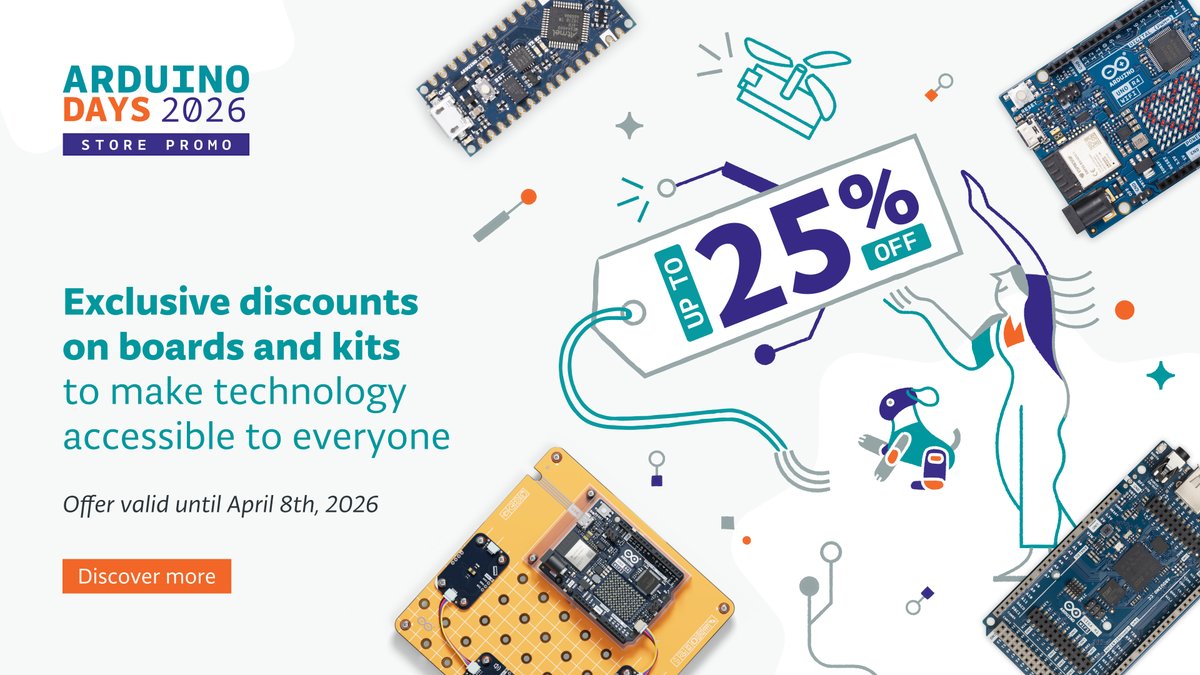
#ArduinoDays2026 is just around the corner and we want to ensure everyone has what they need to join the fun with exclusive discounts for the global community!
Get ready to celebrate with up to 25% boards and kits to empower your passion.
🎉 Shop now! https://t.co/qHTrYZ7Pc9
@SOHAMPATRA18 I'd say you'd need to at least understand all the parts involved, from embedded dev (OS, BSP, Bootloaders, debugging...), secure connectivity, device management through platforms. The rest would be "classic" devops tools (source control, automation, ...)
EmbedOps combines embedded systems with DevOps principles. DevOps emerged from mobile and web development to bridge the gap between development and operations. #EmbedOps#DevOps
Debugging embedded devices used to mean expensive hardware probes and complex tools. Scrutiny Debugger offers an open-source alternative—no hardware needed!
Full #IoTShow episode at https://t.co/nz6Q9ni31a
#EmbeddedDev#IoT#OpenSource