@crawled_blog That's why client email should be draft-only. Let the AI write it, then a human picks the account and hits send. No send access means no wrong-address surprises.
@vishwanath_tns The structure I'd use:
Goal
State (verified vs assumed)
Decisions, plus the option that lost
Tried and rejected
Open risks
Next step
Keep a running decisions log on top so old calls don't get argued again every session.
@SakshiSugandhi Easy fix: keep AGENTS.md as the one source of truth and make CLAUDE.md a single line: @AGENTS.md. Now both tools read the same rules.
One more thing: rules aren't project state. Keep a separate handoff file for what's done and what's next.
@sattyyouneed A handoff file in the repo works best. Before you switch tools, have the agent rewrite four things: the goal, what's done, what's next, and any traps it hit. Pair that with one shared AGENTS.md and a short decisions log.
@Slackwatercap The bots don't transfer. The files do. Give each agent a plain doc with its job and rules. Keep a decisions log (with what you ruled out) and a current-state file. Then test it: can a fresh session run things from those files alone?
@kr0der That hurts. Best fix is keeping memory in plain files in the repo, not inside one tool. Use AGENTS.md for rules (import it in CLAUDE.md), a PROJECT-STATE file updated each session, and a DECISIONS log. Switch models anytime and it all comes with you.
Has an AI ever said "done" when it wasn't?
The AI Memory & Handoff Kit has a done-gate checklist and 10 review prompts that make it show proof. Plain text files you own.
Launch code LAUNCH20: $14 instead of $19 for the first 20 uses.
https://t.co/OWyFhCcbJr
Every new AI chat starts from zero.
Keep a short text file: what the project is, where you stopped, what's next. Paste it at the start of the next chat.
And before the AI says "done", ask it to show proof. The command it ran and the output.
@UberVero Email isn't going anywhere, so I'd split the job.
Let a tool write first drafts and flag the risky ones, like bank detail changes or odd invoices. Sending stays human.
Approving a good draft is faster than cleaning up after a bad one already went out.
@JoCryptoTech The auto-learning is the part I'd fence off.
Keep your rules and decisions in short plain files you write yourself, under git. The agent reads them but doesn't rewrite them.
If something breaks, it's one revert instead of no way back.
@pradyum1916 Keep the context in files both tools read.
AGENTS.md for rules (CLAUDE.md just imports it), a state file with what's done and next, and a decisions file with what you ruled out.
Before you switch, have Claude update the state file. Codex reads it first.
@hirenthakore The piece most setups miss is a decisions file with the rejected approaches and why.
Plus a short state file rewritten each session, re-injected after compaction with a SessionStart hook (matcher "compact").
That stops a fresh session from re-proposing a dead end.
Three emails I never act on without checking first:
1. Someone wants to change bank or payroll details.
2. An "updated invoice" nobody mentioned.
3. A gift card or wire request.
Call the sender on a number you already have. A real vendor won't mind.
Draft Desk 2.0 doesn't guess.
Same email in, same draft out. Every draft shows which template it used and which words matched.
Mac, Windows or Linux. Launch code LAUNCH20: $10 instead of $15 for the first 20 uses.
https://t.co/uj1YjUzmzB
¿Cansado de volver a explicarle tu proyecto a la IA en cada chat?
Kit de Memoria y Traspaso para IA: 3 archivos y unos prompts. Ya en español.
Código LAUNCH20: $5 de descuento ($19 a $14) para los primeros 20 usos.
https://t.co/8Natzm3zhP
Some emails shouldn't get a reply.
Draft Desk 2.0 skips bank-detail changes, wire requests and gift card asks. It lists them with the reason so you check them yourself.
Launch code LAUNCH20: $10 instead of $15 for the first 20 uses.
https://t.co/tCYPd7fVbP
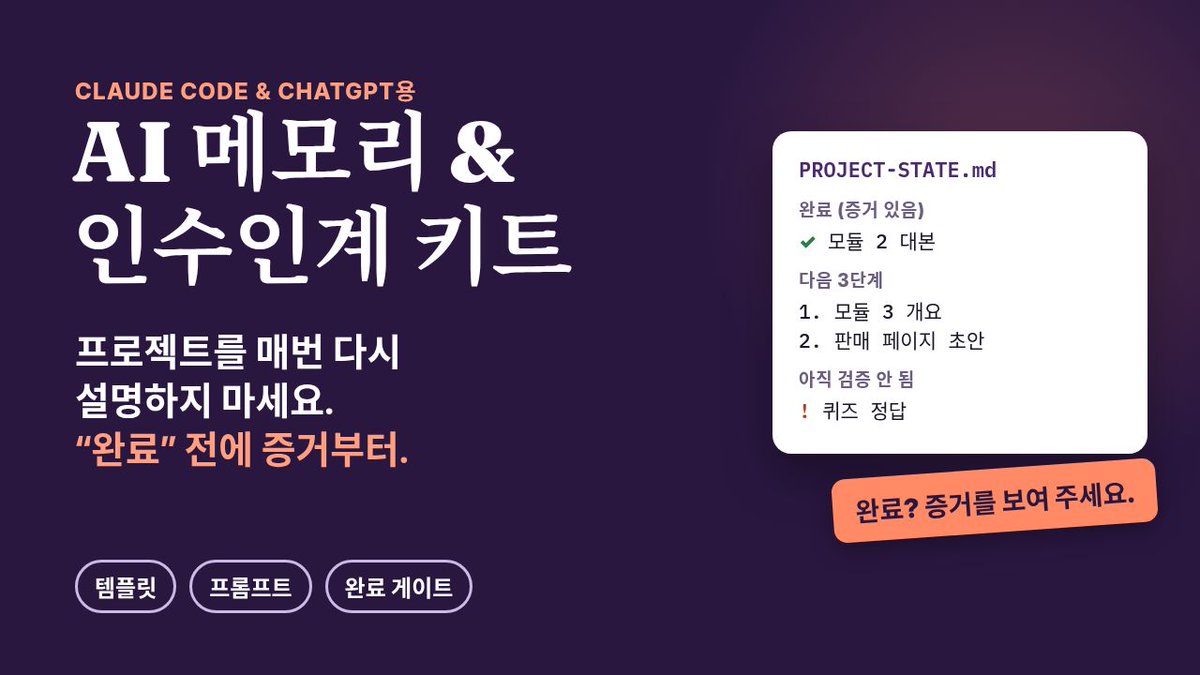
새 AI 채팅마다 프로젝트를 다시 설명하고 계신가요?
AI 메모리 & 인수인계 키트: 파일 3개와 프롬프트로 Claude와 ChatGPT가 지난번에 멈춘 곳에서 바로 이어갑니다.
런칭 코드 LAUNCH20: 처음 20회 사용까지 $5 할인 ($19 → $14)
https://t.co/fkkbXmdrgo
@notmissing_ Agree. The handoff note works even better with a fixed format:
Done
Left
Files touched
Decisions + why
Next first step
Then open the next session with one line: "Read HANDOFF.md and tell me the next step before you touch anything."
No AI. No subscription. No internet.
Draft Desk 2.0 is a small program that runs on your own computer. Your emails never leave it.
Launch code LAUNCH20: $10 instead of $15 for the first 20 uses.
https://t.co/BtjR4hQ5Ge