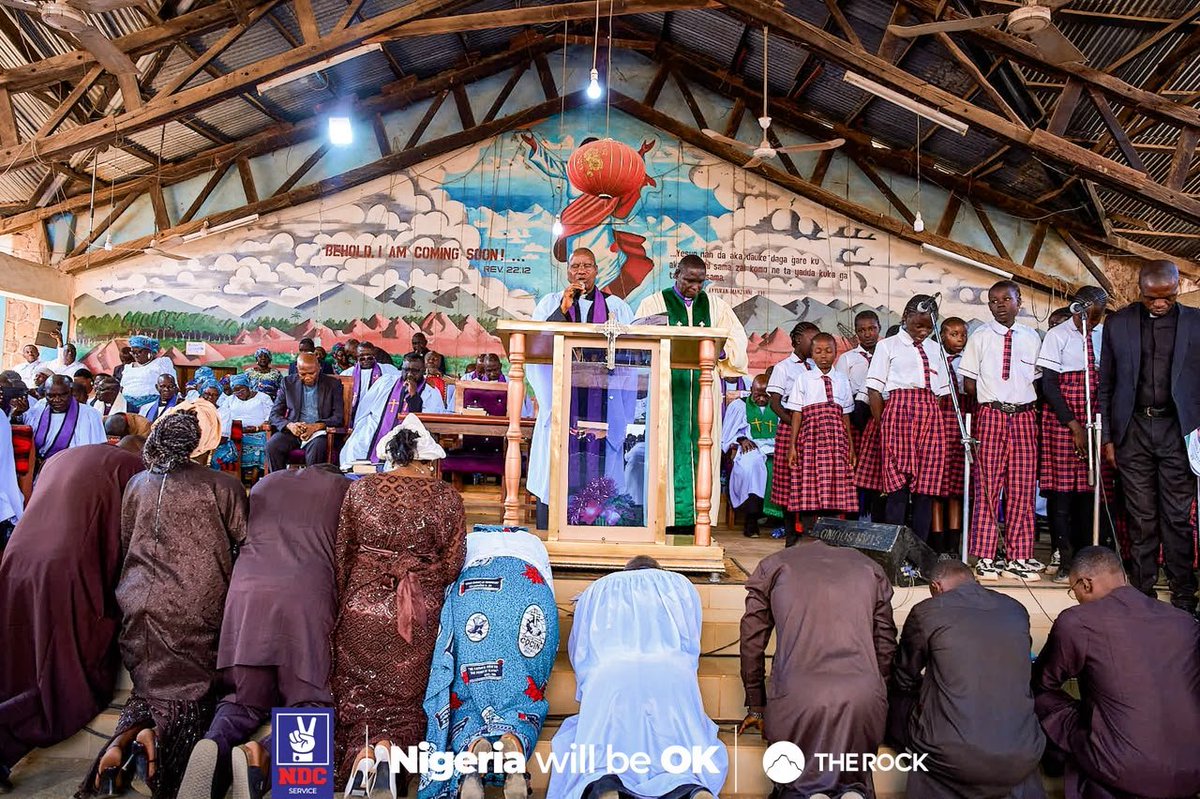
Leadership Beyond Identity: The Courage to Serve and Defend Humanity.
Yesterday, I was honoured to attend the retirement service of Reverend Ezekiel Dachomo in Plateau State. Although it was my first opportunity to meet him personally, I have long admired his courageous advocacy, his compassion for victims of violence, and his steadfast dedication to truth, justice, and the sanctity of human life.
Rev. Dachomo’s example reminds us that faith is expressed not only through what we profess in places of worship, but also through the courage to protect the vulnerable, challenge those in power with the truth, and uphold what is right, even when doing so is difficult or unpopular. The conclusion of formal service should not mark the end of one’s commitment to truth, justice, and humanity.
I also used the occasion to consider the leadership and choices Nigeria requires. Those who support me should not do so because I come from a particular tribe, belong to a particular religion, or benefit from personal sentiment. Their support should be based on my record, character, competence, and the principles I have consistently demonstrated in public service. Nigeria must move beyond identity-based politics and assess leadership according to the ability to deliver results, the integrity to account for public resources, and the compassion to serve those who depend most on government.
Our faith, ethnic identities, and political affiliations must never be used to divide us. Instead, they should reinforce our common humanity and our shared duty to create a nation in which every Nigerian, regardless of background, can live with peace, dignity, and opportunity.
I remain firmly convinced that Nigeria does not lack resources or potential. What we require is leadership that recognises public office as a responsibility rather than a privilege, and as a call to serve rather than an avenue for personal enrichment.
May God continue to strengthen Reverend Ezekiel Dachomo and all who, in their respective callings, remain steadfast in upholding truth, justice, and the dignity of every human being. May He also grant us the wisdom and courage to build the Nigeria we all deserve.
A New Nigeria is POssible. -PO
𝐊𝐕𝐀𝐑𝐀𝐓𝐒𝐊𝐇𝐄𝐋𝐈𝐀 𝐒𝐄𝐍𝐃𝐒 𝐀 𝐁𝐄𝐀𝐔𝐓𝐈𝐅𝐔𝐋 𝐌𝐄𝐒𝐒𝐀𝐆𝐄 𝐓𝐎 𝐃𝐄𝐒𝐈𝐑𝐄 𝐃𝐎𝐔𝐄 🥹
“Stay strong, my brother. We’ll get through this together. Soon we’ll be back on the pitch, smiling and doing what we love most. We’re all with you” 🙏❤️
𝑩𝒓𝒐𝒕𝒉𝒆𝒓𝒔 🫂
How FC Barcelona Saved Football by Treating Lionel Messi with Growth Hormone
Leo Messi, then 13, played for Newell's Old Boys when a move to Buenos Aires giants River Plate fell through. A routine medical revealed hormonal problems affecting his bones, linked to a mild form of dwarfism.
At the time, Messi was just 4 ft 8 in tall. When Newell's refused to pay for treatment, his family sent him to relatives in Spain, where FC Barcelona arranged a trial.
Despite his small stature, Messi scored five goals against older boys and was offered a contract on the spot. Barcelona covered the cost of daily hormone injections his family could not afford alone.
Messi was diagnosed with growth hormone deficiency after appearing smaller than peers. Treatment required regular injections for years at $900–$1,000 a month.
His family and Newell's Old Boys initially contributed, but long-term costs remained a barrier that ability alone could not overcome.
After watching Messi in 2000, FC Barcelona offered him a place at La Masia and covered the rest of his treatment when he moved to Spain at 13.
This was riskier than a typical youth signing: backing an undeveloped teenager with no senior experience while funding ongoing medical costs. It kept him on a professional path.
Fast forward to the future, Leo Messi became both FC Barcelona’s and football’s greatest player. FC Barcelona saved football.