Under Mandel v. Bradley (1977), a summary, unsigned ruling merely agrees the specific facts at issue satisfied the judgment; it carries no broader precedential reach outside that mix.
A Union County inmate is challenging the law banning the possession of child sex dolls and computer generated child sex material.
More on our efforts to uphold this law and protect Kentucky's kids: https://t.co/k6nDqfQkLf
Trump needs to think more and talk less:
"Italy's foreign minister cancels US visit over Trump's 'serious and offensive' remarks"
There are a number of reasons when offending our European allies is not only justified, but also necessary. One among many, is the failure of many European countries to pull their weight in NATO. Another, is their attempt to control what can be said by Americans on American social media platforms. However, offending our allies because of Trump's ego is not one, yet here we are.
According to Fox, Trump told an Italian news outlet that Italian PM Meloni "begged" him to take a photo with her during the G7. Trump's actual words: "She wanted a picture with me so badly. I wouldn't have taken it, but I felt sorry for her...She's probably happy I talked to her. I didn't have to talk to her."
What a moronic statement. Even if Trump truly feels this way, what good does it do to say it publicly? Honestly, because Trump wanted to show people how great he is, he created a friggen international incident with one of the few countries in Europe who have supported us in many areas, not all, but many.
I wish Trump would talk about Iran like he talks about Israel and Europe, and talk about Israel and Europe like he talks about Iran. At least then the only ones offended would be the Iranian regime.
Trump has a lot of great policies he says he wants to implement. Now's the time to concentrate on implementing them. In other words, he needs to stop over promising and under performing. He definitely needs to stop talking about himself.
Silver figurine depicting either a dragon or a tiger, XVIII century, China.
Written on the back is a the Chinese idiom that literally means "to flaunt military might" and is used to describe someone who is arrogant, boastful, or tries to intimidate others by showing off their strength or authority.
John D. Rockefeller called her “that poisonous woman.”
He had reason to fear her.
Because Ida Tarbell did something almost nobody had successfully done before:
She documented, piece by piece, how the richest corporation in America quietly built its empire by crushing everyone beneath it.
And she did it so carefully that even Standard Oil could not truly deny what she found.
Ida Tarbell did not approach the story as a detached outsider.
She grew up inside the Pennsylvania oil fields during the violent early years of the American petroleum boom. Her father, Franklin Tarbell, was one of thousands of independent oil producers trying to survive while Standard Oil steadily swallowed the industry.
At first, small oilmen believed competition would decide who survived.
Then Rockefeller changed the rules.
Standard Oil secretly negotiated railroad rebates that gave the company enormous shipping discounts unavailable to smaller competitors. Worse still, the railroads often charged independents extra fees and quietly funneled portions of those payments back to Standard Oil itself.
The result was devastating.
Independent producers could not compete with prices artificially manipulated against them.
Businesses collapsed.
Towns declined.
Families lost everything.
Tarbell watched it happen as a child.
Her father barely survived financially.
One of his business partners eventually killed himself under the crushing pressure surrounding the industry.
Ida never forgot any of it.
But instead of reacting with public fury, she became something far more dangerous:
A meticulous journalist.
By the time she joined McClure’s Magazine at the turn of the twentieth century, investigative reporting was beginning to transform American journalism. Tarbell believed the most powerful stories were not built from outrage alone, but from evidence so overwhelming nobody could dismantle it afterward.
So she began investigating Standard Oil.
And she worked like an accountant assembling a criminal case.
Court filings.
Railroad contracts.
Internal company memoranda.
Corporate records.
Testimony from former executives.
Government documents.
Thousands upon thousands of pages copied by hand because modern research tools did not yet exist.
She traveled constantly between Cleveland, Pittsburgh, and Washington gathering material.
Then came one of the strangest parts of the entire story.
Henry Rogers — one of Standard Oil’s top executives and one of the most powerful businessmen in America — agreed to speak with her repeatedly over the course of nearly two years.
He genuinely seemed to believe he could manage her.
Charm her.
Control the narrative.
Perhaps he assumed a woman journalist would eventually soften the conclusions.
Instead, Tarbell simply kept gathering facts.
Then in November 1902, McClure’s began publishing The History of the Standard Oil Company.
Nineteen installments.
Running through May 1904.
The writing itself was not explosive in tone.
That was the brilliance of it.
Tarbell did not rant.
Did not exaggerate.
Did not perform outrage.
She simply laid out, calmly and methodically, how Standard Oil used predatory pricing, secret transportation deals, intimidation, and systematic market control to destroy competitors across the oil industry.
Readers were horrified precisely because the prose sounded so controlled.
The evidence spoke for itself.
And the impact was enormous.
Public anger toward monopolies suddenly crystallized into political momentum. President Theodore Roosevelt — already moving against powerful corporate trusts — drew heavily upon the climate Tarbell helped create.
Then came 1911.
The United States Supreme Court ruled in Standard Oil Co. of New Jersey v. United States that the company violated the Sherman Antitrust Act and ordered it broken apart into 34 separate companies.
Those fragments later became corporations like ExxonMobil, Chevron, Marathon, and ConocoPhillips — companies still among the most powerful in the world today.
And Rockefeller himself?
He publicly refused to engage with Tarbell.
“Not a word,” he reportedly instructed his associates. “Not a word about that misguided woman.”
He understood something important:
Arguing with her only gave her findings more oxygen.
Because nobody could truly disprove the documents.
So critics attacked her personally instead.
They called her bitter.
Vindictive.
Difficult.
Emotional.
Almost never inaccurate.
That distinction mattered.
Ida Tarbell spent the rest of her career carrying a strange reputation:
Deeply respected.
Rarely embraced.
She wrote sixteen more books and became one of the most influential journalists of her generation. Yet in private letters, she sometimes admitted feeling that admiration did not always translate into belonging.
Perhaps because she had exposed something many powerful people preferred to keep hidden:
How quietly enormous systems can be built through manipulation that looks almost invisible while it is happening.
And maybe that is why Ida Tarbell still matters more than a century later.
Because she proved journalism does not always require dramatic speeches or public theatrics.
Sometimes the most dangerous thing in the world is simply a patient person with enough evidence.
She did not write to be liked.
She wrote so the record would exist.
And once it existed, even Rockefeller could not erase it.
Americana Quiz for June 17, 2026.
In the Civil War the first naval battle between "iron clad" ships in history occurred at Hampton Roads, Va. Everyone knows the Union ship was the USS Monitor, but what was the name of Confederate ship?
The Americana Quiz for June 16, 2026 is closed and the answer is...9
A 🧵
1/5
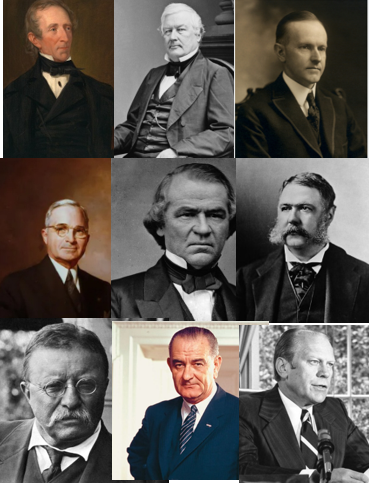
Four Vice-Presidents ascended to the presidency after the President died of natural causes while in office.
Four became President when the President they were serving under were assassinated.
One became President when he was appointed to replace the sitting Vice President who resigned, and then became President about a year later when the sitting President resigned.
Alito argues that schools cannot just wave the magic wand of "government speech" to strip away individual student rights whenever they disagree with a viewpoint.
https://t.co/3zkWErvtya
By declaring devices obscene, Georgia declared the devices as speech. It's difficult to think of a reason the defense didn't point that out. To the extent the devices might have been found obscene, Jenkins v Georgia took a nap.
Under Mandel v. Bradley (1977), a summary, unsigned ruling merely agrees the specific facts at issue satisfied the judgment; it carries no broader precedential reach outside that mix.
A Union County inmate is challenging the law banning the possession of child sex dolls and computer generated child sex material.
More on our efforts to uphold this law and protect Kentucky's kids: https://t.co/k6nDqfQkLf
Brennan pointed out a procedural forfeiture or a waiver of the argument.
"Even if devices might in some circumstances be protected by the First and Fourteenth Amendments, this is not the case here
since no claim is made
that the devices are in any way expressive."
The Swedish government told her she owed 102% of her income in taxes. She was 68 years old, a children's book author, and held no political power. Yet, by writing a simple fairy tale, she helped topple a government that had ruled for 44 years.
Stockholm, 1976.
Astrid Lindgren opened her mail to find a tax assessment that defied logic. As Sweden’s most beloved author and the creator of Pippi Longstocking, her books had taught generations of children about courage, independence, and standing up to bullies. Now, she had to face a broken system of her own.
She read the document carefully, did the math, and realized the truth: due to a quirk in the law that combined regular income tax with self-employment fees, her marginal tax rate had hit 102%.
It was not a typo, nor was it a rounding error. One hundred and two percent.
If she paid what they demanded on her extra earnings, she would owe more than she actually made. She would literally go into debt for the privilege of working.
At 68 years old, she could have hired expensive accountants to quietly find loopholes and protect her wealth. She could have done what many powerful people do when systems overreach—safeguard her own position and leave everyone else to figure it out alone. Instead, she picked up her pen.
In March 1976, she published a satirical fairy tale in Expressen, a major Stockholm newspaper. It was called "Pomperipossa in Monismania" (Pomperipossa in Money-mania). It told the story of a successful author who loved her country and worked hard, only to discover a tax system designed to punish honesty and success.
The story was witty, precise, and impossible to misread. Pomperipossa was Astrid; Monismania was Sweden.
The ruling Social Democratic Party—which had governed Sweden for over forty consecutive years—was furious. Prime Minister Olof Palme went on the defensive, dismissively claiming in public that Lindgren was a wonderful storyteller but a terrible mathematician.
Astrid didn't back down. She stood by her numbers, and soon enough, the Ministry of Finance was forced to admit that her math was completely correct.
She began appearing on television and speaking out publicly, pointing out—with the calm, steady patience of someone used to explaining things to people who aren't listening—that a tax system taking more than 100% of a person's earnings wasn't progressive. It was absurd.
That September, Sweden held its national elections. For the first time in forty-four years, the Social Democratic Party lost power. While political analysts pointed to several contributing factors, like economic stagnation and inflation, everyone acknowledged that Astrid Lindgren’s tax revolt had fundamentally shifted the national conversation. She had made it safe to question a system that once seemed untouchable, giving a voice to frustrations millions of people felt but hadn't known how to articulate.
The new coalition government reformed the tax code, cutting the most extreme rates, and Astrid quietly went back to writing children's books.
But she never stopped paying attention. In the 1980s, when Sweden debated a new animal protection bill, she noticed loopholes that would still allow for cruel factory farming practices. She wrote articles, lobbied politicians, and testified before Parliament well into her eighties. In 1988, Sweden passed some of the strongest animal welfare laws in the world. It was widely nicknamed "Lex Lindgren" (Lindgren's Law) because everyone knew she was the driving force behind it.
Astrid Lindgren passed away in January 2002 at the age of ninety-four. Sweden honored her with a state funeral attended by the Royal Family and the prime minister, while thousands lined the streets of Stockholm.
But her true legacy lives on far outside of official ceremonies. Every child in Sweden still reads her books, every debate about fair taxation still references Pomperipossa, and animal welfare advocates across Europe still look to Lex Lindgren as proof of what is possible.
She never ran for office, nor did she ever build a formal political movement. She had no credentials in economics or public policy—just an extraordinary gift for storytelling. But she had spent decades writing about Pippi Longstocking, a girl who refused to follow rules that didn't make sense, stood up to bullies, and never shrank herself to make others comfortable.
Astrid Lindgren simply chose to live her life exactly like the hero she created. When authorities insisted that nonsense made sense, she refused to pretend along with them. And because she spoke up, the world listened.
The Americana Quiz for June 12, 2026 is closed and the answer is...1,700 to 2,000, though some outlier estimates place the death toll at 3,000 or more.
A 🧵
1/5
On December 19th, 1777, more than 12,000 Contential troops along with 400 women and children marched into Valley Forge, Pennsylvania and built about 2,000 log huts, transforming the area into essentially the fourth largest city in the colonies at the time. The Contential Army would remain in their winter encampment until June 18, 1778.
Contrary to popular belief, the army that marched into Valley Forge in 1777 was not downtrodden and disillusioned, but instead exhausted and poorly supplied. However, by all reports they had a sense of purpose and belief in themselves that they could defeat the British.
One Year Ago Today: "Most modern prohibitionist propaganda is based upon depicting the prostitute as a mentally inferior creature whose statements about her own thoughts and feelings cannot be trusted." https://t.co/9W7Z9CkORJ
BREAKING: Elon Musk has become the world's first trillionaire.
After SpaceX raised a record $75 billion in its IPO, Musk’s net worth shot up to top $1.1 trillion when the stock began trading Friday, putting him in an economic class of his own.
Combined with his holdings in electric vehicle maker Tesla, as well as other investments and assets, Musk's net worth is now estimated at about $1.1 trillion.
Musk's stake in the rocket and satellite company alone is now estimated at a staggering $690 billion, but it's also a life-changing moment for thousands of workers at the company who hold equity.
Investors who watched Musk help turn Tesla into an automotive giant are now betting he can do the same in space and artificial intelligence, as SpaceX launches the largest IPO in history.