Solving real-life problems often requires solving several smaller (still complex) problems. A one-step-at-a-time approach. Here is one solid step, with important applications to many other real-life problems such as search and rescue operations or oil spills.
Trash at the ocean surface swirls in giant ocean currents, caught up in huge garbage Patches. New research can help aid in the cleanup.
Read the full story: https://t.co/jhCTLyZfOP
@ocRoDu
Image Credit: Matthew Chauvin.
6/6 While this is just the first step, it opens exciting new possibilities for ocean prediction science. Full paper (open access): https://t.co/mcHNjn8XoX
#OceanScience#FluidDynamics
1/6 Excited to share our newly published method for improving oceanic trajectory simulations! 🌊 This breakthrough enhances tracking of drifting objects for search & rescue operations, oil spills, plastics, sargassum, and even atmospheric smoke dispersion.
5/6 We hope this research can assist agencies like @NOAACleanCoasts and @USCG in enhancing their operational forecasting capabilities for oil spill response and search & rescue operations. We are ready to collaborate on practical implementations.
That’s all for this thread!
Consider reading the peer-reviewed paper at
https://t.co/rcZLFmUaXj
Consider following @ocRoDU for more insights into our oceans, brought to you from the frontiers of what we know and a bit beyond (scientists are explorers in the realm of knowledge).
New study significantly advances our understanding of sea-surface objective saddle points—as introduced by @Mattia__Serra & @GeorgeHallerETH in 2016—a collaboration with Luca Kunz, Alexa Griesel, Carsten Eden and Bruno Saint-Rose
https://t.co/rcZLFmUaXj
A thread on some results📜
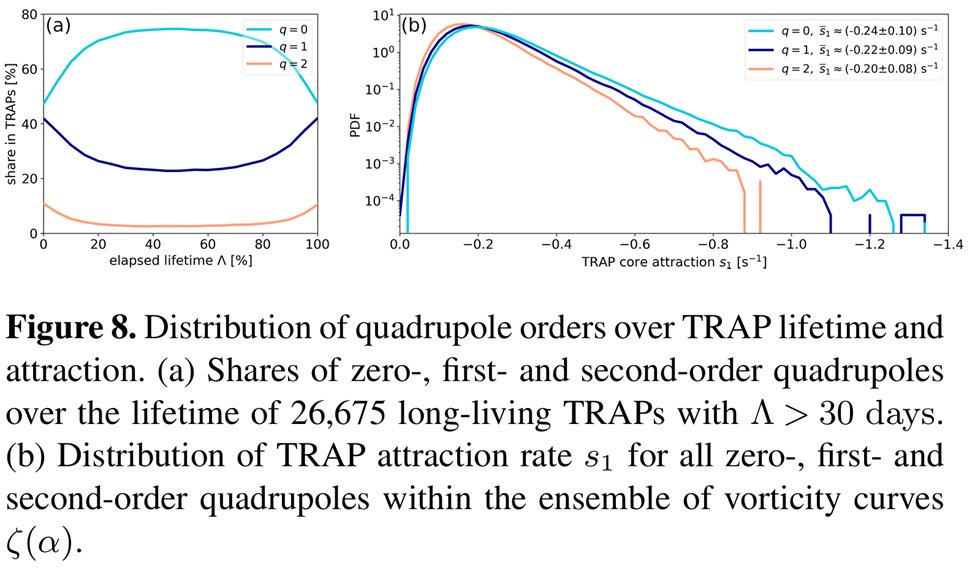
Regarding vorticity polarities around TRAPs, q=1 and q=2 TRAPs tend to become q=0 as they mature, but the share of q=0 TRAPs concedes to q=1 and q=2 as they decay. Attraction strength is strongest for q=0 TRAPs, and many weak TRAPs have a q=2 polarity.