One of the global shipping industry’s most important functions is delivering the energy sources humans consume daily, like diesel, liquefied natural gas, and thermal coal; without them much of the world’s population would be without electricity.
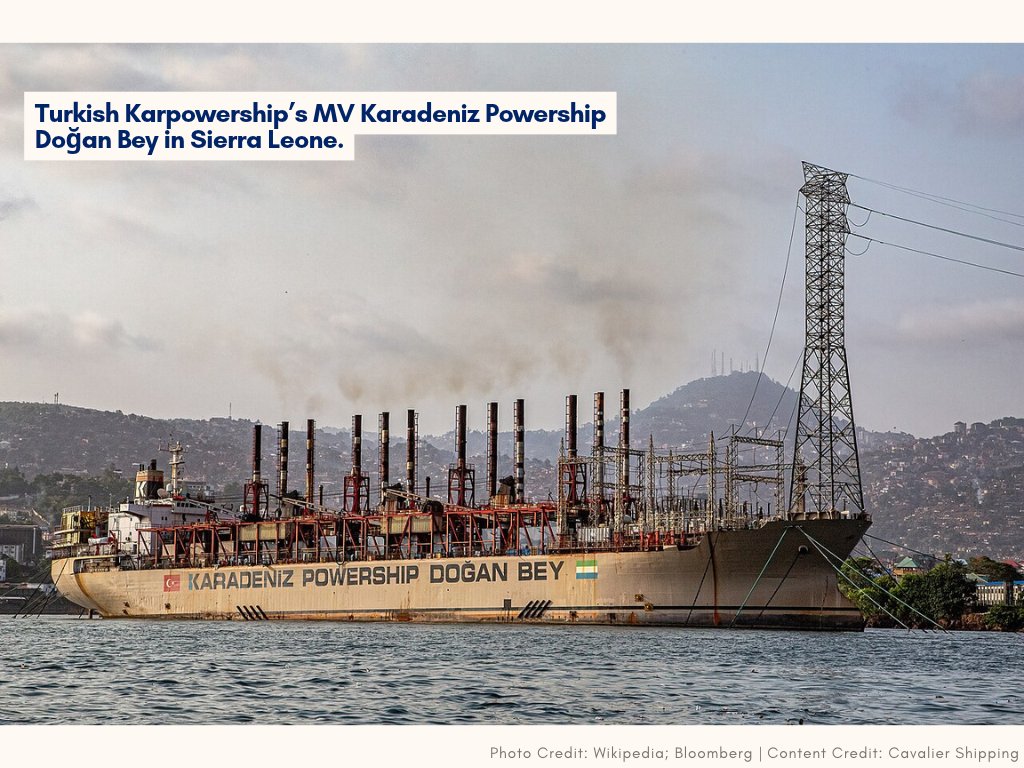
But ships could play an even greater role in the electricity supply chain. Rather than simply delivering the fuel required to run power plants on shore, ships could, themselves, be the power plants.
The U.S. pioneered the modern “powership” concept with the conversion of the freighter Jacona in 1930.
Although the Americans invented the powership, they’ve largely left the business to others.
Since 2009, Turkey’s @Karpowership has built a fleet of 45 powerships.
In 2020, Russia’s state-owned nuclear company, @RosatomGlobal, commissioned the Akademik Lomonosov, a floating nuclear power plant equipped with two reactors, which supplies electricity and heat to Pevek in the remote Russian Arctic.
Nearly a century after pioneering floating power generation, have American companies entirely ceded the market?
A growing crop of American companies has emerged seeking to commercialize small modular nuclear reactors, predominantly with land-based applications in mind.
Ocean Atomics is taking a different approach.
Rather than developing another terrestrial nuclear power plant, @OceanAtomics is pursuing a nuclear power plant designed for installation aboard commercial vessels. The idea is to leverage serial shipyard construction to tackle nuclear power’s perennial problems with cost and schedule overruns, while using the ocean to bring generating capacity to wherever it’s needed.
(Disclosure: I’m the company’s CFO.)
With the Turks' fleet of conventional powerships and the Russians' floating nuclear power exports, it’s time for the Americans to reenter the business they invented.
https://t.co/J9UGFBSK3t
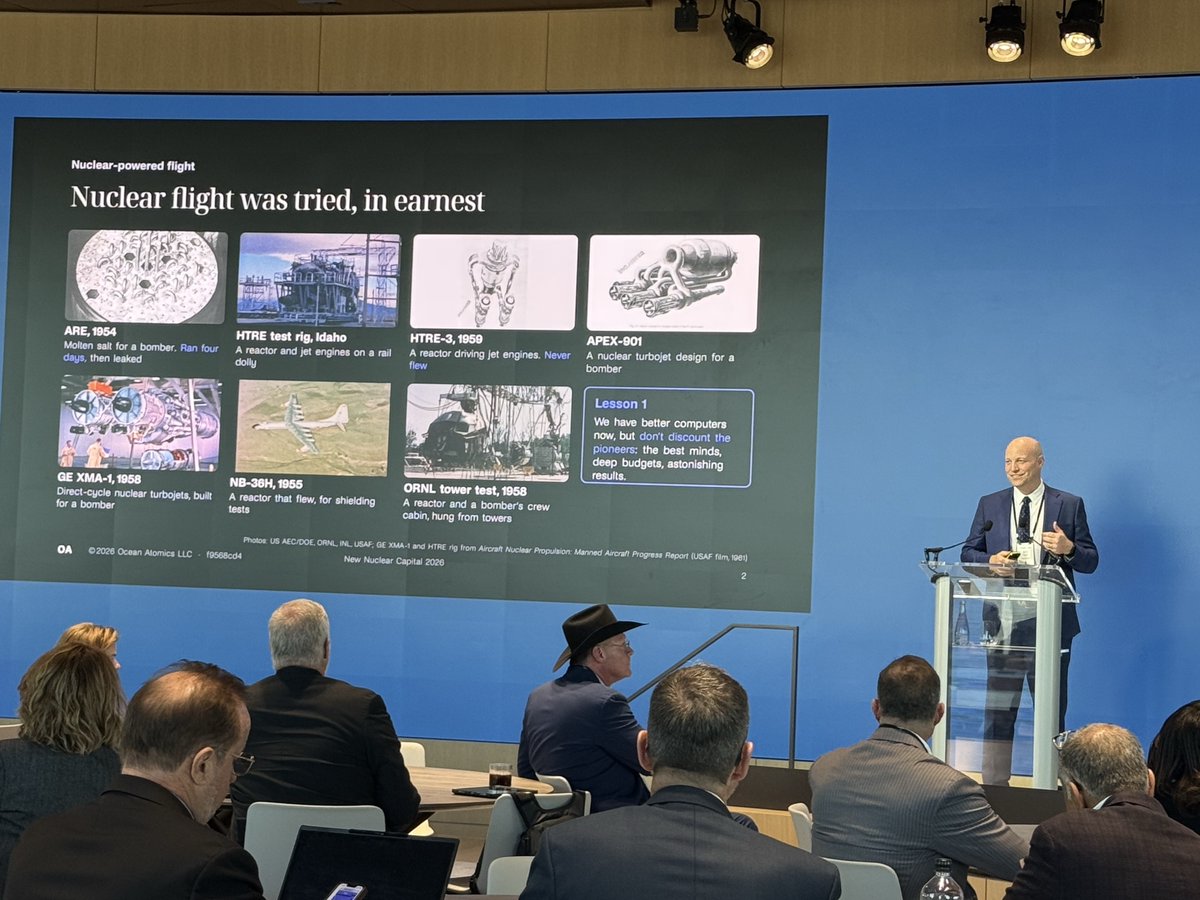
Been there, done that. At New Nuclear Capital 2026, our CTO Nick Touran (@whatisnuclear) took investors, utilities, developers and regulators through parts of nuclear history most of the industry has never heard: we’ve already built and run nearly every “advanced” reactor on the table today.
➤ We took advanced coolants to commercial demonstration. From the 1950s on, the US ran full development programs, from test reactors to utility-scale plants, for:
• sodium-cooled fast reactors (EBR-I → Fermi-1 → FFTF → CRBRP)
• sodium-graphite (SRE → Hallam)
• high-temperature gas (Peach Bottom 1 → Fort St. Vrain)
• organic-cooled (OMRE → Piqua)
• superheat boiling water (BORAX-V → Pathfinder, BONUS)
Each had too many maintenance challenges and cost too much. Fermi-1 logged 13.5 full-power days in its life; Fort St. Vrain was a costly failure; the Clinch River Breeder was canceled after billions.
➤ At the same time, the LWR demonstrations ran beautifully. Plants like Yankee Rowe, Dresden and Big Rock Point were built quickly, ran reliably and were easy to maintain. That’s why we have a fleet of LWRs today. Even the US Navy tried a sodium reactor early on and ripped it out, replacing it with a PWR. France had its own gas-cooled fleet and switched to PWRs, and the UK and the Soviet Union did similarly.
➤ Small reactors struggled to pay. Stick-built small LWRs like Elk River and La Crosse carried the full construction cost for very little power, so the industry scaled up. These problems are refraining today with some SMRs under construction.
➤ Microreactors were tried too. The Army ran them on trucks, under the Greenland ice and in Antarctica, but they were hard to maintain, needed large crews, and cost far more than diesel. Space, defense, and remote areas are super interesting markets today, but history shows even those customers are cost sensitive, so it may be uphill.
➤ Giant plants have the opposite problem. Each is a megaproject; Vogtle 3 and 4 finished about seven years late at more than twice the budget.
The lesson: water won on technical merit. Calling LWRs “legacy” and other designs “advanced” gets the history backwards, and investment, development and policy that pass over LWRs risk repeating it.
A low-pressure or high-temperature coolant, on its own, is not a reason to invest. Investors should ask promoters how they’ve solved the maintenance and cost problems that sank earlier versions of their technology. A thin-walled vessel is often a bad trade for a more complex balance of plant and much more downtime. Many non-water reactors have appealing special capabilities, and we need people working on them. But we shouldn’t put LWRs on hold or discount their winning status.
We agree with the push for Henry Ford-style assembly lines for reactors, but units have to be at least medium-sized to serve most markets. That’s why we’re building the OAR-1: a 50 MWe pressurized water reactor, mass-produced in a waterfront factory and delivered by sea. Big enough to compete, small enough to build in series.
Thank you to @US_NIC and @jpmorgan for the platform.
Check out Nick's full presentation in comment below ⬇️
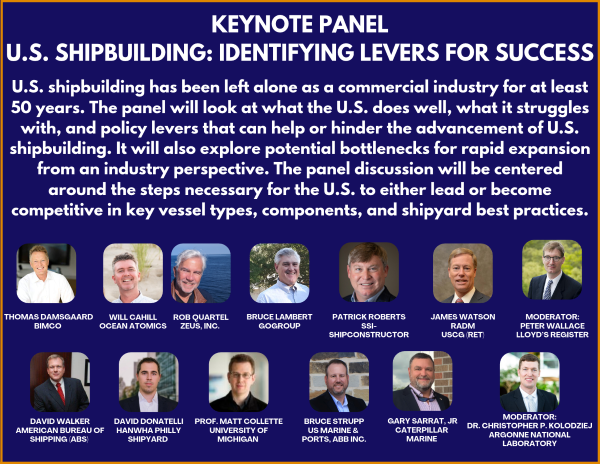
Our CEO Will Cahill is on the keynote panel “U.S. Shipbuilding: Identifying Levers for Success” at @SNAME_HQ’s Maritime Convention in Houston.
Nuclear power at sea depends on U.S. shipyards that can build at scale. We’re there for that conversation. #SMC2026
The Ocean Atomics Reactor can be installed on numerous types of ships: power ships, cargo ships, passenger ships, floating data centers, etc. It's an integral Pressurized Water Reactor, leveraging the physics advantages of water and the established supply chain.
The American shipbuilding industry is in shambles due to decades of shortsighted policies and neglect. China rolls out roughly 1,000 cargo ships a year, while the U.S. rolls out about three. The Trump administration has called this a national security crisis. https://t.co/oZGpOTkTMx