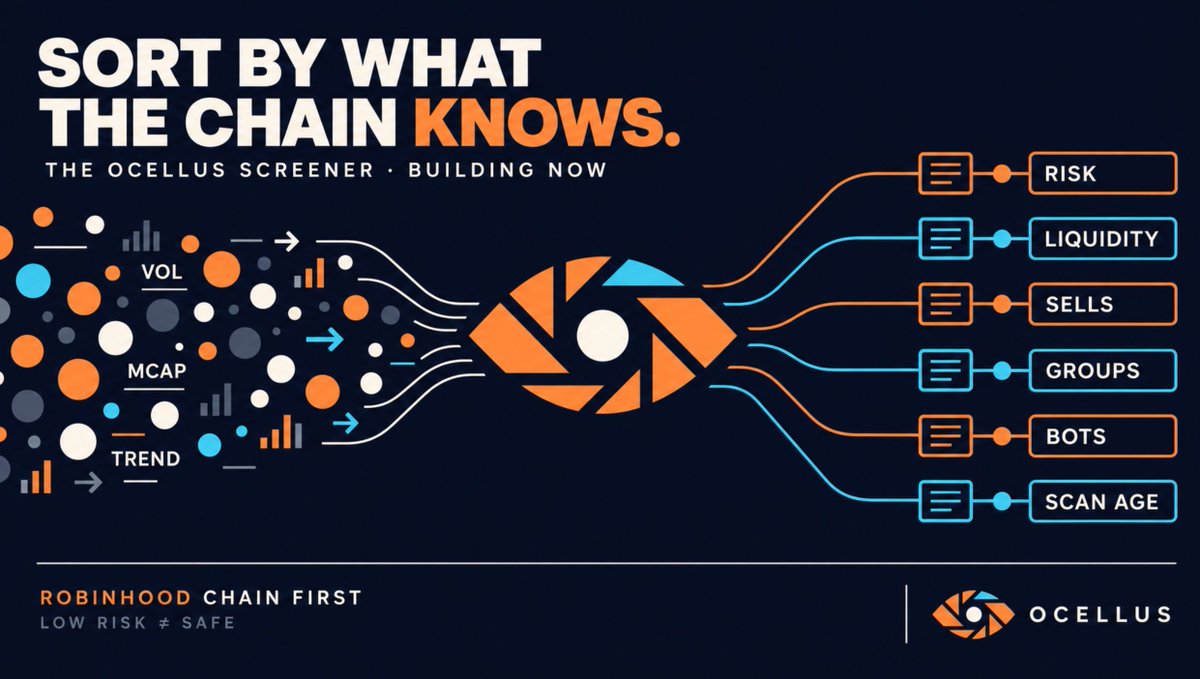
Building the Ocellus Screener.
Most screeners help you sort tokens by volume, market cap, price change or what’s trending.
Ocellus will let you filter them by what the chain actually shows about them.
Every scanned token gets a row, but instead of just showing market data, you’ll be able to filter by things like:
• Risk level based on findings that could actually hurt a buyer
• What happens to the price if the top wallet, top 10 holders, creator or bots sell
• Whether the liquidity position is actually held where it should be, checked on-chain
• Whether holders have actually been able to sell, and what those sells cost in fees/tax
• Connected wallet groups
• Bot activity, separated from real buy groups
• Scan age, so stale data doesn’t sit around pretending to be current
By default, Severe-risk tokens and tiny market caps will be filtered out. High-risk tokens can still appear.
That part is important.
This is not a list of “gems”, picks or tokens Ocellus thinks you should buy.
It’s a screener.
Ocellus surfaces risk signals from on-chain records. You set the filters and make your own decision.
Every token will still open into the full Ocellus report, where findings can be traced back to the transactions behind them. If something important could not be checked, the report tells you instead of quietly treating the missing data as clean.
The list will also build itself. Ocellus is already learning to find actively traded launches on Robinhood Chain and scan them before anyone asks.
Instead of starting with thousands of launches and checking them one by one, you start with a list you can actually filter by the things that matter.
Coming to Robinhood Chain first.
Building the Ocellus Screener.
Most screeners help you sort tokens by volume, market cap, price change or what’s trending.
Ocellus will let you filter them by what the chain actually shows about them.
Every scanned token gets a row, but instead of just showing market data, you’ll be able to filter by things like:
• Risk level based on findings that could actually hurt a buyer
• What happens to the price if the top wallet, top 10 holders, creator or bots sell
• Whether the liquidity position is actually held where it should be, checked on-chain
• Whether holders have actually been able to sell, and what those sells cost in fees/tax
• Connected wallet groups
• Bot activity, separated from real buy groups
• Scan age, so stale data doesn’t sit around pretending to be current
By default, Severe-risk tokens and tiny market caps will be filtered out. High-risk tokens can still appear.
That part is important.
This is not a list of “gems”, picks or tokens Ocellus thinks you should buy.
It’s a screener.
Ocellus surfaces risk signals from on-chain records. You set the filters and make your own decision.
Every token will still open into the full Ocellus report, where findings can be traced back to the transactions behind them. If something important could not be checked, the report tells you instead of quietly treating the missing data as clean.
The list will also build itself. Ocellus is already learning to find actively traded launches on Robinhood Chain and scan them before anyone asks.
Instead of starting with thousands of launches and checking them one by one, you start with a list you can actually filter by the things that matter.
Coming to Robinhood Chain first.
I know it’s been a bit quiet here.
Still working on the next update and getting a few things right before pushing it out.
In the meantime, I burned another 1% from the tokens bought back.
https://t.co/w6rPGFELHd
I know it’s been a bit quiet here.
Still working on the next update and getting a few things right before pushing it out.
In the meantime, I burned another 1% from the tokens bought back.
https://t.co/w6rPGFELHd
Between updates, I’ll be doing buybacks and burns.
After bonding, that will shift toward a mix of burns and adding liquidity to the LP.
A few people have also been asking about tokenomics, utility, and how holders benefit from the product itself.
The idea is pretty simple.
We’re still in beta right now, but once that phase is over, Ocellus will introduce advanced paid features and services. A portion of the revenue generated from those services will be used to buy back $OCELLUS from the market and burn it.
So as the product grows and generates more revenue, part of that value flows back into the token through buybacks, burns, and liquidity.
The more data Ocellus collects, the more useful the screener becomes.
Not because it starts “picking winners”, but because it gives you more ways to remove the noise.
Want tokens where liquidity is actually verified? Filter for it.
Want to avoid large connected holder groups? Filter them out.
Want to see where whales or smart wallets are already involved? That becomes part of the view too.
The database underneath all of this is still growing, and every new scan gives us more context to work with.
The end goal is simple: spend less time checking everything manually, and get to the interesting tokens faster.
The more data Ocellus collects, the more useful the screener becomes.
Not because it starts “picking winners”, but because it gives you more ways to remove the noise.
Want tokens where liquidity is actually verified? Filter for it.
Want to avoid large connected holder groups? Filter them out.
Want to see where whales or smart wallets are already involved? That becomes part of the view too.
The database underneath all of this is still growing, and every new scan gives us more context to work with.
The end goal is simple: spend less time checking everything manually, and get to the interesting tokens faster.
Working on the UI and, more importantly, filling the database with more useful information so the filtering keeps getting smarter.
The goal is not just to show more tokens. It is to make it easier to narrow them down by what actually matters.
Risk signals, liquidity, holder concentration, whales, smart money, selling activity, age, market cap, scan history and more.
Every scan adds more context to the database, which means better filtering and better comparisons over time.
Still refining a lot of this, but the screener is starting to look much closer to what I had in mind.
Working on the UI and, more importantly, filling the database with more useful information so the filtering keeps getting smarter.
The goal is not just to show more tokens. It is to make it easier to narrow them down by what actually matters.
Risk signals, liquidity, holder concentration, whales, smart money, selling activity, age, market cap, scan history and more.
Every scan adds more context to the database, which means better filtering and better comparisons over time.
Still refining a lot of this, but the screener is starting to look much closer to what I had in mind.
Working on the UI and, more importantly, filling the database with more useful information so the filtering keeps getting smarter.
The goal is not just to show more tokens. It is to make it easier to narrow them down by what actually matters.
Risk signals, liquidity, holder concentration, whales, smart money, selling activity, age, market cap, scan history and more.
Every scan adds more context to the database, which means better filtering and better comparisons over time.
Still refining a lot of this, but the screener is starting to look much closer to what I had in mind.
Morning everyone. Hope you’re having a good start to the week.
If you want to keep up with everything being shipped, the changelog is the best place to follow along.
The bigger, more impactful updates will still be posted here.
Plenty more coming. Stay tuned.
https://t.co/hDAeiDcznq
Morning everyone. Hope you’re having a good start to the week.
If you want to keep up with everything being shipped, the changelog is the best place to follow along.
The bigger, more impactful updates will still be posted here.
Plenty more coming. Stay tuned.
https://t.co/hDAeiDcznq
We had 248 unique manual scans today.
That might not sound like a huge number, but every one of those scans tells us something about what people are actually interested in.
New pairs, established memes, tech projects, older tokens suddenly getting attention again.
That data helps us understand what users are looking for and, more importantly, what information matters most when they open a report.
If you feel like something is missing from the scans, submit a feature request. We’re actively looking at them and using that feedback to decide what gets improved next.
At the same time, Ocellus keeps scanning tokens automatically in the background, feeding more data into the database and helping us refine what gets surfaced in each report.
PS: In the last 72 hours, I’ve probably slept around 8 hours total. The first night was 2 hours, and somewhere in between we also had a database outage to deal with.
Still, the product has come a long way. The vision keeps getting clearer, and I genuinely believe this will become a tool used by thousands of people.
This is also the only time I’m going to talk about price or market cap.
If you’re not here for a quick flip, short-term price action shouldn’t be the main focus. Ocellus is still very early. The product keeps improving, usage is growing organically, and distribution is slowly moving toward people who actually understand what’s being built and want to stick around for it.
I’d much rather build that foundation than chase short-term attention.
Anyway, enough of my blabbing.
Back to building.
PS: In the last 72 hours, I’ve probably slept around 8 hours total. The first night was 2 hours, and somewhere in between we also had a database outage to deal with.
Still, the product has come a long way. The vision keeps getting clearer, and I genuinely believe this will become a tool used by thousands of people.
This is also the only time I’m going to talk about price or market cap.
If you’re not here for a quick flip, short-term price action shouldn’t be the main focus. Ocellus is still very early. The product keeps improving, usage is growing organically, and distribution is slowly moving toward people who actually understand what’s being built and want to stick around for it.
I’d much rather build that foundation than chase short-term attention.
Anyway, enough of my blabbing.
Back to building.
Building the Ocellus Screener.
Most screeners help you sort tokens by volume, market cap, price change or what’s trending.
Ocellus will let you filter them by what the chain actually shows about them.
Every scanned token gets a row, but instead of just showing market data, you’ll be able to filter by things like:
• Risk level based on findings that could actually hurt a buyer
• What happens to the price if the top wallet, top 10 holders, creator or bots sell
• Whether the liquidity position is actually held where it should be, checked on-chain
• Whether holders have actually been able to sell, and what those sells cost in fees/tax
• Connected wallet groups
• Bot activity, separated from real buy groups
• Scan age, so stale data doesn’t sit around pretending to be current
By default, Severe-risk tokens and tiny market caps will be filtered out. High-risk tokens can still appear.
That part is important.
This is not a list of “gems”, picks or tokens Ocellus thinks you should buy.
It’s a screener.
Ocellus surfaces risk signals from on-chain records. You set the filters and make your own decision.
Every token will still open into the full Ocellus report, where findings can be traced back to the transactions behind them. If something important could not be checked, the report tells you instead of quietly treating the missing data as clean.
The list will also build itself. Ocellus is already learning to find actively traded launches on Robinhood Chain and scan them before anyone asks.
Instead of starting with thousands of launches and checking them one by one, you start with a list you can actually filter by the things that matter.
Coming to Robinhood Chain first.