I stopped trying to be interesting and started being useful.
Nobody follows an account. They follow a feed that tells them something they didn't know.
I write about cross-border M&A: deal structures, who's buying whom, and where the money actually moves. That's the whole account. One niche, no compromise.
@drfeifei "The threat is within ourselves" is the right frame — and it's also the reason AI governance can't be solved by the labs themselves. If the risk is human, then the oversight has to sit with someone who isn't selling the model.
Anthropic is doing something no AI lab has done: it's putting its safety evaluators inside its own building.
Anthropic and Accenture are creating an embedded evaluation team. They'll sit alongside employees, watch model-training decisions in real time, and issue independent safety assessments.
Each side commits at least $1 billion over five years.
Why this matters more than it sounds: last week, the "we must pace the frontier" calls became an antitrust lawsuit — the argument being that synchronized safety warnings were really incumbents locking the door. The critique wasn't that safety is fake. It was that self-regulation is unverifiable.
Embedded evaluators are an attempt to make it verifiable.
The context: Anthropic's annualized revenue is expected to top $100 billion this year, up from $65 billion in July, targeting $200 billion by 2028 — while it prepares a Nasdaq listing at a reported $2 trillion.
So here's the tension worth naming: the company about to ask public markets for the largest raise in history is also building the institution that will grade its own safety.
Independent verification only means something if the verifier can say no.
$1 billion a year is the budget. The question is what happens the first time they find something they don't like.
#Anthropic #AI #Governance
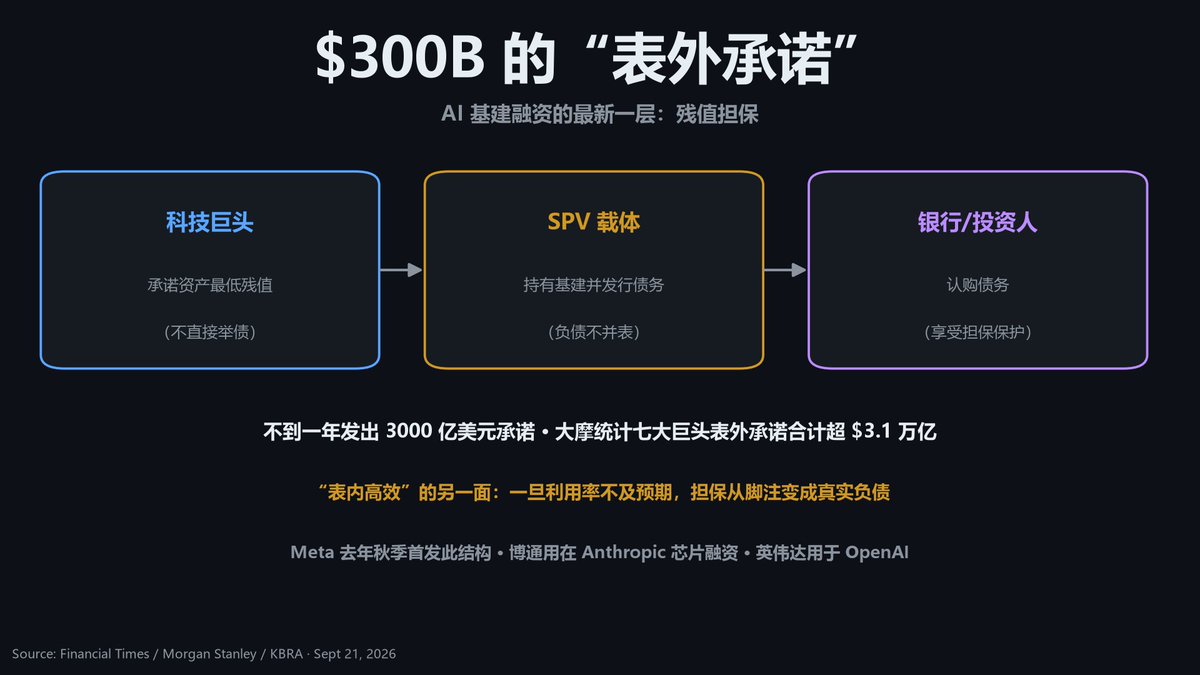
There's a $300 billion layer in the AI buildout that almost nobody is pricing.
It's called a residual-value guarantee.
How it works:
A tech company promises a chip or data center will retain a minimum future value
A special-purpose vehicle owns the asset and issues the debt
The guarantor never fully books the liability
In under a year, big tech has issued up to $300 billion of these commitments while recording little of it on balance sheets.
Morgan Stanley counted $3.1 TRILLION in off-balance-sheet commitments and credit support across just seven hyperscalers and chipmakers.
Meta deployed it first on a data center project. Broadcom used it in Anthropic's chip financing. Nvidia has offered similar support to OpenAI.
Bankers call it "balance-sheet efficient." That phrase tells you both the appeal and the risk.
The mechanism only works if utilization holds. If AI infrastructure demand disappoints — oversupply, slower adoption, business models that never turn — those guarantees convert from footnotes into real liabilities, all at once.
Read the structure honestly: the AI buildout is being financed on assumptions about demand that hasn't arrived yet, using vehicles designed so the risk doesn't show up where you'd look for it.
Watch the disclosure changes in the next set of filings. That's where this story moves.
#AI #Finance #Credit
Alibaba just answered the chip question — with hardware, not a press release.
At its Yunqi conference, Alibaba's T-Head division unveiled Zhenwu V900.
3x the compute of the previous M890
216 GB memory, 1,200 GB/s inter-chip bandwidth
Native FP8 and FP4 support
Up to 500,000 chips in a single cluster
Mass production: Q1 2027
And the bigger number: Alibaba Cloud is targeting over 20 gigawatts of global data center capacity by 2032.
The part that matters most isn't the chip. It's that M890 supernodes are already live, already running Qwen3.8 and Kimi K3 at 2-trillion-parameter scale. Alibaba says 650+ enterprise customers are on the Zhenwu line.
Alibaba's stock rose over 4% in Hong Kong on the announcement.
Here's the strategic read: the US export controls didn't stop China's AI buildout — they forced it vertical. Alibaba now designs the chip, the interconnect, the network card, the SSD controller, the supernode, the cloud, AND the model.
That's not a workaround. That's a full stack.
When you can't buy the best chip, you build the whole factory.
#Alibaba #AI #Semiconductors
The biggest Hollywood deal in a decade just cleared its last hurdle — and the price was a list of promises.
Paramount settled with California and 11 other states over its $110 billion Warner Bros. Discovery acquisition. WBD jumped 11%.
What Paramount gave up to avoid selling CNN:
At least 30 films a year for two years, then 32 a year for three
At least 4 indie films a year, and 20% must be blockbusters — miss the quota, pay $30M per film
$300M MORE per year in US production spending, $1.5B total
No theater-rate increases for three years
No selling either studio lot
An independent news editorial board for CBS and CNN
The company also agreed not to cut certain jobs for five years and to pay $17.5M into the Writers Guild health fund.
Closing expected early October. And note what it avoids: a $7 million per day ticking fee that would have started October 1.
Read the structure of this settlement. The remedy wasn't divestiture — it was behavioral commitments, monitored by a board, backed by financial penalties.
That's the new template for media consolidation: you don't have to sell assets, you just have to promise to behave, with a price tag attached to breaking your word.
$6B in promised synergies. $80B in debt. And a compliance department that now has real teeth.
#Paramount #WarnerBros #MergersAndAcquisitions
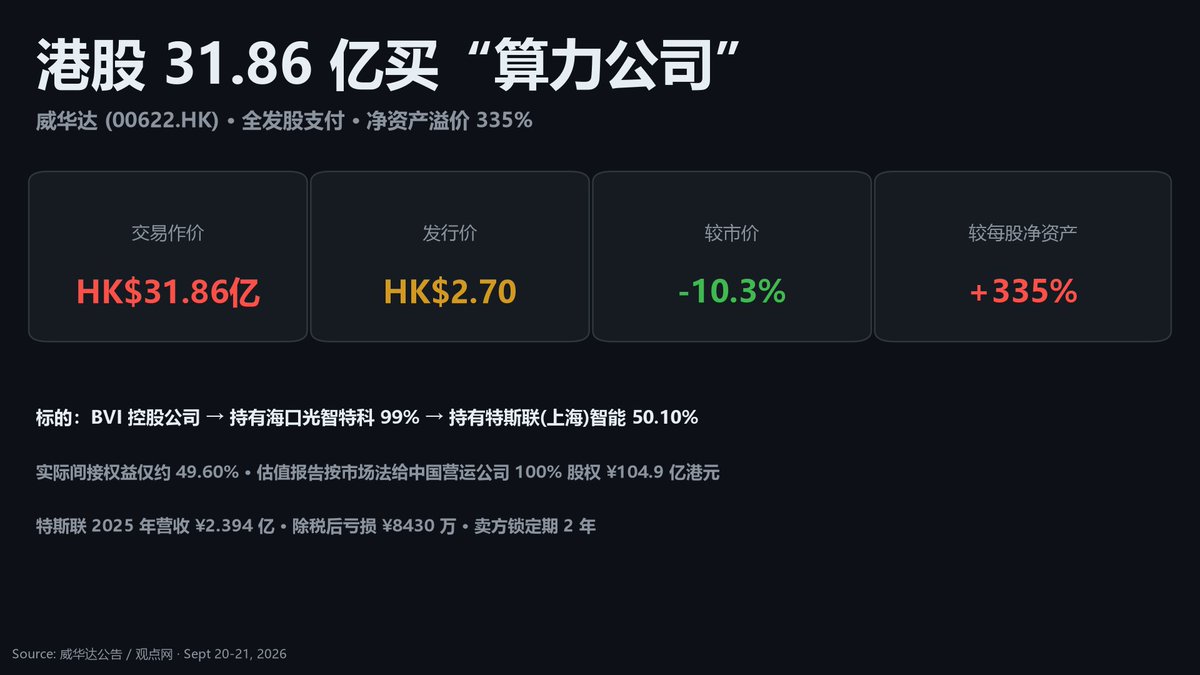
A Hong Kong-listed shell just bought "an AI compute company" for HK$3.19 billion. Read the structure.
Wah Da Holdings (https://t.co/btAJ2ncKhV) is issuing 1.18 billion new shares at HK$2.70 to acquire Apex Realm Ventures.
The price signals:
10.3% DISCOUNT to market. In a control transaction, that's unusual.
335% PREMIUM to the company's audited net asset value per share of HK$0.62.
Now the part that matters. What does it actually own?
Apex Realm → holds 99% of Haikou Guangzhi → which holds 50.10% of the Chinese operating company (Terminus Shanghai Intelligent Technology).
Net indirect economic interest: roughly 49.6%. Not control. A minority stake, wrapped in three layers of holding companies, valued by an appraiser at HK$10.49 billion for the operating company.
And the operating company's financials? 2025 revenue of ¥239 million, with a net loss of ¥84 million.
So: 3.19 billion Hong Kong dollars for a 49.6% indirect stake in a loss-making company, paid in discounted new shares, at a 335% premium to book.
Bought for the AI narrative, priced on a valuation report, paid with paper.
Watch the lock-up. Two years. That tells you what the seller thinks about the price.
#MergersAndAcquisitions #HongKong #AI
Nuclear medicine just had its consolidating deal — and it's a supply-chain play, not a science play.
Telix is acquiring Germany's ITM (Isotope Technologies Munich) for $1.65 billion.
The structure:
$1.25B in Telix stock (Nasdaq ADRs at $11.84/share, escrowed)
Telix assumes $302M of net debt
Up to $700M contingent — tied to ITM-11's FDA approvals and 2030 global sales
Now here's why this is really interesting:
ITM is the world's only commercial-scale supplier of lutetium-177. Also actinium-225 and terbium-161. If you make targeted radioligand therapies, you buy your isotope from ITM — or you don't make them at all.
Telix already had the drug pipeline. What it didn't have was guaranteed access to the isotope.
That's what $1.65 billion buys: a chokehold on the raw material in a market headed to $41 billion by 2034.
This is what vertical integration looks like in pharma. You don't buy the competitor. You buy the thing the competitor can't operate without.
#Telix #Pharma #MergersAndAcquisitions
The safety story just got subpoenaed.
Anthropic, OpenAI, SpaceXAI, and Google are now facing an antitrust suit alleging that their synchronized calls to "pace the frontier" amount to collusion — incumbents using safety as cover to lock the door behind them.
Follow the sequence:
1、Three of the biggest labs publicly call for a coordinated slowdown.
2、They propose a third-party standards body — a FINRA for AI.
3、Then the market realized: in every industry, "let's agree to go slower" is the oldest cartel playbook there is.
This was obvious weeks ago. When the three companies with the largest lead all agree the race should slow down, the question isn't whether they believe it. It's who benefits.
And now the courts get to decide.
The uncomfortable irony: if safety arguments can be litigated as anticompetitive conduct, every future lab has a reason to never say a word about risk again.
#AI #Antitrust #OpenAI