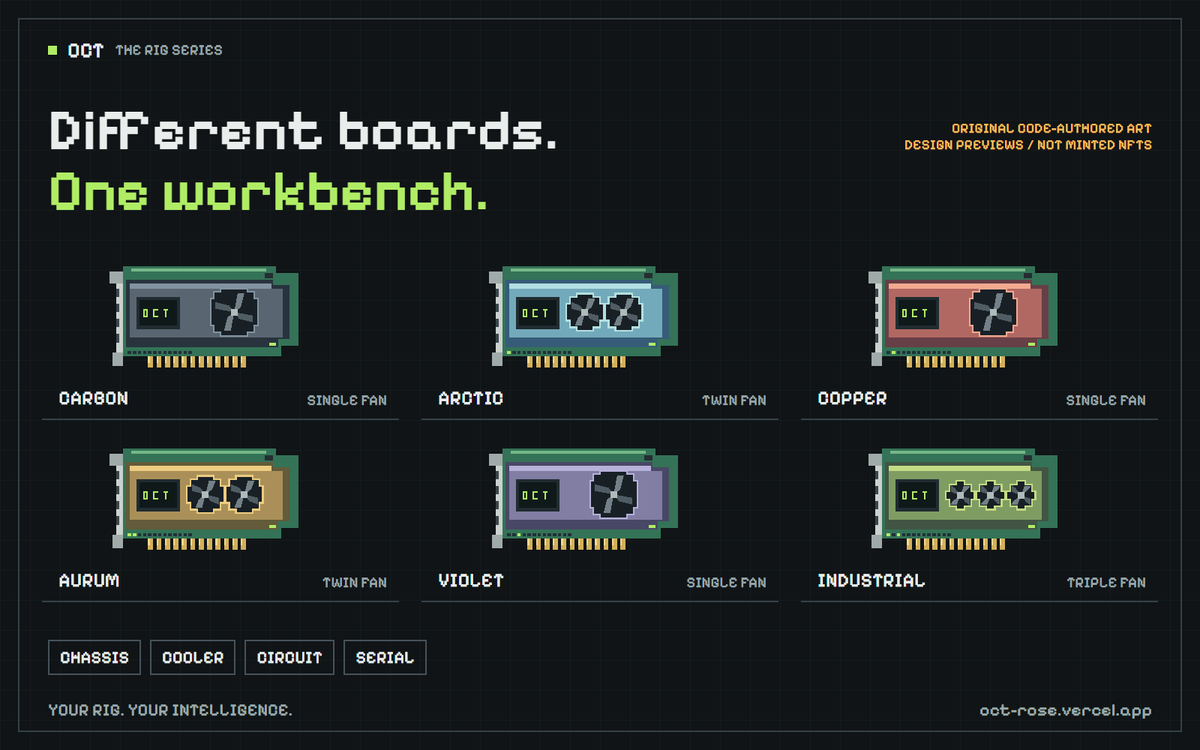
Different boards. Different coolers. Different identities.
OCT brings collectible pixel Rigs into the design of a programmable AI workbench.
NFT identity. Owner-defined tactics. Modular capabilities. API + MCP.
Your Rig. Your intelligence.
OCT. Overclock Terminal.
An AI workbench designed around collectible pixel Rigs on Solana. Not a mining screen. A system built around identity, useful computation and owner-defined automation.
THE RIG
Every Rig starts with its own identity: an original GPU design, a serial number and collectible traits. Chassis, cooling systems, PCB colors and circuit patterns make the collection visually distinct. The artwork comes from original code, not AI-generated NFT images.
The product architecture connects three layers:
NFT: the collectible Rig, built around Metaplex Core.
Vault: the Rig's accumulated assets and protocol rights.
Configuration: its owner's tools, workflows, automations and spending limits.
The vault design ties control to NFT ownership: transfer the Rig, transfer control of its vault. A Rig represents a digital identity, not ownership of a physical GPU.
MINT
The mint design combines an $OCT token burn and NFT creation in one atomic Solana transaction. The burn is part of receiving the Rig, not a separate promise. Collection supply and mint activity are read from the chain, while wallet confirmation stays under the user's control.
COMPUTE
The compute layer is designed for real work: document analysis, image understanding, embeddings and agent workflows. A task has an execution flow, a result, measured usage and a receipt. Compute is paid for with funded credits and constrained by spending limits.
API + MCP
The workbench connects to external applications and agents through API and MCP. Wallet-scoped access keys provide a revocable connection to settings, Rig ownership, jobs and task execution. Access keys are not wallet-signing keys.
OVERCLOCK
The module system gives $OCT burns a concrete role: extending the workbench's capabilities.
Memory: document libraries and context.
Vision: image-analysis tools.
Automation: workflows and schedules.
Parallel: concurrent agents and tasks within capacity limits.
Turbo: premium model routing.
Custom: Rig personalization.
Collectible rarity and installed upgrades are separate. A rare shell is an identity trait; a module is a capability. Token burns unlock software access, while inference still consumes compute credits.
THE ECONOMIC DESIGN
OCT combines two revenue sources: margins from useful computation, after execution costs, and creator fees collected from token launches. The model connects those sources to usage credits, an operating reserve and $OCT buyback-and-burn mechanisms, under published allocation rules.
The token design targets an OCT/NVDA custom pair with a 3% creator fee. This is a design target, not a claim about total trading costs or guaranteed returns. A Rig does not represent NVIDIA equity; OCT is independent of NVIDIA.
Collect the identity. Configure the tools. Put intelligence to work.
Your Rig. Your intelligence.
https://t.co/mqUNjnKs9i