King County's homelessness agency had over $1 billion in grants available over six years.
They left $260 million of it unspent.
But they budgeted their overhead like they'd spent every dime. So they still ran a $16.7 million deficit, and borrowed from the county to cover it.
Their records were such a mess, auditors had to rebuild six years of books from individual checks and invoices.
Homelessness doubled on their watch. Councilmember Rod Dembowski says people died because that money never hit the street.
A shelter for older women in Kenmore got told "we don't have the money." They had a quarter billion dollars.
This isn't compassion. It's malpractice. Shut it down.
@koba0823 The Japanese were fearsome opponents in the Pacific War and the outcome was not preordained. I have many issues with Imperial policies but the tenacious and industrious character of the Japanese remains and only fools would openly question it.
I don't think advocating for reduced jail time for dangerous offenders is admirable *at all*
I know someone who was killed by a repeat offender who *very clearly* should have been in jail for his much lesser offense
I'm suspicious that people who advocate for leniency (and the judges who grant it) are getting high on their own moral superiority and not giving any thought to who this person might hurt next
The ideal form of forgiveness is the black parishioners who forgave Dylan Roof for his murderous rampage against their friends and family and prayed for his soul.
And then he was convicted and sentenced to death.
https://t.co/WMThKPD2w3
Anti-gun critics claim an armed American citizen with a concealed pistol will only panic when a mass shooter opens fire.
On Father's Day, June 17, 2018, forty-seven-year-old pastor and EMT David George stood in a Washington Walmart with his family.
Suddenly, a convicted felon high on methamphetamine shot open a glass ammunition case with a revolver and ran toward the front exit.
Because George had trained with local police, he knew drawing a pistol inside a crowded store before seeing a clear target could cause a tragedy.
First, he made sure his wife, daughter, and granddaughter escaped through the exit according to their family safety plan.
Then he followed the gunman into the parking lot, where the killer had just shot father-of-two Rickey Fievez in the neck and chest and jumped into a woman's car while she crouched terrified behind the bumper.
Approaching within seven feet on the passenger side so his line of fire would never endanger the woman, George drew his Glock 19 as the killer turned his revolver toward him.
George fired five shots into the gunman's chest, ending the rampage in two seconds.
Then the pastor holstered his pistol, dropped to his knees on the bloody asphalt, and used his EMT training to keep the paralyzed father breathing until ambulances arrived.
A shepherd carries a staff to stop the wolf, and bandages to heal the flock.
@japan_nobunaga Thank you. It’s really important to highlight the stories of how the Japanese have ‘shown up’ as they don’t get the attention here they deserve. From my perspective the Japanese tend to be quiet or boisterous yet respectful but when action is needed the Japanese go all in.
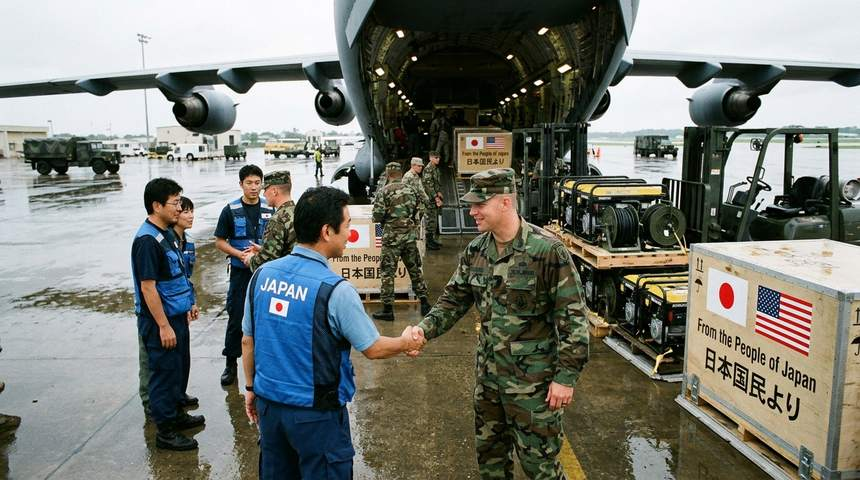
When U.S. Marines and sailors landed in devastated Tohoku during Operation Tomodachi in 2011, many of them told Japanese survivors, "We are just paying you back for 2005."
Most people had no idea what they meant. The people of Louisiana and Mississippi knew.
In late August 2005, Hurricane Katrina smashed the Gulf Coast, flooding eighty percent of New Orleans and leaving over a million Americans without power, clean water, or roofs in ninety-five-degree heat.
Why did the richest superpower on earth need emergency generators and cash from Japan? Because thousands of U.S. National Guard troops and heavy equipment were deployed overseas in Iraq, and the storm had wiped out power grids across ninety thousand square miles all at once.
While some foreign commentators on television gloated over America's disaster, Japan moved immediately.
The Japanese government, the Japanese Red Cross, Japanese automakers, and ordinary Japanese schoolchildren who collected coins in train stations poured over fifty million dollars of relief into the American South.
Japanese cargo planes landed in the United States packed with industrial portable generators, heavy cord reels, blankets, and medical supplies to keep darkened southern hospitals and shelters running.
Japanese funds rebuilt destroyed schools in Mississippi and community centers in New Orleans without asking for a single headline.
Six years later, when the tsunami hit Japan in 2011, boys from Louisiana and Mississippi wearing U.S. military uniforms were the first to jump off the helicopters into the mud of Tohoku.
Honor is a long memory. A debt of kindness between warriors is never forgotten.
@nobodyknows2322 There was a huge concern publicly that we were fighting to restore European colonialism. Boy would the mid-century have looked different had we not armed all of the Asian communist factions who knew better than to fight the Japanese?
I quibble about the US in 1940 having ‘colonial ambitions’ as that was a serious point of divergence between the US and Europe, the Philippines would have been independent before 1945 if not for the Japanese, but otherwise a brutally honest take.
I'm not American, but I am a historian. I view the entire Pacific theatre as something which could have been avoided, but American foreign policy choices and colonial ambitions forced the issue. America did not, however, necessarily want war with Japan.
A land invasion of Japan would have resulted in cataclysmic population collapse, if not outright ethnic cleansing as a consequence of existing Japanese culture and supply constraints.
Across the Pacific theatre, Japan operated under what was close to a "no retreat" doctrine; strategic repositioning could be justified, but ceding territory to mitigate losses was not. It was expected, and required often, that soldiers and civilians both would give their lives for the Emperor. To be clear, this is not an indictment against Japan's honour, as its men fought bravely and legitimately believed that they were fighting an implacable, possibly genocidal threat. The Americans, after all, did not have perfectly friendly relations with Japan for the prior century.
This attitude, and the belief that terrible harms would come upon Japanese women and children, resulted in horrific and avoidable tragedies. There are many stories from Marine veterans of civilians killing themselves when they successfully occupied an island or village. A few hundred, maybe a thousand here and there, but these events were significant enough they made it to American high command and had US troops seriously questioning what they were doing.
And it was for this reason that a mass shock-and-awe decisive strike was planned, to force the unconditional surrender. The American people still wanted revenge and a conditional surrender would not have been that, and, American command wanted to mitigate the damage to civilians because they knew full-well what would happen in the case of a ground invasion.
The final point to take note of is, in the months leading up to the bombing of Hiroshima and Nagasaki, the Imperial Japanese Army had started training civilian men and women to fight, using everything from farm tools to sharpened bamboo spears. Whether or not this was out of genuine fear or not is irrelevant; it trains the populace to expect certain things and behave in certain ways.
So, in the case of a ground invasion without the use of nuclear weapons:
A wave of bombers strikes Japanese airfields first, destroying most of them essentially overnight. They also target and destroy any military bases they can find, as the US planes can simply fly higher than the Japanese interceptors. This goes on for two weeks, with a final ultimatum issued: Surrender or the mainland will be invaded. The Japanese generals refuse.
America lands its troops across the Eastern coasts, moving inland rapidly. Warships bombard cities and fortifications, while overhead planes firebomb everything. Even trying to mitigate damages and warning civilians to evacuate, many stay behind to fight and are slaughtered by the thousands. American troops arrive to razed cities with few scattered defenders, most too poorly equipped to present a real threat. Word gets out to the government of Japan, who declares that this is an existential war and that everyone must fight.
The Soviets now, having finished in Germany, are turning Eastward and are moving to invade Hokkaido as well as Japan's remaining territories in continental Asia. Already stretched thin defending against America, the Soviets quickly move in and take over. Thousands of Japanese women, having colonized these provinces when they were conquered, are raped. They later go on to form a distinct local ethnicity of mixed Russo-Japanese people, with much of those continental territories and Hokkaido permanently changed, demographically.
Back on the Mainland, Japan's industrial centres are gone. Instead of nuking them, Hiroshima and Nagasaki are firebombed and the cities do not survive. The devastation and casualty numbers are similar, albeit drawn out over several weeks of sustained bombardment. Due to interruptions in food supplies, millions of urban civilians starve. Many lose faith in the Japanese government and decide to seek refuge in American-built concentration camps where they at least receive food and shelter. These camps are not safe either, however, as while Americans violently punish any rapists found amongst their number, many rapes do still occur. Children trying to protect their mothers are viciously beaten, and this reaches the American mainland as a series of scandals.
Every mile of land secured by American forces comes with at least 50% casualty rates among the locals, often by their own hands, sometimes when they attack American troops. Traps severely damage American troops' morale, but aren't common issues as they push towards Japan's capital. Upon reaching it, the Emperor is quickly found, surrounded, imprisoned and forced to surrender. A press statement is issued, broadcast to every city, every internment camp, every newspaper, etc., mirroring the one we saw in real life. Accompanying it, however, is a declaration that Japan is now an American colony.
Administratively, Japan loses its autonomy. It is given a constitution much more restrictive than the one in real life, however, much of the worst consequences are still avoided for the same reasons as in real life. The major differences are mass depopulation, permanent American bases across the entirety of Japan, and the complete loss of its Northern isles. Hokkaido becomes a Soviet province, completely alien in culture and language from the rest of Japan, forming a North/South Japan not unlike Korea. The entire island is demographically changed, with a large influx of American men taking Japanese women as wives; primarily due to so many of Japan's men being wiped out during the war. Modern parallels to this is Ukrainian women. Japanese itself becomes a secondary, local ethnic language whilst the primary language is English. This is, primarily, for ease of communication between the provisional government of Japan and America.
In this alternate timeline, Communism is much more powerful of a force in Japan as well, thanks to both Soviet and CIA subversion within the country. Its identity already damaged heavily from the war, and demographic changes, it's possible that 'South Japan' ends up seeking unification with 'North Japan', with a constant and persistent risk of violent revolution. That's a bit harder to predict, however.
All in all, while I absolutely loathe the loss of life from using nuclear weapons, I do truly believe it was the lesser of two evils. The alternative sees Japan demographically ruined and its culture annihilated, while losing territory to the Soviets who continue to push their weight around militarily. Without the fear of nuclear exchange, there's no reason for the soviets to ever stop in their expansionism besides domestic tensions and so the second half of the 20th century would have been much bloodier all around.
A terrible case where it was necessary to sacrifice a few, for the sake of the many. Both in Japan, and around the world.
@petersellis@X@SpaceX I have to say that there’s only be real effort to improve the platform since Elon took over. I look forward to your achievements.
My uncle fixed American warships for 41 years.
He was a welder at the US Navy base in Yokosuka. He started at 19. He barely spoke English. He didn't need to. He spoke steel.
Destroyers. Cruisers. An aircraft carrier, more times than he can count. If a ship in the Seventh Fleet had a seam, there's a decent chance my uncle welded it.
He never met most of the sailors who sailed on them. He just knew they came home safe. Because the seams held.
Last spring, he retired.
He expected a cake in the break room. Maybe a certificate.
Instead, when he walked out of the shop on his last day, there were sailors lined up on both sides of the pier. In dress uniform.
A boatswain raised a whistle to his lips.
My uncle had no idea what was happening. Someone had to explain it to him later.
In the US Navy, when a sailor retires after a long career, they "pipe him ashore." Sideboys line up. The whistle sounds. Everyone salutes.
It's an honor the Navy gives its own.
They gave it to a Japanese welder.
My uncle walked between them slowly. Every few steps, he stopped and bowed. They held their salute the entire time.
At the end of the line, the captain shook his hand and said something my uncle didn't understand.
That night, he asked me to translate it.
"Fair winds and following seas."
He made me write it down in Japanese letters, so he could say it right.
Now, every time we leave his house, he walks us to the door and says the only English sentence he knows by heart.
"Fair winds and following seas."
@TheGMan_1 Now that's the kind of Monday morning I like! 😁 I've got plenty more American hero stories where this came from.
I even put together a third Kindle collection, 115 stories in 476 pages:
https://t.co/PY3IBN42tc
#PR#AmazonAssociate
Critics love to say that twenty-year-old American Marines on New Year's Eve liberty in Japan only care about partying.
On December 31, 2016, four young U.S. Marines were walking in Yokosuka when an SUV plunged five stories off a garage.
The vehicle slammed upside down onto the pavement with a Japanese family of five inside. Eight local bystanders and two U.S. Navy Sailors pulled on the doors, but the crushed roof jammed the steel shut.
Waiting ten minutes for hydraulic rescue jaws meant the children trapped upside down inside the compressed cabin would suffocate or bleed out.
Marine Lance Corporal James Flores shouted that they had to flip the heavy vehicle upright by hand, and Lance Corporal Raheem Gilliam used the Japanese numbers he had just practiced in his barracks to unite the crowd.
"Ichi, ni, san!" Gilliam roared.
Four Marines, two Sailors, and eight Japanese citizens locked their fingers under the twisted frame and deadlifted the SUV upright in one heave.
The Marines crawled into the glass, pulled two young Japanese boys out alive, and used their Combat Lifesaver training to stop the bleeding until ambulances arrived.
Walking to the emergency room afterward to get his own cut hands checked, Gilliam did not brag. He quietly called Oklahoma just to tell his mother he loved her.
Honor needs no translator when good men lift together.
@ApexSeeker_ I respect Admiral Yamamoto but am also glad we succeeded in getting revenge. It was not his policy to attack the US but he orchestrated it. I would respect a shrine to him. As a tactician I think he was not great but he had visions beyond most in either the USN or IJN. So mixed.
@2ray_degenemax Another American military axiom is “Don’t give an order you know won’t be obeyed” it’s probably common beyond the US but has special meaning here.