This is tragic! I know at least 2 people who perished on this flight!
RIP professor Mojgan Daneshmand who got me very excited about electrical circuits in 2013 and in school for a while!
RIP to all the victims!
I wish peace, solace to their families, communities and countries!
🤝 We’re thrilled to expand our partnership with @Temenos! Our custody solution, Taurus-PROTECT, is now fully integrated with Temenos Core Banking, making us the first fully integrated digital asset custody platform within Temenos’ ecosystem.
Read more: https://t.co/lJDBXMDlwT
We often hear about HSM and MPC in the context of digital asset custody. But what do they mean, and what should financial institutions know about these technologies?
Jean-Philippe Aumasson, Taurus’ CSO, explains in this video.
7/ The victims in the 2019 hack had been targeted with a simple missed video call exploit.
No action required, and once-infected, the call log would typically be deleted.
We @citizenlab volunteered help investigate the target list and try find journalists, dissidents, and human rights defenders.
We found a lot.
And plenty of unexpected pockets of repression. Like the targeting dissident members of the clergy in Togo.
https://t.co/H5BYYDmDsR
https://t.co/5W8s6T7x2j
For me, this passes the Turing Test. I genuinely can’t tell if it’s generated by artificial intelligence. If so, it’s an astonishing showcase for what AI can do. Either way, it’s an excellent showcase for my new book, The Genetic Book of the Dead.
3/ Today, the court decided that enough was enough with NSO's gambits & efforts to hide source code.
Judge Hamilton granted @WhatsApp's motion for summary judgement against the #Pegasus spyware maker.
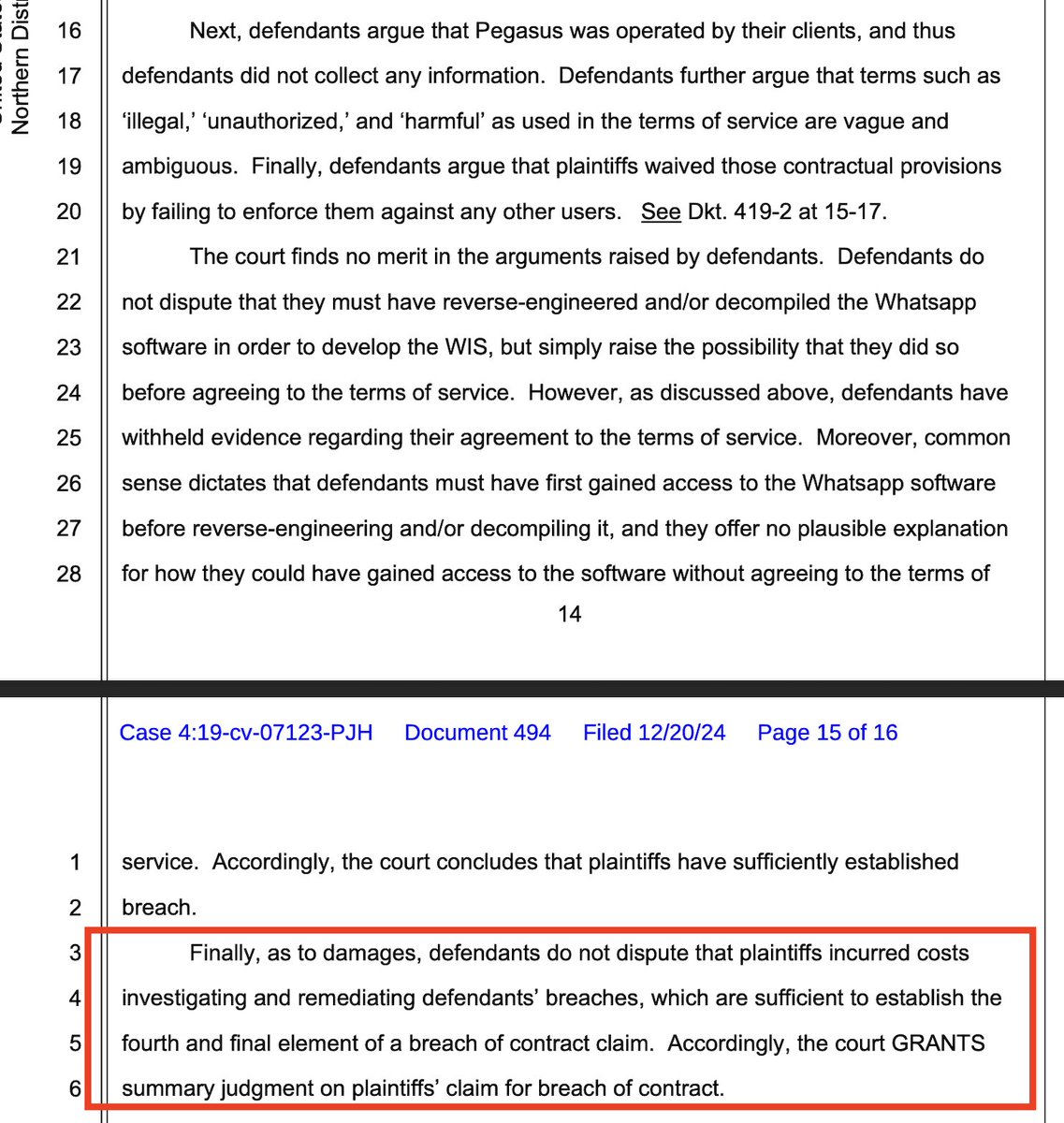
The judge finds NSO's hacking violated the federal Computer Fraud & Abuse Act (#CFAA), California state anti-fraud law #CDFA, and was a breach of contract.
What happens next? The trial proceeds only on the issue of resolving damages stemming from NSO's hacking.
Order: https://t.co/N3oNS76JRw
2/ In 2019, 1,400 @WhatsApp users were targeted with #Pegasus.
WhatsApp did the right thing & sued NSO Group.
NSO has spent 5 years trying to claim that they are above the law.
And engaged in all sorts of maneuvering.
With this order, the music stopped and NSO is now without a chair.
BREAKING: NSO Group liable for #Pegasus hacking of @WhatsApp users.
Big win for spyware victims.
Big loss for NSO.
Bad time to be a spyware company.
Landmark case. Huge implications. 1/ 🧵
Tiktok's Monolith paper is a must read.
It shows that you don't need a social graph to make an addictive product if you nail real-time recommendations that update AS each user scrolls.
Very few great applied CS papers exist and even fewer that made a 1B+ user product!
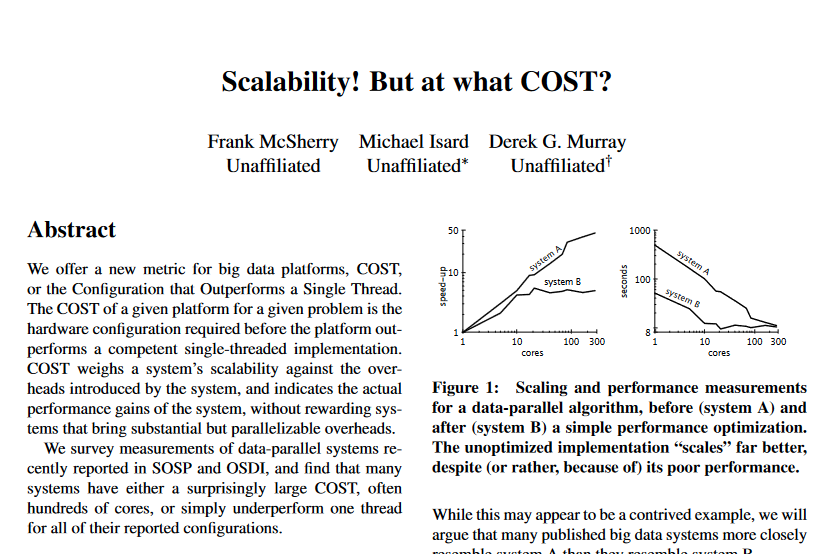
Scalability! But at what cost?
This paper is an absolute classic because it explores the underappreciated tradeoffs of distributing systems.
It asks about the COST of distributed systems--the Configuration that Outscales a Single Thread. The question is, how many cores does a big distributed system need to outperform some moderately-optimized single-threaded code running on your laptop?
As it turns out, scalability often comes with an extremely high COST. The authors examine several graph processing systems--including some big names like Spark--and find that they need dozens to hundreds of cores to outperform a single-threaded program.
Why is this the case? It's not because these distributed systems are badly designed, but because distributing computation is inherently inefficient for many problems.
Fundamentally, a distributed system cannot rely on all processors sharing state, at least not efficiently. This is a big issue! In graph algorithms, it means servers need to expensively exchange data and eliminates a wide swathe of algorithms and optimizations that rely on shared state. In distributed databases, it means expensive coordination is required to distribute transactions to ensure participating servers have consistent views of data.
Does this mean we shouldn't build scalable systems? Of course not! Many problems are well beyond the capability of a single server, no matter how optimized. But it does mean we should be mindful of the efficiency costs of scaling.
As an aside, I think this kind of thinking is why Postgres is so popular, despite not being distributed. A large Postgres server can handle a vast amount of traffic (especially with read replicas, which can be cheaply maintained). You need a huge company or incredibly heavy workload to outscale that single server, and when you do, the alternatives come with huge tradeoffs!
CVE-2024-9143 (https://t.co/ApXML9Eiuv) was disclosed recently, which was found by OSS-Fuzz-Gen! This is a pretty proud example of our team showing the promise of leveraging LLMs enable more fuzzing coverage.
Earlier this year, I used a 1day to exploit the kernelCTF VRP LTS instance. I then used the same bug to write a universal exploit that worked against up-to-date mainstream distros for approximately 2 months.
https://t.co/vRjyHR9GOA
After 25.3 million autonomous miles driven, @Waymo vehicles have an 88% reduction in property damage claims and a 92% reduction in bodily injury claims compared to human drivers per mile driven. 🚖
The rise of Go is phenomenal. It is definitively a mainstream programming language. I am a long-time fan of Go... and even I is surprised by the uptake.
#golang