Here some of my Tiny Lessons from this episode with @JamesClear
1. “Every action you take is like a vote for the type of person you wish to become.”
2. “You cannot outwork the person working on a better thing.”
3. “The cost of good habits is in the present. The cost of bad habits is in the future.”
4. Prioritize work that keeps working for you once it’s done. Build assets that accumulate, rather than tasks that evaporate.
5. Standardize before you optimize. You cannot improve a habit that does not exist.
6. Shape your environment with friction. Make things you don’t want to do harder and things you do want to do easier.
7. Intensity makes for a good story. Consistency makes for good results.
8. “Do the obvious things first. That gets you 80% of the way there.”
9. Live in two timeframes: 10 years and one hour. Do something right now that benefits you in a decade.
10. “Don’t be the first to tell yourself no. Let the world tell you no first.”
11. Use your current advantages to gain new advantages.
12. The work is not being wasted. It’s just being stored.
13. Success isn’t 10,000 attempts; it’s 10,000 iterations. Don’t just try again—try differently.
14. “The quest for novelty overpowers the desire for results.”
15. When something’s working, we underestimate how long it can go for and how powerful it can be.
16. A lack of patience changes the outcome.
17. “If you’re not outthinking them, you’re not outworking them.”
18. “The most powerful form of preparation is a mindset that can handle uncertainty.”
19. You don’t know when the break will come, but if you keep creating surface area, luck will eventually find you.
20. It is highly unlikely that whatever you are working on right now is the best use of your time.
21. “The heaviest weight at the gym is the front door.”
22. “To start, you only need points A, B, and Z. You don’t need to see steps C through Y.”
23. If your actions are not oriented toward your goal, they’re not accumulating.
24. “Almost every thought you have is downstream from what you consume.”
25. Just because improvements aren’t noticeable, that doesn’t mean improvement isn’t happening.
26. “The tighter you cling to an identity, the harder it becomes to grow beyond it.”
27. You don’t want to compete with the person having fun.
28. The fastest way to stop learning is to believe you already know it.
29. Knowledge is about the past, but decisions are about the future.
30. The desire to belong often overpowers the desire to understand.
31. “Habits are the repeated solutions to recurring problems.”
32. Broad funnel, tight filter.
33. Move like thunder: do fewer things, but with a crash that cannot be ignored.
34. Find ways to visualize your progress.
35. “The goal is not to beat the market. The goal is to end up wealthy.”
36. “Reputation takes care of itself if you take care of other people.”
37. Your first idea is not your best idea.
38. “We crave the status as much as we crave the outcome.”
39. Outcome over ego.
40. The only bad mindset is the one you’re fixed in.
41. People want to believe there’s a secret. There isn’t.
42. If you want to be a better writer, read more.
43. Maintain a positive mental attitude regardless of current circumstances.
44. So many problems in life come from your brain over-emphasizing minor details that don’t matter.
45. Success is having power over my days.
46. Don’t waste the reader’s time.
One of the great lessons in life.
'If you’re having fun, then you’re dangerous.
You’re hard to compete with. You don’t want to go up against the person who’s having a good time doing it because if it feels like a hassle or a chore, that’s the person who gives up when it gets difficult.
But the person who’s having a great time at the start is much more likely to stick with it when it gets hard."
@jamesclear on The Knowledge Project
“Greatness does not come out of intelligence, it comes from character.
Character is not formed out of smart people: it is formed out of people who have suffered.”
— Nvidia CEO, Jensen Huang
A reminder from Atomic Habits:
New goals don't deliver new results. New lifestyles do. And a lifestyle is a process, not an outcome. For this reason, all of your energy should go into building better habits, not chasing better results.
My favorite deep work week of the year is upon us:
The forgotten week of 26,27,28,29,30,31.
Gifts are unwrapped. You already swapped your stories. Ate your aunts special recipe.
You’re well rested. Time to dig in.
*work-life balance disclaimers apply*
this is probably an unexpected opinion coming from me... entrepreneurship is over-sold and self-awareness is under-sold 👇🏾
The not so popular truth is, most people would be happier with a good salary than a successful startup.
But social media continues to push a generation to optimise for lives they don't actually want.
Entrepreneurs like me get a lot of likes and followers when we tell people to quit their jobs and chase their dreams.
But here is the context that we nearly always miss👇🏾
Entrepreneurship can be really really boring - you will have to do things you do not enjoy.
You will deal with big, hard, stressful problems, every day - including bank holidays, christmas and any other time off - for years.
If you're lucky enough to be successful, the problems will get bigger, not smaller.
You will not have one boss. You will have hundreds - every customer, every investor, every employee. You will answer to them 24/7.
You will probably work 3x the hours you do now, have 10x the stress and a tiny probability of significant success.
A recent survey found 87.7% of founders deal with at least mental health issues. That's not a bug. It's a feature of entrepreneurship.
You'll see your kids less. You'll probably earn less (for years, maybe forever).
You will probably pay yourself last and as little as possible.
You'll struggle to switch off. Forever. Your phone will probably become a prison.
And here's the punchline: If you succeed, it all gets harder.
More money = more complexity. More growth = more anxiety. More success = more people depending on you.
In life, when you find yourself following someone else's playbook, you are at risk of winning someone else's prizes. All I'm saying is be intentional.
I'm not AGAINST entrepreneurship, I'm FOR self-awareness.
Truth "wealth" is probably👇🏾
✅ Knowing what game you want to play and why
✅ Having the courage not to play other people's games
✅ Understanding your real strengths and weaknesses
✅ Designing within them, not against them
Happiness is not about the structure, the social media post or the story.
Happiness is about alignment. Building a life that's aligned to whoever you are!
This does the beg the question, why do I do it?
If I'm honest, the answer is probably....I don't know.
It's probably some blend of lower t trauma, my inability to fit inside normal structures like school and conventional work-places (I was fired a few times), my adhd brain that makes working on something for 14 straight hours feel like 7 minutes and some childhood self-esteem issues.
Whatever the reason, this is who I am and what works for me.
This is the weird way I make myself happy and fulfilled.
To someone that is not me, it would probably feel like torture.
And to me, their life would probably feel like torture.
And that’s the thing… when you create a life that feels like home to you, it will probably look like hell to tourists.
Please know what you are not!
People hate the Catholic Church for supposedly hoarding wealth and being obscenely rich. The Catholic Church has around 15 billion dollars in reported assets for a religion of 1.4 billion people. That's $10.71 per Catholic. You hear people go on and on daily that this is unacceptable wealth.
The Church of Jesus Christ of Latter Day Saints, aka Mormons, has 265 billion dollars in reported assets for a church of 17 million people. That's $15,588.24 per Mormon. You rarely, if ever, hear anyone talk about this.
There are 5,500 Catholic hospitals, 221,000 Catholic k-12 schools, 9,000 Catholic orphanages, 1,300 Catholic colleges and universities, over 160 charitable organizations and estimated 500,000 local charity offices in the world.
There is only 1 hospital Intermountain Health in Utah founded by Mormons that no longer has anything to do with the LDS, 15 Mormon k-12 schools, 4 Mormon universities, 0 Mormon orphanages, Mormon charities is under Deseret Industries with less than 10,000 local centers.
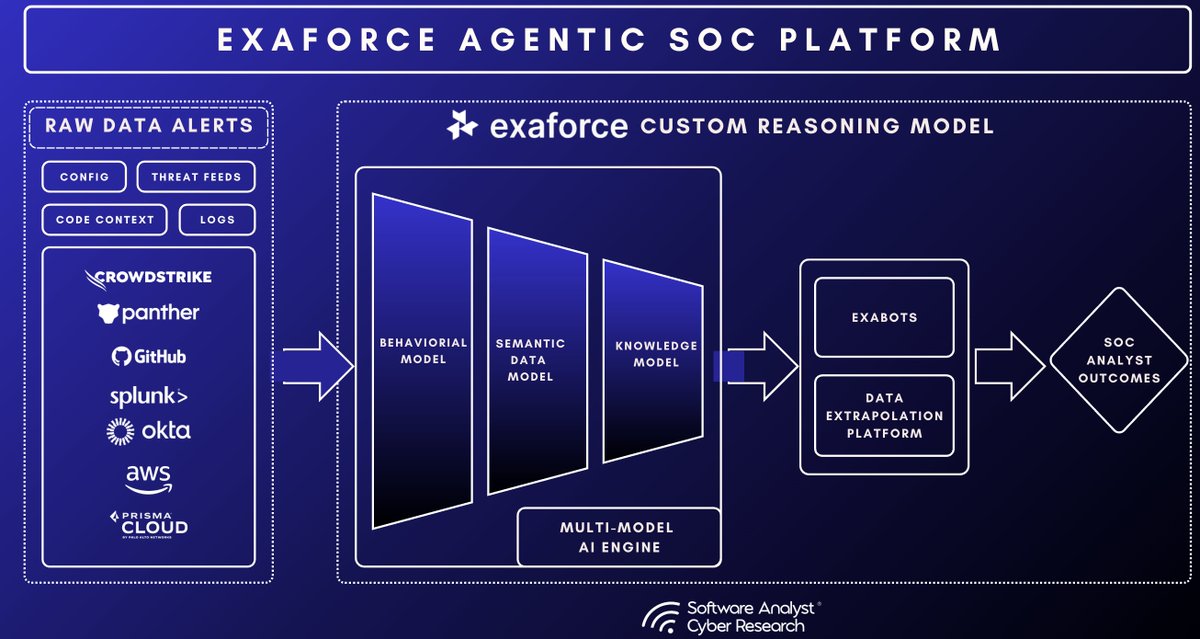
I analyzed @exaforceAI . in stealth mode before they announced their $75M Series A funding last week. As an analyst who's seen a lot of “agentic SOC” pitches, I thought they had some differentiated things (perhaps what convinced their investors on a BIG round).
A few thoughts. See a distilled flow image of how their stack is architected.
Everything starts with data: cloud logs, IAM, code context, and threat intel stream into an open warehouse. The following 3 steps are intruging:
1) Semantic model
It normalizes every field from CrowdStrike, Okta, AWS, etc. This includes converting raw JSON into typed security objects (users, roles, repos, resources) into a graph an analyst can actually reason over. This is key as correlation that used to take regex effort is now a one-hop graph query.
2) Behavioural model
This model leverages normalized data, allowing them to create baselines for every identity and asset, and flag anomalies before detection rules fire off an alert in your SIEM/Data Lake/XDR. This already helps cuts alert noise at the source. Many solutions stop here, but
3) Knowledge LLM
This third-layer reads both the semantic graph and behavioural deltas to add long-form reasoning and dynamic playbooks on top, as needed. Analysts can ask plain-English questions and get context-rich answers with a co-pilot. Only some remediation is auto-approved today as human-in-the loop is still key. I like this bcos autonomous agents are useless without a purpose-built knowledge layer.
The common thread is that each layer enriches the next. The warehouse fuels semantics → semantics sharpen behaviour → behaviour grounds the LLM → the LLM directs Exabots. These "bots" are task-oriented agents that triage, investigate, and respond to the stack above as required.
Custom semantic + behavioral layers provide deterministic outputs at cloud scale, overcoming the usual direct log‑to‑LLM pipelines (or SOARs in some cases)
TLDR; The team has seen big results in their speed to detect and lower cost in some of their early pilots. I’m betting that this "data: semantics+behaviour+knowledge LLM” pipeline is what we need to drive future SOC outcomes.
(This is what CISOs should ask companies next week, showcasing their shiny new AI agents.)
***
Congrats, Ankur Singla, Ariful Huq, Dhruv Gupta and team, on the launch and the raise
**
Follow along, I'll have more on this topic later in the Fall.
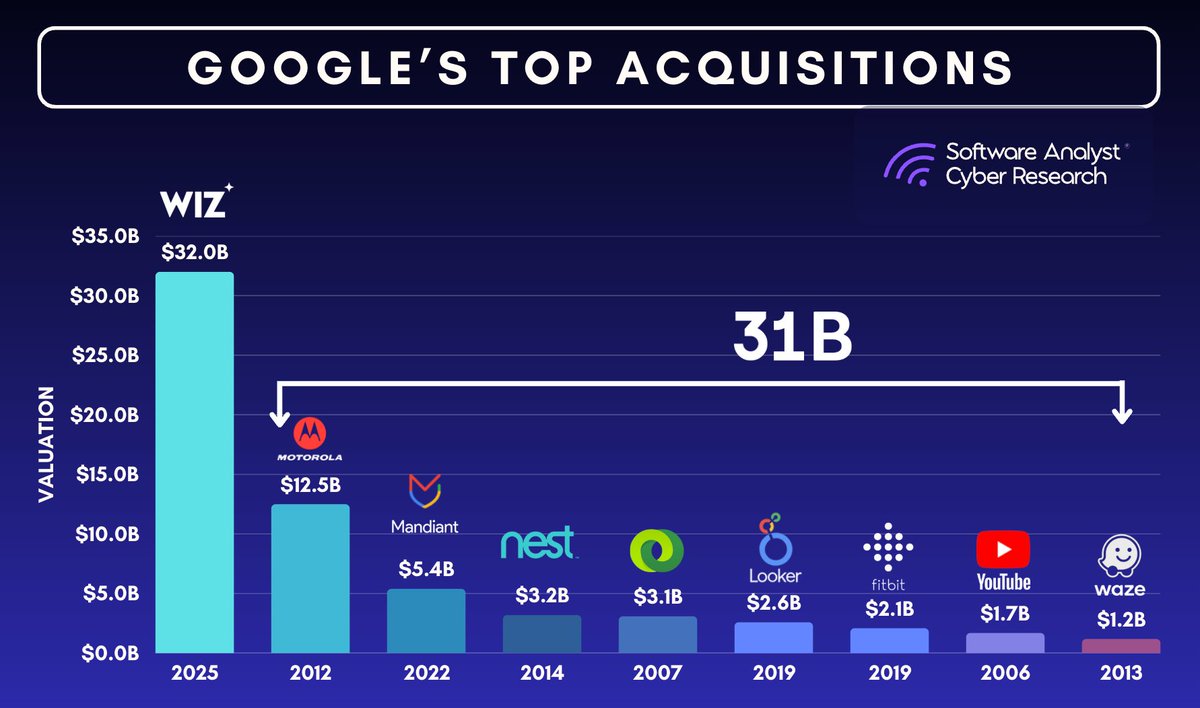
Google’s acquisition of Wiz easily combined all of its previous acquisitions—DoubleClick, YouTube, Motorola, Nest, Looker, and others—totaling approximately $31+ billion.
Key questions as a result:
1/ Security Gold Rush: Is Google signalling that cloud security is now more valuable than all their past market-defining deals combined? In the long-run with AI/LLM cloud-centric era - will Wiz prove a better acquisition than YouTube?
2/ Skyrocketing Valuations: The valuation signalled 30X NTM multiple, assuming Wiz hits $1B this year. The only comparable multiple was Adobe's proposed acquisition of Figma or, Meta's combo with WhatsApp (h/t Cole Grolmus). Have cybersecurity valuations reached new heights—or is this just a bold move to boost Google Cloud’s growth advantage?
3/New M&A Arms Race: Will such an eye-popping price spark a funding frenzy across the cybersecurity market (primarily in adjacent cloud security startups)— is this or a necessary evolution in tech?
This is a sneak peek into our upcoming report that drops tmrw here (link in comments)
MY DEEP DIVE ON WIZ!!
Incase you're trying to justify the $32B historic acquisition by Google.
Wiz was quietly on the path to becoming even more significant company than Crowdstrike or anything we've seen in cybersecurity!
See my piece below. Congrats to the @wiz team!!!
I had a good time speaking at Nasdaq in New York last week, where I presented emerging trends in Non-Human Identities (NHI). It was a great opportunity to highlight how organizations can prepare for the next wave of growth and governance. My talk focused on:
▪️ Vendor landscape - The different evolution / trends around how enterprises are securing NHIs vs. the various approaches I'm seeing from vendors.
▪️ Cloud NHIs – The growing need to provision and secure identities for cloud services.
▪️ Machine PKIs & Certificates (Resurgence) – Why machine authentication and certificate management are back in the spotlight
▪️ API Explosion – Managing the rapid rise with APIs and NHIs associated
▪️ Compliance & Regulatory Drivers – How I envision looming requirements that will push companies to be even more vigilant about non-human management later this year.
A big thank you to the hosts— @entrosecurity and NHI Mgmt Group for spearheading, and all the other co-partners Akeyless Security, Twine Security, Andromeda Security, P0 Security, SlashID, Axiom Security, BHI, Aembit, and Britive - for making this event possible.
It was also great to meet old friends from The Identity Underground and the broader identity community, who inspire conversation around identities (both human and non-human).
Looking forward to sharing more insights as this space evolves (quickly!) later this summer. Stay tuned!
#IdentitySecurity
Very interesting results from $OKTA a few days ago. Okta is gaining rapid traction within identity security -- outside of its core authentication products.
Based on its recent earnings call:
Okta IGA highlights:
✔️ Over 1,300 customers are now using OIG, contributing over $100M in annual contract value.
✔️ Time to value: Okta emphasized that OIG deployments are quicker compared to legacy governance solutions and deliver value in “months rather than years.”
✔️ Larger governance portfolio: Okta Lifecycle Management and Okta Workflows, Okta’s governance-related business tops $400M in annual contract value.
Okta Privileged Access
✔️ Broadening coverage: PAM is increasingly part of larger upsell deals, helping their customers modernize and secure privileged accounts in SaaS and cloud environments.
✔️ Okta sees Privileged Access as part of a full “platform” play, alongside Identity Governance, AI-based Threat Protection, and Lifecycle Management.
Okta now covers Workforce Identity (including single sign-on, MFA, governance, privileged access) and Customer Identity (including Auth0), tied together by new AI-driven and posture management capabilities.
I believe that Okta poses strong competition to a number of incumbents and emerging startups within the startup identity ecosystem.
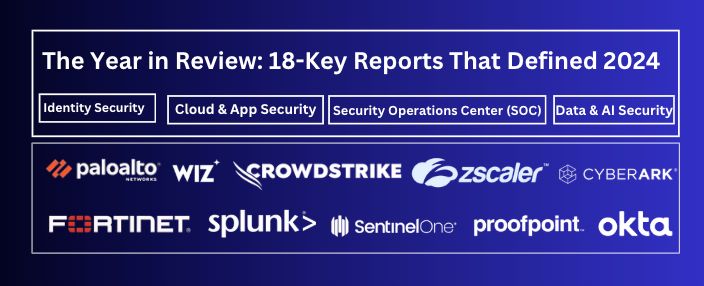
2024 was a big year for Software Analyst Cybersecurity Research (SACR), and I’m thrilled to welcome many new readers!🎉
To mark the milestone year, I’ve aggregated all my research publications from the past year into one comprehensive report, covering key areas like:
1️⃣ Identity Security
2️⃣ Security Operations
3️⃣ Cloud & App Security
4️⃣ Data & AI Security
The report explores trends shaping these domains in 2024 and the road ahead in 2025. Check out the full report in the comments!⬇️
A massive thank you to everyone who engaged, contributed, and has been part of the journey! 🚀 We’re optimistic for 2025!
#CyberSecurity #IdentitySecurity #cloudsecurity #AI #SecurityOperations