Great conversations today at #GU26@ASCO (ASCO) ! @DocHariKris and I presented two posters focused on cardio-oncology, implementation, and health equity in prostate cancer.
Today’s posters:
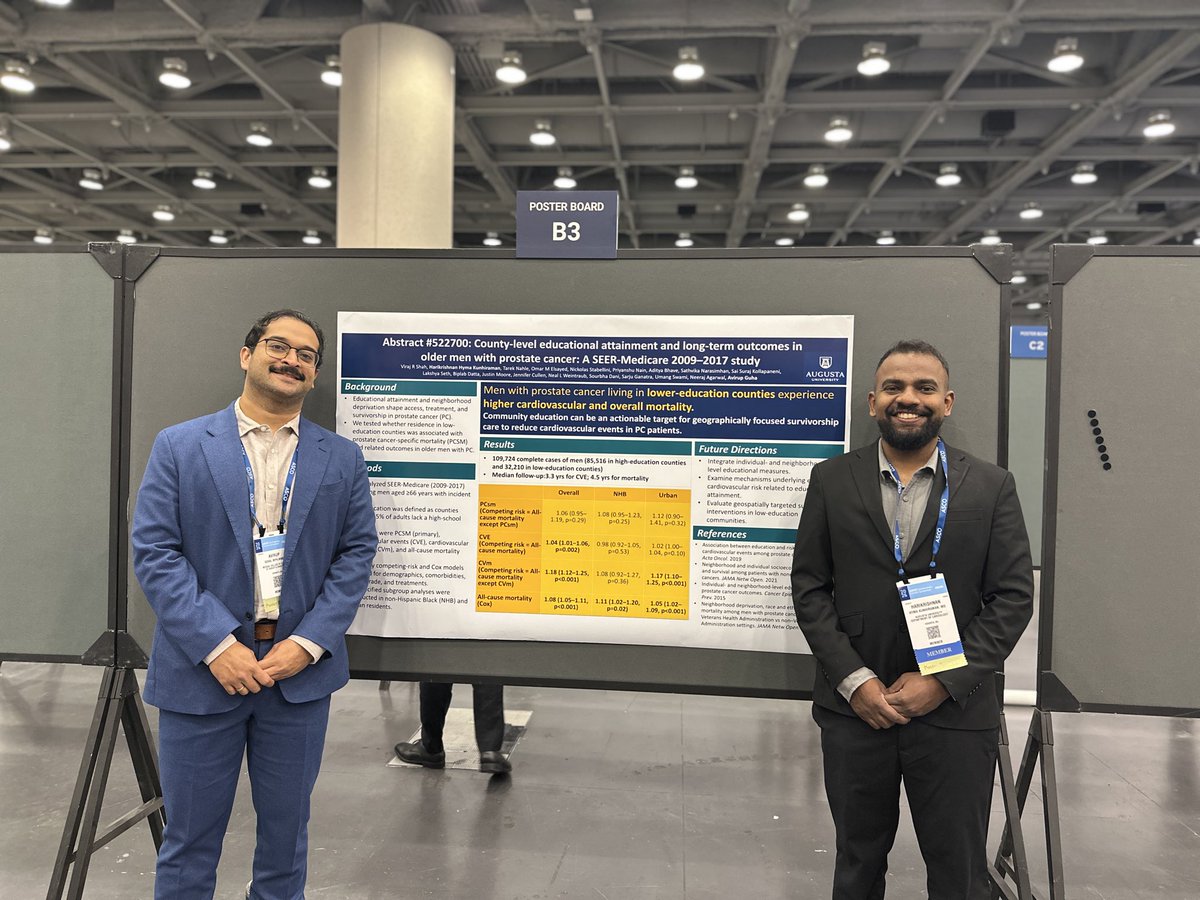
•County-level educational attainment and long-term outcomes in older men with prostate cancer (SEER–Medicare 2009–2017). @virajshahr
Key takeaway: Men living in lower-education counties experienced higher cardiovascular and overall mortality—highlighting community education as a potentially actionable lever for geographically targeted survivorship care.
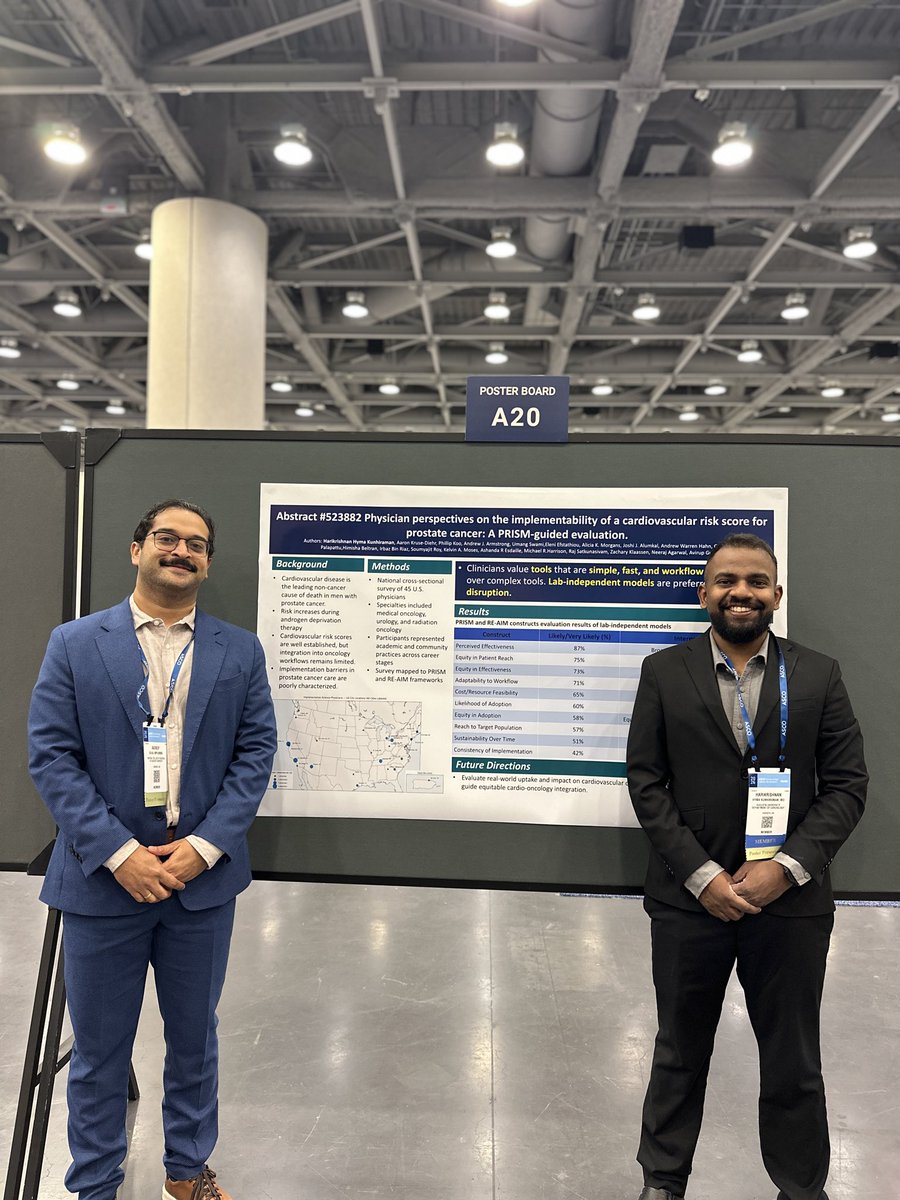
•Abstract #523882: Physician perspectives on implementing a cardiovascular risk score for prostate cancer (PRISM-guided evaluation). @ASCOPost
Key takeaway: Clinicians prioritize tools that are simple, fast, and workflow-compatible—with a clear preference for lab-independent models to minimize disruption. We thank all the leaders in the field who worked with us to make this study possible. Posting video on the topic here as well
@GACancerCenter@neerajaiims@zklaassen_md@mcg_urology@umangtalking@OncoAlert@oncodaily@PCFnews@IrbazRiaz@PBarataMD@AarmstrongDuke@CaPsurvivorship@PhillipKooMD@ZEROCancer@MCGCardFellows all abstracts will be available in @JCO_ASCO . Thanks to @CDMRP and @AHAScience for funding our work.
Big day in the poster hall for our group! @DocHariKris and I shared 6 posters today spanning cardio-oncology + multi-omics in prostate cancer: connecting imaging, adiposity, immune remodeling, proteomics, and cardio–kidney–metabolic (CKM) risk. @TarekNahle@neerajaiims@GACancerCenter@anantm
Poster lineup:
•T1 MRI / radiomics: Skeletal muscle radiomic features on prostate T1-weighted MRI and association with major adverse cardiac events (MACE) @anantm
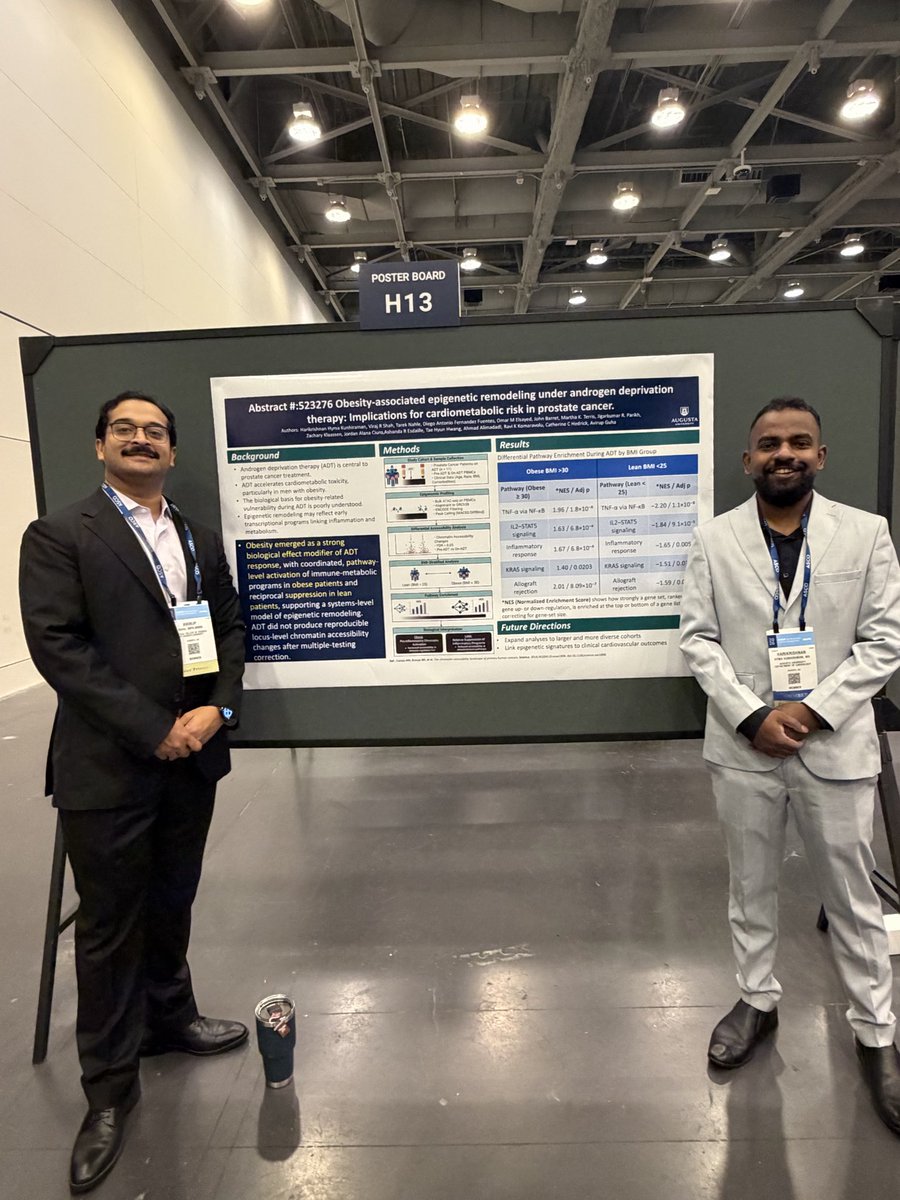
•Obesity-associated epigenetic remodeling under androgen deprivation therapy (ADT) and implications for cardiometabolic risk @ImmunologyAU
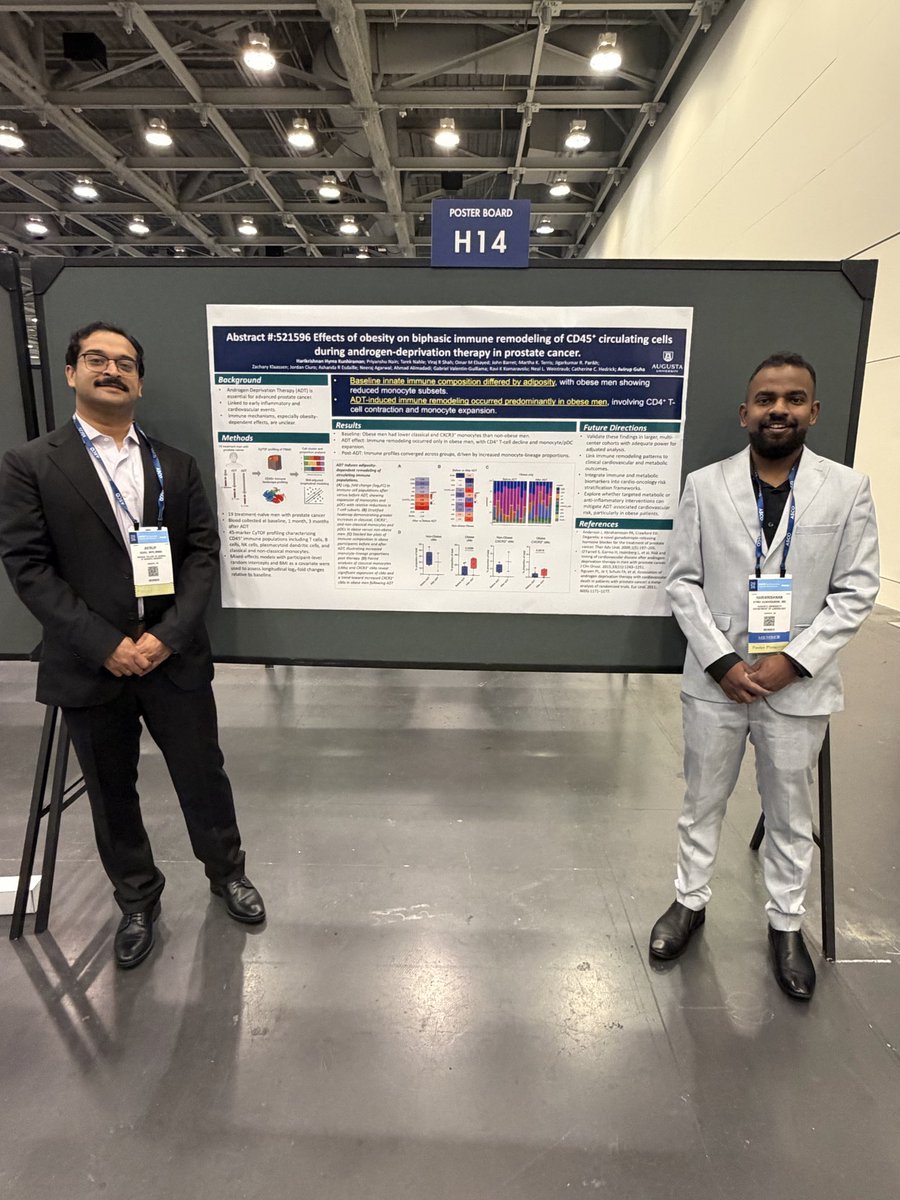
•CyTOF: CyTOF immune profiling: how obesity shapes biphasic immune remodeling (CD45+ circulating cells) during ADT @ImmunologyAU
•Proteomics: Proteomic remodeling after ADT: how age modifies innate immune/complement–ECM pathways @mayo
•CardioKidneyMetabolic Syndrome: CKM syndrome stages in prostate cancer and prognostic significance for CV morbidity/mortality
•MRI T2 microenvironment: Periprostatic adipose microenvironment remodeling in aggressive prostate cancer (atlas-based geometric analysis) @anantm
Really appreciated all the thoughtful questions and conversations: always energizing to share the work and hear new perspectives. If you’re here, come say hi!
#ProstateCancer #CardioOncology #Radiomics #Epigenetics #CyTOF #Proteomics #CKM #CancerResearch #TranslationalScience #GU26 @ASCOPost@ASCO@OelsayedMD@EmoryAIHumanity . All abstracts out in @JCO_ASCO . Thanks to @CDMRP and @AHAScience for funding our work.
New in JNCI Cancer Spectrum‼️ Socioeconomic position (SEP) meaningfully predicts cardiovascular🫀 (CV) outcomes in men with #prostate_cancer. We examined how neighborhood disadvantage shapes long-term CV and survival risks #cardiooncology#CancerResearch
https://t.co/68G6lZ6Bxk
Presentation #5 on last day of #AHA25 by @dukemedicine#SarahMalik from @MCG_AUG - Take home - In 12,832 #ARIC participants followed for 28 years, 877 cancer survivors and 3,653 non-cancer participants developed incident CVD. Across both unmatched and propensity-matched analyses, the use of statins, anti-hypertensives, and aspirin was consistently associated with lower CVD risk in both cancer and non-cancer groups. The magnitude of benefit was comparable between groups, indicating that cancer survivors derive similar cardiovascular protection from these preventive medications as individuals without cancer. @JHUBloombergCtr@ShelbyKuttyMD@ICOSociety@oncodaily@OncoAlert
Final (#6) presentation of #AHA25 by @MCG_AUG student @sathvika_n focused on disparities in clinical trials - take home - Among 284 Southern U.S. cities, only 26% contained a Phase III lipid-lowering trial site, with a median drive time of 36 minutes to the nearest site. Each one-point increase in Area Deprivation Index (ADI) was linked to a 2.1% longer drive time (p<0.001), and moving from the 25th to 75th ADI percentile more than doubled travel burden. Minority-majority cities had 21.7% shorter drive times, largely due to trial clustering in a few large urban hubs. Overall, more socioeconomically deprived cities faced significantly longer travel distances, underscoring inequitable access to PCSK9 and lipid-lowering clinical trials. @NIMHD@trialradar
🌟 What an incredible experience presenting at #AHA25! 🎤 Honored to share our collaborative work with Memorial Sloan Kettering—advancing risk prediction in HER2+ breast cancer under the mentorship of @anita_deswal 💙🫀 Grateful for the journey & teamwork #CardioOncology
Thrilled to present our new abstract at #AHA25! 🫀
We compared traditional (BMI> 30) vs. new (BMI> 25 + central adiposity) #obesity definitions in the ARIC study (25-yr follow-up).
Key Results:
✅ The new definition found a large, intermediate-risk group for CVD (aHR 1.25).
Third moderated poster by @OelsayedMD presenting moderated digital poster - take home #1 Among 14,834 ARIC participants followed for 25 years, 54% were classified as obese by the newer central adiposity definition versus 27% by the traditional BMI-based definition. The newly defined group captured individuals with BMI 25–29.9 kg/m² but high waist circumference or ratio, 7% of whom reverted to non-obese status over time. @JHUBloombergCtr
🎬 Grateful for the opportunity to join Dr. Fred Kusumoto in providing #AHA25 coverage with @ACCinTouch 💙We discussed standout trials from Day 2️⃣ & previewed upcoming #HeartFailure studies, including POLY-HF & CAVIAR 🫀✨#CardioTwitter
Second presentation for the day by superstar @virajshahr - take home - Among 3,192 African American ARIC participants followed for 22.4 years, 30% developed cancer. The DARC-positive genotype was not significantly associated with overall, smoking-related, or obesity-related cancer risk (HR 0.95, 95% CI 0.83–1.09). However, DARC-null individuals with CVD showed a trend toward higher incidence of smoking-related and lung cancers, suggesting possible effect modification by cardiovascular disease. @OelsayedMD@ICOSociety
Third moderated poster by @OelsayedMD presenting moderated digital poster - take home #1 Among 14,834 ARIC participants followed for 25 years, 54% were classified as obese by the newer central adiposity definition versus 27% by the traditional BMI-based definition. The newly defined group captured individuals with BMI 25–29.9 kg/m² but high waist circumference or ratio, 7% of whom reverted to non-obese status over time. @JHUBloombergCtr
On the eve of #AHA25, I am happy to report a new paper from our lab looking to replace CHADSVASC for AF in breast cancer. Published in @Cancers_MDPI - BS2CALED - In breast cancer + AF, B‑S2CALED predicts stroke/TIA better than CHA2DS2‑VASc and is externally validated. Simple 0–10 score from routine data to support anticoagulation decisions in oncology. DOI:10.3390/cancers17223600 #CardioOncology #BreastCancer #AFib #Stroke @sdent_cardioonc@nickolastab@Dr_Mike_Fradley@KoberLars
#AHA25
Excited to present our work from @MCG_AUG with my team:
“Unequal Access: Socioeconomic Deprivation & Travel Distance to Phase III Lipid-Lowering Trials in the Southern U.S.”
Join me for my moderated poster session on Mon, Nov 10 (2:06–2:11 PM CT, Population Science Zone)!
Excellent disparities work in access to modern lipid lowering trials by M1 at @MCG_AUG@sathvika_n . Inspired by an unexplained denial to an oral PCSK9 phase 3 trial, we wondered what happens when ultra modern medicine is not available to large number of patients due to biased site selection. Come see our unbiased work using @Google API to find distance to trial site. @DrMakaryFDA@US_FDA@neerajaiims@MCGCardFellows@nationallipid@AHAScience@PCSK9Forum #AHA25