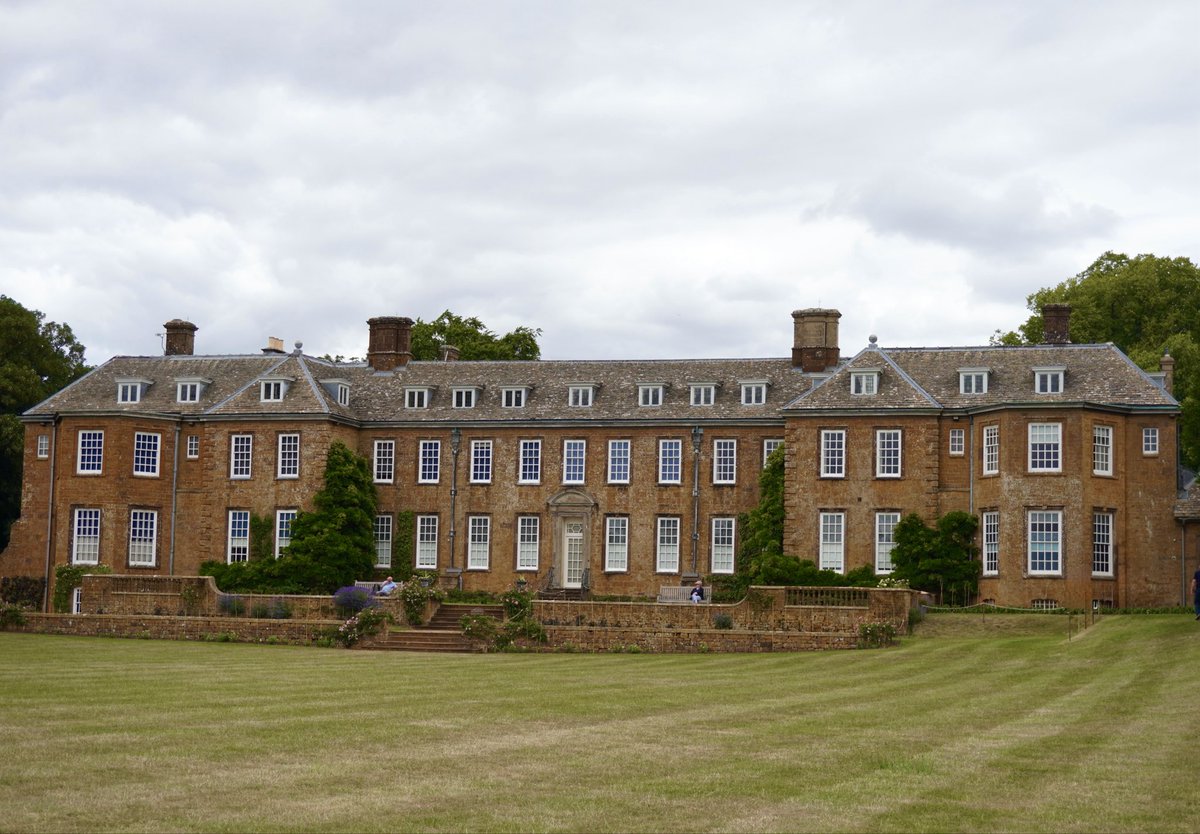
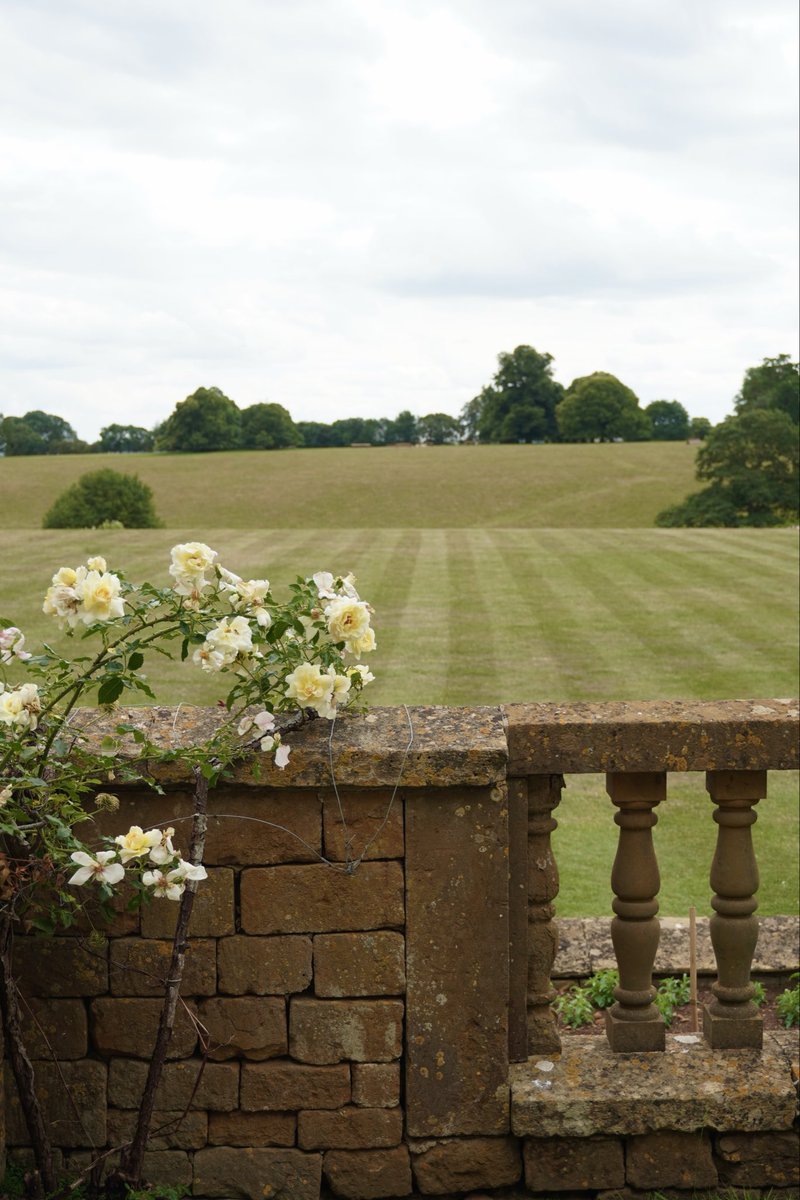
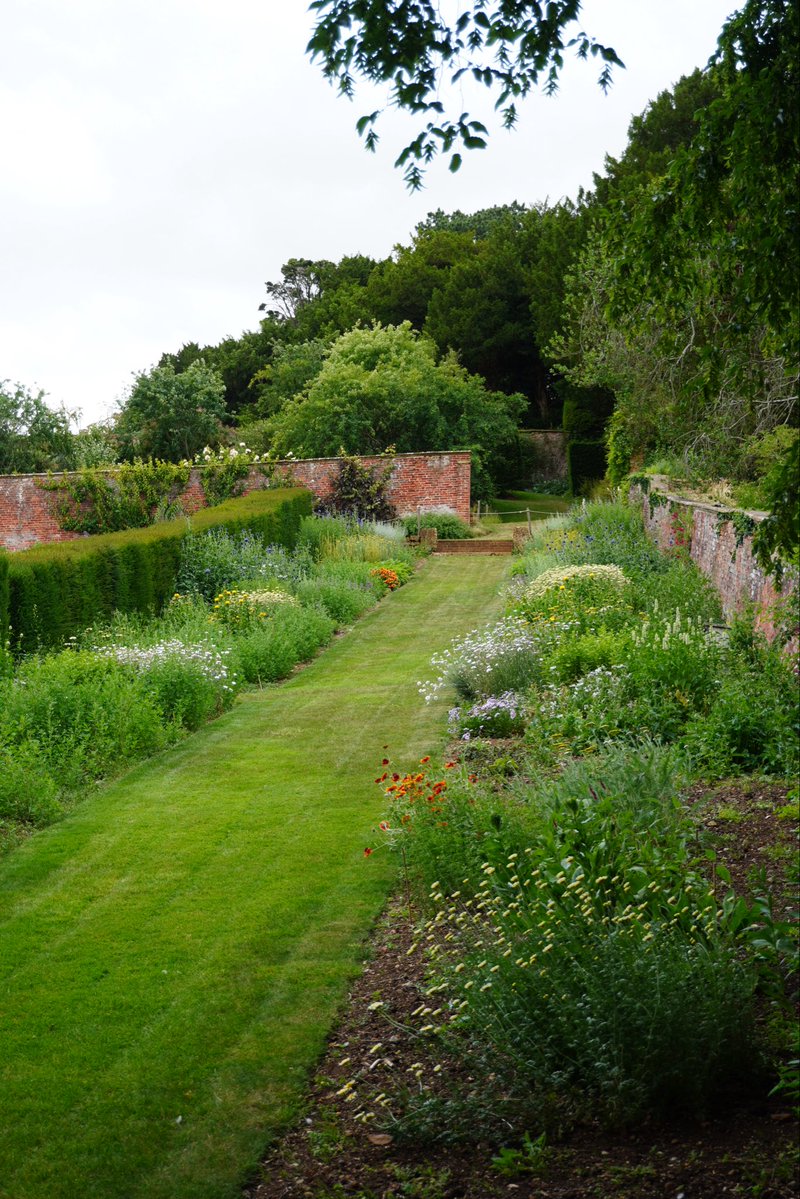
📍 🏴 Exploring one of Warwickshire's most beautiful country estates, Upton House and Gardens.
With a history dating back to 1500, Upton House has been home to a remarkable succession of owners, including a Justice, politicians, a banker, and, most recently, the esteemed Samuel family, of Shell Transport and Trading renown.
In 1927, Walter Samuel, the son of Shell's founder and the 2nd Viscount Bearsted, purchased Upton House. With the assistance of his wife, Lord Bearsted transformed the estate into an elegant weekend retreat for the family.
Although the family continued to live at the stately home until 1986, Upton House was bequeathed to the National Trust in 1948, along with one of the finest private art collections in the country, enabling its beauty to be appreciated by all.
#UptonHouse #Warwickshire #NationalTrust #Shell
'I have considered it my duty to die for my faith, rather than to stain my conscience with a lie'.
Today, we commemorate Saint Oliver Plunkett, Archbishop of Armagh and Primate of All Ireland.
In 1625, Oliver Plunkett was born in County Meath to an aristocratic family with ties to the Barons of Louth and the influential Dillons family, of Hiberno-Norman descent. Yet this noble ancestry did not preclude Plunkett from contending with the then-rife discrimination against Irish Catholics, which had proliferated across the British Isles since the Reformation's inception. Although the Penal Laws would not be enacted until 1695, after Plunkett's death, during his life, Catholics were prohibited from publicly celebrating Mass, establishing seminaries to train clergy, and exercising episcopal authority. Thus to attain his aspiration of ordination, Plunkett was guided to Rome in 1647 by Father Pierfrancesco Scarampi, envoy between the Papacy and the Irish Catholic Confederation.
Despite being ordained in 1654, Plunkett was unable to return to Ireland while it remained under Cromwellian jurisdiction, and thus he stayed in Rome as a professor of theology. The 1660 Stuart Restoration ameliorated conditions for Irish Catholics and so, in 1670, Plunkett returned to his native land, now as the Archbishop of Armagh and Primate of All Ireland. Over the next four years of his ministry, Archbishop Plunkett is said to have confirmed over 48,000 Catholics. However, amidst the reemergence of Catholic antipathy, including the 1673 Test Act, Plunkett went into hiding. For the Archbishop, this antagonism culminated in a false accusation of High Treason amidst the 1678 Popish Plot, with Plunkett accused of plotting a French invasion to rebel against and murder Protestants. Brought to London to be tried, a Protestant jury convicted the Archbishop on account of the fabricated testimonies of his accusers. On 1st July 1681, having been brought to the Tyburn Cross, Oliver Plunkett was hanged, drawn and quartered; he was the last Catholic martyr to die in England.
#SaintOliverPlunkett #OnThisDay #IrishHistory #CatholicSaint
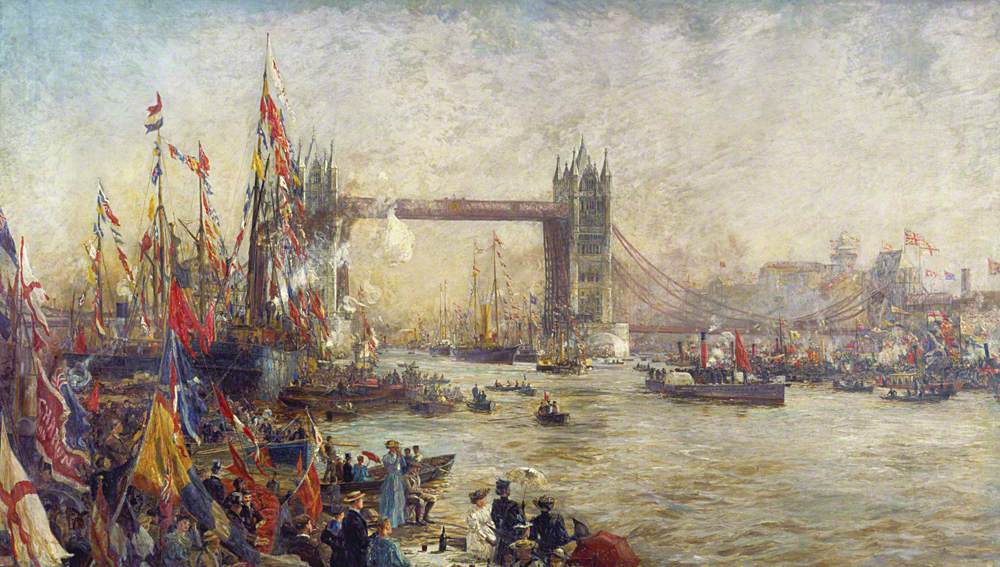
🇬🇧 Admiring William Lionel Wyllie's glorious oil painting commemorating the opening of Tower Bridge on 30th June 1894.
After eight years of construction, London's now iconic bridge was first opened by Edward, the Prince of Wales, accompanied by his wife Alexandra and their son, George, the Duke of York.
Of Neo-Gothic design, Tower Bridge complements its surroundings, its architecture congruous with the nearby Tower of London. At the time of its opening, Tower Bridge was an exceptional example of British engineering, standing as the most sophisticated bascule bridge ever built. Despite each half weighing 1,200 each, the rapidity with which the bridge could be raised is due to the ingenious invention of Sir W. G. Armstrong, the hydraulic accumulator; coal-fired steam engines powered hydraulic pumps to pressurise water, which was then stored at a great height for quick release on the approach of a vessel. Naturally, Tower Bridge couldn't be opened without a demonstration of such an innovation: 'Daisy', the Harbour master's cutter, was the first ship to sail between her raised leaves.
#TowerBridge #London #OnThisDay #BritishHistory
Ignored by the modernist architectural press, the Classical tradition is witnessing a true revival - skilled craftsmen and architects with an eye for beauty
(6) St. Mary's Church, Alveley:
Some close-up photographs of the splendid silk altar frontals at St. Mary's, the original dating back to the late 15th century with its replica completed in the 1870s.
The original frontal was discovered in a church chest in the vaults of nearby Coton Hall, sometime between 1865 and 1870. The central figure is Abraham holding the souls of the departed in Paradise. Flanking Abraham are three angels carrying banners inscribed with 'Da Gloria Deo', 'Give Glory to God', as well as fleurs-de-lis, symbolic of the Holy Trinity, and pomegranates, signalling prosperity and abundance.
(5) St. Mary's Church, Alveley:
Placed in St. Mary's Chancel are these beautiful oak armchairs, with relief-carved panels and bust finials. I wish that I could find more information about the origin of these chairs, their maker, and how they came to be in Alveley. To my layman's eyes, these seem to be Gothic Revival wainscot armchairs with Flemish influences, but do let me know if you have any insight!
I suspect that the panel on left-hand chair (as photographed) may depict the suffering Job visited by his comforters, Eliphaz, Bildad, Zophar, and Elihu. The smaller figure kneeling above the reclined figure is distinct in both dress and facial features to the other standing figures. This could be Elihu, as the youngest of the comforters, but I initially interpreted the bowl carried by this figure to refer to Job 2:12, 'each one tore his robe and sprinkled dust on his head toward heaven', a scene which predates the arrival of Elihu (Job 32). The chronological discrepancy may be insignificant if the panel is intended to broadly represent the torments of Job but it left me searching for alternative biblical passages (suggestions welcome!).
I am also uncertain about the panel on the right-hand chair: could it depict Cain and Abel, indicated by the rural setting and the different agricultural implements? Does the magisterial posture of the figure on the left, in contrast to the cowering figure on the right, accord with the Lord's questioning of Cain, 'Where is your brother Abel?' (Gen. 4:9). I'm leaning towards the latter explanation but, as with the first panel, I welcome any input!
#Alveley #Church #Shropshire
Situated beneath the window is Kempe's splendid reredos, rather unusually painted onto zinc but seemingly free from any corrosion (at least to the untrained eye!).
The Christological scenes depicted here are the Presentation of Christ, the Crucifixion, and Christ's Descent from the Cross.
In the first panel, we see Mary and Joseph presenting the Christ Child to Simeon in the Temple of Jerusalem, along with the offering of two doves, a permitted oblation for those of modest means; 'My eyes have seen thy salvation' (Luke 2:30-2).
Upon the Cross of Christ in the central panel is the inscription 'INRI', Iesus Nazarenus Rex Iudaeorum (Jesus of Nazareth, King of the Jews); standing at His feet are the Virgin Mary and Saint John the Evangelist: 'When Jesus saw his mother there, and the disciple whom he loved standing nearby, he said to her, 'Woman, here is your son', and to the disciple, 'Here is your mother'.' (John 19:26-27).
The final panel shows Nicodemus, Joseph of Arimathea, and the Virgin Mary standing beside the body of Christ, having been taken down from the Cross. On the ground beside His body are an ointment jar, emblematic of Mary Magdalen's anointing of Jesus' feet, and the crown of thorns, here, seemingly gilded as an indication of Christ's forthcoming triumph over death; 'They took the body of Jesus and wrapped it with the spices in linen cloths, according to the burial custom of the Jews' (John 19:40).
(3) St. Mary's, Alveley:
The chapel contains two ornate works by C. E. Kempe: a stained glass window and a painted reredos, both thought to date from 1887.
The three central lights of the window depict Saint Augustine of Hippo, Saint Mary, and Saint Stephen. Dressed in the traditional vestments of a bishop, Augustine wears a mitre and carries a crozier. Although the Virgin Mary is depicted wearing a richly ornamented robe and is crested with a halo, her role as the doting mother is emphasised as she affectionately clasps the Christ Child. Stephen is portrayed wearing a deacon's dalmatic, carrying a book of the Gospels and a martyr's palm, symbolic of his defence of God's Word and his spiritual triumph over death.
#Alveley #Church #StainedGlass #Kempe
(2) St. Mary's, Alveley:
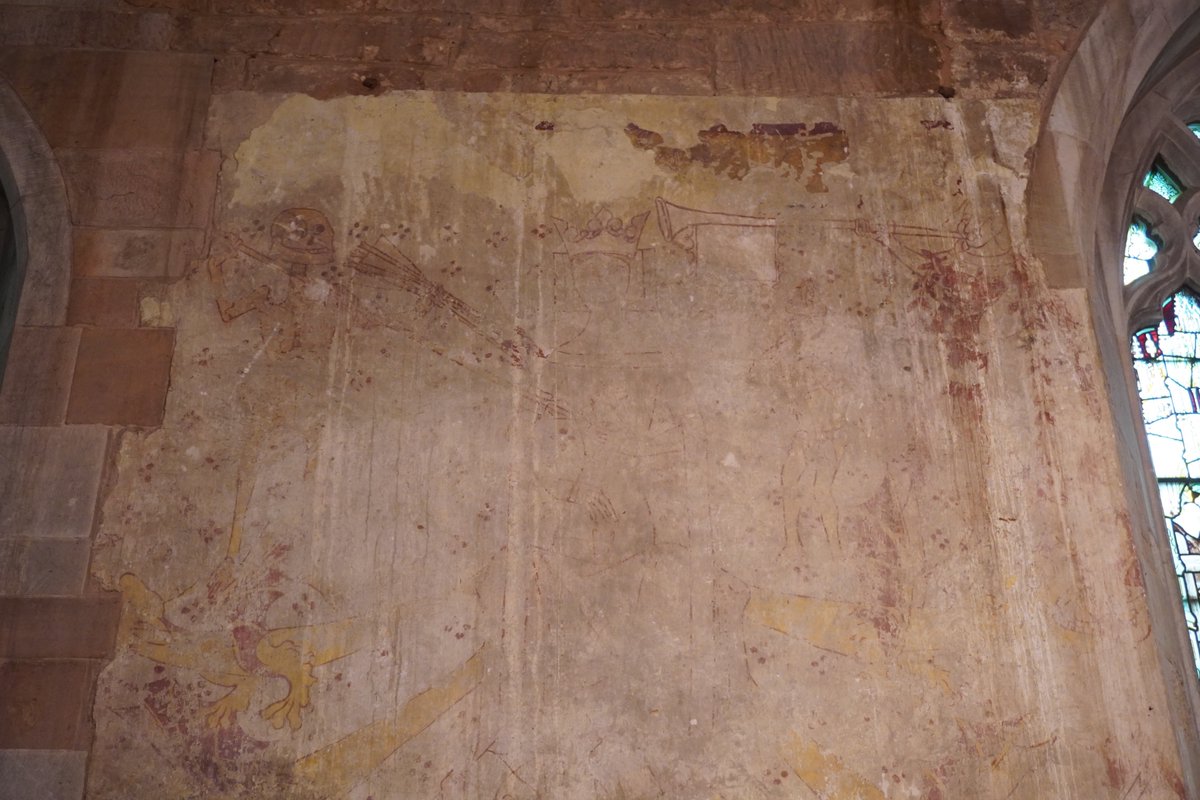
In 1353, the south aisle of St. Mary's was remodelled into a chantry chapel by Sir Thomas Astley of Coton Hall. Upon the south wall of the chapel we find the remnants of a colourful mural, also dating from the fourteenth century.
In the centre of the painting, we find a crowned female with dragons at her feet; to the left stands a skeleton, armed with a spear and arrows; on the right are two figures, the most prominent of which is a trumpeter, with the smaller figure seemingly a minstrel. As this was once a Roman Catholic Church, and it has always been dedicated to Saint Mary, the central figure is almost certainly Our Lady, with the evil beasts beneath her feet plausibly alluding to Revelations (Chs. 12; 13), where dragons threaten the pregnant Mary.
As noted in the didactic label that accompanies the mural, the Virgin Mary is often contrasted with Eve: the disobedience of the first woman brought death into the world and the Fall of Man; the dutifulness of Mary brought Jesus into the world and the Salvation of Man. In the mural, with the skeleton representing Death, the pointing of its spear towards the womb could be symbolic of the fate awaiting all men since the Fall. Yet, as we know, Mary will give birth to Christ, who shall bear the sins of men and ultimately conquer Death. In this sense, although the mural is relatively simple in its depiction, it could be interpreted as promoting the Virgin Mary as the 'New Eve', with the coming salvation of mankind heralded by the trumpeter. Within the context of fourteenth-century England, a time of inordinate suffering due to recurrent famines and plagues, this mural would have conveyed a message of hope, encouraging faith though death be all around.
#SundayService #Alveley #Church #Medieval #Mural
St. Mary's Church in the Shropshire village of Alveley dates back to 1140, with its Norman origins visible in the tufa masonry of the lower part of the tower, the nave, and the aisles. From the early 13th century, additions and alterations to St. Mary's were constructed from local sandstone ashlar, with its deep red-brown hue characteristic of Shropshire's geology and thus architecture.
#SundayService #Alveley #Church #Shropshire
Image credit:
'Arthur Edward Jeune Collins, pictured on an 1899 postcard' published in the Public Domain via Wikimedia Commons.
Bibliography:
(1) Wilde, S. (2007) 'The boy who knew no boundaries' published online via ESPN Cricinfo; available at: https://t.co/c2BorQzT8U
Arthur Edward Jeune Collins, 628 not out.
Across four afternoons in June 1899, this English schoolboy set the world record for the most runs scored by an individual in a single innings. Contesting this school match were two Houses of the Bristolian Clifton College, Clarke's and North Town. With ‘James’ Collins having won the toss and deciding to bat, he took to the crease after 3pm on 22nd June; by the time of Stumps at 6pm, after just a few hours of play, Collins had posted 200 on the board, despite nearly being caught on three occasions at around 50, 100, and 140 runs (Wilde).
Play continued the following day and, as Collins' tally increased, news spread throughout the area and spectators began to gather. By 5:30pm, A. E. Stoddart's record of 485 for Hampstead was eclipsed; by Stumps, Collins was 509 not out. The pause in play over the weekend generated further 'buzz', resulting in even greater crowds turning up on Monday to watch during the lunchtime break; in just under an hour, Collins added 89 runs: 598, not out.
At 12:30pm on Tuesday 27th June, Collins walked out to the crease alongside his fellow batsman, Redfern. The score was 804 for 9. Two runs off the first ball brought Collins to 600, onto which he added an additional 28 in the 25 minutes before Redfern's wicket fell. Of Clarke's House 836 runs, Collins scored 628. Proving himself to be an adept all-rounder, Collins proceeded to take 7 wickets for 33 runs in 21 overs, with North Town bowled out for 87 in 90 minutes.
Achieved at the tender age of 13, James Collins’ finest innings stood as the world record for 116 years before being beaten in 2016 by Pranav Dhanawade. However, amongst British cricketers, Collins' record 628 runs remains unbeaten: 127 years, not out.
Despite such promise, Collins never played first-class cricket, opting to serve his country by joining the British Army in 1902. Unfortunately, James died in 1914 during the First Battle of Ypres, while serving as a captain with the 5th Field Company of the Royal Engineers. Although Collins is primarily remembered for his flair on the cricket pitch, his selfless service to our nation should not be forgotten.
Illustrations:
(1) ‘Diphthera orion’; plate 404, published in Vol. 5.
(2) ‘Fœnis assectator’; plate 423, published in Vol. 3.
(3) ‘Malachius bispinosus’; plate 167, published in Vol. 2.
(4) ‘Apis Mellifica’; plate 769, published in Vol. 4.
Curtis, J. (1829-40) ‘British Entomology : Being Illustrations and Descriptions of the Genera of Insects Found in Great Britain and Ireland: Containing Coloured Figures from Nature of the Most Rare and Beautiful Species, and in Many Instances of the Plants upon Which They Are Found’. Volumes 1-8. London. (N.B. the work was originally issued in 16 volumes from 1824-1839). Available online at: https://t.co/k2NaAaT8er.
Celebrating Insect Week with some wonderful illustrations by the esteemed English entomologist, John Curtis.
Born to an anthophile mother in 1871, John Curtis inherited a passion for the natural world. Fascinated with insects from young age, John initially studied under local naturalist Richard Walker before later becoming acquainted with the eminent entomologists William Kirby and William Spence. While John was able to generate some income from selling specimens, the combination of his erudition and artistic ability soon enabled him to secure the patronage of James Charles Dale, a member of the Entomological Society of London. In 1824, John began to compile his research and illustrations into a voluminous work, ‘British Entomology: Being Illustrations and Descriptions of the Genera of Insects Found in Great Britain and Ireland’, the renown of which endures today.
#InsectWeek #JohnCurtis #Entomology @RoyEntSoc
Bibliography:
(1) Bede (731)The Ecclesiastical History of the English People; translated by Sellar, A. M. (1902). Extract available online at: https://t.co/Iq4P3D8UGR
Image credit:
(1) Saint Æthelthryth of Ely from the Benedictional of St. Æthelwold, illuminated manuscript in the British Library; image available in the Public Domain via Wikimedia Commons.
(2) Avery, R. (2010) 'Statue of St Etheldreda on the West Front of Salisbury Cathedral, UK'; available in the Public Domain via Wikimedia Commons.
'None can part her from them which follow the Lamb enthroned on high, whom none had severed from the Love enthroned on high'.
Today, we commemorate Saint Æthelthryth, the Abbess of Ely. Though she was of noble birth, daughter of King Anna of East Anglia, the legacy of Æthelthryth endures on account of her Christian faith.
Æthelthryth was married twice, with each union strengthening regional alliances. Her first marriage c. 652 was to Tondberct, an ealdorman of the Southern Gyrwas (the western region of The Fens), though he died just a few years later. Subsequently, c. 660, Æthelthryth became the wife of Prince Ecgfrith of Northumbria. According to the Venerable Bede, throughout both of her marriages, Æthelthryth remained a virgin: she wished to dispatch with worldly cares and 'to serve only Christ, the true King, in a monastery'.
After receiving her religious habit, Æthelthryth entered the monastery at Coludi (Coldingham, Scotland) under Abbess Aebba, the aunt of her recently crowned husband. Before long, Æthelthryth returned to East Anglia to become abbess of the monastery which she had established at Elge (Ely, Cambridgeshire).
A mere seven years later, Æthelthryth developed a tumour upon her neck, though she welcomed this affliction as a form of penance for the luxuries of her youth. Replacing the needless weight of 'gold and pearls' that once adorned her neck was the 'fiery heat of a tumour', which Æthelthryth deemed to be a just punishment: 'I believe the Divine goodness would have me endure the pain in my neck...so I may be absolved from the guilt of my needless levity'. Though the tumour was excised, Æthelthryth died a few days after the operation, on 23rd June 679.
Initially, Æthelthryth was buried in Ely cemetery but, sixteen years later, Abbess Seaxburh, Æthelthryth's sister, decreed that her remains be translated into the church, a more sacred resting place. Yet when Æthelthryth was disinterred, her body was found to be free from corruption, her linen clothes without blemish. Bearing witness to this phenomenon was Æthelthryth's old physician, who, upon seeing her neck, noted: 'the incision which I had made was healed up; so that, in marvellous wise, instead of the open gaping wound with which she had been buried, there then appeared only the slightest trace of a scar'. Such divine miracles were perceived to verify the truth of Æthelthryth's chastity in life, and in her death, the '[exchange of] all pain...for everlasting life and health'.
#Saint #Æthelthryth #Etheldreda #Ely #Christian







![ofTheseIsles's tweet photo. 'None can part her from them which follow the Lamb enthroned on high, whom none had severed from the Love enthroned on high'.
Today, we commemorate Saint Æthelthryth, the Abbess of Ely. Though she was of noble birth, daughter of King Anna of East Anglia, the legacy of Æthelthryth endures on account of her Christian faith.
Æthelthryth was married twice, with each union strengthening regional alliances. Her first marriage c. 652 was to Tondberct, an ealdorman of the Southern Gyrwas (the western region of The Fens), though he died just a few years later. Subsequently, c. 660, Æthelthryth became the wife of Prince Ecgfrith of Northumbria. According to the Venerable Bede, throughout both of her marriages, Æthelthryth remained a virgin: she wished to dispatch with worldly cares and 'to serve only Christ, the true King, in a monastery'.
After receiving her religious habit, Æthelthryth entered the monastery at Coludi (Coldingham, Scotland) under Abbess Aebba, the aunt of her recently crowned husband. Before long, Æthelthryth returned to East Anglia to become abbess of the monastery which she had established at Elge (Ely, Cambridgeshire).
A mere seven years later, Æthelthryth developed a tumour upon her neck, though she welcomed this affliction as a form of penance for the luxuries of her youth. Replacing the needless weight of 'gold and pearls' that once adorned her neck was the 'fiery heat of a tumour', which Æthelthryth deemed to be a just punishment: 'I believe the Divine goodness would have me endure the pain in my neck...so I may be absolved from the guilt of my needless levity'. Though the tumour was excised, Æthelthryth died a few days after the operation, on 23rd June 679.
Initially, Æthelthryth was buried in Ely cemetery but, sixteen years later, Abbess Seaxburh, Æthelthryth's sister, decreed that her remains be translated into the church, a more sacred resting place. Yet when Æthelthryth was disinterred, her body was found to be free from corruption, her linen clothes without blemish. Bearing witness to this phenomenon was Æthelthryth's old physician, who, upon seeing her neck, noted: 'the incision which I had made was healed up; so that, in marvellous wise, instead of the open gaping wound with which she had been buried, there then appeared only the slightest trace of a scar'. Such divine miracles were perceived to verify the truth of Æthelthryth's chastity in life, and in her death, the '[exchange of] all pain...for everlasting life and health'.
#Saint #Æthelthryth #Etheldreda #Ely #Christian](https://pbs.twimg.com/media/HLhIEKoWMAAzaIz.jpg)








![ofTheseIsles's tweet photo. 'None can part her from them which follow the Lamb enthroned on high, whom none had severed from the Love enthroned on high'.
Today, we commemorate Saint Æthelthryth, the Abbess of Ely. Though she was of noble birth, daughter of King Anna of East Anglia, the legacy of Æthelthryth endures on account of her Christian faith.
Æthelthryth was married twice, with each union strengthening regional alliances. Her first marriage c. 652 was to Tondberct, an ealdorman of the Southern Gyrwas (the western region of The Fens), though he died just a few years later. Subsequently, c. 660, Æthelthryth became the wife of Prince Ecgfrith of Northumbria. According to the Venerable Bede, throughout both of her marriages, Æthelthryth remained a virgin: she wished to dispatch with worldly cares and 'to serve only Christ, the true King, in a monastery'.
After receiving her religious habit, Æthelthryth entered the monastery at Coludi (Coldingham, Scotland) under Abbess Aebba, the aunt of her recently crowned husband. Before long, Æthelthryth returned to East Anglia to become abbess of the monastery which she had established at Elge (Ely, Cambridgeshire).
A mere seven years later, Æthelthryth developed a tumour upon her neck, though she welcomed this affliction as a form of penance for the luxuries of her youth. Replacing the needless weight of 'gold and pearls' that once adorned her neck was the 'fiery heat of a tumour', which Æthelthryth deemed to be a just punishment: 'I believe the Divine goodness would have me endure the pain in my neck...so I may be absolved from the guilt of my needless levity'. Though the tumour was excised, Æthelthryth died a few days after the operation, on 23rd June 679.
Initially, Æthelthryth was buried in Ely cemetery but, sixteen years later, Abbess Seaxburh, Æthelthryth's sister, decreed that her remains be translated into the church, a more sacred resting place. Yet when Æthelthryth was disinterred, her body was found to be free from corruption, her linen clothes without blemish. Bearing witness to this phenomenon was Æthelthryth's old physician, who, upon seeing her neck, noted: 'the incision which I had made was healed up; so that, in marvellous wise, instead of the open gaping wound with which she had been buried, there then appeared only the slightest trace of a scar'. Such divine miracles were perceived to verify the truth of Æthelthryth's chastity in life, and in her death, the '[exchange of] all pain...for everlasting life and health'.
#Saint #Æthelthryth #Etheldreda #Ely #Christian](https://pbs.twimg.com/media/HLhJWkZagAAb_aN.jpg)


