The Finance Act 2022 has again proposed considerable amendments to reassessment and introduced a brand-new scheme of updated returns, which is likely to further surge in the incidence of tax litigation.
In order to remove the purported unintentional drafting errors in the past provisions, the expansion of the term“information” would mandate the tax authorities to reopen cases where the reported transactions are inconsistent with the information available with the department.
The Finance Act, 2022 has brought in amendments to the reassessment proceedings to assess serious tax fraud cases, provide certainty in the procedures and encourage ease of doing business. Reducing the time during which reassessment proceedings could be conducted.
This option of filing an updated return is envisioned to be exercised within 24 months from the completion of the AY. But, there are some exceptions , i.e. where a person is not eligible to furnish an updated return i.e. “Specified person”. Who are they?
The amendments stand effective from April 1, 2022, i.e., AY 2022-23 onwards. Section 139(8A) provides that the assessee may update the return for the previous year relevant to such AY at any time within 24 months from the end of the relevant AY.
The Finance Bill 2022 was passed on March 31, 2022, with the amendments proposed, vide the “Notice of Amendments to Finance Bill 2022”.
The Finance Act, 2022 has brought about the scheme of filing “Updated Returns” to foster voluntary tax compliance.
The Direct Taxes Committee of ICAI invites all to a panel discussion on" Finance Act 2022". Pleased to be a member of the panel. The webinar is scheduled for today, April 1, 2022, Friday from 5:30 p.m. to 7:30 p.m. Click the link to join in https://t.co/d2bEbsTTGn
Former Chief Justice of India RC Lahoti passed away on March 23, 2022, at the age of 81. Justice RC Lahoti believed strongly in improving Judicial Administration in the country. At the same time, his judgments have significantly dealt with civil, criminal, and tenancy matters.
The Central Government has taken proactive steps in order to decriminalize several provisions of the Companies Act, 2013 and a high-powered committee has been constituted in order to provide some respite due to the crisis precipitated by the pandemic.
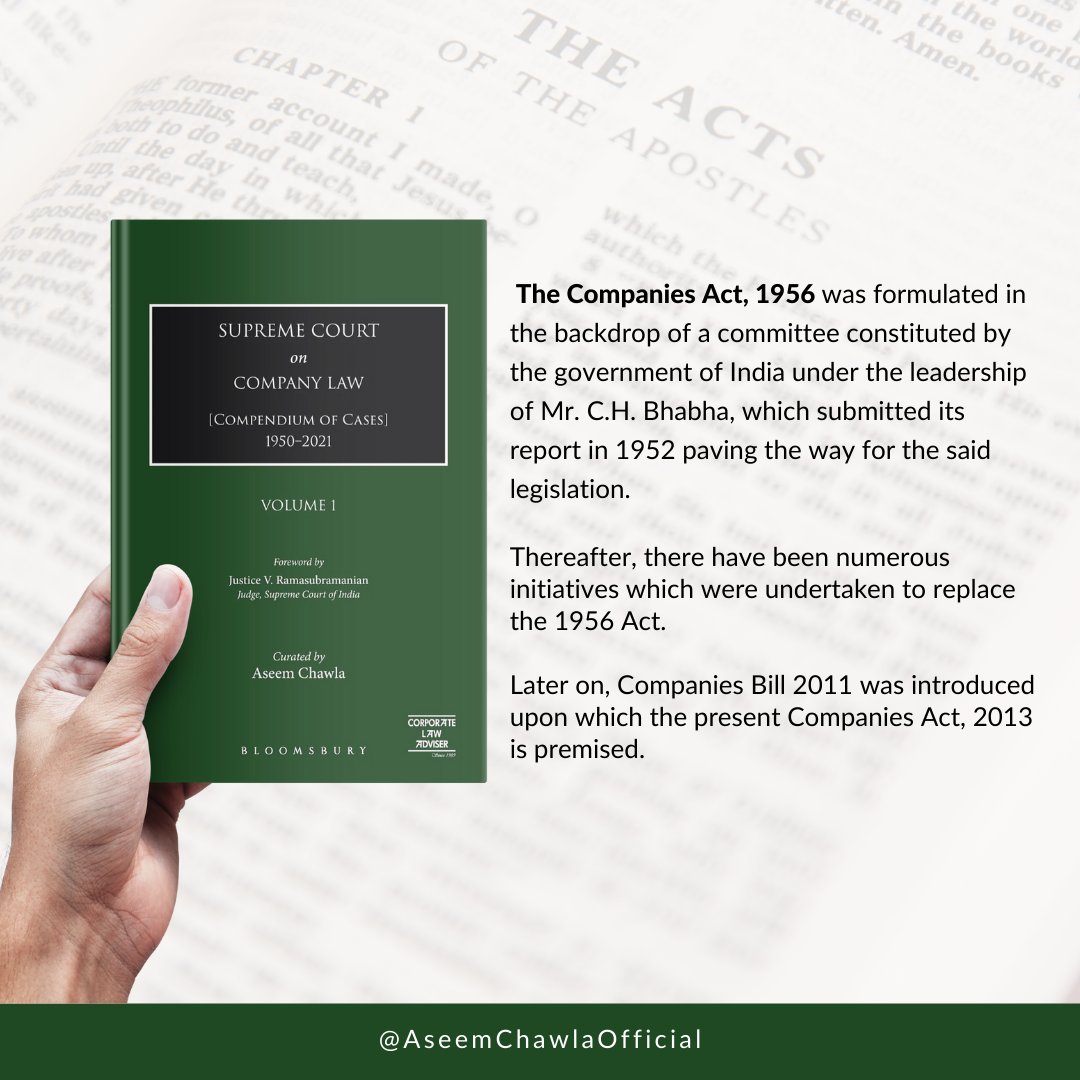
The journey of comprehensive legislation dealing with Corporations in India is over a century old. In 1913, the first Indian legislation regarding Corporations was enacted. The 1956 Act incorporated many provisions from the English Companies Act, 1948.
Pleased to share the release of Supreme Court on Company Law [Compendium of Cases] (1950-2021) In Three Volumes Curated by Aseem Chawla Published Jointly by Bloomsbury and Corporate Law Adviser.
It was a pleasure to be a part of The Indo-American Chamber of Commerce, North India Council's Interactive Session on Union Budget 2022: India-US Partnership – Budget 2022 and Beyond.
The session was held on Tuesday, 8th February 2022 on virtual platform.













![official_aseem's tweet photo. Pleased to share the release of Supreme Court on Company Law [Compendium of Cases] (1950-2021) In Three Volumes Curated by Aseem Chawla Published Jointly by Bloomsbury and Corporate Law Adviser. https://t.co/cUzAIBMeOr](https://pbs.twimg.com/media/FOh3YxpaQAMgwTx.jpg)


