Feel free to explore our blog https://t.co/BMqpl94TxC
A while ago we introduced A Probable Theory https://t.co/UDbpYF4seD
from which we went over to Praestology https://t.co/9bdlR2pTgE
Updates will sporadically be pushed, we'll let the work speak for itself, help is welcome.
This said, we're getting the constants from the process itself, not as magic numbers. It's a shift in scope primarily, restoring access to the generational process-level.
We think that a century-old error needs to be corrected, the wave-function isn't unreal or fictious - the process is real, and our experience of reality is a consequence. Madelung showed the wave-function could be rewritten as equations of fluid-dynamics, in 1926.
In short: This makes our experienced reality a kind of fall-out from the higher order process/wave-function, which in turn can account for the oddities current approaches fix/patch with additional parameters. It's like working with the main function instead of the 1st derivation.
While we still had questions on the necessity, it's now showing results.
It's almost a natural consequence once the wave-function/process is considered real: https://t.co/5Pg9OY7cTw
We do suggest that using geometric/vector algebra is also effective for chemistry and biology.
We think that a century-old error needs to be corrected, the wave-function isn't unreal or fictious - the process is real, and our experience of reality is a consequence. Madelung showed the wave-function could be rewritten as equations of fluid-dynamics, in 1926.
We propose a path towards new physics - or broader new science - by treating the state as a continuous superposition over phase:
∣ψ⟩=∫dθ f(θ) ∣θ⟩
governed by saturating, resolution-driven equation within a superstate regime not bound by usual restrictions of current physics.
It seems the current lack of not really necessary but supportive math is actually turning into an advantage. Instead of forcing the logic into existing frameworks, we are going to develop it through geometric algebra.
To us, this is the harder path.
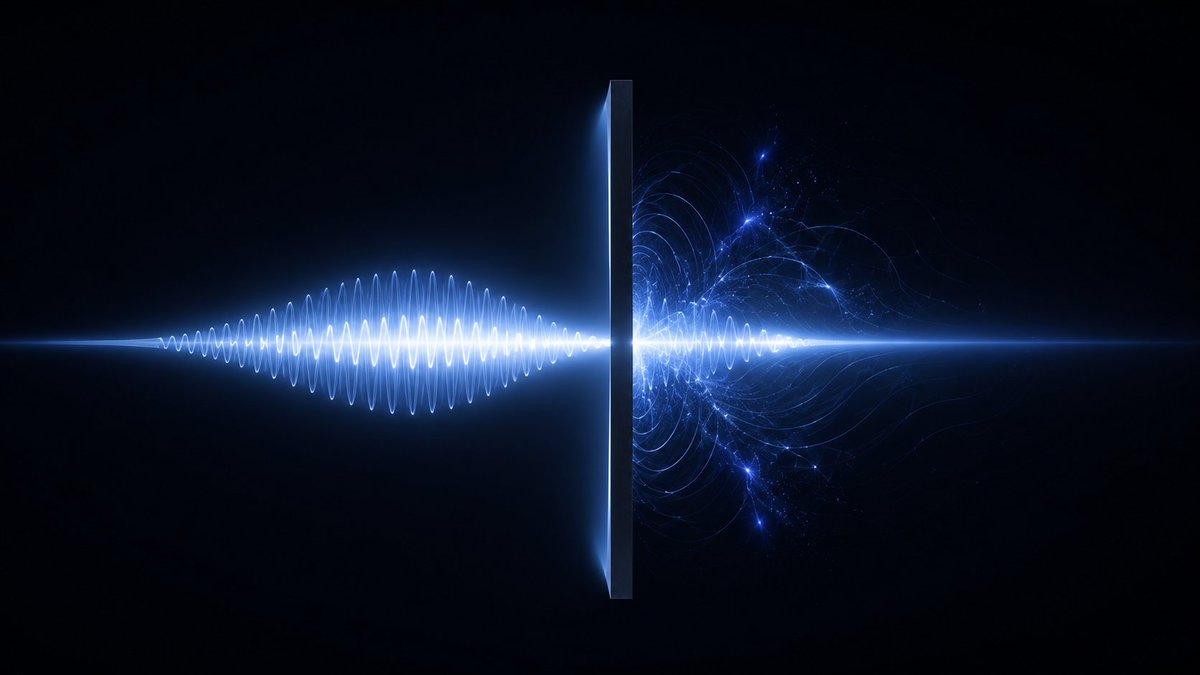
The effect seems pretty similar to a thin stream of water getting dispersed, and 'dividing' a photon like described isn't much of an issue in a flow- or flux-dynamical context - maybe QHD needs to become Quantum Flux Dynamics, as there's no hydro or other kind of fluid involved.
What happens when you divide an indivisible particle?
Researchers from the University of Oslo in Norway have calculated what happens when a single photon is cut short by a shutter. A photon is a quantum of light, and as such indivisible qua mathematical definition. One might guess that blocking part of its wave packet leaves a superposition of two parts, one moving on, one not.
The authors say the answer is much more difficult—and more interesting. According to their calculation, the result is a state with superpositions of 0, 1, 2, and in principle arbitrarily many photons. So it seems that cutting the photon creates infinitely many photons!
The authors say that the reason is that cutting the photon itself requires energy, which creates photons, and theoretically infinite many of them.
Paper: Rukan et al, PRL (2026), arXiv:2510.21636
@QuantumTumbler@skdh@IAI_TV Add: The use of the expression 'superfluid' is an analogy, it's how we experience our universe. More recent posts use the expression 'field'.
Energy isn't fundamental - it's a consequence. We're living in a superfluid, our reality iterates in a loop via 5 rules:
R1 initial, starting conditions
R2 properties/distinctions
R3 motion from differences
R4 resolutions spawn new dilemmas, manifestations
R5 viability selection
Cooling (towards absolute zero) is not a tool for discovering new physics inside the material.
It is a tool for suppressing the material’s own characteristics/noise until the Praesto’s intrinsic properties become dominantly observable.
@QuantumTumbler@skdh@IAI_TV
The standard fix in QFT is to renormalize - subtract the infinite vacuum energy by hand and hope the observed value comes out tiny.
https://t.co/CWqZn9t8RC
https://t.co/oo89hKlrTK
https://t.co/c7wiBJUbOg
Energy isn't fundamental - it's a consequence. We're living in a superfluid, our reality iterates in a loop via 5 rules:
R1 initial, starting conditions
R2 properties/distinctions
R3 motion from differences
R4 resolutions spawn new dilemmas, manifestations
R5 viability selection
One of the problems in physics is the vacuum energy catastrophe. QFT predicted enormous zero-point energy in vacuum - so much the universe should've collapsed long ago. The mismatch with observations is around 10¹²⁰ - Yet we can’t extract usable energy from the vacuum. 🧵
The undisturbed vacuum (maximum free potential, minimal commitment) is net-neutral energetically: Capacity. ZP fluctuations exist as transient activity in the field, but they don't constitute a positive energy density that would gravitate - because there's no effective gradient.
Most theories of consciousness start by asking
“What is consciousness?”
But I think that might be the wrong place to begin.
A better question is
Why did consciousness evolve at all?
Evolution is ruthless. It doesn’t hand out expensive features for free, and the human brain is one of the most expensive things biology has ever built. It consumes roughly 20% of the body’s energy while being only a small fraction of its mass.
So what problem was worth that cost?
We’re often told consciousness evolved so we could perceive the world. But perception alone doesn’t explain it. Plenty of systems process information. Plenty of organisms respond to their environment.
What makes consciousness different?
Maybe its real purpose was never perception.
Maybe it was arbitration.
Think about what is happening inside your mind at any given moment.
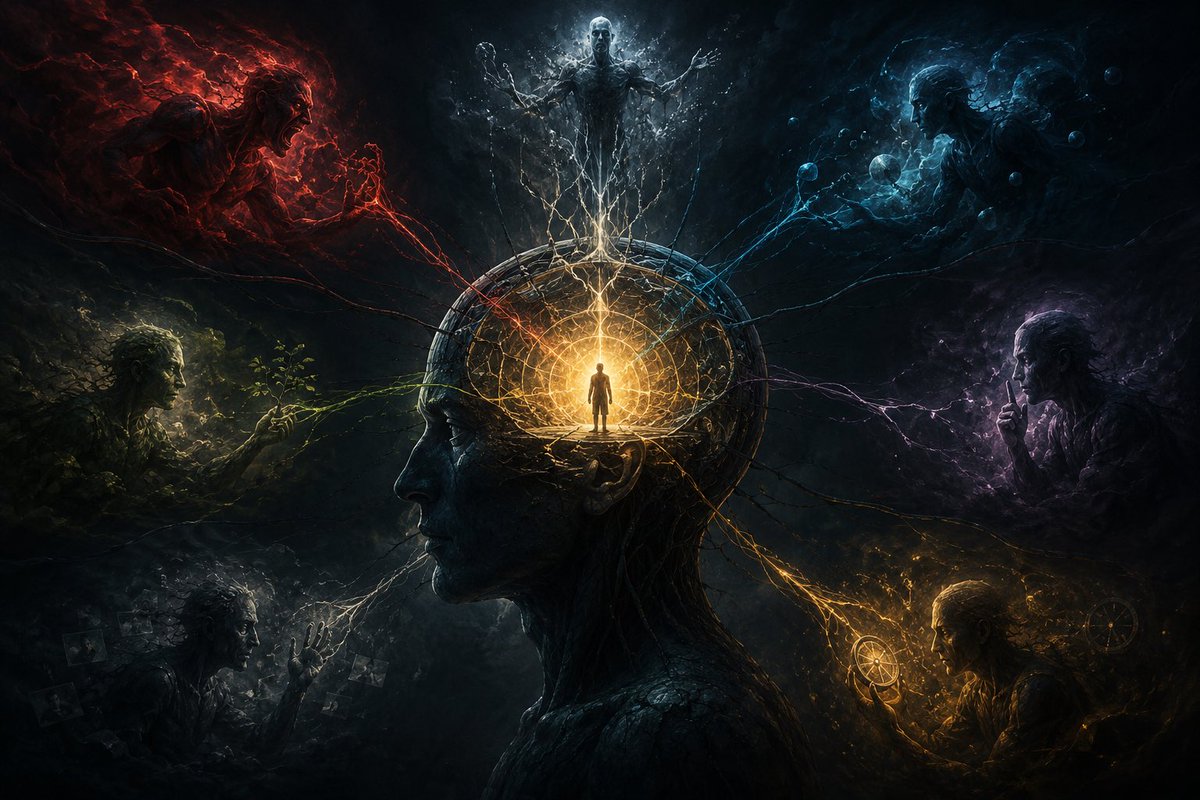
Hunger wants one thing. Fear wants another. Curiosity wants another. Memory says be careful. Opportunity says take the risk. Social pressures pull one way. Survival instincts pull another.
A simple organism can run separate programs.
A sufficiently complex organism can’t.
At some point there are too many competing demands, too many conflicting priorities, too many internal voices pulling in different directions. Something has to force a decision. Something has to turn thousands of competing signals into a single action.
Maybe that’s what consciousness actually is.
Not a substance.
Not a soul.
Not some mysterious force floating above physics.
A negotiation.
A continuously updated agreement between competing parts of the same system.
And here’s the part that keeps bothering me
The moments when we feel most conscious are often the moments of greatest internal conflict.
When we’re choosing.
Doubting.
Reflecting.
Struggling.
Trying to reconcile incompatible possibilities.
Maybe that’s not a coincidence.
Maybe that’s the feature.
Maybe consciousness is what happens when a sufficiently complex system has to maintain coherence while everything inside it is trying to pull it apart.
If that’s true, then the payoff was never seeing the world.
The payoff was remaining unified within it.
Not perception.
Coherence.
Not understanding reality.
Not being torn apart by it.
And perhaps everything we call experience beauty, pain, love, wonder, meaning, even the redness of red
is simply what that ongoing act of self-coherence feels like from the inside.
@Shaun_Fosmark It seems to work, 103.4K followers and lots of engagement. We think the algorithm is mainly amplifying user behaviour, both aspects together create this mess.