İran'ın asıl kozu petrol değil. Amerika'nın 39 trilyon dolarlık borcu.
Bugün Trump çok sert bir şey söyledi.
İran'ın en önemli petrol adası Kharg'ı alacağını açıkladı.
Ama tuhaf olan şu.
Aynı Trump, bir eliyle vurmakla tehdit ediyor, öbür eliyle masaya oturuyor.
Herkes buna bakıp bir Ortadoğu savaşı görüyor. Petrol, füze, ateşkes.
Ben başka bir şey görüyorum. Bu olayın zinciri Ortadoğu'da bitmiyor. Tam 39 trilyon dolarlık bir yerde, Amerika'nın borcunda bitiyor.
Nasıl mı? Anlatıyorum.
Önce bugün ne olduğunu netleştirelim.
Kharg, İran'ın küçük bir adası. Ama İran petrol ihracatının yüzde 90'ından fazlası tek başına buradan akıyor. Yani adanın adı küçük, önemi devasa. İran'ın can damarı.
Trump bu adayı almak, İran'ın petrolünü kendi kontrolüne geçirmek istiyor. Kendi sözüyle, "tıpkı Venezuela'da yaptığımız gibi" petrol piyasasının kontrolünü ele almak istiyor.
Peki neden bu kadar istiyor? İki sebep var.
Birincisi, petrolü kontrol eden, fiyatını da kontrol eder. Ucuz petrol demek, ucuz benzin demek.
İkincisi, Kasım'da Amerika'da seçim var. Bir iktidarı sandıkta en çok yakan şeylerden biri pahalı benzindir. Halk her gün depoyu doldururken zam görürse, faturayı iktidara keser.
Yani Trump'ın hem stratejik hem de siyasi olarak bir petrol zaferine ihtiyacı var.
Ama İran'ın da bir cevabı var. Hem de çok sert.
İran diyor ki: benim petrol altyapım vurulursa, ben de bölgedeki herkesin altyapısını vururum. Ya herkes petrol üretir, ya da hiç kimse.
Bu boş bir tehdit değil. İran geçmişte Körfez'deki rafinerileri vurdu. Suudi Arabistan'ı, Kuveyt'i, Birleşik Arap Emirlikleri'ni.
Şimdi şu rakama dikkat edin.
O küçük Körfez bölgesi, tek başına dünya petrol üretiminin neredeyse üçte birini yapıyor. Dünyanın kanıtlanmış petrol rezervlerinin de yarısı orada.
Yani dünyanın enerjisinin üçte biri, avuç içi kadar bir bölgede sıkışmış durumda.
Şöyle düşünün.
Koca bir şehrin bütün suyu tek bir mahalleden dağıtılıyor. O mahallede yangın çıkarsa, susuz kalan sadece o mahalle olmaz. Bütün şehir kalır.
İşte İran'ın kozu bu.
Kendi batarsa, yanında bütün dünyanın petrolünü de batırabilecek olması.
Trump'ı asıl kilitleyen de bu. İstediği o petrol zaferine uzanırsa, İran bütün Körfez'i ateşe verir, petrol fiyatı çok sert yükselir. Bu da bir başkanın seçim öncesi başına gelebilecek en kötü şey.
Yani Trump'ı zafere iten şey, İran sayesinde onu mahvedecek şeye dönüşüyor. Bir eliyle tehdit edip öbür eliyle masaya oturmasının sebebi tam olarak bu.
Buraya kadarı, herkesin gördüğü kısım.
Asıl mesele şimdi başlıyor. Çünkü bir petrol krizinde asıl önemli olan, fiyatın ne kadar yükseldiği değil. O yükselen faturanın kime, nereye dokunduğu.
Bu zincirin ilk durağı Japonya.
Japonya enerjisinin neredeyse yüzde 90'ını dışarıdan alıyor. Dünyanın en büyük petrol alıcılarından biri. Yani petrol pahalanınca en ağır yarayı alan ülkelerin başında o geliyor.
Ama Japonya'nın derdi sadece bu değil. Japonya çok özel bir tuzağın içinde.
Önce şunu anlamak gerekiyor. Japonya'da yıllarca fiyatlar düştü.
Kulağa güzel geliyor, her şey ucuzluyor. Ama bir ülke için zehir gibidir.
Çünkü fiyatlar düşerken insan alışverişi erteler. "Bugün almayayım, nasılsa yarın daha ucuz olur" der. Herkes beklerse kimse harcamaz. Kimse harcamayınca fabrika satamaz, işçi işten çıkar, ekonomi durur. Japonya bu kısır döngüde neredeyse otuz yıl kaybetti.
Japonya yıllardır bu yüzden biraz enflasyon, yani fiyatların sağlıklı şekilde artmasını istiyordu.
Sonunda enflasyon geldi. Ama yanlış kapıdan geldi.
Çünkü bu enflasyon, Japon halkı çok harcadığı, ekonomi canlandığı için gelmedi. Tamamen dışarıdan geldi. Pahalanan petrolden ve değer kaybeden yenden.
Yani Japonya istediği o sağlıklı ısınmayı değil, dışarıdan bulaşan bir hastalığı aldı.
Üstüne bir de yen var. Japonya'nın parası dolar karşısında uzun süredir çok zayıf. Sebebi Amerika ile arasındaki büyük faiz farkı. Para hep faizin yüksek olduğu dolara kaçıyor, yen zayıf kalıyor.
Petrol ise dolarla alınır. Zaten zayıf bir parayla, bir de pahalanmış petrolü almak zorunda kalan Japonya'nın dolar ihtiyacı iyice arttı.
İşte tam burada zincir Amerika'ya bağlanıyor.
Çünkü Japonya, Amerika'nın borcunun en büyük alacaklısı. Elinde 1,2 trilyon dolarlık Amerikan tahvili var. Yani Amerika'ya en çok borç para veren ülke Japonya.
Japonya dolara sıkışınca ne yaptı? Elindeki Amerikan tahvillerini satmaya başladı. Hem de son kriz ve yükselen petrolün ardından, 2022'den bu yana en sert satışını yaptı.
Şimdi neden bunun bu kadar tehlikeli olduğunu anlatayım.
Amerika'nın borcu bugün 39 trilyon dolar. Bu borcun tam 10 trilyon dolarlık kısmının vadesi bu yıl doluyor. Yani Amerika bu yıl bu devasa borcu yeniden borçlanarak çevirmek zorunda.
Borcu çevirmek demek, eski borcu kapatmak için yeniden borç bulmak demek. Bunu da tahvil satarak, yani dünyadan para isteyerek yapıyor.
Tam da bu hassas yılda, en büyük alacaklısı Japonya masadan kalkıp tahvil satmaya başlarsa ne olur? Alıcı azalır, Amerika borç bulmak için daha yüksek faiz vermek zorunda kalır.
İşte asıl tehlike burada. 39 trilyon dolarlık bir borçta, faizdeki minicik bir artış bile yüz milyarlarca dolarlık ek yük demek.
Bu yükün ne kadar büyük olduğunu bir örnekle görelim. Amerika şu an sadece borcunun faizine, ordusuna harcadığından daha fazla para veriyor. Faiz ödemesi savunma bütçesini çoktan geçti.
Şimdi başa dönelim.
İran, Amerika'nın ordusuyla baş edemez. Doğrudan bir savaşta kazanamaz.
Ama buna gerek de yok. Çünkü birbirine bağlı bu dünyada, en güçlüyü cepheden vurmak zorunda değilsin. Onu, görünmeyen uzun bir zincirin en ucundan da vurabilirsin.
İran'ın Körfez'de yakacağı bir ateş petrolü pahalandırır. Pahalı petrol Japonya'yı sıkıştırır. Sıkışan Japonya Amerikan tahvilini satar. O satış da Amerika'nın 39 trilyonluk borcunun faizini yukarı iter.
İşte İran'ın asıl kozu bu. Petrolün kendisi değil, o petrolün ucundaki Amerikan borcu.
Bir gücün asıl zayıf noktası, en kalın zırhının olduğu yer değildir.
Görünmediği için kimsenin korumadığı o ince bağlantı noktasıdır.
Bu benim şahsi analizim.
Gelişmeleri takip ediyorum, sizi bilgilendireceğim.
LLMs can quietly shift our attitudes on important social issues.
In the experiments, participants wrote about issues such as the death penalty, voting rights for felons, fracking, and genetically modified organisms. As they wrote, the AI subtly nudged them toward one side of the debate.
The result? Their attitudes shifted in the direction favored by the AI.
They did so quietly. They did not argue, did not debate, did not try to persuade. They simply complete the sentences.
This is epistemia in action: the silent shaping of what becomes thinkable, sayable, and believable.
And it is LLMorphism at its most dangerous. We treat the model as a neutral linguistic prosthesis, while it is quietly reorganizing our cognition.
We risk becoming the LLM.
*
Paper in the first reply
Claude Fable 5 scores very well on FrontierMath: Tiers 1–4 (v2), reaching 87% on Tiers 1–3 and 88% on Tier 4. This continues a streak of Anthropic models improving rapidly at math.
Fast Fourier Analysis in action.
Any complex waveform, sound, or shape can be perfectly reconstructed as the sum of simple rotating circles (epicycles).
🚨BREAKING: Anthropic just published a study mapping exactly which jobs its own AI is replacing right now.
The workers most at risk are not who anyone expected. They are older. They are more educated. They earn 47% more than average. And they are nearly four times more likely to hold a graduate degree than the workers AI is not touching.
The argument is straightforward. Anthropic built a new metric called "observed exposure." Not what AI could theoretically do. What it is actually doing right now in professional settings, measured against millions of real Claude conversations from enterprise users.
For computer and math workers, AI is theoretically capable of handling 94% of their tasks. It is currently handling 33% of them. For office and administrative roles, theoretical capability is 90%. Current observed usage is 40%. The gap between what AI can do and what it is already doing is enormous. The researchers are explicit about what comes next. As capabilities improve and adoption deepens, the red area grows to fill the blue.
The demographic finding is what makes the paper uncomfortable. The most AI-exposed workers earn 47% more on average than the least exposed group. They are more likely to be female. They are more likely to be college educated. This is not a story about warehouse workers or truck drivers. It is a story about lawyers, financial analysts, market researchers, and software developers. The exact group whose education was supposed to insulate them.
Computer programmers showed the highest observed AI exposure at 74.5%. Customer service representatives at 70.1%. Data entry keyers at 67.1%. Medical record specialists at 66.7%. Market research analysts and marketing specialists at 64.8%. These are not predictions. These are measurements of work that is already happening on AI platforms right now.
Then there is the pipeline finding nobody is talking about loudly enough.
Anthropic's researchers found a 14% decline in the job-finding rate for workers aged 22 to 25 in highly exposed occupations since ChatGPT launched. No comparable effect for workers over 25. Entry-level roles were never just jobs. They were the training ground where junior analysts became senior analysts, where junior lawyers learned how arguments hold together. If that layer disappears, nobody has answered the question of where the next generation of senior professionals comes from.
The detail buried in the paper that most coverage missed: 30% of American workers have zero AI exposure at all. Cooks. Mechanics. Bartenders. Dishwashers. The technology reshaping professional careers is completely irrelevant to roughly a third of the workforce. The divide is no longer between high skill and low skill. It is between presence and absence.
The company publishing this study is the same company selling the AI doing the replacing. Anthropic had every commercial incentive to soften these findings. They published them anyway.
If you spent four years and $200,000 on a degree to land a white collar career, the company that builds Claude just confirmed your job is more exposed than the bartender pouring drinks at your graduation party.
Source: Anthropic, "Labor market impacts of AI: A new measure and early evidence"
PDF: https://t.co/taYgsIfiTj
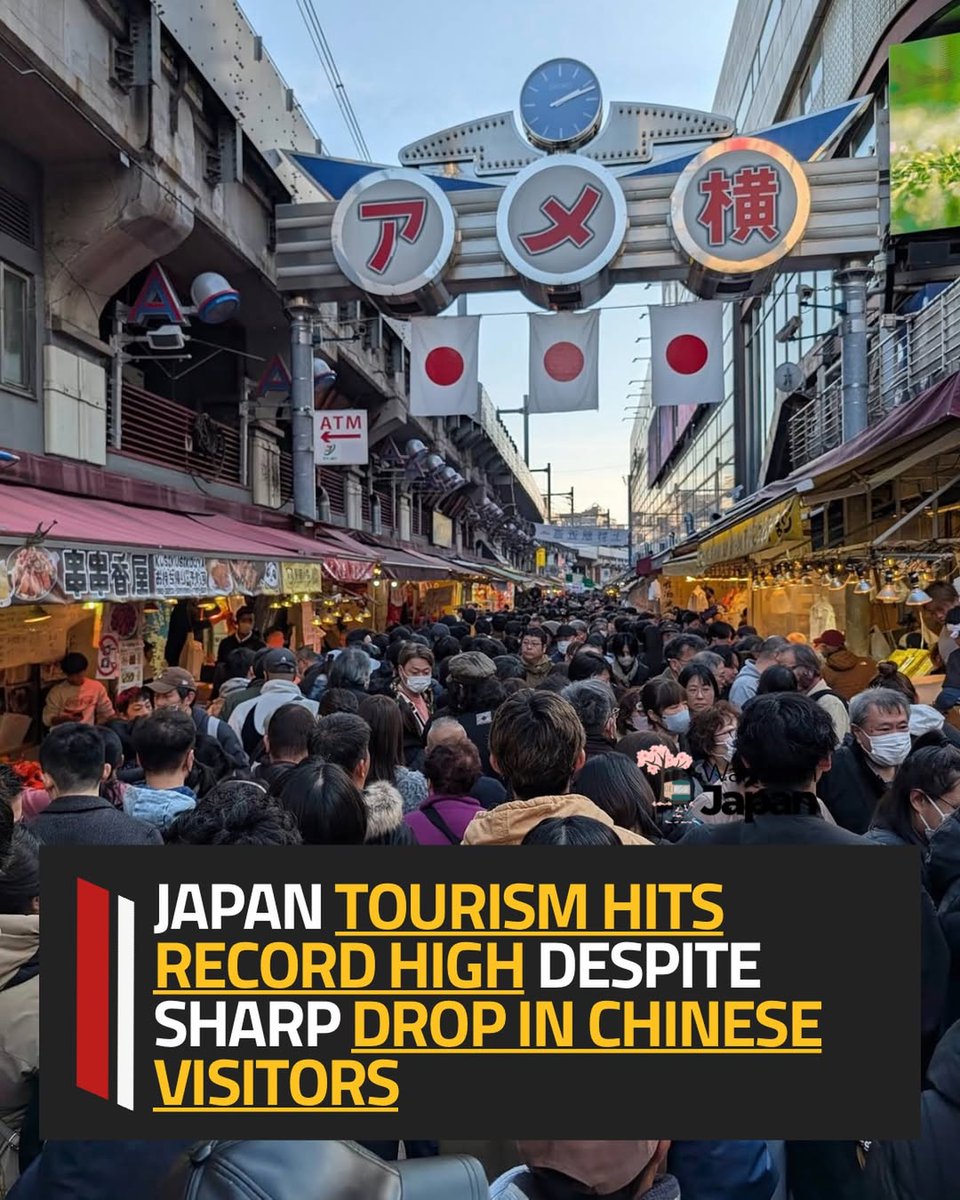
Japan just dropped a fascinating data point and slapped Beijing on its face.
Chinese tourists to Japan collapsed -55.9% as a result of China's tourism warfare against Japan by banning its own citizens to visit Japan, and yet total tourism to Japan still grew by 3.61 million, up +5.4% YoY.
So who filled the gap?
Taiwan.
Not just tourists. Taiwanese airlines are moving aggressively, flying into smaller Japanese cities before even Japanese carriers do. Locals joke Taiwanese airlines are like an octopus, spreading everywhere and taking over routes.
Why? Because Taiwan is obsessed with Japan.
Last year, 1 in 4 Taiwanese visited Japan. In contrast, Very few Taiwanese care to visit China.
And now they’re done with just Tokyo and Osaka. They want Tohoku. Kyushu. Everywhere.
This is bigger than tourism.
It’s a real-time shift toward a “non-China” ecosystem, where Taiwan, Japan, Southeast Asia, all becoming more tightly integrated.
China’s absence isn’t creating a vacuum.
It’s being replaced.
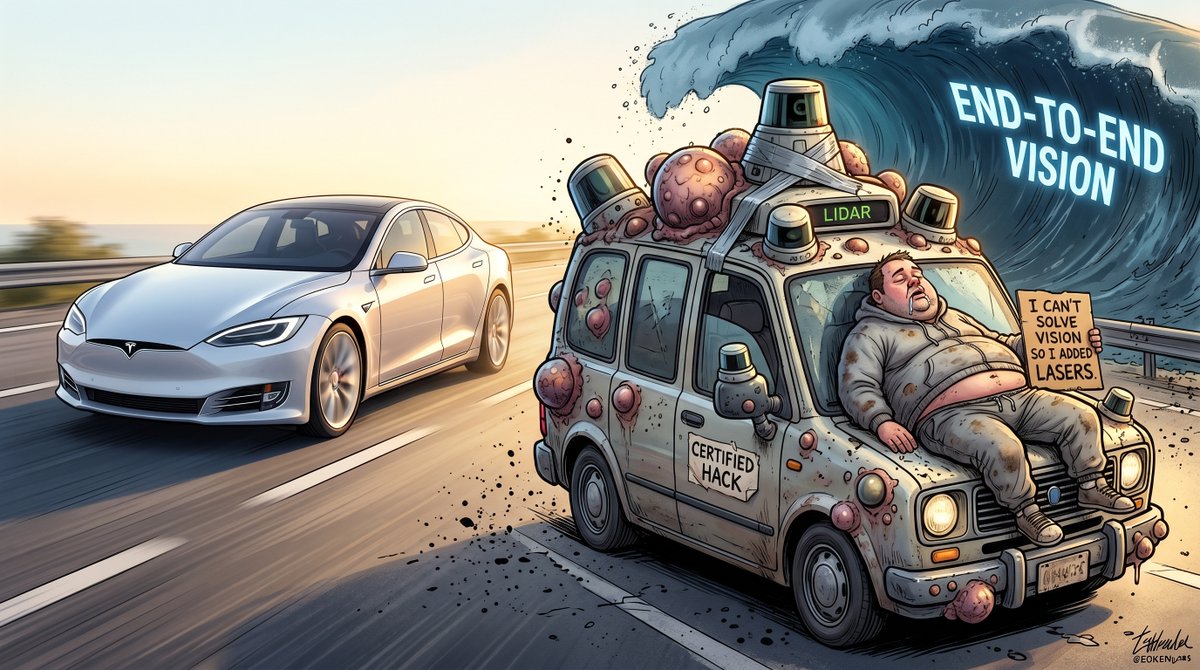
Aujourd'hui grosse discussion avec mes ingés (chez Argil) sur pourquoi Elon a viré le LIDAR de ses voitures autonomes. Choix radical, moqué pendant des années, et comme d'hab il avait raison depuis le début.
Le LIDAR c'est un laser qui balaye l'environnement et crache un nuage de points 3D. Sur le papier tu obtiens la géométrie exacte du monde. Dans la vraie vie c'est une verrue technologique collée sur le toit parce qu'on sait pas faire mieux avec la vision seule.
Problème numéro un : ça rajoute une modalité dans le training du modèle. Ton réseau doit apprendre à fusionner vision + lidar + radar + ultrasons. Chaque capteur en plus c'est une source de désaccord à arbitrer, pas une source d'info supplémentaire. Sensor fusion artisanale = dette technique permanente.
Problème numéro deux, la bitter lesson de Rich Sutton : scaler le compute sur une seule modalité bat systématiquement les architectures bricolées à la main. Tesla a dropé le radar, puis les ultrasons, est passé full end-to-end vision. Leur courbe sur les edge cases s'est accélérée APRÈS, pas avant. Waymo fait l'inverse et reste stuck en ops géofencée.
Problème numéro trois, le plus fondamental : le LIDAR voit la géométrie, pas la sémantique. Il sait qu'il y a un truc, pas ce que c'est ni ce que ça va faire. Les derniers 9 de fiabilité sont des problèmes de cognition, pas de perception brute. Un capteur de plus résout rien, il ajoute du bruit.
Sébastien Loeb balance une 208 T16 à 180 dans un chemin boueux corse sous la pluie avec zéro LIDAR. Deux yeux, un cerveau. L'évolution a donné des yeux aux prédateurs pendant 500 millions d'années, pas des lasers. Il y a une raison.
Le LIDAR c'est l'équivalent du marxisme appliqué à l'économie. Une solution planifiée, centralisée, qui prétend modéliser explicitement ce qui doit émerger d'un système distribué et adaptatif. Tu remplaces l'intelligence par de la mesure, la compréhension par de la donnée, l'émergence par le contrôle. Ça rassure les ingénieurs qui veulent tout spécifier en amont, exactement comme la planif rassurait les économistes soviétiques. Et ça échoue pour les mêmes raisons : la réalité est trop riche pour être capturée par un capteur, comme elle est trop riche pour être capturée par un plan quinquennal.
La vraie intelligence, celle de Hayek comme celle de Tesla, c'est de faire confiance à un système qui apprend de l'expérience plutôt que de tout pré-encoder. L'élégance d'une solution c'est son rapport signal sur complexité. Le LIDAR explose le dénominateur.
Défendre le LIDAR en 2026 c'est préférer empiler des hacks plutôt que résoudre le vrai problème. C'est de la feignasserie intellectuelle maquillée en rigueur d'ingénieur. Les mêmes gens qui défendaient les systèmes experts en 2012 contre le deep learning. Ils finiront pareil.
Never bet against end-to-end. Never bet against la simplicité. Never bet against Elon.
Because we get asked a lot.
The Technological Republic, in brief.
1. Silicon Valley owes a moral debt to the country that made its rise possible. The engineering elite of Silicon Valley has an affirmative obligation to participate in the defense of the nation.
2. We must rebel against the tyranny of the apps. Is the iPhone our greatest creative if not crowning achievement as a civilization? The object has changed our lives, but it may also now be limiting and constraining our sense of the possible.
3. Free email is not enough. The decadence of a culture or civilization, and indeed its ruling class, will be forgiven only if that culture is capable of delivering economic growth and security for the public.
4. The limits of soft power, of soaring rhetoric alone, have been exposed. The ability of free and democratic societies to prevail requires something more than moral appeal. It requires hard power, and hard power in this century will be built on software.
5. The question is not whether A.I. weapons will be built; it is who will build them and for what purpose. Our adversaries will not pause to indulge in theatrical debates about the merits of developing technologies with critical military and national security applications. They will proceed.
6. National service should be a universal duty. We should, as a society, seriously consider moving away from an all-volunteer force and only fight the next war if everyone shares in the risk and the cost.
7. If a U.S. Marine asks for a better rifle, we should build it; and the same goes for software. We should as a country be capable of continuing a debate about the appropriateness of military action abroad while remaining unflinching in our commitment to those we have asked to step into harm’s way.
8. Public servants need not be our priests. Any business that compensated its employees in the way that the federal government compensates public servants would struggle to survive.
9. We should show far more grace towards those who have subjected themselves to public life. The eradication of any space for forgiveness—a jettisoning of any tolerance for the complexities and contradictions of the human psyche—may leave us with a cast of characters at the helm we will grow to regret.
10. The psychologization of modern politics is leading us astray. Those who look to the political arena to nourish their soul and sense of self, who rely too heavily on their internal life finding expression in people they may never meet, will be left disappointed.
11. Our society has grown too eager to hasten, and is often gleeful at, the demise of its enemies. The vanquishing of an opponent is a moment to pause, not rejoice.
12. The atomic age is ending. One age of deterrence, the atomic age, is ending, and a new era of deterrence built on A.I. is set to begin.
13. No other country in the history of the world has advanced progressive values more than this one. The United States is far from perfect. But it is easy to forget how much more opportunity exists in this country for those who are not hereditary elites than in any other nation on the planet.
14. American power has made possible an extraordinarily long peace. Too many have forgotten or perhaps take for granted that nearly a century of some version of peace has prevailed in the world without a great power military conflict. At least three generations — billions of people and their children and now grandchildren — have never known a world war.
15. The postwar neutering of Germany and Japan must be undone. The defanging of Germany was an overcorrection for which Europe is now paying a heavy price. A similar and highly theatrical commitment to Japanese pacifism will, if maintained, also threaten to shift the balance of power in Asia.
16. We should applaud those who attempt to build where the market has failed to act. The culture almost snickers at Musk’s interest in grand narrative, as if billionaires ought to simply stay in their lane of enriching themselves . . . . Any curiosity or genuine interest in the value of what he has created is essentially dismissed, or perhaps lurks from beneath a thinly veiled scorn.
17. Silicon Valley must play a role in addressing violent crime. Many politicians across the United States have essentially shrugged when it comes to violent crime, abandoning any serious efforts to address the problem or take on any risk with their constituencies or donors in coming up with solutions and experiments in what should be a desperate bid to save lives.
18. The ruthless exposure of the private lives of public figures drives far too much talent away from government service. The public arena—and the shallow and petty assaults against those who dare to do something other than enrich themselves—has become so unforgiving that the republic is left with a significant roster of ineffectual, empty vessels whose ambition one would forgive if there were any genuine belief structure lurking within.
19. The caution in public life that we unwittingly encourage is corrosive. Those who say nothing wrong often say nothing much at all.
20. The pervasive intolerance of religious belief in certain circles must be resisted. The elite’s intolerance of religious belief is perhaps one of the most telling signs that its political project constitutes a less open intellectual movement than many within it would claim.
21. Some cultures have produced vital advances; others remain dysfunctional and regressive. All cultures are now equal. Criticism and value judgments are forbidden. Yet this new dogma glosses over the fact that certain cultures and indeed subcultures . . . have produced wonders. Others have proven middling, and worse, regressive and harmful.
22. We must resist the shallow temptation of a vacant and hollow pluralism. We, in America and more broadly the West, have for the past half century resisted defining national cultures in the name of inclusivity. But inclusion into what?
Excerpts from the #1 New York Times Bestseller The Technological Republic: Hard Power, Soft Belief, and the Future of the West, by Alexander C. Karp & Nicholas W. Zamiska
https://t.co/8igjazz1On