Early on at NLPearl, we paid a high price for perfectionism. We lost the chance to be first to market.
Our MVP was rough, but the tech was actually there.
We sat in our cramped office debating: "Should we release the AI agent demo?"
We got scared. We thought, "We can't show this yet. It’s not ready."
Big mistake.
Days later, a competitor I'll call "The Imposters" released a demo that looked exactly like our vision.
The difference?
Theirs was 100% video editing. Zero code. Vaporware.
While we hesitated with a working product, they aggressively marketed a fake one. They broke LinkedIn, captured the leads, and owned the conversation.
They eventually collapsed (obviously), and when we finally launched weeks later, we converted that hype into cash because we had a real product.
But I learned a painful lesson that day: The market doesn't care about your perfectionism.
Better to ship a "barely working" product today than watch someone else sell your dream with a fake video tomorrow.
If you have something that works (even barely) = ship it. Don't wait. 🙏
The era of "Drag and Drop" is already over.
If you are manually connecting nodes on a canvas, you are moving too slow.
Building an AI voice agent usually looks like this:
—> Hire a Python dev ($110/hr)
—> Fight with Twilio for 2 weeks
—> Manually map out conversation trees
—> Result: 1 month lost, $10k spent.
Now, watch the video below.
We didn't move the cursor. Not once.
We typed one prompt.
Our platform autonomously:
1. Understood the business context
2. Constructed the logic flow & decision tree
3. Integrated Salesforce for automatic claims
4. Assigned the perfect voice and personality
—> Result: A production-ready agent in 60 seconds.
If you can type a sentence, you can now build an enterprise-grade call center.
We built this to handle any use case and endless integrations, completely autonomously.
Stop building from scratch. Start prompting.
Question: If you could automate one phone call your business receives daily, which one would it be?
The era of "Drag and Drop" is already over.
If you are manually connecting nodes on a canvas, you are moving too slow.
Building an AI voice agent usually looks like this:
—> Hire a Python dev ($110/hr)
—> Fight with Twilio for 2 weeks
—> Manually map out conversation trees
—> Result: 1 month lost, $10k spent.
Now, watch the video below.
We didn't move the cursor. Not once.
We typed one prompt.
Our platform autonomously:
1. Understood the business context
2. Constructed the logic flow & decision tree
3. Integrated Salesforce for automatic claims
4. Assigned the perfect voice and personality
—> Result: A production-ready agent in 60 seconds.
If you can type a sentence, you can now build an enterprise-grade call center.
We built this to handle any use case and endless integrations, completely autonomously.
Stop building from scratch. Start prompting.
Question: If you could automate one phone call your business receives daily, which one would it be?
A product update:
Yesterday we shipped an update that makes our agents respond faster.
We improved our turn-taking model. This is honestly one of the hardest problems in voice AI - knowing when someone is done talking.
There are two ways a turn-taking model mispredicts:
1. The model thinks you're done when you're not, so it interrupts you mid-sentence. (Annoying)
2. Or it thinks you're still talking when you've actually finished.
The second one creates a small pause we wanted to optimize away.
We refined the prediction model and eliminated some remaining cases of unnecessary waiting.
More coming.
Day 3:
Yesterday I posted myself instead of just resharing the company post.
Commented back on everything. Liked everything. Got a few more leads.
And tons of connection requests.
But here's what I don't get: most sent requests without liking or commenting on the post first. Just... straight to connect.
Is that normal? Am I overthinking this?
Building in public = figuring it out as I go.
We launched yesterday. Posted our story on LinkedIn.
Some leads came in (which is amazing).
But now I'm asking: what's the next move for founder-led marketing?
I'm building in public, learning as I go.
For those who've done this - what would you focus on day 2?
Startup confession:
We spent 3 years building an AI voice platform that only we knew how to use.
Clients loved the results. Hated the process.
> Needed devs
> Weeks of setup
> Endless debugging
Six months ago: nuclear option. Start over.
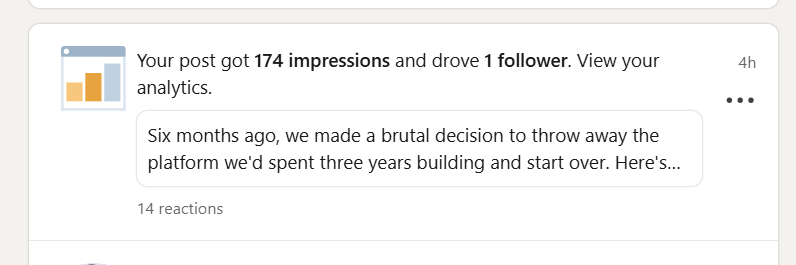
Six months ago, we made a brutal decision to throw away the platform we'd spent three years building and start over.
Here's why.
From day one, our vision was simple: bring AI voice agents to everyone.
We thought we'd nailed it. For three years, we had what seemed like the simplest solution on the market - and the best AI phone agent available.
But something wasn't right. We hit a business plateau and stayed stuck there for months.
I remember us asking each other constantly: "What are we doing wrong?"
We talked with clients daily, trying to understand the pain points. Nothing was connecting. Until suddenly, it was.
The click moment hit us all at once. We realized:
1. Our platform was built for developers only
2. Clients needed a lot of integrations we didn't have
3. The only people who could create great agents with it were us
So we refactored everything. The entire system. From scratch.
It took 17 prototypes to get here. Making something truly accessible is harder than making something powerful.
PearlVibe is the result.
What used to take developers, weeks, and countless hours of building... now takes one sentence.
In 2 minutes, you get a fully functional AI phone agent tailored to your business.
We didn't just make it easier. We made it possible for everyone.
I'm going to share more about our journey in later posts. For now, try it and tell me where it breaks. Real-world testing is how we improve.
What would you build?
Six months ago, we made a brutal decision to throw away the platform we'd spent three years building and start over.
Here's why.
From day one, our vision was simple: bring AI voice agents to everyone.
We thought we'd nailed it. For three years, we had what seemed like the simplest solution on the market - and the best AI phone agent available.
But something wasn't right. We hit a business plateau and stayed stuck there for months.
I remember us asking each other constantly: "What are we doing wrong?"
We talked with clients daily, trying to understand the pain points. Nothing was connecting. Until suddenly, it was.
The click moment hit us all at once. We realized:
1. Our platform was built for developers only
2. Clients needed a lot of integrations we didn't have
3. The only people who could create great agents with it were us
So we refactored everything. The entire system. From scratch.
It took 17 prototypes to get here. Making something truly accessible is harder than making something powerful.
PearlVibe is the result.
What used to take developers, weeks, and countless hours of building... now takes one sentence.
In 2 minutes, you get a fully functional AI phone agent tailored to your business.
We didn't just make it easier. We made it possible for everyone.
I'm going to share more about our journey in later posts. For now, try it and tell me where it breaks. Real-world testing is how we improve.
What would you build?
The uncanny valley is your brain's defense mechanism
It evolved to detect:
> Sick people
> Corpses
> Threats disguised as friendly
When AI is 95% human:
> Your brain knows something's wrong
> Fight or flight activates
> Trust evaporates
> Call ends
"almost perfect" fails.