A chemical engineer noticed that the spectra of the hazy atmosphere of mini-Neptune planets looked like the soot produced by combustion engines. https://t.co/LHk6deAKJ5
Andrew Lytle notes that the heights of the Cumberland Mountains were home to great flocks of “Cumberland Parrots” at the time of settlement. Another name for “Louisiana” subspecies of the Carolina Parakeet, sadly extinct. Imagine…
He’s typing in a search bar, quick show him the search option he’s looking for.
Perfect. He typed the next letter that is also the next letter in the option we just showed him so take that option away and show him an option that doesn’t match at all
At the absolute peak of the water crisis in Flint, the city’s kids had average blood lead levels of 1.3 micrograms per deciliter. That was, obviously, a crisis — it was roughly 2x the average American child’s blood levels that year.
But from 1976 to 1980, the *average* kid in Los Angeles had average blood levels of 15 micrograms — and that was seen as normal.
And little wonder: In the era of leaded gasoline, lead levels in LA’s ambient air were 50 times higher than they are today.
That’s one of many staggering facts I learned from Ann Carlson’s new book, “Smog and Sunshine: The Surprising Story of How Los Angeles Cleaned Up Its Air.”
She tells the story of how LA cleaned up its air pollution problem — and helped solve the entire world’s air pollution problem in the process. For instance, the global end of leaded gasoline was in some ways a happy byproduct of the quest to eliminate LA’s smog.
The successful cleaning up of LA’s air is one of many environmental victories that have become so normal that we hardly notice them — even though much of the real progress behind that win actually happened in my lifetime (and the lifetime of my fellow Millennials).
Listen and get the whole story at @heatmap_news: https://t.co/ey9yYOn1n6
or wherever you get your podcasts: https://t.co/8ziYUVWArs
“Hey Peter, what’s happening… I noticed that you only used 2 million tokens yesterday. The company minimum is 100 million per day…. So, uh if you could uh, just get that token spend up a bit, that would be great…”
So if we stipulate that Kurzweil had
A) Stunningly good intuitions for the timeline of AI progress
B) Generally wrong notions of the tech path that took us here
How should we weight his predictions for the next 25 years?
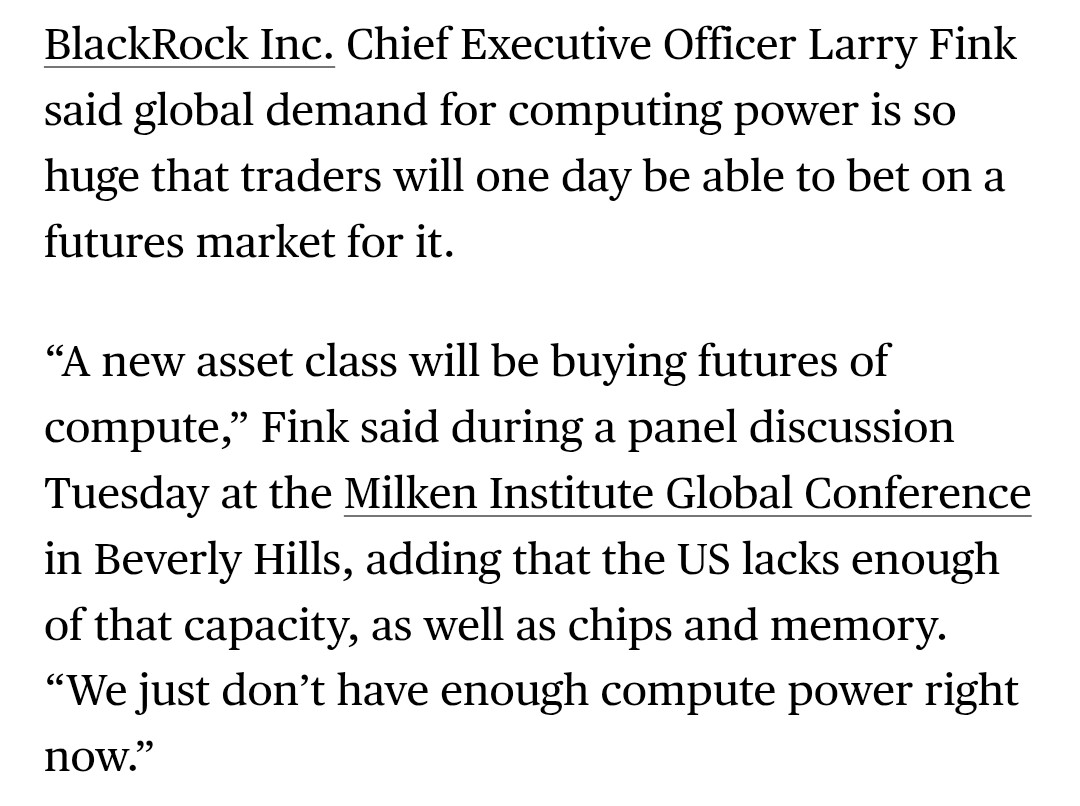
there's this Chinese tradition of burning paper money to your deceased relatives to send it to the afterlife. it evolved to paper cars and paper houses. I think there's an opportunity to start burning paper gpus. it's unfilial to have your deceased be compute poor.
Every so often I think about how, in 2022, for $24B we could had "prototype vaccines ready for each of the 26 known viral families that cause human disease" so they can be deployed in 100 days if there was ever a need.
This effort was not funded. https://t.co/TJBuqp69Nn
Most of the time, too much voltage is a bad thing.
…except in early ICBMs.
In the late 50s, you literally had to fry the targeting system to make it work.
At the time, US Air Force generals were extremely skeptical of computerized targeting:
"Where are you going to put the five Harvard professors you'll need to keep it running?"
The traditional method of storing guidance constants was to solder an individual board with the right values. If you wanted a different target, you would have to build a different board.
Wen Chow, a computer engineer, proposed a really (clever? weird?) solution.
Have everyone assemble the same board (a universal diode matrix) with every possible targeting configuration. Then, send a high reverse voltage across particular leads to burn out the junction…
By frying individual diodes with high voltage, you “program” individual bits!
If you’ve ever heard of the term, “burning the PROM”…now you know it comes from working on Atlas ICBMs!