6 weeks first @HyperliquidX $HYPE US ETF was listed.
The three US spot $HYPE ETFs have now pulled ~$189M in cumulative net inflows (Farside, Jun 18), up from the ~$155M at the time I wrote the article.
AUM sits near ~$220M.
What's driving it:
- $BHYP (@Bitwise) is the clear leader at ~62% of all inflows. The edge is structural: in-house staking turns the wrapper into a yield-bearing instrument, and that's the feature winning allocations.
- $THYP (@21shares_us) follows (~$62M),
- $HYPG (@Grayscale) still building (~$10M).
The flow record is almost spotless. June 5 was the only outflow day on record (a $2.9M $BHYP redemption).
The bid isn't only ETFs. a16z-linked wallets have accumulated ~148M of $HYPE since mid-April, most of it staked. And @HypeStrat Hyperliquid Strategies ($PURR), the "MicroStrategy for HYPE", now holds ~23.7M $HYPE (~$1.65B).
$HYPE actually has strong buying preassure: no VC, no private sale, ~99% of protocol fees routed to the Assistance Fund to buy $HYPE on the open market.
ETF inflows + treasury accumulation + protocol buybacks all stack up as buying pressure.
Will we see $HYPE ETFs from @vaneck_us and @BlackRock soon? Seems like it is just a matter of time.
$THYP and $BHYP logged $4.4M in combined opening-day inflows on debut, what was the strongest altcoin ETP launch of 2026.
Within 9 sessions the pair crossed $100M. Combined with $HYPG's $5.2M, total net inflows stand at ~$155M.
$BHYP: $89.4M @Bitwise | $THYP: $60.3M @21shares | $HYPG: $5.2M @Grayscale
Source: https://t.co/IuISB87qSC
coinbase is now hyperliquid’s official $USDC treasury deployer. @circle handles technical infra (mint/burn, CCTP). both stake 500k $HYPE as collateral, which will be slashed if yields fall short.
what changed
~$5–6B of $USDC reserves were sitting in T-bills generating yield that stayed with coinbase/circle. AQAv2 reroutes ~90% of that back to hyperliquid’s assistance fund → $HYPE buyback & burn daily. $USDH deprecated, $USDC mandatory quote asset for all HIP-4 markets going forward.
numbers
1) $135–200M/yr yield to protocol
2) $370–550k/day in HYPE buybacks from this alone
3) ~$62M HYPE staked combined (coinbase + circle, confirmed onchain june 9)
coinbase keeps a ~0.3–0.5% spread (~$6–15M/yr) but the real play is positioning: first time stablecoin issuer shares revenue with blockchain/protocol
both @circle and @coinbase are now direct economic counterparties with skin in the game, not just service providers.
Launch by @Kinetiq_xyz is launched today
It can be best described as Exchange-as-a-Service for HIP-3
What it is
•First Exchange-as-a-Service platform on Hyperliquid’s HIP-3
•Solves the biggest entry barrier: the 500k HYPE (~$20M) deployer stake
•Contributors crowdfund the stake into exchange-specific contracts and receive $exHYPE, which is an isolated LST per venue
How it works
•Slashing is isolated per pool: backers of one exchange are never exposed to another’s failures
•Kinetiq handles the full stack: validators, smart contracts, HyperCore integration
•Deployers focus on market curation and community
•Trading fees (up to 50% to the deployer side) are auto-distributed to contributors pro-rata
•Already validated: https://t.co/BOUU2Yuqzo went live in January as the first Launch-built exchange; crowdfunding tooling goes public today
Implications for HIP-3
•Capital barrier removed: deployment opens beyond $20M balance sheets, enabling more specialized and exotic markets
•$exHYPE = new asset class: per-venue fee streams + staking yield with isolated risk;
•Structural $HYPE demand: every deployment locks 500k+ $HYPE
•Distribution decides winners: each HIP-3 DEX runs isolated books, so more venues means competing liquidity
Launch converts HIP-3 deployment from a capital requirement question into a distribution question and expands @Kinetiq_xyz role to exchange factory.
Wall Street is taking @HyperliquidX seriously - as an opportunity and a threat
I think there are 3 factors that made it happen:
1. Hyperliquid enables round-the-clock trading of TradFi assets when traditional markets are closed
2. Hyperliquid enables pre-IPO markets with impressive trading volumes and OI
3. Reliable and democratic infrastructure that allows it to happen.
“convenience store” is becoming a department store.
perps. commodities. pre-IPO. outcomes. one venue. 24/7.
that’s the vision: house of all finance. and it’s getting closer
Pre-IPO markets on @HyperliquidX, June 1:
SPCX · $61.6M OI · $205 (↑41% in 4 days)
ANTHROPIC · $8.74M OI · $1,551
QNT · $4.14M OI · $99
OPENAI · $3.46M OI · $1,352
Total: $80.5M open interest.
SpaceX IPO: June 12. 11 days.
CBRS peaked at $58M OI the day it resolved. SPCX is already at $61.6M - and still climbing. Trade it on @Markets_xyz: https://t.co/A6tAIAcEeT
Cerebras @cerebras IPO'd 12 days ago. Traders didn't go home.
They rotated into SpaceX.
I analyzed every pre-IPO perpetual on @HyperliquidX. Five markets, two deployers, $1.12B cumulative volume in 90 days in a category that did not meaningfully exist before March.
What the data shows, market by market:
→ CBRS (Cerebras · @tradexyz): proof of concept. Launched May 1. IPO day did $281M in volume - the single largest pre-IPO day in HIP-3 history. OI still sticky at $37M post-resolution.
→ SPCX (SpaceX · @tradexyz): the new flagship. Day 1 volume $54.5M. OI ramped $25M → $50M in seven days. Doing in 10 days what CBRS took three weeks to build.
→ ANTHROPIC (@ventuals): $7.5M OI · funding +58% annualized. Most-loved Ventuals name. Longs paying the highest premium in the category.
→ SPACEX (@ventuals): $4.5M OI on $72K daily volume. OI/vol = 62×.
→ OPENAI (@ventuals): $3.4M OI.
CBRS → SPCX isn't two trades. It's one trade in two parts. When Cerebras resolved on May 14, capital didn't leave the venue, it redeployed into SpaceX four days later.
@tradexyz captured 61% (~$43K) of Pre-IPO HIP-3 revenue, while @ventuals accounted for 39% (~$28K).
Three months ago, retail couldn't touch SpaceX without a $1M net worth and a broker relationship.
Today: a Hyperliquid account.
now Quantinuum $QNT is next Pre-IPO Perpetual (IPOP) Market on @tradexyz
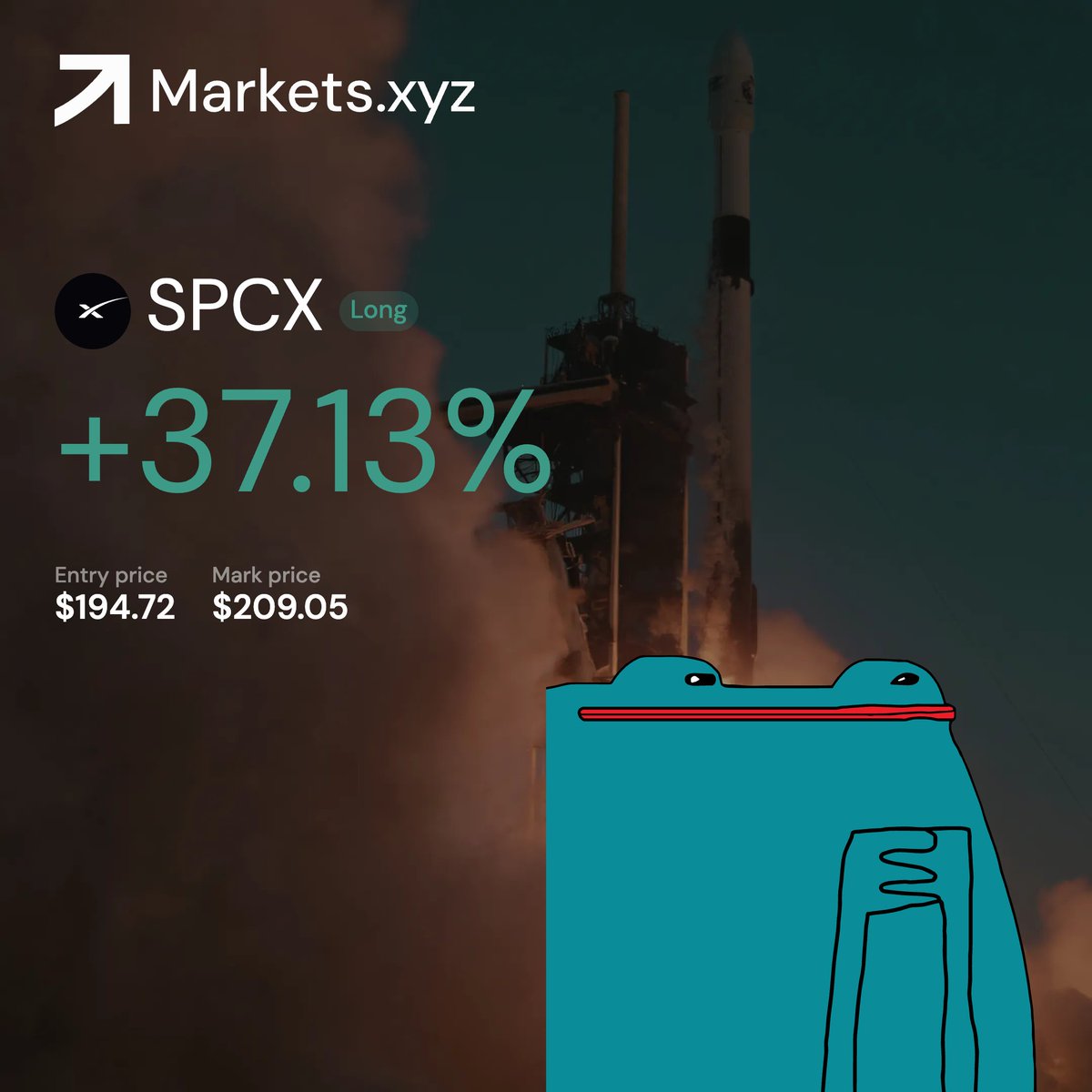
i've been writing about pre-IPO of @SpaceX perps for a week. felt right to actually be positioned in the thesis i keep posting.
long $SPCX. mark at $209.
@SpaceX is moving into its IPO filing now, and a share-price perp is the cleanest way to be positioned 24/7 ahead of a print the gated secondary venues are still mispricing.
the perp isn't a hedging product yet: OI is too thin for that. but as a directional take on "the IPO cohort is underpriced," it does the job. holding into the filing.
what an amazing opportunity from @HyperliquidX@tradexyz@Markets_xyz
Hyperliquid testnet has its first HIP-4 market on a real-world event - not a crypto price. It's "Fed rate change in June."
The resolution rules are sharp. It settles "Change" if the Fed moves rates at the June 16-17 meeting, and "No Change" if rates hold or the meeting produces no decision. Moves between meetings don't count.
But here's the gap: the spec says what counts as a rate change - it doesn't say who posts the result on-chain, or whether there's a challenge window.
$BTC and $HYPE markets settle to @HyperliquidX own mark price, so they never needed an external oracle. A Fed decision can't do that. This is the first HIP-4 market where real-world resolution actually has to be solved - and the mechanism or oracle isn't public yet.
The one to watch: https://t.co/AfrUJxm1VJ
price discovery doesn't live on nasdaq anymore. cerebras proved it.
may 13, 9pm eastern. cerebras prices its IPO at $185.
may 14, 9:30am. the stock opens at $350. an 89% pop. largest US tech IPO since uber.
between those two moments, the most liquid forward curve on cerebras wasn't on nasdaq. it was on @HyperliquidX
the volume gap is the whole story.
in the hours before the open:
- hyperliquid pre-IPO perps: $230M daily volume
- nasdaq premarket: $30M
7.7x more volume on a L1 than on the actual listing venue. traders using HL charts, next to bloomberg terminals.
this isn't a fringe venue mirroring nasdaq. nasdaq was mirroring the fringe venue.
the price action says the same thing.
three reference points:
- IPO price: $185
- hyperliquid implied open: $277 (+50%)
- actual nasdaq open: $350 (+89%)
HL got the direction right and underpriced the magnitude. the implied curve was off by $73, but it was the only forward signal anyone had. nasdaq premarket, the supposed institutional price discovery layer, had a quarter of the volume and didn't get closer.
what cerebras actually changed.
HL has been on this trajectory since HIP-3 went live. cerebras is the moment it stopped being deniable. once a US tech IPO's most-watched forward curve lives on an offshore L1, the question isn't whether traditional venues notice. it's how loudly they react.
they reacted on may 15.
CME and ICE went to the CFTC and capitol hill, framed as market manipulation and oil benchmark risk.
two facts undercut the framing:
- ICE put $1.64B into polymarket two months ago and isn't lobbying against it. if this were really about anonymous on-chain price discovery, polymarket would be in the memo.
- CME ships competing crypto products on june 1 and june 8, bitcoin vol futures and a multi-asset crypto index. same week as the lobbying.
the lobbying and the product launch are one campaign.
this isn't about manipulation. it's about who hosts the forward curve.
the $230M / $30M split on cerebras is the only number that matters in this fight. price discovery for a $95B nasdaq listing happened somewhere other than nasdaq.
regulated venues used to be where price was found. now they're often where price gets confirmed. cerebras made that visible to washington.
watch CFTC registration scope and CLARITY act language for the legal answer.
cftc just streamlined the rules for prediction market exchanges.
one umbrella letter now replaces 18 separate approvals. new exchanges can join by request.
19 venues on the list, including @kalshi, @polymarket us, cme, bitnomial, @cryptocom, railbird, ex-ledgerx.
the takeaway: lower barrier to entry, consistent rules, and the cftc is signaling formal rulemaking is next.
prediction markets are graduating from experiment to recognised venues.
trade[xyz] q1: $112.87B volume, +857% qoq.
what the headline doesn't show:
commodities = 67.65% of platform throughput
silver + cl = ~50% of total volume ($56.52B combined)
two stress windows:
- silver crash (jan 20 - feb 10, 22 days): $18.89B
- hormuz crisis (feb 24 - mar 18, 23 days): $10.47B
~26% of q1 volume came from 45 stress-event days.
48 consecutive days of OI ATHs is real for @tradexyz. spread convergence to crypto perps is real. the s&p license is real.
but the volume curve has two named catalysts driving the spikes.
the "no-event month" baseline is the q2 question.
kudos and credits to for amazing research: @smartestxyz and @shaundadevens
$HYPE outcome market is up on @HyperliquidX testnet.
Same template as the $BTC one, recurring daily binary, settles to the $HYPE mark price on HL.
First contract: HYPE above 28.18 at May 15, 00:00 UTC.
ticker: hype-above-2818-yes-may-15-0000
$BTC was the canonical first market on mainnet. $HYPE looks like #2.
HIP-4: Week One Numbers
HIP-4 launched 7 days ago with a single market: a recurring daily $BTC binary.
In its first week it cleared $20.6M in volume across 132,462 transactions.
That's 0.37% of the prediction market category for the same week. It's also the wrong number to fixate on.
Here's why.
@Polymarket runs thousands of markets. @Kalshi runs hundreds. HIP-4 launched with one.
The right comparison isn't HIP-4 vs Polymarket. It's HIP-4's $BTC daily binary vs Polymarket's most active $BTC price markets (5 and 15 mins).
On that basis, $3.3M daily volume on a single binary puts HIP-4 within striking distance of @Polymarket's biggest crypto-price contracts. From day one.
Three patterns from the data:
→ Daily volume held steady at ~$3.3M for six straight days. May 2 → $3.03M. May 7 → $3.19M.
→ Transaction count grew through the week. 17,899 on day one. 28,589 by day six.
→ Avg trade size: $156 on HIP-4 vs $97 on Polymarket. HIP-4 is pulling larger, more sophisticated participants. That tracks with the cross-margin thesis: these are traders sized for perp positions, treating binaries as portfolio tools rather than retail bets.
What week one proves:
The mechanism works. The opening auction clears. The CLOB handles size. Settlement executes cleanly. The oracle layer holds for a $BTC mark price binary.
Phase 1 was about proving canonical markets can carry meaningful volume on the rails. They can.
What week one doesn't prove:
Whether non-canonical markets attract liquidity. Whether the oracle architecture holds for sports, elections, macro releases. Whether multi-outcome support lands and unlocks the categories where Polymarket and Kalshi actually win.
Those are questions for the next 90 days.
Ondo just bridged 250+ tokenized US stocks to @HyperliquidX via @felixprotocol and @LayerZero_Core
How I farm~39% APR, delta-neutral, on $GME
Funding rate on the $GME perp is currently +0.0091%/hour on @tradexyz (~78% APR)
Long the Ondo-tokenized $GME spot on HyperEVM, short the perp on Hypercore, capture the spread.
Same wallet. HyperEVM and Hypercore. 24/7.
https://t.co/87lSa0vlCP
https://t.co/g6yBM6CGbx
Hyperliquid stopped being a DEX. It's a 24/7 equity venue now.




![PDmytriiev's tweet photo. trade[xyz] q1: $112.87B volume, +857% qoq.
what the headline doesn't show:
commodities = 67.65% of platform throughput
silver + cl = ~50% of total volume ($56.52B combined)
two stress windows:
- silver crash (jan 20 - feb 10, 22 days): $18.89B
- hormuz crisis (feb 24 - mar 18, 23 days): $10.47B
~26% of q1 volume came from 45 stress-event days.
48 consecutive days of OI ATHs is real for @tradexyz. spread convergence to crypto perps is real. the s&p license is real.
but the volume curve has two named catalysts driving the spikes.
the "no-event month" baseline is the q2 question.
kudos and credits to for amazing research: @smartestxyz and @shaundadevens](https://pbs.twimg.com/media/HIJ0IzTWwAAUqQi.jpg)