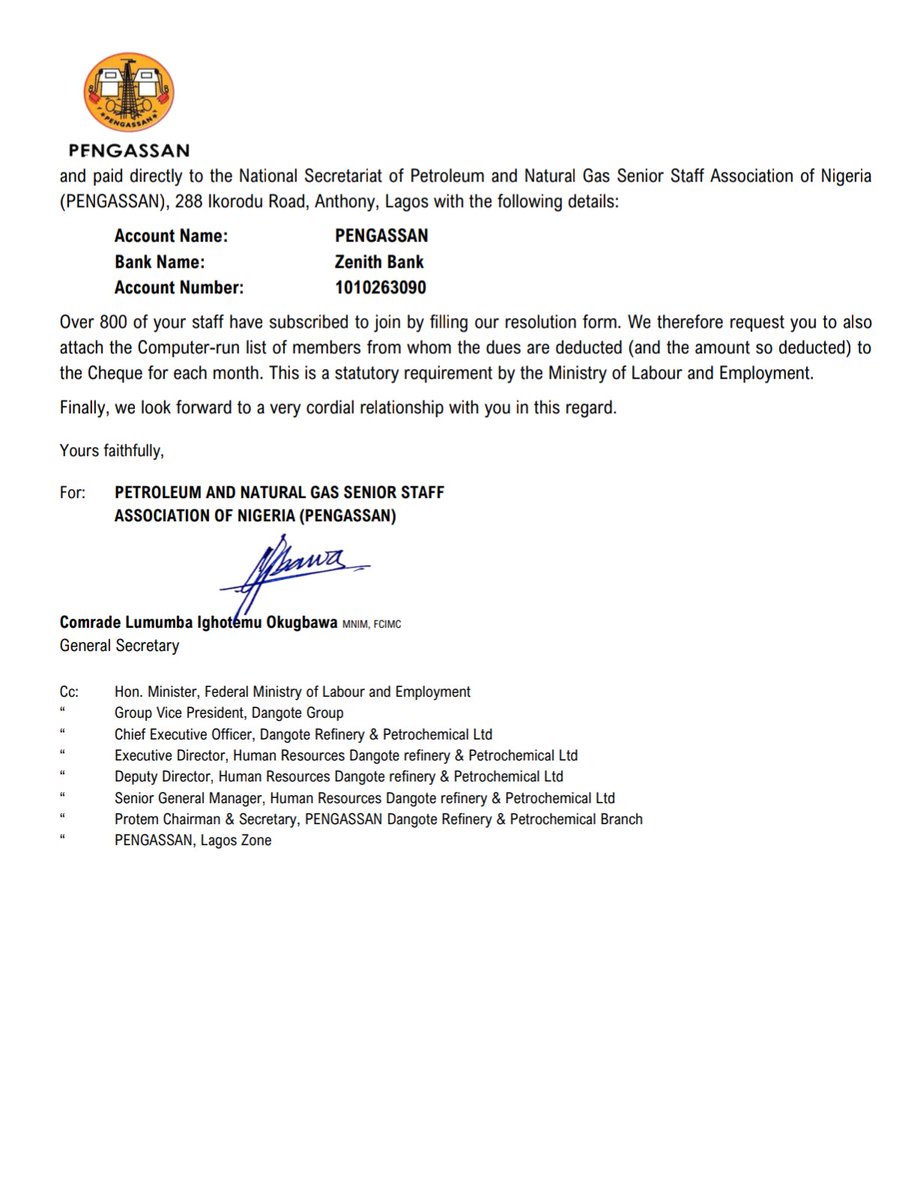
PENGASSAN officially notified the Management of Dangote Petroleum Refinery and Petrochemicals on September 22, 2025, that the company's Senior and Middle Management Staff have been successfully organized into the union, in line with extant laws.
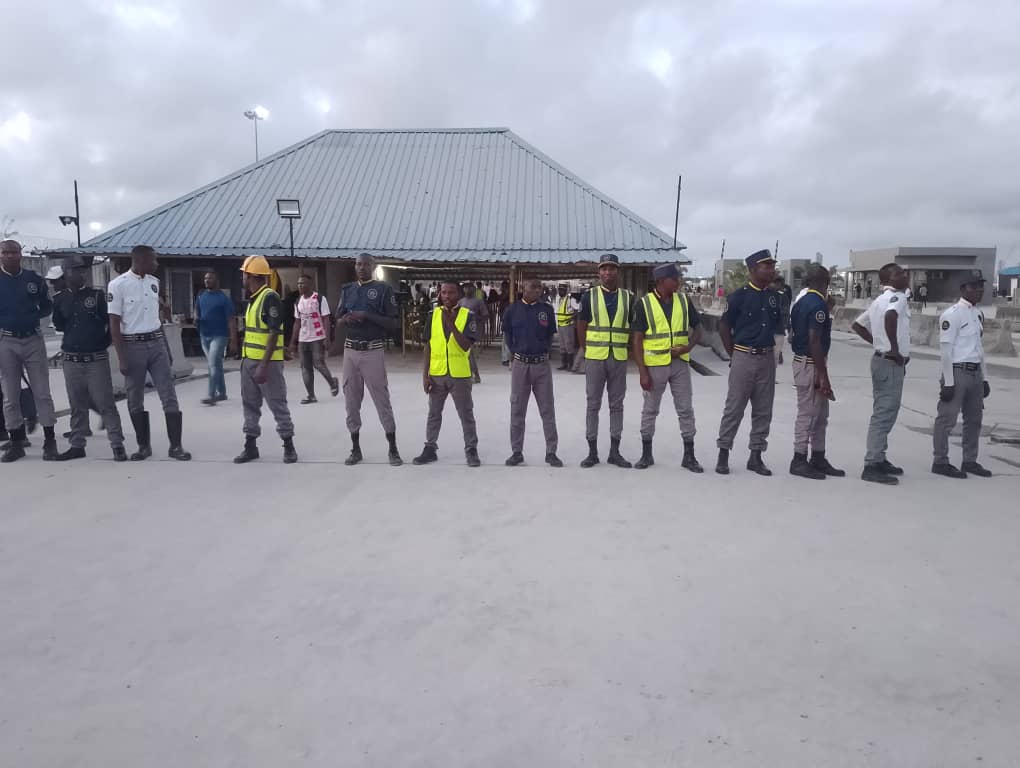
After overcoming the transport failure, staff were met with a rude shock at the gate: a group of security guards was standing guard, actively preventing the entry of all Nigerian Refinery staff.
On September 25th, just 10 minutes before the 5:00 PM pickup time, the Night Shift staff were suddenly informed that their buses were unavailable due to "maintenance."
Hi Stephen,
It is actually PENGASSAN, not “PENGASSEN.” If you can’t even spell the name of the union, I wonder if you're commenting from a place of knowledge or a shallow place. Let’s clear the fog.
Like most Nigerians, I do not always agree with unions. I’ve disagreed with PENGASSAN many times, even though I was briefly a member. Same way I was once part of ASUU but still critiqued them. But to brand every labour action as “selfish” is not just lazy, it is a dishonourable lie.
You claim the “average Nigerian worker” is a looter. That’s a cheap insult. I work in a private sector, in an organisation much bigger than Dangote Refinery, with presence in over 100 countries, over 100 years in operation. Every Nigerian staff there has been a developer, not a looter. We don’t even fight for our rights, because they’re provided even before we ask. That’s what global standards look like.
Now, let’s talk about the refinery engineers. Do you know what it truly means to become a refinery engineer in less than a year? Do you know the kind of sacrifices they made to make that refinery come alive?
They pre-commissioned. They commissioned. They started up. They operated. They stabilized the plant. If they were useless, then maybe Dangote himself should put on a helmet and try doing what they did. Or cheap story tellers 'ike you should take the task.
They went in without proper training. Without adequate PPEs. Some used their own money to buy safety gear, njust to keep the dream alive. Six days on, one day off. Some pulled 24-hour shifts during shutdowns. They lost lunch, breakfast, and rest facilities midstream. No health insurance. No safe working conditions. Yet they stayed, and delivered.
And now, after giving all of that, they’re branded as saboteurs and cast aside. That’s not just unfair, it’s wicked.
Quoting them directly:
“Everyone says protect investment, yet nobody cares about the sweat and blood that keeps the investment alive. Today it is young engineers cast aside, tomorrow it could be your own son.”
Now Stephen, tell me, after years of this kind of sacrifice with nothing changing, what should workers do? Sit quietly and smile while being exploited? Or demand fairness and dignity?
Your “if you don’t like it, leave” argument is weak. It’s the excuse of those too blind, or too compromised, to confront injustice. No serious society develops that way. You don’t build world-class assets by treating your own people as disposable.
Capital doesn’t run a refinery. People do. Protecting investment must include protecting the humans who make that investment productive. Otherwise, you end up with unreliable operations, safety disasters, and eventually, brain drain.
And let’s stop dragging history wrongly. Yes, unions in America between 1920-45 were strong. But the lesson wasn’t “crush labour.” It was to strike a balance between capital and labour. Because when balance is lost, accidents, outages, and unrest follow.
Stephen, you are wrong on the facts, wrong on the analysis, and wrong in spirit. If you really want Dangote and others to succeed, start by respecting the very professionals who turned steel and concrete into a working refinery. Without them, capital is dead weight.
So next time, if you want to argue, at least argue with facts, not lazy stereotypes about Nigerians being looters.
Thank you.
@kidqudzy@IU_Wakilii Someone working there for over two years, has no PPEs, no HMOs
Staff buys everything themselves. Sabotage was used to gain public sympathy, it's quite disheartening how the public are believing their lies. He is more interested in profit at the expense of staff welfare, so sad..
Between Investment Protection and Workers’ Rights: The Untold Struggles at the Dangote Refinery 2.
After listening to more information, I am directing this second piece to the Nigerian Content Development and Monitoring Board @OfficialNCDMB , the Federal Ministry of Labour and Employment, and the Government of the Federal Republic of Nigeria,
The recent mass termination of Nigerian engineers at the Dangote Petroleum Refinery has been explained away by management as a response to sabotage. However, testimonies from staff members paint a very different picture; one that points to years of poor working conditions, unfair labour practices, and pay disparities that undermine Nigeria’s local content aspirations.
Staff recruited across various batches, revealed that a level 9 step 3 engineer earns as little as ₦383,000 monthly. Even with shift allowances, total pay rarely exceeds ₦500K. In an industry where safety is paramount, personal protective equipment (PPEs) were reportedly issued only once, forcing workers to buy replacements from their pockets when worn out. Such alleged neglect of welfare and hazard protection stands far below the acceptable minimum standard for oil and gas operations.
In fact, the unannounced resignation of the refinery’s Chief Operating Officer, David Bird, further highlights these concerns. Known for promoting Nigerians within the refinery, it is elleged that he left due to the worsening staff welfare situation. Yet, despite his efforts, Nigerian engineers continue to earn a fraction of their expatriate colleagues’ salaries. While local staff struggle with ₦383,000, their Indian counterparts reportedly earn no less than $2,000 (around ₦3,000,000) monthly, even though a lot of them are Diploma holders. This fosters resentment and erode morale.
The situation came to a head when staff sought to exercise their right to unionize by joining the Petroleum and Natural Gas Senior Staff Association of Nigeria (PENGASSAN). Management, however, threatened them, insisting that because they operated within a Free Trade Zone, they could not join any trade union. PENGASSAN nevertheless registered hundreds of staff and formally wrote to the refinery. The response was punitive: workers were forced to declare whether or not they had registered, shift buses were withdrawn, and many were denied access to the refinery before their official termination letters were released.
This raises troubling questions. If sabotage truly occurred, can the management of Dangote Refinery explain what it was and who was culpable? Why were Dangote Fertiliser staff, who also joined PENGASSAN, not sacked? Is it because the fertiliser plant depends on locals for over 90% of its operations, while the refinery, being largely run by expatriates, can afford to dispense with Nigerian engineers? The selective application of punitive measures suggests that this is less about sabotage and more about silencing Nigerian workers who dared to seek fair treatment.
Now, a new management directive signed by Manas, a senior official of the refinery, has been released in response to the “manning crisis” caused by Nigerian staff not reporting to work. It reads:
•“All leaves of expats are cancelled until further notice. Anyone needing leave on genuine emergency will have to talk to me.”
•“Six (6) days work (12 hours) plus one day off to be followed in every unit until normalisation.”
This order confirms the depth of the crisis. With Nigerian engineers disengaged or locked out, expatriates are being overstretched to fill the gap. Rather than solving the crisis, such directives create unsustainable pressure on expatriates, deepen the divide between local and foreign staff, and expose the refinery’s overdependence on foreign labour. It further reveals that the termination of Nigerians was not a matter of discipline alone but a miscalculation with serious operational consequences.
Benefits to the country
1. NUPENG was a key member of the NLC that played a part in fighting military rule for the entrenchment of democracy. You may want to read about Frank Kokori and the June 12 struggles.
2. Many people may not have been following, but NUPENG and PENGASSAN have been at the forefront of further Nigerianization of the Nigerian petroleum industry ie creation of more jobs for Nigerians. An oil company (not Dangote) had over 10,000 expats in its employ, in violation of Nigeria’s local content laws. PENGASSAN took this up.
3. For many employers (not just in Nigeria), employees do not get top priority in the allocation of their resources. If not because of these unions, many employees would be treated as slaves. These unions checkmate excesses of these employers.
4. You all here aspire to work in oil industry. Some of the perks of oil industry you read about are not out of those oil companies’ generosity but strong unions that negotiate. I posted here few days ago that I bought my first car in March 2009 from the car grant I was paid few months after my employment. Car grant, among other perks, are negotiated by these unions (PENGASSAN in my case). If oil industry becomes like one-man businesses with bad labour practices, many Nigerian families will not be spared.
Finally, these macro and micro benefits don’t necessarily come at the detriment of the employers. They exist in Oando, Mobil, Shell etc. How many times have we read about them “sabotaging” businesses?
I don’t think any employer should be afraid of union if they don’t have sinister motive of instituting bad labour practices.
Onchain data of the #SUI blockchain have been impressive over the past months, and it's evident with the price action of #SUI that there's a great demand and interest in the benefits and advantages the blockchain offers.
It's been consistently averaging 250M USD in onchain volume, and also ranked 10th on dexscreener by volume.
Builders have been moving over to the network, and one interesting one that piqued my curiosity is H2O l @H2OSUIxyz
It's the 1st DeSci meme on @SuiNetwork launching soon, according to their tweets.
Noticed some great achievements such as good increase in the engagements & followers on X & Telegram, clean & native arts representing the solid narrative (H2O), innovative use of Giftdrop which airdrops SUI rewards for the community (I somehow missed this, haha), and the confirmed launch & listing on @CetusProtocol with locked LP.
Feels like this could be huge as everything looks perfect for a clean launch, and I will be bidding on launch!
It's important to follow @H2OSUIxyz and stay tuned!
For buying this on launch, I recommend using RaidenX as it offers the best speed. Here's my referral link if you want to use it: https://t.co/merd6AgTUa
ARE YOU THIRSTY? 💧
quote this tweet, DM us "Gift me H2O" and your SUI wallet
we're launching soon, probably... but god knows when and what happens next 🤷♀️
🌊 The #SUNWAVES revolution is here, and MILLIONS are already on board! 🎉
Ready to upgrade your festival game with a touch of #Blockchain magic? We’re transforming the way you experience events!
🚀 Don’t wait—join us today and get your welcome bonus.
#IceOpenNetwork#ION #ElectronicMusic #Festivals
🌟 One of the biggest and oldest electronic music festivals in the WORLD is launching its token on #IceOpenNetwork Join @sunwaves_token and receive 500 SW coins when you sign up. 🎶 Music is the anSWer https://t.co/2bVTIyZtzP
☀️ The #SUNWAVES Token is set to transform the festival experience through blockchain technology.
👉 https://t.co/sd0WIGUShb
🎁 Sign up today and receive 500 $SW Tokens as a welcome gift!
🌟 Part of the @ice_blockchain#ION Ecosystem
#SWToken#CryptoCommunity #FestivalExperience