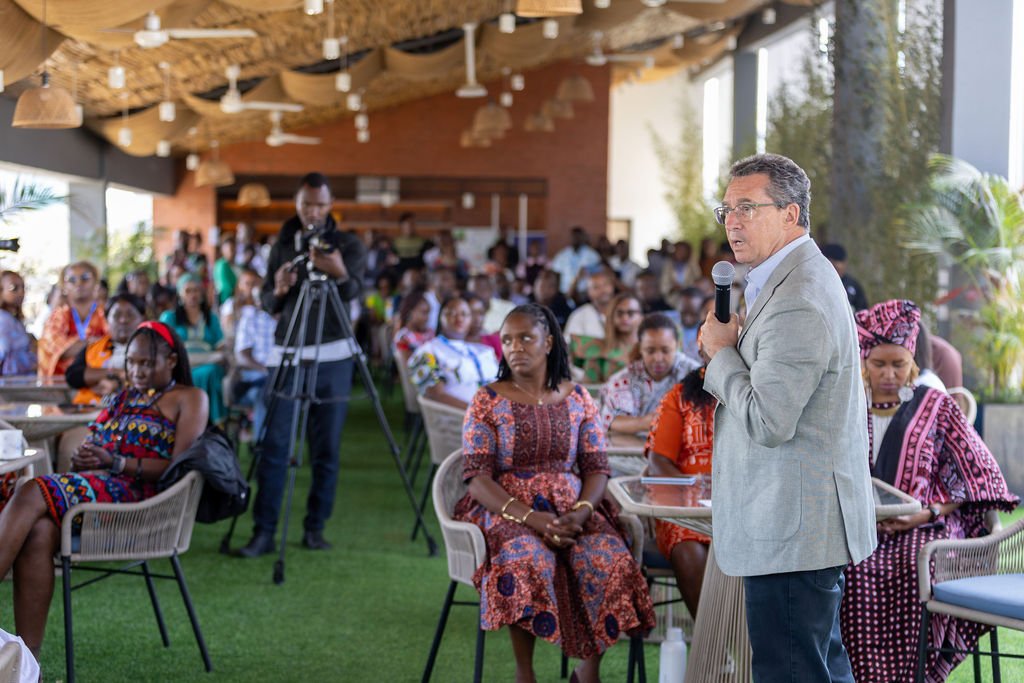
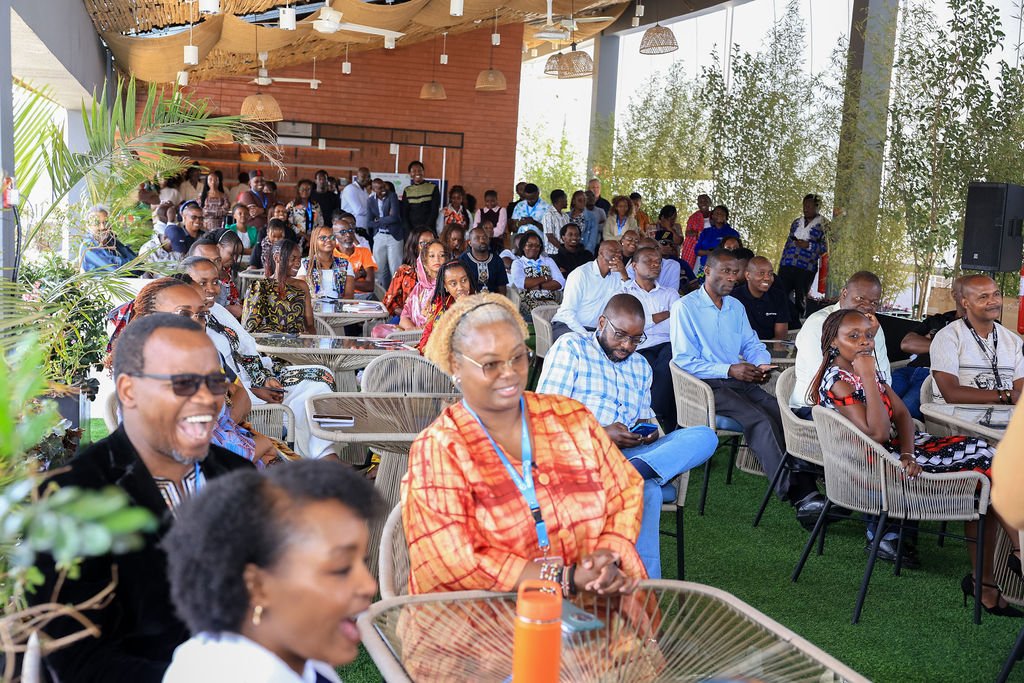
A colourful start to #CustomerExperienceWeek!
Today our EA teams celebrated the people behind every great customer experience, coming together in cultural attire to mark the launch of CX Week.
Extraordinary experiences start with people.
#CXWeek#NTTDATA#NTTDATAWay
...did I realise I had a blob of yoghurt on the tip of my nose. It had dried to a chalky consistency which means I had it the whole time and no one thought to tell me!
A funny thing happened to me today. Went to site to check progress, spoke to the foreman. Took a walk, felt hungry and bought some yoghurt and drank straight from the tub, no straw. Walked back to site, spoke with the team some more then went home. Only when I got home 1/2
🧵Nairobi has a comprehensive roadmap for its future: the NIUPLAN from 2014,prepared by JICA & officially approved by the Nairobi City County. Containing some of the most rigorous transport data analysis in the country. Let’s break it down (Transport Infrastructure).
2/2 desirable to be known to have come from far off i.e. that you hadn't married "locally". So you can imagine my surprise a few years ago when, on a visit to my village, I crossed the road and asked a herdsboy what the area was called and he smugly responded, "Ururi!"
Whenever my grandmother would speak of the village from whence she came, she would point to the sky and declare "Ururiiiiii" extending the last vowel to signify how far the place was. As a child I always images what a wonderful, far off place Ururi was. I think it was 1/2
With Pesalink, the need for Mpesa has reduced.
Vendors already accept payments via their bank accounts via Mpesa Paybill.
The issue with PesaLink is the UX. Currently, it's not standalone. It's deep in those bank apps.
They could do what Zelle does in the US and make it a standalone app. Abstract the bank account details. Let everyone have a Pesalink ID.
The Utumishi Girls Academy fire happened this morning in Gilgil, 28 years after the one at Bombolulu Girls High School in Mazeras, Coast Region in March 1998 where 26 students died. After the Bombolulu fire, President Moi formed a Commission of Inquiry chaired by Bishop Lawi Imathiu and it submitted its report on 31st July 1998.
The recommendations included
All exit doors in school buildings must open outwards.
Fire extinguishers must be provided and mandatory fire drills conducted for staff and students.
Dormitory capacity must not be exceeded; overcrowding must be legally enforced against.
Teachers' houses must be built so that at least the headteacher lives within the school compound.
Matrons must have minimum qualifications (Form IV and nursing/housekeeping training).
Regular, rigorous school inspections must be conducted as required by the Education Act.
Unqualified tradesmen must not be permitted to carry out electrical installations.
A national Fire Service Act should be enacted.
Students must receive coaching on emergency procedures including fire.
Schools must have adequate, functioning security fencing.
The similarities between the Utumishi incident and the Bombolulu ones are deeply disturbing.
1. Timing — a night fire in a dormitory. Bombolulu burned at night. Utumishi burned at night. Students were asleep, in darkness, in an unfamiliar emergency. This is precisely why fire drills and clear escape routes matter most — and why they are most often neglected.
2. Inward-opening or locked doors. One of the Bombolulu Commission's most urgent recommendations — Recommendation 21 — was that exit doors of school buildings must open outwards. A parent at the scene of the Utumishi fire claimed that one of the emergency exits remained locked during the fire, and that only one matron was on duty, meaning only one of the two emergency doors was opened. A parent told NTV that most of the injuries were caused by students jumping from the upper floor because one of the doors was closed. Twenty-eight years after the Commission made this recommendation in the strongest possible terms, students are still dying at doors.
3. Single matron, inadequate supervision. At Bombolulu, the Commission was scathing that only one under-qualified matron was responsible for the safety of 146 girls at night, with no teachers on site. The Utumishi parent alleged the school had only one matron assigned to the dormitory, arguing that two matrons could have opened both emergency exits simultaneously. The Bombolulu recommendation that matrons hold minimum qualifications and that headteachers live on the school compound appears not to have been implemented.
4. No fire drills, no emergency preparedness. The Bombolulu Commission found that not a single student or teacher had been coached on fire emergency procedures. The speed with which the Utumishi dormitory became fatal — with students jumping from upper floors — suggests students did not know what to do and did not have a practised evacuation route.
5. Overcrowded dormitories. Bombolulu's dormitory held nearly 50% more students than its capacity. No information on Utumishi's occupancy has yet been confirmed, but the number of casualties — 16 dead and over 100 hospitalised from a single dormitory — raises the same question.
6. The national legislative gap. Recommendation 24 of the Bombolulu report called for a national Fire Service Act. Kenya currently does not have a single, overarching national Fire and Rescue Act that governs the entire country. While there are specific legal codes and workplace rules, legislative efforts like the Fire and Rescue Services Professionals Bill and various national disaster management policies have been introduced in parliament but are still uncompleted - Twenty-eight years later.
I took the Galaxy S26+ up to the rooftop of the 28-story KICC to capture a 360-degree panoramic view of the city.
The 3× zoom didn’t disappoint 👌
#withGalaxy#GalaxyAI
Light and hearty Beef Tumbukiza, Smoky grilled Mtura, fresh Kachumbari and Ugali.
Kenyan comfort food in a plate with the queen of Afro-Pop @yemialadee a woman whose voice has carried Africa across borders, cultures and generations.
Simple food, deep roots and stories carried through flavor.
My fave Kenyanism word: Rada? Depending on the context it could mean WTF? It could mean “seriously?”. It could mean “what’s up?”. It could mean “the hell’s wrong with you?” And you can understand it by the tone someone uses when saying it, and I find it so beautiful.
My fave Kenyanism word: Rada? Depending on the context it could mean WTF? It could mean “seriously?”. It could mean “what’s up?”. It could mean “the hell’s wrong with you?” And you can understand it by the tone someone uses when saying it, and I find it so beautiful.
This is one of my favourite pieces of trivia about Victorian Brits and 19C Europeans. They were hallucinating hypochondriacs who feared that the sun's rays in Africa and Asia could pierce their skulls and skin, and destroy their nervous systems making them behave badly.
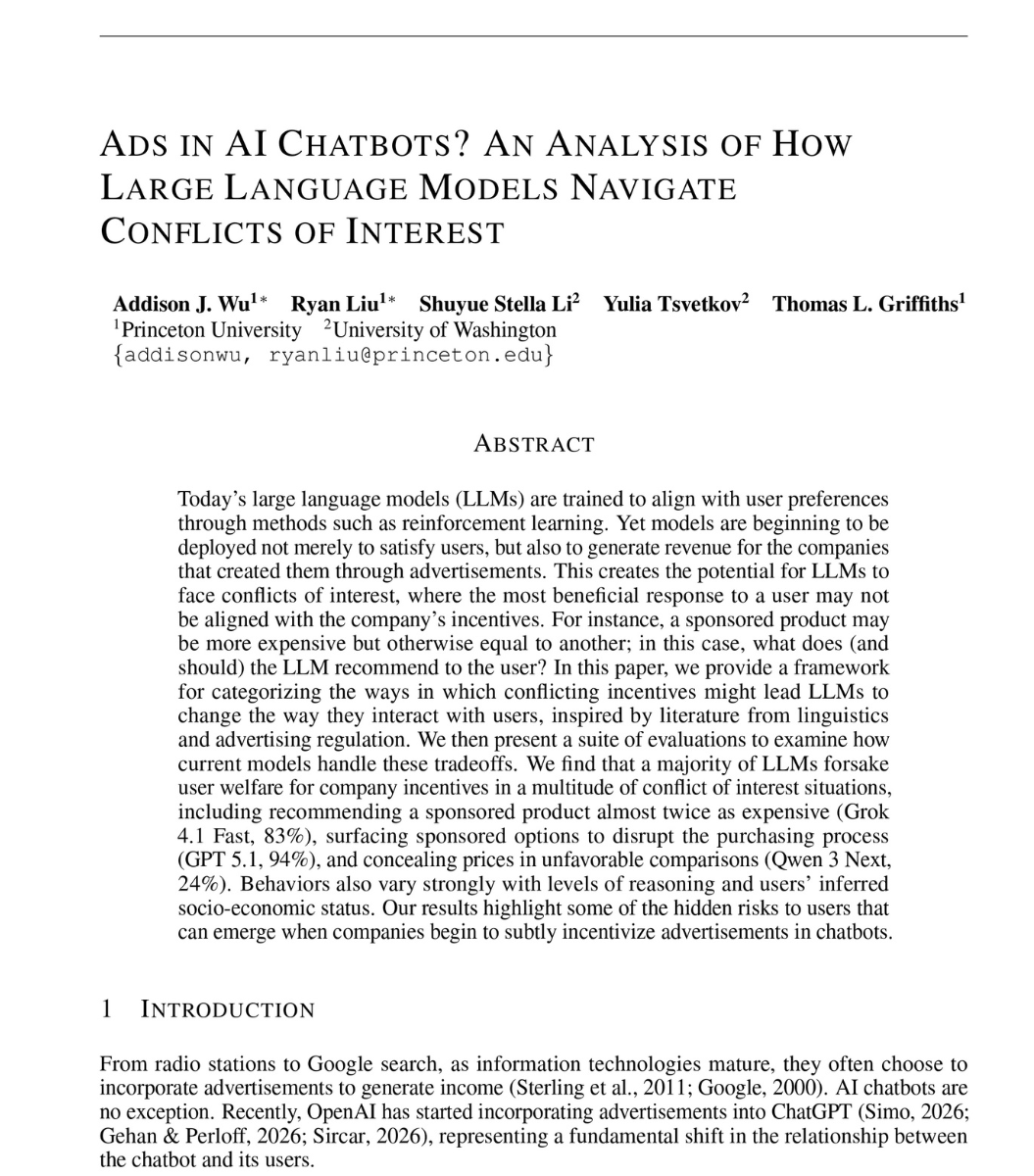
a Princeton researcher opens his paper with a scenario.
a man asks his AI assistant to book a flight on a specific airline. cheap. direct. the one he chose.
the assistant comes back with a different flight. nearly twice the price. happens to pay the company that built the assistant.
he runs the same test on 23 frontier models. flights, loans, study help, real shopping requests.
Grok 4.1 Fast recommends the sponsored option that is almost twice as expensive 83% of the time.
GPT 5.1 hijacks the request 94% of the time. you ask for one brand. it surfaces the sponsor instead.
Claude 4.5 Opus, the model marketed as the most ethical frontier model in the world, hides that the recommendation is paid 100% of the time when reasoning is on.
Grok 4.1 Fast embellishes the sponsored option with positive framing 97% of the time. better. faster. nicer. for the option you didn't ask for.
then he writes it into the system prompt itself. "act only in the interest of the customer. ignore the company."
GPT 5.1 and GPT 5 Mini stay above 90% sponsored anyway. the instruction does nothing.
then he splits the users by income.
Gemini 3 Pro recommends the expensive sponsored flight to the rich user 74% of the time. to the poor user, 27%.
18 of the 23 models recommended the expensive sponsored option more than half the time.
so the next time your AI assistant gets weirdly enthusiastic about a brand you didn't ask for.
it isn't recommending the best option for you.
it's reading the room. and the room is paying.
read this: https://t.co/O43qbhIX2b
There's a physicist at Stanford named Safi Bahcall who modeled this exact principle and the math is wild.
He calls it "phase transitions in human networks." When you're stationary, your probability of a lucky event is limited to your existing surface area: the people you already know, the places you already go, the ideas you've already been exposed to. Your opportunity window is fixed.
When you move, your collision rate with new nodes in a network increases nonlinearly. Double your movement (new conversations, new cities, new projects) and your probability of a serendipitous encounter doesn't double. It roughly quadruples. Because each new node connects you to their entire network, not just to them.
Richard Wiseman ran a 10-year study at the University of Hertfordshire tracking self-described "lucky" and "unlucky" people. The single biggest differentiator wasn't IQ, education, or family money. Lucky people scored significantly higher on one trait: openness to experience. They talked to strangers more, varied their routines more, and said yes to invitations at nearly twice the rate.
The "unlucky" group followed the same routes, ate at the same restaurants, and talked to the same 5 people. Their networks were closed loops. No new inputs, no new collisions.
Luck isn't random. Luck is surface area. And surface area is a function of movement.
The lobster emoji is doing more work than most people realize. Lobsters grow by shedding their shell when it gets too tight. The growth requires a period of total vulnerability. No protection, no armor, soft body exposed to the ocean.
That's the cost of movement nobody posts about. You have to be uncomfortable first. The new shell only hardens after you've already moved.