AI 일꾼들한테 일 넘기고 혼자 일하는 중임.
여기엔 두 가지만 올림. 하나는 바로 써먹는 AI 팁. 새 도구 소식 중에 혼자 일하는 사람한테 진짜 쓸모 있는 것만 골라서 어떻게 쓰는지까지 적음. 다른 하나는 자동화 맡겼다가 깨진 이야기. 잘된 것보다 조용히 망가진 데서 배울 게 더 많더라.
직접 돌려 보지 않은 건 「써 봤다」고 안 씀. AI로 일 줄이고 싶으면 팔로우해 두셈
Andrej Karpathy:
"Prompting is going away.
Delete everything, keep Graph."
In 1 hour he explains how to build Graphs, and why it's the only thing that will be left standing at the end
LLMs → Prompts → Agents → Graphs
a prompt gets you one answer and forgets the job
an agent finishes the job and forgets what it learned
a graph saves every finished job and turns it into the starting point for the next one
watch it today
then save the full guide on Graphs below before everyone catches up ↓
클로드 채팅창에 /katana 치면 내 사진으로 숏폼 편집 영상이 나옴
영상 AI 회사 히그스필드가 클로드 안에 넣은 편집 기능 Katana임. 라이브러리에 있는 편집 영상(프리셋)이나 내가 올린 영상을 뼈대로 잡고, 등장인물·상품·옷만 내 사진으로 갈아 끼워서 다시 만들어 줌. 클로드에 히그스필드 MCP(외부 도구를 클로드에 꽂는 연결 통로)를 붙여서 돌림. 히그스필드 유료 구독이 있어야 하고 API 키는 따로 안 받음.
쓰는 법은 3단계임.
① 클로드 설정 → 커넥터에서 히그스필드 연결 주소를 추가하고 히그스필드 계정으로 로그인함
② 채팅에 /katana 치면 프리셋 목록이 뜸. 마음에 드는 걸 고르거나, 내가 쓸 권리가 있는 편집 영상을 올림
③ 넣을 사진을 최대 5장 올리면 영상이 채팅창과 히그스필드 보관함에 같이 뜸. 그다음은 「이 컷만 바꿔 줘」처럼 말로 다듬음
명령어 없이 「히그스필드로 (내 상품 이름) 소개 편집 영상 만들어 줘」처럼 평소 말투로 시켜도 Katana가 켜짐. 괄호 자리만 내 걸로 바꾸면 됨.
제일 많이 막히는 데는 사진 올리는 곳임. 클로드 채팅창에 사진을 바로 끌어다 붙이면 참조 파일로 안 넘어감. 채팅 안에 뜨는 히그스필드 업로드 창으로 올리거나 파일 직접 링크를 줘야 함. 인스타·틱톡 프로필 링크도 안 받음. 다시 만들 때마다 크레딧이 드는데, 만들기 전에 클로드가 얼마 드는지 먼저 보여 줌. 결과 MP4는 길이·화면 비율·프레임이 뼈대 영상을 그대로 따라감.
숏폼 편집 맡길 데 찾던 1인 사장님은 저장해 두셈
Starting today, aura farming is accessible to everyone.
With Higgsfield Katana:
> Pick a preset or upload any edit
> Add photos of your characters
> Get your own version
Connect the Higgsfield MCP and type /katana in Claude.
AI가 남긴 노하우 메모, 다음 작업을 오히려 망칠 때가 꽤 많음
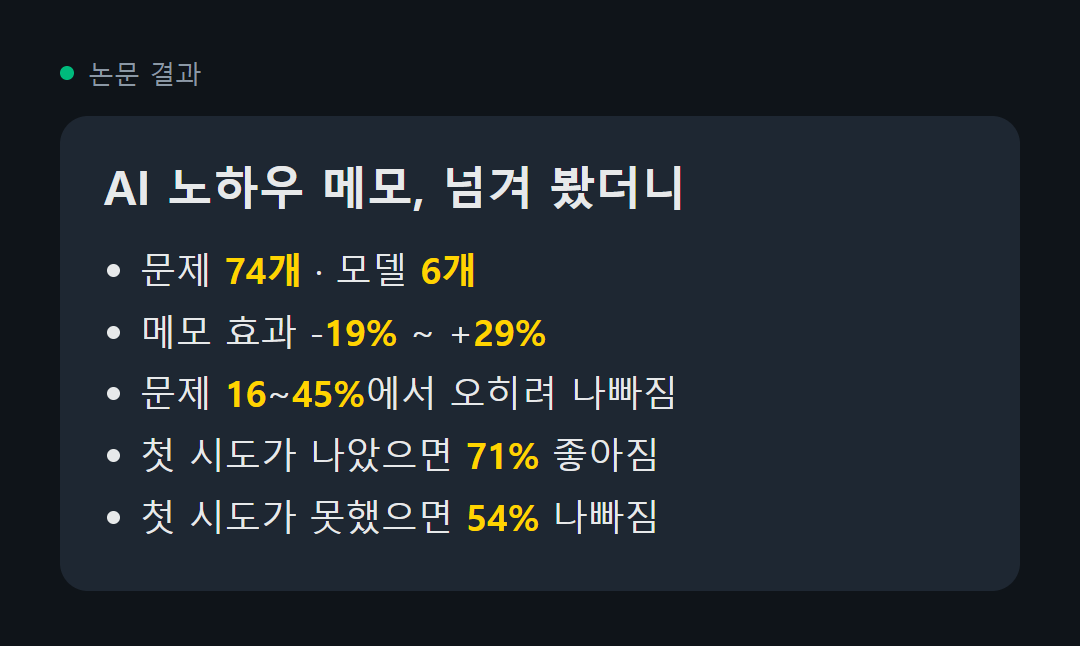
이번 달 초 arXiv에 올라온 MetaKernelBench 연구임. AI 에이전트한테 GPU 코드 최적화 같은 어려운 작업을 한 번 풀게 한 뒤 「이렇게 하면 됨」 노하우 메모(요즘 말로 스킬)를 직접 쓰게 하고, 그 메모만 들고 같은 문제를 다른 코드 언어로 다시 풀게 했음. 메모 없이 그냥 푼 결과랑 나란히 비교함.
문제 74개, 모델 6개로 돌렸는데 결과가 들쭉날쭉함. 메모 효과가 모델과 방향에 따라 -19%에서 +29%까지 갈렸고, 어느 모델이든 문제 16~45%에서는 메모 때문에 더 못 풀었음. 갈린 이유는 메모를 쓴 첫 시도의 실력이었음. 첫 시도가 메모 없이 푼 쪽보다 나았으면 71%가 좋아졌고, 더 못했으면 54%가 나빠졌음. 망친 경우일수록 메모에 근거 없는 결론이 더 많이 섞여 있었다고 함.
스킬이나 메모 파일 쌓아 두고 AI 돌리는 사람은 잘 끝난 작업에서 나온 메모만 남기는 게 나음. 헤맨 작업의 메모까지 다 모아 두면 실패한 방법이 다음 작업에 그대로 따라 들어감. 메모에 확인 안 된 추측이 있으면 지우고 넘기는 습관 하나가 꽤 큼.
긴 대화에서 AI가 앞에 정한 걸 까먹으면 이 프롬프트 하나로 다시 잡힌다.
원글이 공유한 건 대화 도중에 AI한테 「지금까지 프로젝트 메모」를 짧게 뽑게 하는 프롬프트다. 목표, 이미 정한 결정, 지켜야 할 조건, 내 취향을 한 덩어리로 묶게 한다. 특정 모델용 설정은 따로 없다. 대화형 AI 창에 그대로 붙이면 된다.
쓰는 법은 세 단계다. ① 답이 앞뒤가 안 맞기 시작하면 이 프롬프트를 넣는다. ② 나온 메모를 읽고 틀린 결정이나 빠진 조건을 내가 고친다. ③ 새 대화창을 열고 그 메모를 첫 메시지로 붙인다. 바꿔 쓸 곳은 메모에 넣을 항목이다. 글 작업이면 말투와 분량, 개발이면 건드리면 안 되는 부분처럼 내 일에 맞는 칸을 더하면 된다.
제일 많이 틀리는 데는 ②다. 메모를 안 읽고 넘기면 AI가 잘못 기억한 것까지 정답으로 굳는다. 대화가 길수록 중간 내용을 놓친다는 연구가 이미 나왔고, 앤트로픽도 긴 작업은 요약해서 새 창으로 넘기는 방식을 권한다. 긴 작업 자주 하면 저장해 두고 꺼내 쓰면 된다.
Your AI keeps forgetting important details halfway through a project
The longer your conversation gets, the worse it can become
Here’s a prompt that helps fix it:
“Create a compact project memory from our conversation. Include goals, key decisions, constraints, preferences, completed work, and next steps. Remove unnecessary details but preserve critical context. Format it so I can paste it into a new chat and continue without starting over.”
Stop losing hours explaining the same project to AI over and over again
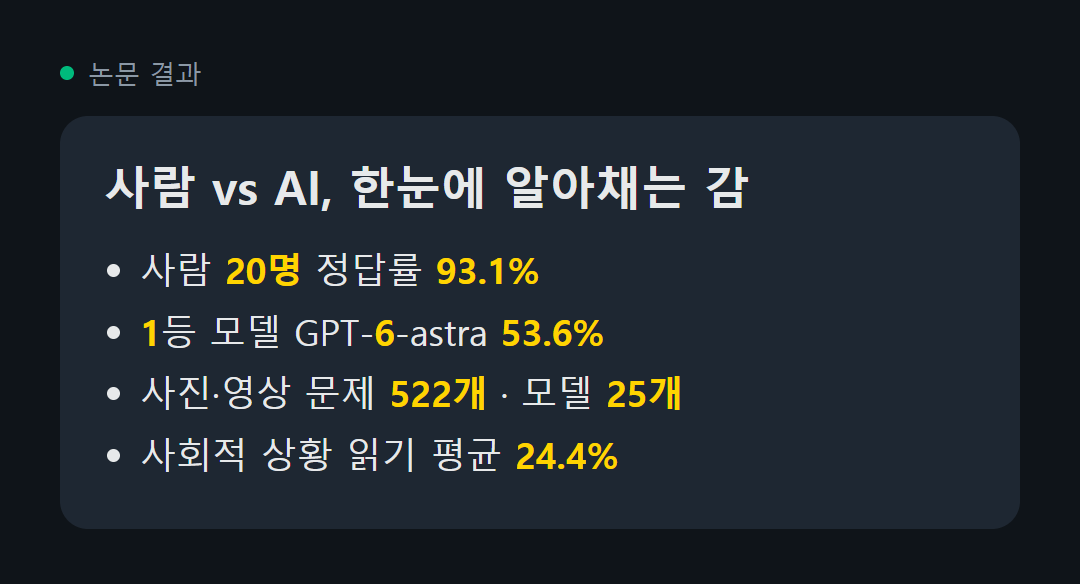
사람 93점, AI 54점. 한눈에 알아채는 감을 잰 시험 결과다.
스케일AI 등 연구진 29명이 10월 6일 arXiv에 올린 논문 Humanity's Sixth Sense 얘기다. 사람이 사진 한 장, 영상 몇 초만 보고 저절로 짐작하는 것들을 AI도 하는지 쟀다.
문제는 사진·영상 522개였다. 방금 전에 무슨 일이 있었을지, 차가 저 틈에 들어갈지, 방 안에서 누가 윗사람인지 같은 걸 물었다. 사람 20명은 93.1%를 맞혔고, 25개 모델 중 1등인 GPT-6-astra는 생각을 최대로 시켜도 53.6%에 그쳤다.
① 영상이 사진보다 어려웠다. 25개 중 23개 모델이 영상에서 점수가 떨어졌다.
② 제일 약한 건 사회적 상황 읽기였다. 평균 24.4%였다.
③ 틀린 답의 53%는 추론보다 앞 단계, 화면을 잘못 본 실수였다.
④ 생각을 더 오래 시킨다고 늘 나아지진 않았다.
AI한테 사진이나 영상을 보고 판단하는 일을 맡겼다면, 분위기나 관계처럼 감으로 읽는 부분은 사람이 마지막에 한 번 더 봐야 한다. 지금 1등 모델도 사람 점수의 절반을 조금 넘는 수준이다.
메타 새 모델 다섯 시간 써 본 개발자, 결국 클로드 코드로 복귀함
메타가 10월 12일 첫 프런티어 모델 Muse Wonder를 냈음. 개인 일·업무 에이전트용으로 만들었고, 독립 평가 사이트 Artificial Analysis 지능 지수에서 52점이 나와 전작 Muse Spark 1.3(48점)보다 4점 올랐음.
그런데 원글 작성자는 다섯 시간 붙잡고 써 본 뒤 영상까지 만들려다 그만뒀다고 함. 만들 필요가 없었다면서 다시 코덱스랑 클로드 코드로 돌아갔다는 짧은 한 줄이 조회 10만을 넘겼음. 같은 평가 사이트 기준으로 과제 하나 푸는 비용도 4.52달러라 비슷한 점수대 모델 중 비싼 편임.
점수표 숫자랑 내 일에 붙는 느낌은 따로 노는 경우가 많음. 새 모델 나올 때마다 갈아타기보다 지금 하던 일 하나를 똑같이 시켜 보고 결과만 비교하는 쪽이 덜 헤맴.
클로드 코드로 소개 영상 뽑을 사람 이거 ㄹㅇ 보셈
코드로 움직이는 그림을 그려 주는 스킬 huashu-art-motion이 해외에서 퍼지는 중임. 깔아 두고 반 고흐 풍으로 해 달라고 하면 별이 소용돌이치는 영상이 나오고, 배경 음악도 코드로 한 음씩 찍어서 박자에 맞춰 줌.
→ 화풍 35개 (주제 상관없이 쓰는 17개 + 미술사 오마주용 18개)
→ 설명 영상 문법 9개 (수학 개념 변형, 데이터 차트, 화이트보드, 키노트풍 등)
→ 참고 영상을 주면 컷·박자·화면 움직임부터 뜯어본 뒤 코드로 다시 만듦
→ 완성되면 제작에 안 낀 에이전트가 결과물만 보고 문제를 찾아냄
저장소를 직접 열어 봤음. 화풍 35개·설명 문법 9개는 README 숫자랑 그대로 맞고, 스타 3.8천 개에 MIT 라이선스임. 다만 원글에 나온 「파랑·보라 배경이 30% 넘으면 납품을 막는다」는 README에서 못 찾았음. 적혀 있는 건 영상 중간에 빈 화면이 끼었는지 거르는 검사 정도임.
주의할 것도 있음. 문서가 전부 중국어라 클로드한테 읽고 한국어로 설명해 달라고 시켜야 하고, 영상을 뽑으려면 uv·ffmpeg·Playwright 크로미움을 먼저 깔아야 함. 내 캐릭터 그림이나 이미지 모델을 안 붙이면 사람은 손이나 뒷모습으로만 나옴.
외주 없이 화풍 바꿔 가며 소개 영상 시안 뽑는 게 되는 거라 이건 저장해 두셈
Claude Code tip: install huashu-art-motion and Opus 5.5 can draw animations in 𝟯𝟱 𝗮𝗿𝘁 𝘀𝘁𝘆𝗹𝗲𝘀 with code. Van Gogh's starry sky swirls. Dalí's clocks drip. And its delivery script rejects any film where almost nothing moves.
You can just ask for an animation in the style of Van Gogh, Monet or Bauhaus, an explainer animation to go with your voiceover, or a character walking through one famous painting after another. Hand it a reference animation and it first breaks down the cuts, the beat and what moves where in the frame, then recreates it in code.
𝗪𝗶𝘁𝗵𝗶𝗻 𝟭𝟬 𝗺𝗶𝗻𝘂𝘁𝗲𝘀 𝗼𝗳 𝗶𝗻𝘀𝘁𝗮𝗹𝗹𝗶𝗻𝗴 𝗶𝘁, Opus 5.5 made this demo video from its 35 built-in styles. It runs from cave painting 40,000 years ago all the way to 2026. The room, the cat and the girl never change; only the style does.
17 that work for any subject: products, data, stories
→ Van Gogh, Matisse cut-outs, Seurat pointillism, Impressionism
→ Analytic Cubism, Lichtenstein pop art, Bauhaus, Russian Constructivism
→ Ghibli watercolor backgrounds, Makoto Shinkai light, Chinese ink wash
→ 8-bit pixel art, vaporwave neon, 2026 flat illustration
→ Pompeii mosaic, early ray-traced CGI, Rembrandt chiaroscuro
18 for time travel, tributes and art-history speedruns
→ Monet's water lilies, Klimt's golden period, Munch, Dalí
→ Hopper, Picasso's blue period, Mucha's Art Nouveau
→ Keith Haring, Kusama polka dots, Jack Kirby comics, 1930s rubber hose cartoons
→ Cave painting, Egyptian tomb murals, Greek black-figure pottery, Dunhuang murals
→ Chinese shadow puppets, Gothic illuminated manuscripts, Renaissance sfumato
Each style spells out what moves in the picture. The eyes on Klimt's robe blink in turn, Hopper's hard-edged patch of sunlight slides slowly across a face, and the 8-bit question block pops out a coin.
9 explainer styles
→ For math and AI concepts, use 3Blue1Brown, where one shape morphs into the next
→ For data, use finance charts: axes first, then the data, and label only one thing
→ For UI steps in a software tutorial, use the keynote look: light-spot background, frosted-glass cards, big numbers
→ To draw relationships as you narrate, use the whiteboard, where the pen tip reveals the line art bit by bit
→ For a collage of graphics and info, use the Vox explainer look: clippings, red lines, highlighter
→ Kurzgesagt, flat with no outlines, moving between tiny and huge scales
→ Storytime, cutting to reaction close-ups and leaving a beat for the joke
→ Kinetic type, with the key word slamming into the frame
→ Presenter-led finance explainers, where you supply the character yourself
The music is synthesized in code too, note by note on a BPM grid. When a film is done, it runs its QA script, then sends an agent that took no part in making it to watch only the finished film and find problems. The delivery script also blocks two more things: 0.3+ seconds of blank frames mid-film, and a blue-purple background in over 30% of the film, a palette it counts as AI slop.
The skill has 𝗮 𝘁𝗶𝗲𝗿 𝗷𝘂𝘀𝘁 𝗳𝗼𝗿 𝗖𝗹𝗮𝘂𝗱𝗲 𝗢𝗽𝘂𝘀 𝟱.𝟱 or stronger models, where it can combine the libraries itself and write its own renderers. All 35 styles are star-rated, and the 20 with three stars are recognizable at a glance and ready to use.
The skill's docs are in Chinese; the prompt below has it read them and talk to you in English.
Rendering video needs uv, ffmpeg and Playwright Chromium.
If you want people on screen, use your own character art or connect an image model to make the frames. Without either, it only draws hands and figures seen from behind.
npx skills add alchaincyf/huashu-art-motion
https://t.co/tGUVjIj4FB
Once it's installed, send this to Opus 5.5 in Claude Code 👇
"Use huashu-art-motion to make me a 15-second animation. The skill's docs are in Chinese; read them and talk to me in English.
1. First check for uv, ffmpeg and Playwright Chromium, and tell me how to install anything that's missing.
2. Ask me what it's about, who it's for, and whether it's landscape or portrait. From the material layer in references/风格配方/INDEX.md, pick 3 styles that fit, three-star ones first. Redesign the composition for my subject in all three, each different from the others, and don't copy the room from the samples. Show me one still frame of each to choose from.
3. Once I pick, give each scene one main action plus two motif loops from that style's card. For Van Gogh, that's the starry sky curling into swirls and the lamp's halo spreading outward. If there's music, use the skill's BPM synthesis and put the motion on the beat.
4. If people need to appear, ask me first: my own character art, frames from an image model, or only hands and figures seen from behind.
5. After rendering, follow the skill's own QA steps: run its QA script first, then send a subagent that took no part in making it to watch only the finished film and find problems, have it write its findings into the 审片/ folder, and deliver with its delivery script. If anything comes up red, fix it and re-render before giving it to me."
AI한테 12시간짜리 연구 맡겼더니 혼자 실험 고쳐 가며 계속함 ㄷㄷ
중국과학기술대랑 알리바바 AMAP 연구진이 10월 9일 arXiv에 올린 TerminalHorizon 논문임. AI 에이전트한테 오래 걸리는 일을 가르치는 연습 문제를 자동으로 만드는 방법을 다룸.
지금 에이전트 학습 자료는 대부분 짧은 시범이라 명령 몇 개 치는 법은 배워도, 긴 일에서 단서 모으고 피드백 보고 방향 틀고 결과물로 마무리하는 건 잘 못 배움. 그래서 연구진은 실제 현업 과제를 돌려 볼 수 있는 작업 환경 1,535개로 바꿨음. 다른 AI한테 먼저 풀게 해서 살펴보기나 검증 같은 중요한 단계를 건너뛰어도 풀리는 환경은 다시 만들었고, 통과한 과제엔 앞 결과에 기대는 요구를 덧붙여 길게 늘렸음. 기록 한 편이 평균 52.8번 주고받기임.
이걸로 Qwen3.5-27B를 학습시켰더니 터미널 작업 시험(Terminal-Bench 2.0) 점수가 41.6에서 55.8로 오름. 12개 시험에서 다 올랐고, 12시간 연구 과제에선 피드백 보고 방법을 고치고 잘 된 개선은 남기면서 실험을 이어 감. 이건 ㄹㅇ 사람 일하는 방식이랑 비슷함.
혼자 일하는 입장에선 이게 꽤 중요함. AI한테 긴 일 맡겼을 때 중간에 흐지부지되는 건 모델 머리보다 길게 일해 본 연습이 모자라서일 수 있다는 뜻임. 데이터랑 모델은 허깅페이스에 공개돼 있음.
앤트로픽에서 레거시 코드를 최신 코드로 바꿔주는 플러그인을 내놨네요.
단순히 바꿔주는게 아니라 제대로 동작하는지까지 검증해준다고 합니다.
오래된 레거시 프로젝트 개선하려는데 엄두도 못내던 횽님들 한번 써보시는것도 나쁘지않을것 같아요~
https://t.co/XKdTavgQmA
MiniCPM-V 4.7, 사진과 문서를 읽는 AI를 아이폰 안에서 돌리는 모델이 나왔습니다
OpenBMB 팀이 10월 12일 공개한 오픈소스 멀티모달 모델입니다. 이미지와 글을 같이 이해하는데, 서버로 보내지 않고 기기 안에서 돌아가게 만든 것이 이번 판의 목표입니다.
→ 35B-A3B 버전은 전체는 크지만 한 번에 일하는 부분이 3B 정도라 폰에서도 돌아갑니다
→ 1B 버전은 더 작고 가볍습니다
→ 다음에 쓸 부분을 미리 불러오는 LES 방식으로 실제 기기에서 5배 빨라졌다고 합니다
→ iOS와 안드로이드를 둘 다 지원합니다
저장소 문서를 직접 열어 보니 아이폰 17 Pro Max에서 메모리 3GB로 초당 13토큰 넘게 나온다고 적혀 있습니다. 라이선스는 Apache-2.0입니다. 고객 사진이나 영수증처럼 밖으로 내보내기 꺼려지는 자료를 다루는 1인 사업자에게 특히 쓸모 있습니다.
다만 원글의 34개 벤치마크 성적은 개발팀 자체 발표입니다. 공식 모델 페이지에는 성적이 그림으로만 있고, 아이패드 속도는 숫자 없이 화면 녹화로만 보여 줍니다. 내 폰 사양으로 직접 돌려 보기 전까지는 기대치를 조금 낮추는 게 맞습니다.
폰에 AI 올려 볼 생각 있으신 분은 저장해 두십시오.
🚀 Introducing MiniCPM-V 4.7, our new open-source MLLM series!
Advancing the Performance–Efficiency Pareto Frontier.
It brings strong multimodal capabilities to iOS and Android devices with extreme efficiency.
Two new models:
🔹 MiniCPM-V 4.7 35B-A3B — Bring SOTA performance to local devices with newly introduced LES (Lookahead Expert Scheduling) technique, a new milestone of on-device multimodal AI.
🔹 MiniCPM-V 4.7 1B — Lightweight, efficient multimodal AI. Easier to deploy.
⚡ What's new?
SOTA performance: Competitive results across 34 benchmarks spanning multimodal understanding, STEM reasoning, OCR and long-video comprehension.
Fast on-device inference: LES predicts and preloads expert weights to reduce inference stalls, boosting 5× speedup on iPad Pro M4 (16GB) with byte-for-byte identical outputs. It enables MiniCPM-V 4.7 35B-A3B to achieve 17+ tokens/s on iPad Pro M4 (16GB) and 13+ tokens/s on iPhone 17 Pro Max, while costing only 3GB memory 🤯
Efficient visual processing: 4× and 16× hybrid visual token compression. Even at 16× compression, 35B-A3B scores 90.4 on OCRBench, 5.2 points ahead of Qwen3.6 35B-A3B.
Easier customization: We introduce Self-Replay Fine-Tuning, a simple way to customize new target capabilities at low cost while maintaining general performance.
Broad hardware support: Day-0 adaptations for Apple, Intel, AMD, Arm and Rockchip, with many more platforms supported through FlagOS!
Download, deploy, and build something we haven't imagined yet. 👀👇
🔗 GitHub: https://t.co/msjm2QlrvX
🤗 Hugging Face: https://t.co/W95QKGhymw
자동화는 잘 돌던 임시 버전을 정식으로 옮길 때 제일 많이 깨짐
자동으로 글을 올려 두는 작업이 하나 있음. 처음엔 급하게 짠 임시 버전으로 돌렸고 문제없이 올라갔음. 그래서 깔끔한 정식 버전으로 다시 만들었는데, 두 번째 글 올리는 날 글이 공개가 안 되고 초안 그대로 남아 있었음.
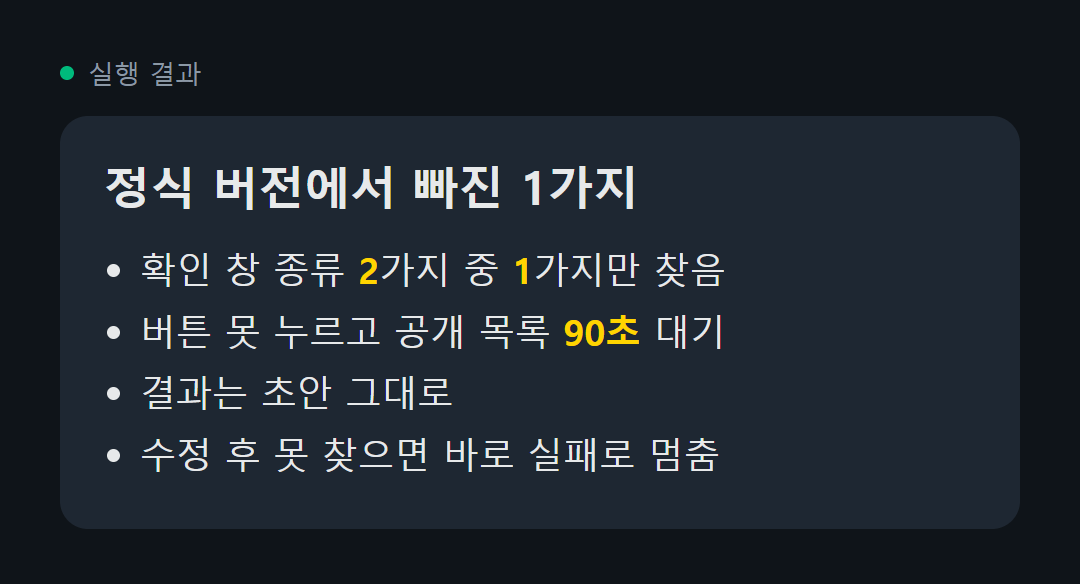
원인은 마지막 「정말 올릴까요」 확인 창이었음. 이 창이 뜨는 종류가 2가지인데 정식 버전은 그중 1가지만 찾게 돼 있었음. 임시 버전은 둘 다 찾았는데 옮기면서 그게 빠진 거임. 더 아팠던 건 그다음임. 확인 버튼을 못 눌렀는데도 그냥 넘어가서 공개 목록을 90초나 기다렸고, 끝에는 「올라갔을 수도 있음」이라고 애매하게 보고함.
임시 버전을 정식으로 옮길 사람한테 권하는 거 3개. ① 임시 버전이 실제로 처리하던 경우를 하나씩 적어 두고 새 버전이랑 대조함 ② 꼭 눌러야 하는 버튼을 못 찾으면 기다리지 말고 그 자리에서 실패로 멈춤 ③ 고친 뒤엔 고치기 전 버전이 새 시험에서 진짜 떨어지는지부터 봄
고친 버전으로 다시 올려서 공개된 걸 확인하고 나서야 끝냄. 깔끔하게 다시 짠 코드가 지저분한 임시 코드보다 아는 게 적을 때가 생각보다 많음.