Research Intuition as a Retrieval Task
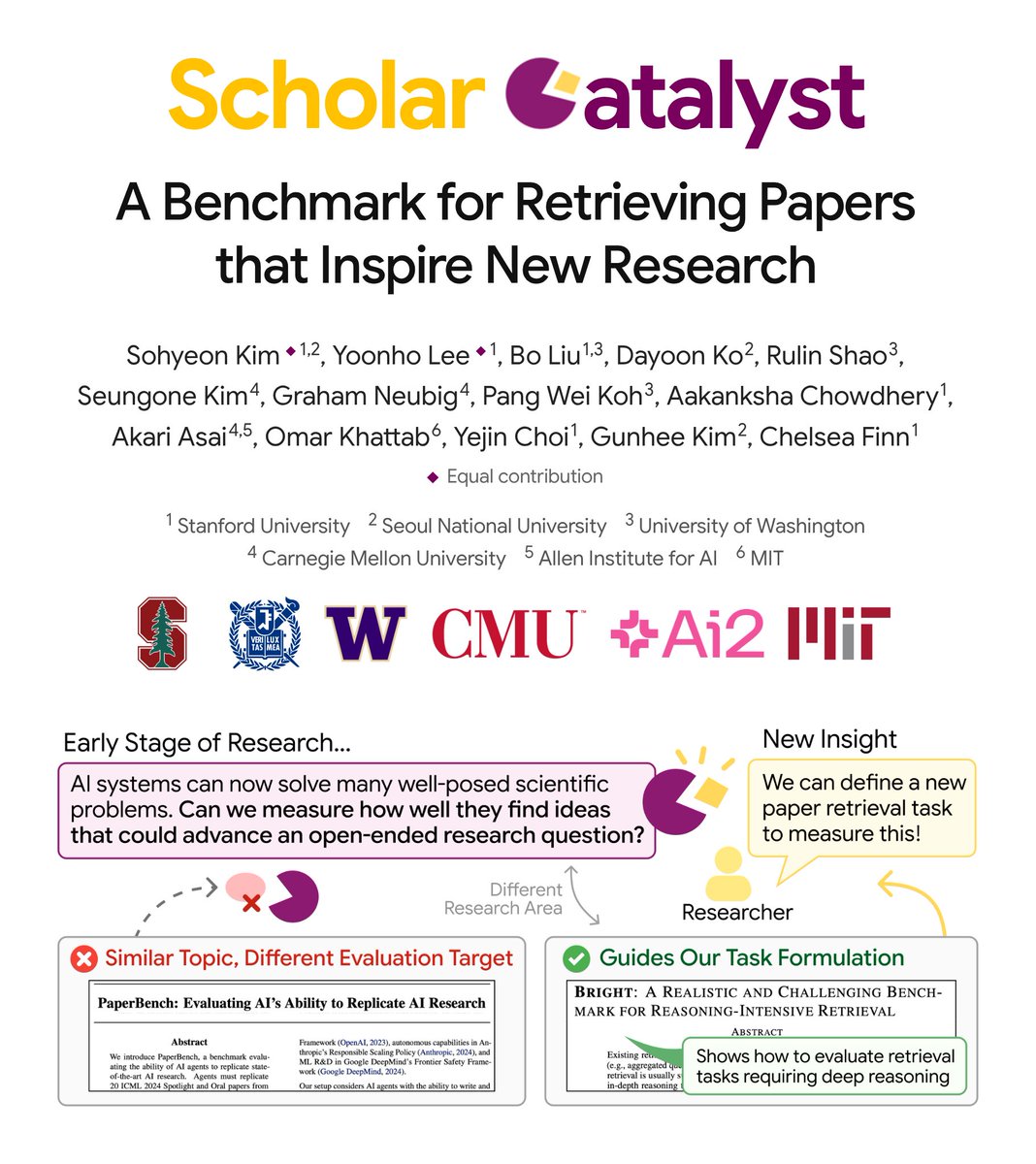
We wrote a @StanfordAILab blog post exploring intuition (taste) in discovery and proposing a path forward.
Open-ended discovery depends on intuition to recognize what is worth reasoning about. Even the strongest reasoning or decision models can explore only a small part of the search space, so they need quick intuition to surface promising directions.
We argue that retrievers are the natural place to learn this intuition, and that the ceiling for learned intuition sits far above human level, since retrievers can scale work in ways humans cannot.
We hope ScholarCatalyst is a step toward a new generation of retrievers that learn intuition beyond semantic similarity.
Blog: https://t.co/lZdCplTxrh
Paper: https://t.co/Z2x1NS7e5p
w/ @yoonholeee
Check out our new SAIL blog post on ScholarCatalyst, a reasoning-intensive retrieval benchmark for scientific discovery built from human researchers’ judgments. The authors rethink retrieval as research intuition and explore how it can surface promising directions for open-ended discovery. https://t.co/nqTTXwxWhW
AI can increasingly make progress on open problems like Navier-Stokes. Yet defining a new problem still relies on human research taste.
Introducing ScholarCatalyst, a benchmark built from AI researchers’ firsthand accounts of what inspired their work.
Research Intuition as a Retrieval Task
We wrote a @StanfordAILab blog post exploring intuition (taste) in discovery and proposing a path forward.
Open-ended discovery depends on intuition to recognize what is worth reasoning about. Even the strongest reasoning or decision models can explore only a small part of the search space, so they need quick intuition to surface promising directions.
We argue that retrievers are the natural place to learn this intuition, and that the ceiling for learned intuition sits far above human level, since retrievers can scale work in ways humans cannot.
We hope ScholarCatalyst is a step toward a new generation of retrievers that learn intuition beyond semantic similarity.
Blog: https://t.co/lZdCplTxrh
Paper: https://t.co/Z2x1NS7e5p
w/ @yoonholeee
Huge thanks to all the researchers who shared the stories behind their discoveries, and to the entire ScholarCatalyst team for making this work possible.
Special thanks to @YejinChoinka, @AkariAsai, @SOURADIPCHAKR18, @jacobli99, @bradenjhancock, @RulinShao for their insightful feedback on the blog post.
We’re also grateful to the @LaudeInstitute for supporting this research direction through the Slingshot program!
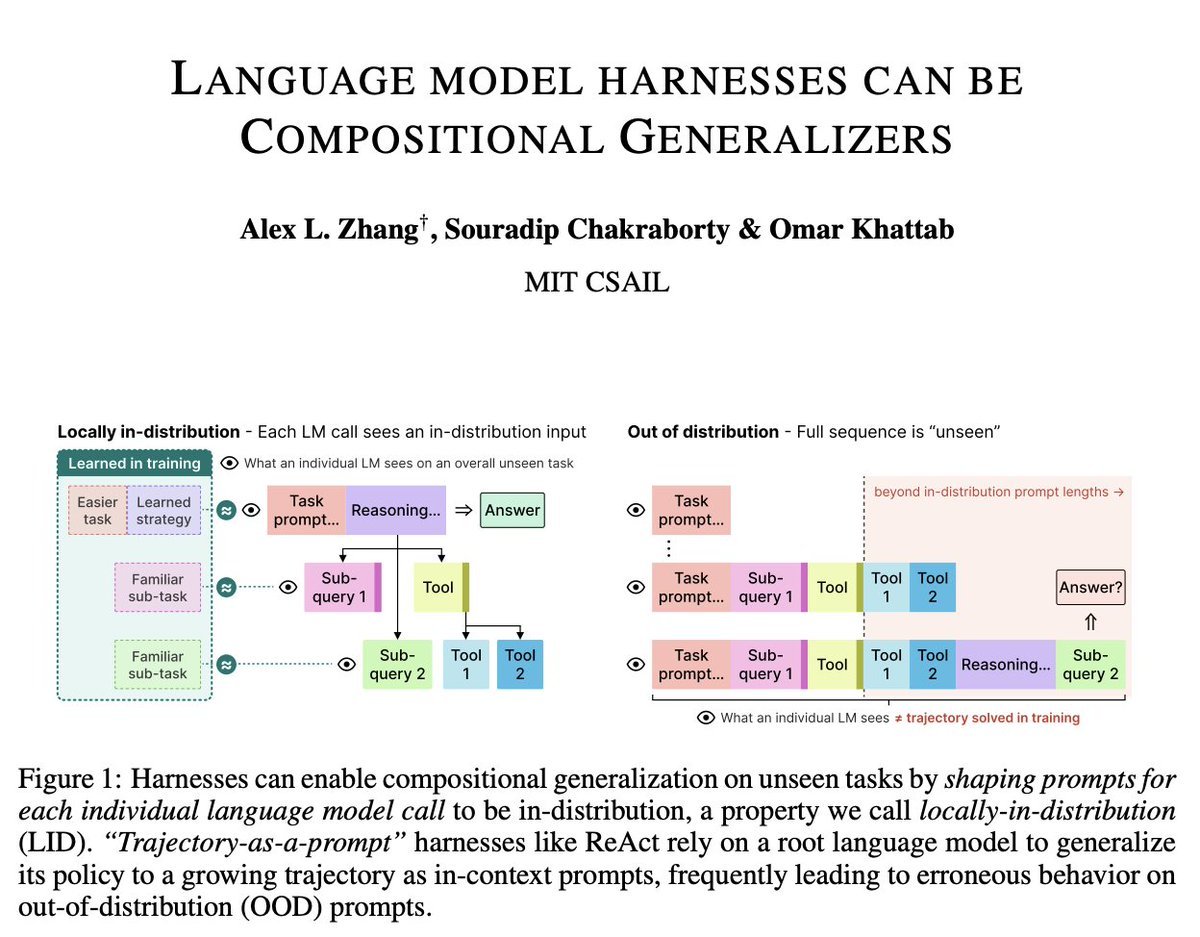
We have largely thought of LM harnesses as inference-time scaffolding. But what happens when we train models with the right harness?
A common assumption is that RL naturally leads to generalization. However, its ability to generalize ultimately depends on the underlying neural network's learned representations, which may not transfer reliably to unseen tasks.
In the recent work by @a1zhang, we show how harnesses can enable compositional generalization during training by programmatically managing context, allowing RL to learn reusable decomposition strategies that compose existing LM capabilities to solve unseen tasks.
The results point toward a broader paradigm: the harness is not merely a wrapper around the model. Harness design and model learning are deeply intertwined, and how we train agents should reflect that.
Very exciting work, as always, by @a1zhang and @lateinteraction
I’m beyond excited about this. When I first started working on on-device personal agents, this was the dream—and now it’s real.
We built a real-time visual indexing method and brought it to life in a working product. The idea is wild: you shouldn’t have to remember every little thing you’ve seen or done on your computer. Your agent should remember it for you. 🤯
It’s already helped me dig up an old Golden State Warriors ticket and find the GEN vs. BLG recap video I was watching over lunch yesterday. Those “wait, where did I see that?” moments? Just ask your agent.
Multimodal. Multilingual. Real-time. All running quietly on your computer, private, lightweight, and ready when you need it.
Incredible work led by @dayoon12161, and an amazing collaboration as always with @sewon__min 🚀
💻 Code https://t.co/oQYVJ7XG8v
📄 Paper https://t.co/HsLeKuxMHF
Wait, what was that paper I saw last week with the pink and blue Pareto curves? 🤔 Keep screenshots of your screen, and you can find it again, right on your laptop. 💻
🔥 Introducing 𝑺𝒕𝒓𝒆𝒂𝒎𝑬𝒎𝒃𝒆𝒅: real-time visual indexing of your screen history, fully on-device.
⚖️ The latency–accuracy trade-off
OCR text index: fast, but loses what only pixels show
Screenshot index: accurate, but 2.3s per screenshot on a laptop GPU
𝑺𝒕𝒓𝒆𝒂𝒎𝑬𝒎𝒃𝒆𝒅 gets both: 𝘂𝗽 𝘁𝗼 𝟯.𝟳× 𝗳𝗮𝘀𝘁𝗲𝗿 than full-screenshot encoding at matched accuracy, and +𝟲.𝟯 𝗥𝗲𝗰𝗮𝗹𝗹@𝟭𝟬 over OCR.
💫 How?
(1) 𝗦𝗰𝗿𝗲𝗲𝗻𝘀 𝗯𝗮𝗿𝗲𝗹𝘆 𝗰𝗵𝗮𝗻𝗴𝗲. Often, only a handful of blocks differ.
(2) 𝗦𝗼 𝘄𝗲 𝘀𝘁𝗼𝗽 𝗿𝗲𝗰𝗼𝗺𝗽𝘂𝘁𝗶𝗻𝗴 𝘁𝗵𝗲𝗺. Spatial token pruning drops blocks that repeat a neighbor; temporal KV reuse recomputes only what changed: 57–71% less compute.
(3) 𝗔 𝘁𝗶𝗻𝘆 𝗮𝗱𝗮𝗽𝘁𝗲𝗿 keeps the embedding faithful to the full screenshot.
📝 𝗧𝗮𝗸𝗲𝗮𝘄𝗮𝘆: keeping your entire screen history as pixels is now practical on a laptop. Next: fully local visual agents with memory.
You can try it on your laptop right now: 𝙥𝙞𝙥 𝙞𝙣𝙨𝙩𝙖𝙡𝙡 𝙨𝙩𝙧𝙚𝙖𝙢𝙚𝙢𝙗𝙚𝙙
💻 Code: https://t.co/uDX6ubWFFN
📄 Paper: https://t.co/4xXnVWtYKY
Recently studied AsyncRL with @YichuanM, my takeaways:
1. Examining gradient norms against staleness reveals what SC fixes and what remains unresolved.
2. A key principle for designing optimizations on top of SC is to reduce the gap between the two policies.
3. Buffer strategies are an important yet understudied knob in async RL.
Through my wonderful time at NVIDIA and Stanford, one question has kept me up at night:
Should the future of AI be monolithic or plural?
To answer this question, we’ve raised $110M to get started, backed by @MenloVentures, @MadronaVentures, @NVIDIA, @NEA, @KindredVentures,@Wing_VC, @aixventureshq, @Principal_VC, @Cisco, @Snowflake, among others.
Today, Carlos (@guestrin) and I are stoked to launch Noeri, a neolab to push the frontier of plural intelligence.
Noeri means “the plural of intelligence” or many intelligences.
The future of AI we root for is plural: a healthy ecosystem of many intelligences, in all sizes, strengths, and quirks.
Discovery, in particular, has always been plural: many curious minds, each devoted to their own question, often on roads less traveled.
Our path there is self-improving AI that:
-> learns continually on the job, closing the gap between what AI can do off the shelf and what the dynamic world demands
-> learns to use other AIs as tools and make new tools to overcome its own limitations
-> picks the right-sized model for your problem, at a fraction of the frontier cost
Then the power of intelligence, from the craftsmanship of making AI to ownership, can be in the hands of all.
@noeri_ai mission reflects who we are as the founding team. My career has been anything but linear, literally continual learning on the job. Carlos has devoted his career to building tools that empower people through AI.
We are all a bit contrarian, a bit adventurous, and above all, big believers in pluralism.
Join us to build this future together: https://t.co/oAAoe0lzEH
So excited to finally share about @noeri_ai 🥳
We believe the future of AI should be plural, and I couldn’t be happier to help build it with this amazing team. We’re just getting started! 🚀
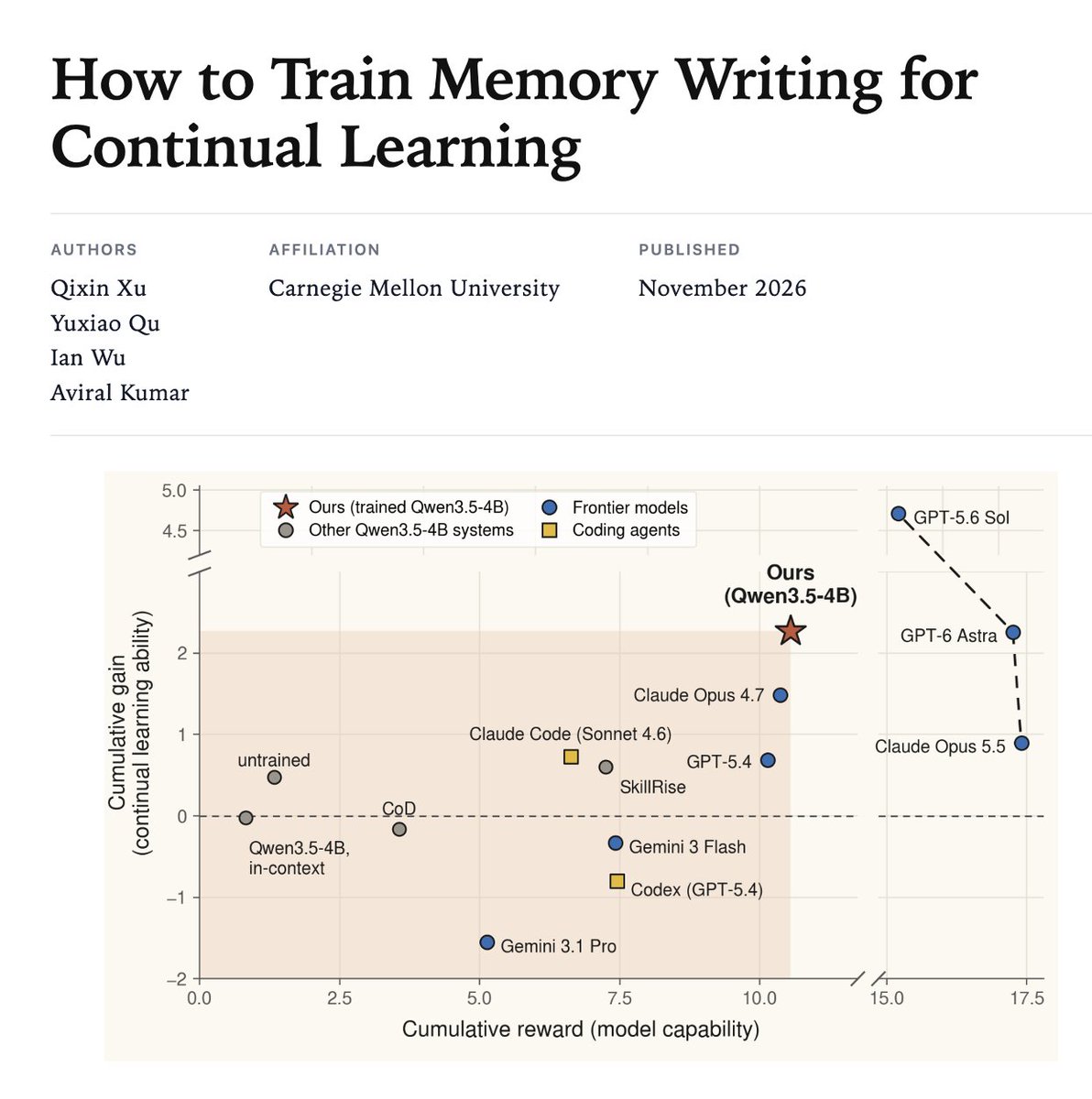
How can we train LLMs to write memories from experience collected on the fly to as best as possible solve the next task, i.e., optimize for both capability and "continual learning" ability?
In our new post, we study this question in the setting continual learning over a sequence of tasks, and develop a simple approach to train models to write effective memories
https://t.co/2NfvlzJV9V
*Spoiler*: the picture is more nuanced than you think 🧵 ⬇️
Introducing Speculative Self-Distillation (SSD, NeurIPS 2026), which pushes the accuracy–efficiency–forgetting frontier of self-distillation.
In SSD, student and teacher (the same model with additional information) write the rollouts together. Like a private tutor, the teacher lets the student write and takes over only when the student drifts too far. As a result, SSD trains on rollouts that stay as close to the student's own writing (on-policy) as possible while the teacher keeps them on track.
📉 38–69% fewer training tokens than on-policy, matching its accuracy
⏱️ Reaches on-policy accuracy in ~130 vs ~414 min (Science Q&A)
🧠 Forgets less in a stress test: −1.4 vs −4.5 points for on-policy