This is an email I sent earlier today to all employees at Coinbase:
Team,
Today I’ve made the difficult decision to reduce the size of Coinbase by ~14%. I want to walk you through why we're doing this now, what it means for those affected, and how this positions us for the future.
Why now
Two forces are converging at the same time. We need to be front footed to respond to both.
First, the market. Coinbase is well-capitalized, has diversified revenue streams, and is well-positioned to weather any storm. Crypto is also on the verge of the next wave of adoption, with stablecoins, prediction markets, tokenization, and more taking off. However, our business is still volatile from quarter to quarter. While we've managed through that cyclicality many times before and come out stronger on the other side, we’re currently in a down market and need to adjust our cost structure now so that we emerge from this period leaner, faster, and more efficient for our next phase of growth.
Second, AI is changing how we work. Over the past year, I’ve watched engineers use AI to ship in days what used to take a team weeks. Non-technical teams are now shipping production code and many of our workflows are being automated. The pace of what's possible with a small, focused team has changed dramatically, and it's accelerating every day.
All of this has led us to an inflection point, not just for Coinbase, but for every company. The biggest risk now is not taking action. We are adjusting early and deliberately to rebuild Coinbase to be lean, fast, and AI-native. We need to return to the speed and focus of our startup founding, with AI at our core.
What this means
To get there, we are not just reducing headcount and cutting costs, we’re fundamentally changing how we operate: rebuilding Coinbase as an intelligence, with humans around the edge aligning it. What does this mean in practice?
- Fewer layers, faster decisions: We are flattening our org structure to 5 layers max below CEO/COO. Layers slow things down and create coordination tax. The future is small, high context teams that can move quickly. Leaders will own much more, with as many as 15+ direct reports. Fewer layers also means a leaner cost structure that is built to perform through all market cycles.
- No pure managers: Every leader at Coinbase must also be a strong and active individual contributor. Managers should be like player-coaches, getting their hands dirty alongside their teams.
- AI-native pods: We’ll be concentrating around AI-native talent who can manage fleets of agents to drive outsized impact. We’ll also be experimenting with reduced pod sizes, including “one person teams” with engineers, designers, and product managers all in one role.
In short: AI is bringing a profound shift in how companies operate, and we’re reshaping Coinbase to lead in this new era. This is a new way of working, and we need to leverage AI across every facet of our jobs.
To those who are affected
I know there are real people behind these decisions — talented colleagues who have poured themselves into this company and our mission. To those of you who will be leaving: thank you. You’ve helped build Coinbase into what it is today, and I am sincerely grateful for everything you've done.
All impacted team members will receive an email to their personal account in the next hour with more information, and an invitation to meet with an HRBP and a senior leader in your organization. Coinbase system access has been removed today. I know this feels sudden and harsh, but it is the only responsible choice given our duty to protect customer information.
To those affected, we will be providing a comprehensive package to support you through this transition. US employees will receive a minimum of 16 weeks base pay (plus 2 weeks per year worked), their next equity vest, and 6 months of COBRA. Employees on a work visa will get extra transition support. Those outside of the US will receive similar support, based on local factors and subject to any consultation requirements.
Coinbase prides itself on talent density. Our employees are among the most talented people in the world, and I have no doubt that your skills and experience will be highly sought after as you pursue your next chapters.
How we move forward
To the team that is staying, I know this is a difficult day. We’re saying goodbye to colleagues and friends you've been in the trenches with. But here’s what I want you to know as we move forward together:
Over the past 13 years, we have weathered four crypto winters, gone public, and built the most trusted platform in our industry. We’ve made it this far by making hard decisions and by always staying focused on our mission. This time will be no different – nothing has changed about the long term outlook of our company or industry. And most importantly, our mission has never been more important for the world. Increasing economic freedom requires a new financial system, and we’re building it.
The Coinbase that emerges from this will be more capable than ever to achieve our mission.
Brian
🚨 I don't think people realize how bad things are at @aave right now.
All core markets are at 100% utilization, that includes $3 bil in USDT and $2 bil in USDC stuck!
That means you CAN'T WITHDRAW your money!
A long post on why and how we ended up here.
When the rsETH exploit happened and AAVE incurred bad debt, whales like Justin Sun, MEXC exchange, and others immediately withdrew billions from AAVE.
This instantly drained all available liquidity in key core markets like ETH, USDT, USDC and so on. Those first to withdraw got out, laggers got trapped.
Initially, the ETH market hit 100% utilization, meaning you could not withdraw your ETH from AAVE.
Worse, this also means the protocol can't process ETH liquidations should ETH price fall/crash. If you can't sell any ETH, you can't liquidate to cover debt obligations.
That means the risk of more bad debt incurred by AAVE is increasing the longer its markets remain stuck.
Nevertheless, users can still sell at a minor loss the aETHwETH tokens on Uniswap or similar aggregators. That exit door is the last one remaining for ETH depositors on AAVE.
The same cannot be said by depositors of USDT and USDC. They are stuck.
That's because AAVE lost over $6 billion in liquidity in the past 24h. As whales took out their money, USDT and USDC also hit 100% utilization.
These markets are now also stuck with money locked. Panic is spreading and desperate times call for desperate measures.
Some users decided to borrow against USDT/USDC and exit via other markets at a 10-25% loss (90-75% LTV). Basically you borrow GHO/DAI/USDe against your locked USDT/C.
But as more liquidity leaves AAVE, more markets get to 100% utilization and get locked/stuck due to low liquidity. This is quickly cascading across all available markets.
Luckily the crypto market was rather flat today so liquidation risks were marginal, but if things change there are billions in stablecoins and other assets locked on AAVE that can't process liquidations = more bad debt for AAVE.
If users or related protocols that are stuck need access to their money to prevent liquidations or other critical function, they have a huge problem on their hands.
Plus, nobody wants to deposit (or provide liquidity) in these markets now since your ETH, BTC, USDC/T could be stuck there for who know how long.
As soon as any available liquidity is made available, it is instantly taken out by bots fighting to get out. As I wrote this I saw 250k in liquidity on USDC vanish in seconds.
Then there is the bad debt question.
There's over $200 mil in bad debt incurred by AAVE via rsETH that's like a hot potato. Nobody knows who will eventually pay this bill.
If you didn't remove your assets from AAVE, you risk receiving at least part of that bill in some form. Not having access to your money is part of that risk too.
Contagion is also extremely high.
Many protocols and apps rely on AAVE for their earn mechanics. These protocols and their users are stuck too and may be forced to incur bad debt with no fault of their own.
October 10th was a CEX driven crash, this is a DeFi risk mitigation failure of epic proportions.
AAVE should have never onboarded rsETH as a collateral asset, at least not to the size of hundreds of millions that allowed the hacker to walk away (i.e. borrow) over $200M in ETH after posting fake collateral.
Rumors on X are saying rsETH was onboarded by AAVE due to a conflict of interest (lobbying) by a given service provider. If true, this is a major failure of its governance structure (nothing new).
The folks at @KelpDAO who manage rsETH also have a tough decision to make on who will actually pay for the $200M exploit. AAVE users? L2 rsETH users? Everyone affected gets a haircut to account for the loss?
The AAVE team and its founder, Stani, have been quiet for over 20h since the exploit after initially announcing the rsETH market freeze.
They have a pretty big problem on their hands since the whole protocol is at risk right now. Trust is already lost as AAVE is bleeding billions in TVL to the level of hitting 100% utilization on all core markets.
Maybe some key actors in the space will step in to provide liquidity to stabilize the markets on AAVE before this gets even worse.
I got lucky to get out of AAVE early when I first saw this. I also removed all assets from DeFi and will not touch any protocol in the next few weeks. Too much risk for a few percentage points in yield.
If you found this informative, like, share, and follow @duonine
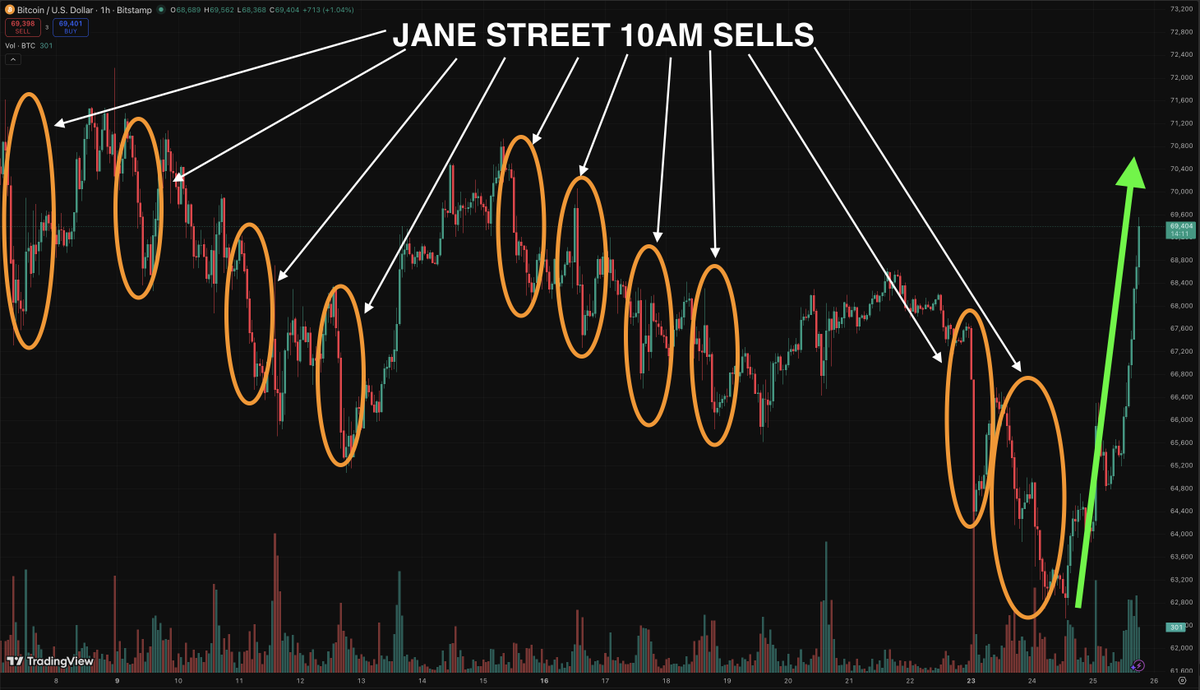
For months, 10 AM meant one thing: the Jane Street dump.
Yesterday, they got hit with an insider trading lawsuit.
Today at 10 AM? Bitcoin rips higher instead.
Coincidence, or did the game just change?