In Ghana, because the state historically lacked the capital to build and maintain massive fleet networks, it delegated public mobility to informal, self-organized private unions. Over time, these unions organized into political and economic cartels. They control the loading terminals, set localized route monopolies, and effectively exert price leverage over the government.
The Recommended Model for Ghana: Gross Cost Contracting (BRT Franchising)
Ghana cannot simply ban trotros overnight; doing so would paralyze daily commerce, as over 70% of urban commuters depend on them. However, Ghana can break union leverage by shifting from an informal, driver-owned system to a Gross Cost Contracting Model (similar to systems in Colombia, South Africa, and Rwanda).
1. Transition Unions into Corporate Bus Operating Companies (BOCs)
The Strategy: Instead of fighting unions, the state offers them equity in formal transport companies.
Execution: Trotro drivers and union executive boards combine into corporate entities. The government helps these newly formed entities finance high-capacity, low emission buses (such as modern electric or CNG mass transit buses).
Result: Operators transition from collecting individual daily fares (which incentivizes chaotic driving and route manipulation) to receiving a fixed, contractual payment per kilometer driven from the government.
2. Implement Gross Cost Contracting & Digital Fare Collection
How it works: The government (via a modernized Greater Accra Passenger Transport Executive / GAPTE) collects all passenger fares centrally using digital contactless cards (e.g., expanding the "Tap and Go" system).
The Benefit: Private companies compete for contracts to operate routes based on reliability, cleanliness, and timing not on fare gouging. The government sets and controls the fares, neutralizing union leverage over price hikes.
3. Dedicated Bus Rapid Transit (BRT) Corridors & Fleet Subsidies
Infrastructure: Re-establish dedicated bus lanes along major arterial routes (e.g., Amasaman to CBD, Madina to 37, Kasoa to Accra) so high-capacity buses bypass traffic.
Market Pressure: When commuters can choose between a fast, air-conditioned GH\mathbb{C}\ 5 municipal/franchised electric bus versus an unpredictable GH\mathbb{C}\ 10 informal trotro, market forces naturally compel informal operators to align with regulated fares or exit the route.
4. Scale State Backed Anchor Operators
Inject capital and fleet modernization into anchor state backed entities like Metro Mass Transit Limited (MMTL) and Intercity STC to act as baseline market stabilizers. Having a dependable state option sets a price ceiling that prevents private cartels from hiking fares arbitrarily.
#GPRTU #transport #Ghana
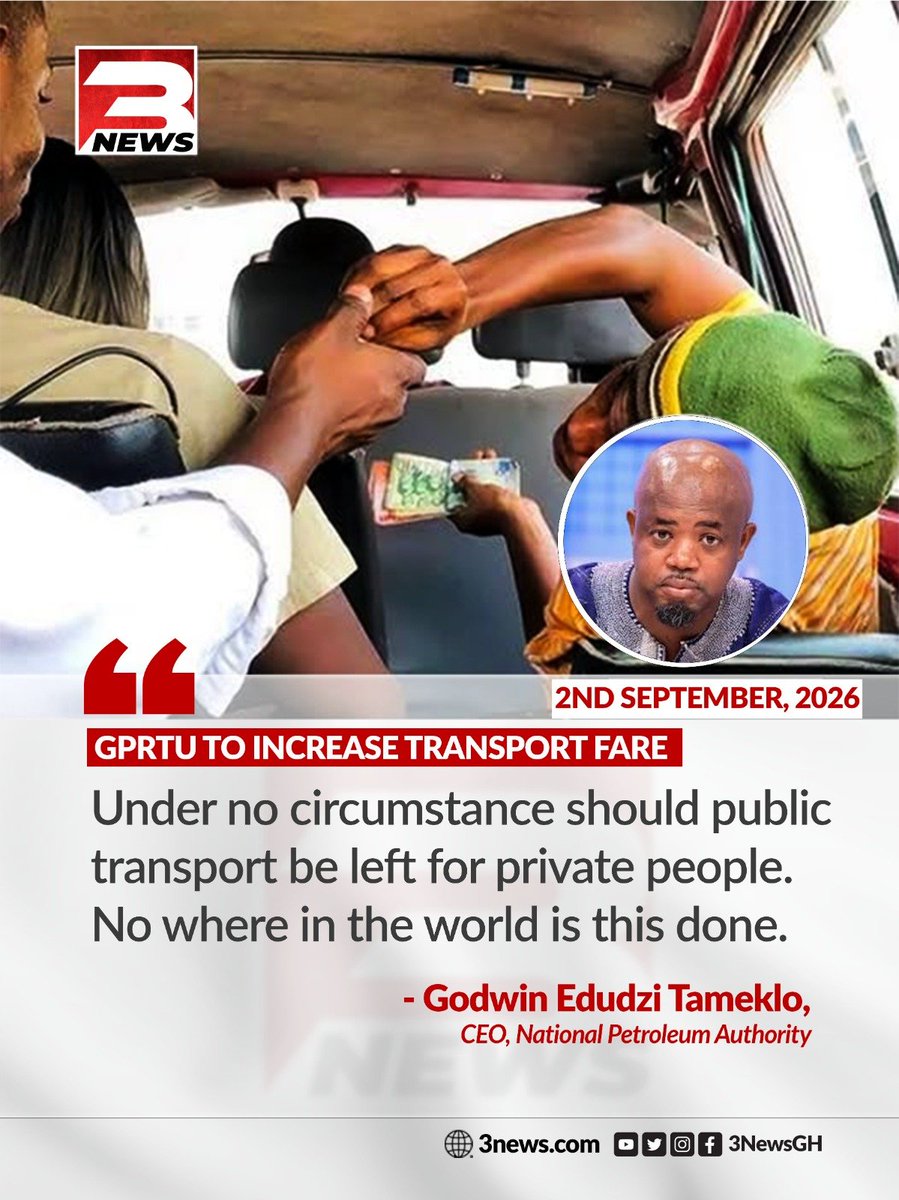
Godwin Edudzi Tameklo, CEO of the National Petroleum Authority, says public transport should not be left in the hands of private operators, arguing that this is not done anywhere in the world.
#3NewsGH#TV3GH
Here me out everybody. There are billions of amazing and loving people on this planet and a few millions of retards and crazy ones too. If the billions will just act as the lady who switched seats with the guy, the world will be a better place. Cos I think we give these fools too much attention and they keep destroying our societies. In the last 20 years we’ve really accommodated what would rather warrant a person to be taken to a mental hospital as a societal norm. And we even made laws to validate all that nonsense.