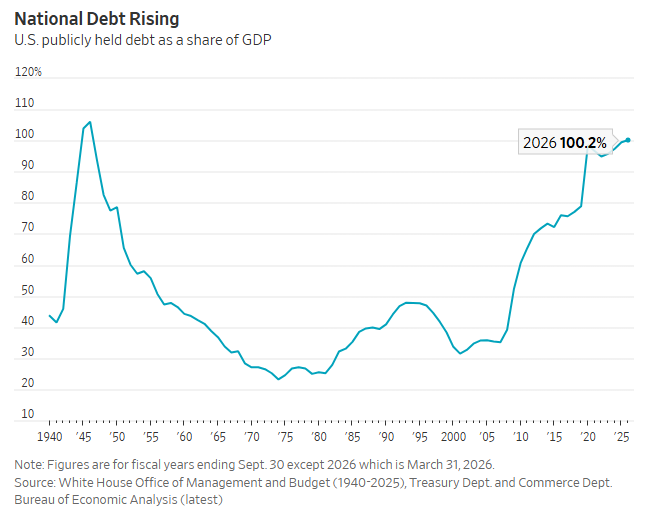
This is how democracies die. It isn’t always a coup or happen at a clear moment in time. It happens slowly as the populace allows democratic norms to be reset towards authoritarian ideals.
New statement from Scott Pelley:
There has never been anything in America like 60 Minutes.
The Sunday tradition is the most successful program of any kind in history. For more than a decade, its innovative growth on every major online platform has extended its reach to countless millions around the world. This spring, at the end of our 58thseason, 60 Minutes grew rapidly with an unheard-of 9% jump in viewers on CBS.
“60” has been the number-one program in America for decades because our beloved audience finds integrity, quality, and humanity in our stories. When stewardship of the program passed to my colleagues and me, our responsibility was to expand energetically into a new age of media technology while preserving the values our audience expects. Now, the new owner of our network is casting this legend aside, apparently to curry a moment of favor with the Trump administration.
The waste is heartbreaking.
Last month, 60 Minutes lost its DNA when our entire senior leadership and two of our best on-air correspondents were cruelly fired without cause. Good people were silenced because they stood up for our audience. They stood for fairness against the forces of political bias; they stood for professionalism against chaos.
For my part, new management has instructed me to inject falsehoods and bias into a politically sensitive story. I’ve been told to include assertions that are unverified. To date, in every case, I have managed to ignore these instructions or refuse them. Recently, politicians have been invited to choose correspondents for interviews on the broadcast. Giving politicians control over 60 Minutes interviews is not how this is done. Finally, incompetence and unprofessionalism in the new management have wreaked havoc. In a case involving one of my stories, the entire program came within 19 minutes of not getting on the air at all.
At 60 Minutes, we have fought harder than anyone knows to save the program that became an American icon. We owed that to our millions of viewers. I am deeply moved by the thousands of wishes we have received to “keep up the good fight.” Most of the men and women of CBS News are still in that fight. But now the collapse of values at the top has become untenable. The leadership of 60 Minutes is no longer recognizable. The principles I hold dear are gone, and so I must leave as well.
I depart after 37 years at CBS with one emotion—a heart brimming with gratitude for the men and women of CBS News who encouraged and enriched my work, very often at the risk of their own lives. I pray for a day when those people and their ideals are honored again—a day when sanity, competence, and courage return.
Scott Pelley
@nxthompson It is truly staggering. Claude Opus 4.6 was the clarion call moment. That was the moment I saw it move from adjacent to replacement of what we have traditionally called work. Implications for not only the future of work, but the future of fiscal policy.
I’ve wondered aloud whether the era of great leadership is behind us. Whether in a world of always-on discourse and exhaustive histrionics the truly great contemplative leaders could still emerge.
@bensasse is the leader we did not deserve. Please watch this.
Kevin Warsh just said in his confirmation hearing that most economists started as a math or physics major but realized it was too hard.
Ummmmmmm guilty.
https://t.co/vSSf4NJLkY
https://t.co/vSSf4NJLkY
Welcome Salesforce Headless 360: No Browser Required! Our API is the UI. Entire Salesforce & Agentforce & Slack platforms are now exposed as APIs, MCP, & CLI. All AI agents can access data, workflows, and tasks directly in Slack, Voice, or anywhere else with Salesforce Headless 360. Faster builds, agentic everything. 🚀
#Salesforce #Agentforce #AI
https://t.co/mxySdJS7HR
The global split we are seeing at OpenClaw is wild:
In America, installing OpenClaw on your work computer gets you fired.
In China, not installing OpenClaw gets you fired.
Two completely different theories of the next decade.
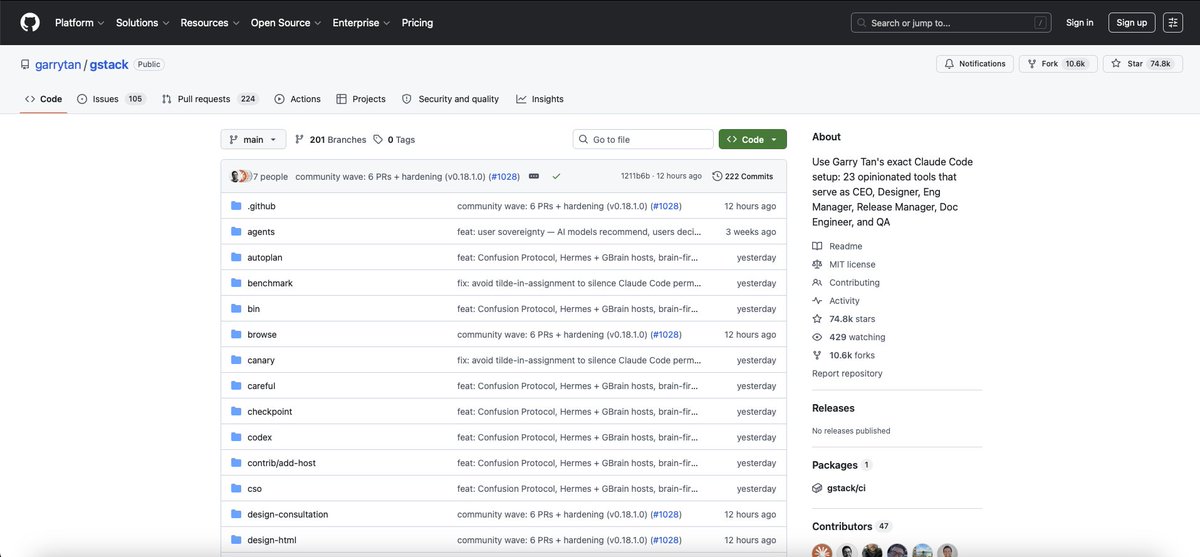
The CEO of Y Combinator just open-sourced his entire AI development setup.
And it is already at 72,600 stars on GitHub.
Garry Tan runs Y Combinator. He has worked with Coinbase, Instacart, and Rippling when they were two people in a garage. Before that he was one of the first engineers at Palantir. He has seen more startups build product than almost anyone alive.
He is now shipping 10,000 to 20,000 lines of production code per day. Part-time. While running YC full-time.
In the last 60 days alone: 600,000 lines of production code. 35% of it tests.
That number is not a typo.
Here is exactly how he does it.
He built a system called gstack — 23 AI tools that turn Claude Code into a full engineering team. He open-sourced the entire thing. Free. MIT license. One command to install. And then he posted the quote that explains why he built it:
"I don't think I've typed like a line of code probably since December, basically, which is an extremely large change." — Andrej Karpathy, March 2026.
When Tan heard that, he wanted to find out how. The result is gstack.
Here is what the 23 tools actually do.
There is a CEO tool that challenges your product framing before you write a line of code. It does not just approve your idea. It finds the 10-star product hiding inside what you described and pushes back on everything you got wrong.
There is an engineering manager that locks architecture, draws ASCII diagrams of data flow, and forces hidden assumptions into the open before anything gets built.
There is a designer that rates every design decision on a 0 to 10 scale, explains what a 10 looks like, and edits the plan until it gets there. It also has AI slop detection. It catches the generic AI output that looks fine and ships badly.
There is a QA lead that opens a real browser, clicks through your actual app, finds bugs, writes regression tests, and verifies the fix. Not a simulation. A real browser.
There is a security officer that runs OWASP Top 10 and STRIDE threat modeling with 17 false positive exclusions built in, so you only see findings that actually matter.
There is a release engineer that syncs main, runs tests, audits coverage, pushes, and opens the PR. One command from approved to shipped.
And then there is something Tan says was the biggest unlock of all.
You can run 10 to 15 of these sprints in parallel. Each one in its own isolated workspace. One agent challenging a product idea. One implementing a feature. One doing QA on staging. Six more on separate branches. All at the same time.
Tan's GitHub contribution graph for 2026 is a vertical wall. In 2013, building Bookface at YC from scratch, he made 772 contributions in a year. In 2026, he is at 1,237 — and still climbing.
Same person. Different era. The difference is the tooling.
One more thing.
In the README, Tan quotes the number directly: 140,751 lines added. 362 commits. 115,000 net lines of code. In one week. Part-time.
That is not what a solo developer looks like. That is what a team looks like.
Except it is one person with 23 AI specialists and a GitHub repo you can clone right now for free.
https://t.co/LRoiMcSYcx
@howard Early in my career, my bias was always to yes. Yes to a meeting, yes to a flight, yes to every friend who asked if I could do whatever.
Then I ran out of time. Every yes became a tradeoff decision.
No my bias is to no, and I am just direct about it. Allows the yes to matter.
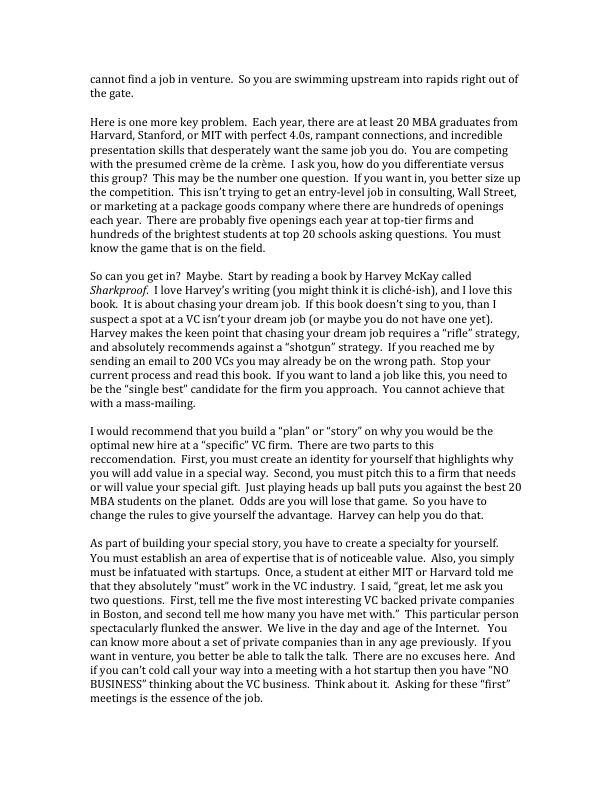
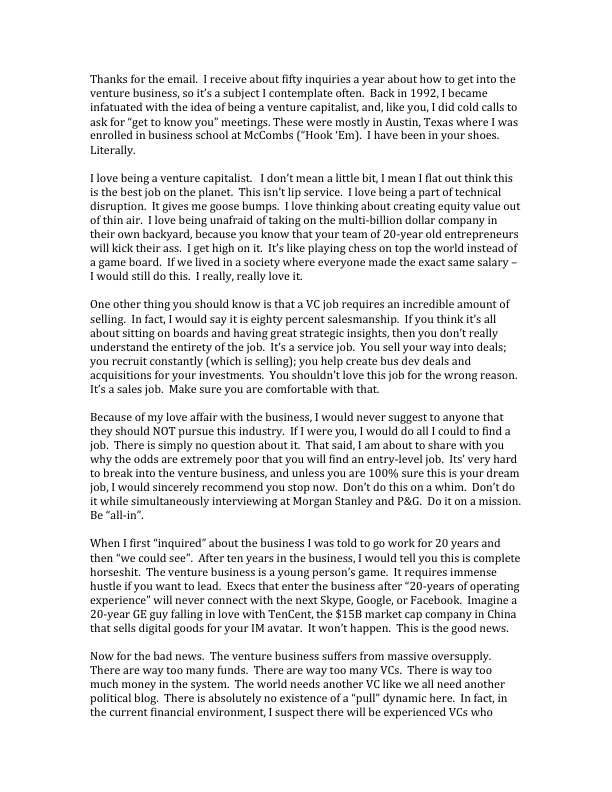
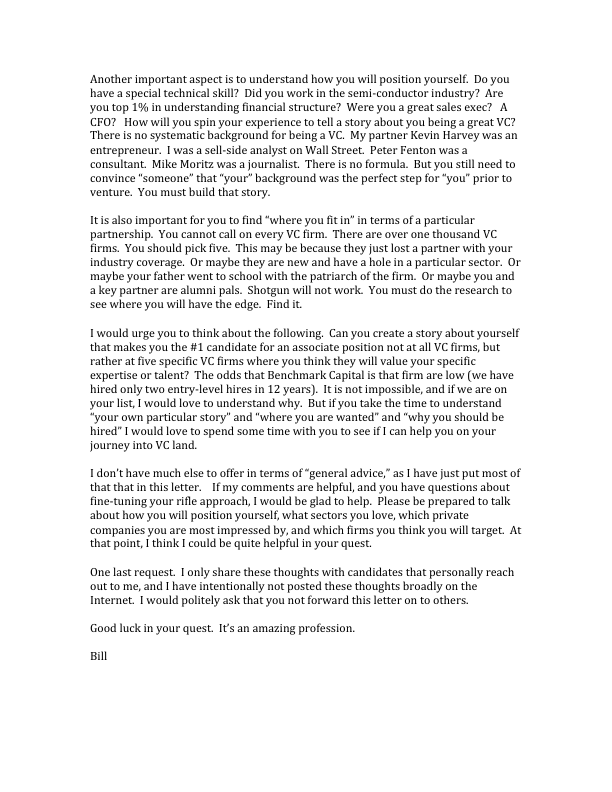
"So You Want to be a VC"
Im enjoying this week in Boston visiting students promoting my new book - Runnin Down a Dream. Not surprisingly, many ask me about trying to break into venture capital. I wrote a letter answering this question 15 years ago. I would send it out when people inquired. I'm making it public for the first time - with zero modifications.
1) I think it holds up well
2) make sure and read my new book also
3) I probably can't help with followups (as suggested in the letter)
Hope you find it useful. Good luck!
Running a company:
2020: can you survive a pandemic?
2021: still here? we’re going to give all of your competitors $100m series A rounds.
2022: wow, you made it? okay, all engineers cost $600,000/year now.
2023: nice job! okay, SVB failed and we’re going to take away your bank account.
2024: a survivor I see. but can you pivot from ai to crypto to defense tech back to ai-enabled defense tech in a 12 month period to stay relevant?
2025: unfortunately all of your competitors have raised $2b series B rounds. oh and only 500 engineers are relevant and they cost $100m/yr each.
2026: well, well, well. you’re still in business? let’s deploy the thunderclap of godlike LLMs from the heavens so all of your customers can rebuild your app in 2 hours. can you survive?
Since then, 𝘄𝗲 𝗵𝗮𝘃𝗲 𝗮𝗱𝗱𝗲𝗱 𝗮𝗹𝗺𝗼𝘀𝘁 $𝟭𝟬𝟬𝗕 𝘁𝗼 𝗼𝘂𝗿 𝗲𝗰𝗼𝗻𝗼𝗺𝘆. Connecticut is back. I wrote about the detail at https://t.co/xW9IABWH4m. (2/2)
https://t.co/xW9IABWH4m
BEA released 2025 numbers and CT was the 12th fastest growing economy in the country. In the 10 years post the global financial crisis, our economy 𝗰𝗼𝗻𝘁𝗿𝗮𝗰𝘁𝗲𝗱 on an inflation adjusted basis. (1/2)
https://t.co/xW9IABWH4m
Our run-rate revenue has surpassed $30 billion, up from $9 billion at the end of 2025, as demand for Claude continues to accelerate. This partnership gives us the compute to keep pace.
Read more: https://t.co/XgSjL0And7